
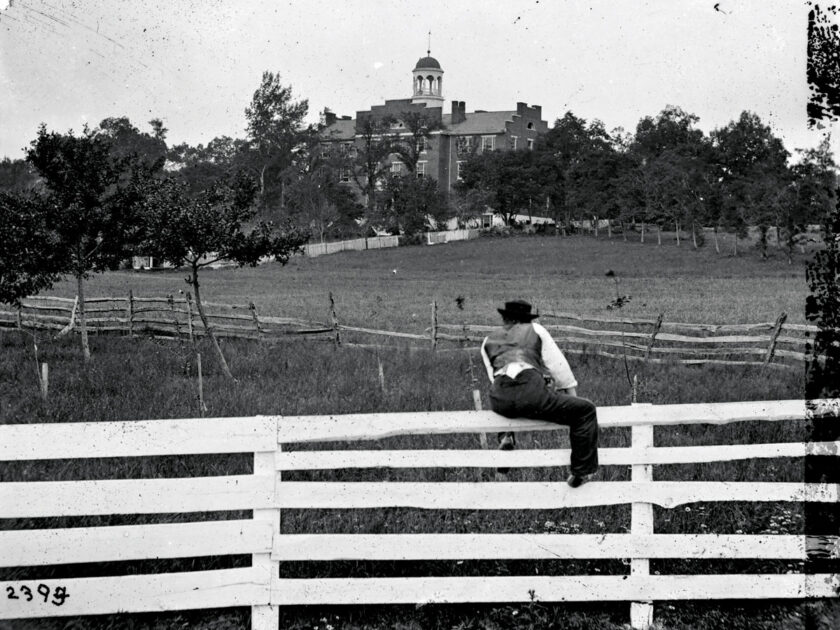
 Our cover story takes us to Gettysburg’s Lutheran Theological Seminary, photographed by Mathew B. Brady’s team in July 1863. The building’s distinctive cupola, visible on the skyline, made the Seminary an important observation post as the battle opened. Its rooms and grounds soon became one of Gettysburg’s largest hospitals.
In Gettysburg’s Lutheran Seminary in the Line of Fire, we explore Brady negative No. 2393 and the details preserved within it—from the man seated on a rail fence to the damaged walls, windows, trees, cupola, and other features that help us understand the Seminary’s appearance and role during three days of fighting. The story is paired with Within These Walls: Gettysburg’s Seminary Hospital, a collection of wartime portraits and personal accounts of Union soldiers, surgeons, and nurses whose lives intersected there during and after the battle. Among them are Col. Robert P. Cummins and 2nd Lt. Andrew G. Tucker of the 142nd Pennsylvania Infantry, both mortally wounded on July 1. The portraits come from a wonderful group of collectors and institutions, with assistance from MI Senior Editor Dale R. Niesen.
Taken together, the two stories represent the two main classifications of Civil War documentary photography: battlefield images and portraits.
Several regular columns expand on the Gettysburg theme. In Of Arms and Men, Phil Spaugy reconstructs the stand made by Union soldiers behind a slight barricade of rails on Seminary Ridge. Their resistance bought precious time as the 1st Corps withdrew toward Gettysburg on the afternoon of July 1. In The Honored Few, Evan Phifer profiles Lt. Col. Henry S. Huidekoper of the 150th Pennsylvania Infantry, who remained with his regiment after suffering two wounds and later received the Medal of Honor for his courage.
Military Anthropologist draws on the pioneering research of William F. Fox to identify nine Union infantry regiments that lost more than 100 men killed or mortally wounded in a single battle—none of them at Gettysburg.
A strong naval current also runs through this issue. Antebellum Warriors highlights 1st Lt. William Stokes Boyd, who commanded the Marine detachment aboard the Niagara during the laying of the first transatlantic telegraph cable in 1858. Boyd posed for his portrait in London at a pivotal moment in the effort, which briefly connected Great Britain and the United States and proved that permanent transatlantic communication was possible.
In Most Hallowed Ground, Augustus G. Kellogg participated in the attack on Fort Fisher aboard the Powhatan, an early chapter in his Navy career. Gene Eric Salecker’s Faces of the Sultana, featuring images from the Sultana Disaster Museum, turns to the deadliest maritime disaster in American history. The sidewheel steamer carried 1,947 recently paroled Union prisoners of war when its boilers exploded above Memphis on April 27, 1865. Portraits and firsthand accounts bring us closer to the soldiers, crew members, civilian passengers, and rescuers caught in a catastrophe that claimed an estimated 1,164 lives.
Family tragedy lies at the heart of Curt Robbins’ Grim Reunion at Galveston: A Father and Son on Opposite Sides of the War. Confederate Maj. Albert Miller Lea watched the capture of the Harriet Lane on January 1, 1863, then boarded the vessel and discovered his mortally wounded son, Union Lt. Cmdr. Edward Lea. Their final meeting offers a heartbreaking example of how divided loyalties reached into American families.
In Vignette, we profile Seth Ledyard Phelps, a fearless builder of the Union’s Brown Water Navy whose service included Forts Henry and Donelson, Shiloh, and the Vicksburg Campaign. Gen. Ulysses S. Grant ranked Phelps alongside David Dixon Porter among the finest naval officers he encountered. Women of War by Melissa A. Wynn explores the ingenuity of Martha Coston, who perfected the pyrotechnic signal system conceived by her late husband. Her colored flares helped Union Navy ships communicate, enforce the blockade, and coordinate operations.
Other stories focus on individuals whose portraits open unexpected windows into the Civil War era. In The Citizenry, Richard Look investigates two young women, Helen Head Briggs and Charlotte P. Churchill, who posed in 1863 wearing the uniform of a soldier named Frank. Notes preserved with their portraits connect the women, the soldier, and a Massachusetts family deeply touched by the war.
Photo Sleuth by Stephen Berry and Kurt Luther examines a composite photograph of South Carolina’s first postwar legislature. At its symbolic right hand sits Prince Rivers, formerly enslaved, a color sergeant in the 1st South Carolina Volunteers, and later a legislator, militia general, trial justice, and mayor. Created by political opponents, the composite illuminates the racism, fear, and violence surrounding Reconstruction. Seven of the men pictured in it were assassinated.
Jan K. Herman’s The Civil War’s First Amputee recounts the extraordinary story of Moses S. Herrick, whose foot was surgically removed after an accidental shooting inside the U.S. Capitol. The operation, performed before the bombardment of Fort Sumter, made Herrick the war’s first documented amputee.
You’ll find more memorable faces in Stragglers: Napoleon Bonaparte Ruff of the 5th Mississippi Infantry, who fell at Franklin; an unidentified U.S. Colored Troops infantryman whose portrait surfaced in Canada; and four soldiers wearing barrel shirts as punishment at Point Lookout. The Last Shot features a Union infantryman leaning forward as though advancing against an unseen enemy. His intense pose, converted musket, Colt revolver, and tin cup attached ingeniously to his shoulder strap create a convincing impression of a soldier moving toward combat.
The visual and material culture of the period receives special attention. In Material Culture, Ron Field explores the distinctive Havelock hats worn by troops from Illinois, Iowa, and Wisconsin, along with the manufacturers who supplied them. In Behind the Backdrop Buck Zaidel and I consider how photographers combined painted scenery, military equipment, and personal possessions to create portraits rich in meaning. In one image, an unidentified soldier’s well-worn army boots sit beside his knapsack while he poses in soft slippers or homemade camp shoes—a quiet detail that invites us to imagine the life behind the likeness.
Passing in Review considers two important new books. Carolyn Ivanoff’s Cornelia Hancock’s Civil War: A Heart Touched by Fire follows the determined young nurse from Gettysburg to Fredericksburg, White House Landing, and City Point. Don Troiani and MI Senior Editor Ron Field’s Civil War Uniforms for Union and Confederate Soldiers combines 152 meticulously researched illustrations with detailed descriptions of the uniforms, equipment, and weapons worn and carried by soldiers across the country.
Collecting and stewardship bring this issue to a fitting close. My Editor’s Desk installment reflects on a summer visit to the Seminary Ridge Museum and time spent with Heather Steele and Ethan Spieles, two passionate collectors early in their journeys. They and other newcomers are the future caretakers of Civil War photographs and the stories preserved within them.
In Practical Stewardship for the Modern Collector, MI Senior Editor Kevin Canberg offers clear guidance for inventorying collections, documenting wishes, identifying trusted advisers, and preparing photographs and artifacts for their next caretakers. Thoughtful planning, he reminds us, can ensure that a collection becomes a legacy rather than a burden.
Finally, Different Journeys, Shared Passion brings together reflections by Larry West, Ross J. Kelbaugh, Dr. Robert Drapkin, and Greg French. Their interests range from pioneering Black photographers and Mathew Brady to little pictures with big stories and discoveries made over decades of searching. They remind us of the shared passion for collecting all formats and genres of 19th-century photography.
Enjoy!
Ronald S. Coddington
Editor & Publisher
SPREAD THE WORD: We encourage you to share this story on social media and elsewhere to educate and raise awareness. If you wish to use any image on this page for another purpose, please request permission.
LEARN MORE about Military Images, America’s only magazine dedicated to showcasing, interpreting and preserving Civil War portrait photography.
VISIT OUR STORE to subscribe, renew a subscription, and more.