
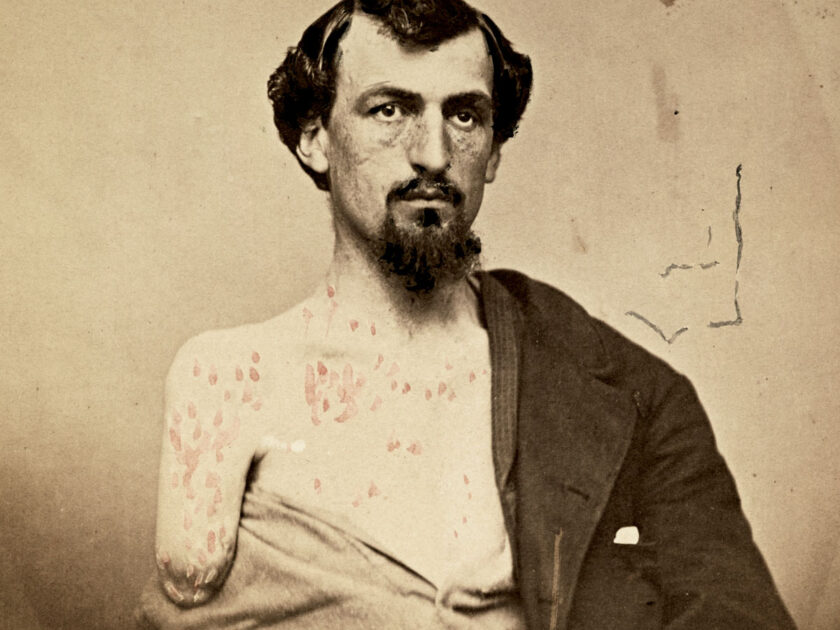

The Seminary hospital during and after the Battle of Gettysburg, told through portraits and personal accounts of Union soldiers, surgeons, and nurses. Featuring images from the collections of the Adams County Historical Society, Ronald S. Coddington, Scott Hann, Scott Hilts, Charles T. Joyce, Jeff Kowalis, Jason Krausz and Mark Krausz, The Liljenquist Family Collection at the Library of Congress, C. Paul Loane, Faye and Ed Max, Robert May, Ronn Palm, Jim Rivest, Paul Russinoff, and Brian White, with assistance from Dale R. Niesen.
Rally at the Seminary
On the afternoon of July 1, the 142nd Pennsylvania Infantry joined other Union troops in a desperate stand near the Seminary. Brig. Gen. James Johnston Pettigrew’s North Carolina Brigade struck with overwhelming force, subjecting the Pennsylvanians to devastating fire from the front and flank.
The 142nd’s commander, Col. Robert Parson Cummins, proved an able leader in the crisis. A modest, unpretentious apothecary owner and sheriff from Somerset, Pa., he inspired confidence in his men.
As the Confederate assault intensified, the 142nd charged but was driven back. The survivors reformed near the Seminary as Confederate troops threatened to envelop them. The fighting became so fierce that soldiers fired until their muskets grew too hot to hold, then picked up loaded weapons from fallen comrades.

Cummins pointed his sword toward the colors and shouted, “Rally round the flag!” At that moment, a bullet struck him in the chest. His soldiers attempted to carry him from the field, but the enemy advance forced them to abandon him. Before leaving, one man unbuckled Cummins’ sword and ran to safety.
Confederates soon captured the desperately injured colonel and carried him into the Seminary. Still defiant, and perhaps delirious, Cummins cried, “For God’s sake men rally, we can whip them yet.”
Cummins suffered through the night in a bed inside the Seminary, groaning, thrashing his arms, and attempting to sit up. Near daybreak, two surgeons examined him and advised that he not be disturbed. He died on the morning of July 2 at age 36 and was buried in the Seminary garden.
His remains were later returned to Somerset for burial, leaving his wife a widow and his children without their father. A newspaper paid tribute to his sacrifice: “Dying on the soil, and in defense of his native State; he sleeps well and gloriously beneath her bosom, and when, in after years, our children’s children read the story of this most bloody and wicked rebellion, and recall the historic names of the heroes who fell a sacrifice to it, they will dwell with affectionate regard upon the name of Robert P. Cummins.”
A Mother’s Only Son
Less than a month after graduating from the University of Lewisburg (now Bucknell University) in 1862, 17-year-old Andrew Gregg Tucker helped recruit troops for the new 142nd Pennsylvania Infantry. Elected second lieutenant of Company E, he departed amid a tearful crowd at the train station. Among them was his widowed mother, Margery. Andrew was her only son.
After a baptism of fire at Fredericksburg, the Pennsylvanians next fought in the fields west of the Seminary at Gettysburg. Wounded in the arm early on July 1, Tucker refused his captain’s order to seek medical attention. Instead, he placed a wounded fellow officer, 1st Lt. Jeremiah Hoffman, on his horse and sent him to the Seminary.
As the 142nd fell back before advancing Confederates, Tucker suffered a second wound in the upper back. While being helped into the Seminary’s Old Dorm, he was struck again, a musket ball perforating his bowels.

Tucker died on July 5 and was buried on the Seminary grounds, his grave lined with wooden fence palings from the campus. Margery traveled to Gettysburg with the president of her son’s alma mater to bring Andrew home for burial.
He “was fast developing into a man,” his captain lamented, but “suffered and died for his country without a murmur” of regret. Margery died in 1888 and is buried alongside Andrew.
— Charles T. Joyce
Wounded at the Barricade

Sergeant William McCafferty and his compatriots in the 121st Pennsylvania Infantry occupied the extreme left flank of the Union line on the afternoon of July 1. When Brig. Gen. James Johnston Pettigrew’s North Carolina Brigade advanced, the Pennsylvanians stopped them with musket fire. Crushing return fire broke the unsupported 121st, and the survivors fell back to a barricade hastily erected in front of the Seminary, already in use as a hospital. “Here, with the broken remnants of other regiments, they defended the fence of the hospital grounds with great determination,” stated the regiment’s lieutenant colonel.
The casualty count—179 of 258 engaged—included McCafferty. Wounded in the back and left leg, the Philadelphia resident was brought into the Seminary, where his leg was amputated. He barely lived to see the battle’s outcome, dying there on July 12. His remains rest in Philadelphia’s Cathedral Cemetery alongside his wife, Josephine, who remained a widow until her death in 1908.
Vivid, Haunting Recollections
During the brutal fighting west of Gettysburg, a projectile struck 1st Lt. Jeremiah Hoffman of the 142nd Pennsylvania Infantry in his right hip, cut through his pelvis, and lodged near his spine. Comrades placed him on horseback and carried him to the Seminary while it remained in Union hands. Before the day ended, Confederate troops occupied the building, transforming the hospital into a prison for Hoffman and hundreds of wounded Federals.
A native of Schaefferstown, Pa., and recent graduate of Franklin and Marshall College, Hoffman later recalled a scene marked by confusion, suffering, and remarkable resilience. Union surgeons, captured with their patients, had been separated from their medical instruments, leaving many wounded men to endure agonizing hours before treatment. When Union artillery unknowingly fired toward the Seminary, Hoffman directed soldiers to improvise a signal by tearing strips from a red flannel petticoat left behind by the absent hostess and flying them from the cupola as a warning.

of Philadelphia, Pa. Robert May Collection.
Death was a constant companion. Hoffman watched helplessly as his beloved commander, Col. Robert P. Cummins, succumbed to his wounds. He also witnessed the burial of 1st Lt. and Acting Adjutant Andrew G. Tucker in a garden grave beside the colonel. The loss was especially painful, as Tucker had helped Hoffman to the Seminary. Hoffman remembered, “They were holding the body over the grave when the head slipped over the edge of the blanket and the Lieutenant’s beautiful, jet black hair dragged over the ground.”
Equally haunting were the smaller tragedies: wounded men dying of thirst, neglected injuries crawling with maggots, and a lack of nurses to assist the patients.
Yet Hoffman also remembered unexpected moments of humanity. Confederate soldiers shared water and hard bread, discussed the campaign with their captives, and admitted the strength of the Union position. One homesick North Carolinian confessed his fear of local citizens, and Hoffman reassured him that the state’s German farmers posed no threat.
Hoffman shared these recollections—the most vivid account of life inside the Seminary during and just after the battle—within several years of leaving the army due to the severity of his wound. He noted “the scar made by that ugly missile, the only visible memento of that which left me lame, probably for life.” He barely survived the dawn of peace, dying in 1867 after being thrown from a carriage during a country drive. He never regained consciousness. A lawyer, Hoffman was 25.
Graham’s Ruse
During fierce fighting east of the McPherson Farm, a bullet struck Capt. Brice Blair of the 149th Pennsylvania Infantry, shattering his arm near the left shoulder. Bleeding profusely, he continued fighting until he grew faint, then called to Cpl. Levi Grible Graham to help him off the field. Graham led Blair toward the Seminary, barely outpacing their hard-pressed comrades.

According to a postwar account, “When they reached the west side of the Seminary building the bullets were knocking holes in the wooden steps so rapidly that they went around the big brick building and went up its stairs. Captain Blair was helped by Graham to an upper story bedroom and as the ‘Rebs’ were soon swarming all over the place, he bloodied one of his arms and put it in a sling, that they might think him wounded and so leave him with the Captain.”
Graham’s ruse worked for a time—the Confederates discovered the truth and sent him away. Paroled the next day, he returned to the 149th and mustered out as a sergeant in June 1865. He died in 1909 at age 73. Blair survived the amputation of his arm and lived until 1890.
Lost Last Resting Place

Scott Hann Collection.
The 16th Maine Infantry had the impossible assignment of delaying an overwhelming Confederate assault during the first day’s fight. One casualty, Capt. Oliver Hawkes Lowell of Company D, suffered a shot that passed through his body. The regiment retreated, leaving him critically wounded on the battlefield.
A year earlier, Lowell taught Greek and Latin at the Young Ladies’ Seminary at Gorham, Maine. A popular instructor, he left the school in August 1862 to join the 16th as first lieutenant and advanced to captain.
Lowell languished on the battlefield throughout the night. The following day, captured soldiers from the 16th were allowed to bring their wounded into the Seminary, where Lowell’s wound was treated.
He died on July 2 and was likely buried hastily in an unmarked grave. When the principal of Gorham Seminary arrived, he led a fruitless search for Lowell’s grave. “We saw in the grove near by twenty unmarked graves, some of which contained the bodies of our brave officers that fell in that first day’s battle. In this grove we hoped to find the place of his burial. Sad, sad indeed, that the friends of this patriotic and brave Captain cannot learn more of his last hours and of his resting place.”
Tragically, Lowell spent his finest hours as an educator and last hours as a soldier within the confines of a seminary.
—Scott Hann
Watching the Iron Brigade from the Seminary
During the first day’s fight, the Iron Brigade faced overwhelming Confederate numbers in McPherson’s Woods. In the 19th Indiana Infantry, the color bearers had all been shot down and volunteers stepped in to keep the flag aloft. Lt. Col. William Wade Dudley saw the colors fall and picked them up. He “held the flag long enough to meet the fate of all who touched it that day,” Dudley recalled.


A bullet struck his right leg and shattered the bone. He lay gripping the flagstaff until a comrade took it. Slightly injured soldiers helped Dudley to the rear. As the carnage continued, he remembered, “Here a determined stand was made and I was carried to the Seminary and lost sight of the individuals of the Regiment and their actions but could see the line as it gallantly withstood the terrific front and flank fire of the enemy.”
On July 3, Dudley was transported to the Baltimore Street home of Gettysburg Compiler Editor Henry J. Stahle. A surgeon performed a double resection, but gangrene and secondary hemorrhaging led to an amputation on July 17.
Dudley’s wound ended his field service. After organizing a battalion of Pension Bureau clerks to help defend Washington during Jubal Early’s 1864 threat, he later became commissioner of the Pension Bureau. His career collapsed in 1888 when his notorious “Blocks of Five” letter appeared to endorse bribing Indiana voters during Benjamin Harrison’s presidential campaign. Though Harrison won, Dudley was disgraced. He died in Washington in 1909 and was buried in Arlington National Cemetery.
He Amputated His Friend’s Arm
Though Andrew Jackson Ward and Lucius Fairchild were not related by blood, their friendship was brotherly. Pennsylvania-born Ward, older by seven years, had graduated from the University of Pennsylvania Medical School, served as an assistant surgeon during the Mexican War, and moved west to Madison, Wis. Fairchild hailed from the Buckeye State, and he found his way to Madison. Both men were lured to California just after the gold rush, though not together. Fairchild returned to pursue politics, and Ward to become a physician.


The war stirred their patriotic impulses. They became officers in the 2nd Wisconsin Infantry—Fairchild as major and Ward as surgeon. They were destined for higher office: Fairchild to become colonel and commander of the 2nd and Ward the division’s surgeon-in-chief.
During the first day at Gettysburg, the two friends met under difficult circumstances. Fairchild, struck by a bullet that shattered his left arm just above the elbow, made it as far as the home of a professor at the Seminary before he collapsed. Later that day, Ward arrived and took charge of the case. At some point he turned to the saw in his medical kit. When the surgery ended, Fairchild’s brother, Charles, an officer in the 1st Wisconsin Infantry, wrote an upbeat letter his mother, describing the wound and the result of Ward’s work, “leaving an elegant stump.”
Gettysburg ended Fairchild’s military service. He survived his amputation and went on to serve as Wisconsin’s governor and Minister to Spain before his death in 1896 at age 64. Ward remained in Gettysburg until August tending to wounded and sick at the Seminary. Ward’s wife, Eleanor, joined him to care for the men. One of Ward’s highest profile patients, Confederate Maj. Gen. Isaac R. Trimble, had been wounded in Pickett’s Charge. He reportedly complimented Ward as a gentleman even though he preferred to be in a private residence. Ward went on to transfer to the 43rd Wisconsin Infantry and serve as a hospital inspector in Nashville. After mustering out, he returned to his medical practice in Madison, where he died in 1893 at age 69.
Last Vision: a Confederate Flag
In the frenzied fighting just west and in view of the Seminary, Pvt. Michael Link leveled his musket and prepared to pull the trigger when a bullet struck him in the left eye, passed under the bridge of his nose, and exited near the right eye.
The last vision he remembered before losing his sight: A Confederate flag.
Three comrades carried him to safety and placed a knapsack beneath his head. The bullet destroyed one eye and left the other dangling on his cheek. Left for dead, he rolled into a ditch. Drifting in and out of consciousness as maggots did their work on his eye sockets, he lay exposed for about two days before being carried to the Seminary for treatment.

For the 23-year-old farmhand from Reading, Pa., his service with the 151st Pennsylvania Infantry was over and his life forever changed. His stay at the Seminary was brief—he numbered among the first patients transported to Philadelphia to recuperate.
Link’s disability did not prevent him from living a full and productive life. He entered an institute for the blind in Philadelphia and became proficient as a carpet weaver, broom and brush maker, and chair caner. He played dominoes by gliding his fingers over the pieces and used the same sensitive fingers to tell time on his crystal-less watch.
“Blind Mike,” as he was affectionately known, also became a family man. At his death in 1899 at age 59, his wife, Margaret, at least six children, and many grandchildren survived him.
Maggots and a Feather

of Washington, D.C. Scott Hilts Collection.
The Iron Brigade troops of the 2nd Wisconsin Infantry advanced to close range as a storm of bullets raged around them. Among the black-hatted men in blue in the front rank was Corp. William Henry Boyd of Company E, who remembered the fighting disintegrating into hand-to-hand combat. A bullet tore through his right thigh and shattered his femur.
His best friend, Pvt. Ben Davids, dragged Boyd beneath a tree, gave him two canteens, and returned to the fight. Boyd used his suspender and a twig as a tourniquet to stop the bleeding. A Confederate soon came upon him and took the canteens.
Boyd lay there for more than a day, dragging himself to a muddy puddle to drink. Finally found about 11 p.m. on July 2, comrades helped him to the Court House, which was filled with wounded soldiers. By then, maggots had infested his wound. Company E’s fifer, Billy Taylor, helped him run a feather soaked in antiseptic through the wound to kill the worms.
It worked. Boyd was treated at the Seminary and then a military hospital in York, Pa., receiving a discharge for total disability in April 1864. His shortened leg left him unable to walk without crutches, and the wound troubled him until his death in 1913 at age 72. His wife, Libbie, and a son survived him.
Hit by a Blasted Fence Rail
Near Blocher’s Knoll on Gettysburg’s outskirts, the 17th Connecticut Infantry formed behind a rail fence on the afternoon of July 1. As Confederate forces closed in, Sgt. Cyrus Bachelder, 28, and his comrades waited for the order to advance. Lt. Col. Douglas Fowler rode before the line, waving his sword and shouting, “Now, Seventeenth, do your duty! Forward, double quick! Charge bayonets!” The regiment surged ahead, only to be cut down. An exploding shell killed Fowler instantly. Another blasted a fence rail into Bachelder’s chest.

Left behind and captured, Bachelder was most likely taken with other wounded prisoners to a nearby barn converted into a Confederate hospital. The next day, they were loaded into captured ambulances and transported to the Seminary. As the Confederates withdrew, Bachelder accepted a parole later declared invalid and eventually returned to the 17th. He mustered out in June 1865.
The war shattered Bachelder’s health. He died of consumption six years later at age 37, leaving his wife, Mary, a 10-year-old daughter, and a 5-year-old son. Two years later, the destitute family received a widow’s pension.
Oil Fields to Killing Fields
“Oh! I like soldiering—Tip Top,” wrote David W. Tripp from winter quarters in Virginia in late 1862 to a brother back home in Seneca Falls, N.Y. Tripp, 17, had good reason to enjoy the army: the middle child of seven siblings, he had left his family, including his sickly minister-father, to work in the oil fields of northwestern Pennsylvania. He worked hard and earned decent pay, sending as much home as he could.

In August 1862, he enlisted in Company A of the 121st Pennsylvania Infantry. Tripp thrived in the army, putting on weight and continuing to send money home. The regiment faced its first fire at Fredericksburg and was held in reserve at Chancellorsville. At Gettysburg, the 263 men of the 121st acquitted themselves well—and suffered severely. At some point in the action, a gunshot struck Tripp in the head. He breathed his last in the Seminary on July 6. Buried on the grounds, his remains were later returned to Seneca Falls for burial in Springbrook Cemetery.
In 1907, Tripp’s eldest sister, Ann, received a package. Inside was a small, black diary kept by two soldiers during the war. The first section, in Tripp’s hand, detailed his experiences in the army. The second contained entries by the Confederate soldier who found the diary and used it through the war’s end: James King Wilkerson of the 55th North Carolina Infantry. He traced Tripp’s surviving family and returned the book. Wilkerson died six years later at age 70.
An Old Man Inspires—and Amuses
During a lull in the first day’s fighting, the Bucktails of the 150th Pennsylvania Infantry steeled themselves for the combat to come. In these tense moments, recalled Lt. Col. Thomas Chamberlin, an old man approached, seemingly out of nowhere. Dressed in clothes from a bygone era, a black hat, and toting a rifle, he was eager to join the fight. Chamberlin agreed, then directed him to his colonel for approval.


Chamberlin, an ardent abolitionist and 1858 graduate of the University of Lewisburg (now Bucknell University), later recalled this meeting with John Burns with a mix of humor and inspiration—to “stimulate the courage.”
The Bucktails were soon tested and took heavy casualties as Confederates rolled in from the west. A gunshot hit Chamberlin in the upper back, traveled across his shoulder and beneath the collarbone, and lodged in his chest muscles. Five volunteers rescued him, one wounded along the way, and carried him to McPherson House. A surgeon stuffed the wound with sponges to stop the hemorrhaging. Over the next few days, Chamberlin made his way to the Seminary, the home of Sallie Myers until July 6, and returned to Lewisburg on July 13.
Chamberlin rejoined the 150th before the end of August and resigned in early 1864. He eventually settled in Philadelphia and remained active in veterans’ affairs until his death in 1917 at age 78.
Meandering Bullet
The path of the bullet that struck Pvt. John W. Amich proved anything but straight. It entered just above his left elbow, tore through his arm, continued into his side, passed between his ribs and left lung, then deflected upward and exited near his left scapula.
Amich likely suffered the wound about 25 yards from the woods where Maj. Gen. John F. Reynolds fell. His company of the 151st Pennsylvania Infantry fought to the left of the Iron Brigade before overwhelming Confederate numbers forced the regiment to retreat.
Amich, 20, a peacetime miller, landed in the Seminary and remained until about July 11, when he was transferred to Philadelphia’s Summit House Hospital. His soldier’s journey proved as unpredictable as the bullet that hit him.

After mustering out, Amich lacked the strength and endurance to resume milling and found work as a day laborer. In 1869, he married Susan Shide and started a large family in Richland, Pa. A pension helped make ends meet.
In 1893, a week after his 50th birthday, he collapsed and died while currying a horse in a stable. The examining doctor attributed his fatal heart disease to the Gettysburg wound.
From Little Round Top to the Seminary
Not all the patients inside the Seminary were wounded during the first day’s fight. Charley Ballou did not set foot on the battlefield until the morning of the second day. A corporal in Company I of the 44th New York Infantry, he and his comrades successfully defended the extreme left flank of the Union army along Little Round Top later that day. Ballou suffered a severe wound in his right thigh or abdomen.

Born Charles Franklin Ballou in East Otto, N.Y., he was left an orphan at seven after his mother’s death and resided with his sister until he came of age. A part-time schoolteacher when he enlisted as a private in 1861, Confederates captured him at the Second Battle of Bull Run. Paroled after five days without food, he returned to the 44th and received his corporal’s stripes in early 1863.
After his wounding on Little Round Top, he entered the Seminary on July 4 and transferred to the Cotton Factory Hospital in Harrisburg on July 17. He remained there until his discharge on Christmas Day 1863.
Ballou lived a long life, dying in 1929 at age 88. His wife and son survived him.
—Robert May
A Sharpshooter Hit in Pitzer’s Woods
A battalion of Col. Hiram Berdan’s 1st U.S. Sharpshooters reconnoitered Pitzer’s Woods early on July 2. Entering the trees, the marksmen encountered skirmishers from Maj. Gen. Cadmus Wilcox’s Alabama brigade. After a sharp fight, Berdan ordered a withdrawal.
As the sharpshooters fell back, two bullets struck Cpl. William Henry Leach of Company F in the abdomen. One damaged a kidney. The other lodged near his spine after possibly grazing his intestine. The Alabamians captured Leach, and Confederate surgeons treated him until their army evacuated Gettysburg.

Federals found him alive on July 5 and transported him to the Seminary. Medical personnel dressed his wounds, applied cool compresses to his back to ease the pain, and administered opiates to help him sleep. His condition stabilized, and by the end of July he was transferred to the Cotton Factory Hospital in Harrisburg, Pa. By mid-August, his wounds had nearly healed, though the bullet in his back limited his movement for the rest of his life.
Discharged for disability in 1864, Leach died in 1911.
“Did We Win the Battle?”
Artillerist John F. Chase of the 5th Maine Battery worked the first gun of his battery with the skill of a seasoned veteran at Gettysburg. The evening of July 2 found the 20-year-old and his comrades positioned on Stevens Knoll, between Cemetery and Culp’s hills, exchanging fire with Confederate artillery.
As Chase, his jacket off, sleeves rolled up, and face blackened by powder and smoke, rammed a cartridge into his gun, an enemy canister round exploded about three feet away. Metal fragments ripped through his body, tearing away his right arm, shredding his clothes, and leaving him horribly wounded.


Attendants carried the unconscious artillerist to the rear and placed him in a cart while surgeons treated men thought more likely to survive.
On July 4, an attendant heard a groan. Chase had regained consciousness. Given a drink of water, he reportedly asked, “Did we win the battle?”
Surgeons treated his mangled arm, injured left eye, broken ribs, damaged lungs, and at least 48 shrapnel wounds before transferring him to the Nathaniel Lightner Farm on the Baltimore Pike. His condition remained so desperate that he was expected to die. He ultimately lost his arm and eye.
As the crisis eased, Chase was moved to the Seminary hospital. Even there, death seemed imminent. Attendants placed him outside at one point, believing the end had come, but he rallied again. Over the next three months, Seminary surgeons and nurses gradually nursed him back from the brink before transferring him to Philadelphia Hospital.
Discharged for disability in November 1863, Chase built a remarkable second life. He became an inventor credited with 47 patents, including one for an airplane, promoted the Gettysburg Cyclorama and battlefield tourism, and in 1888 received the Medal of Honor for gallantry at Chancellorsville. There, after nearly every member of his gun crew had been killed or wounded, Chase and one comrade continued serving their cannon before dragging it from the field after all the horses had been shot down. He died in 1914 at age 71.
A Surgeon’s Odyssey
The opening of the battle became an odyssey for Asst. Surg. James Fulton of the 143rd Pennsylvania Infantry. Separated at times from his aides, he treated wounded at McPherson’s Barn before making his way to the Seminary, where he learned that his 3rd Division, 1st Corps hospital had been established in Gettysburg’s Catholic and Presbyterian churches.
At the Catholic Church, Fulton, 31, a physician trained at Jefferson Medical College in Philadelphia, took charge. Finding the wounded without adequate food, he begged and borrowed provisions and established a makeshift soup kitchen at the nearby home of Sallie and Henry Myers.

The growing thunder of artillery interrupted their work as civilians and soldiers crowded into the cellar. Confederate infantry arrived before Fulton could escape. A soldier demanded his sword and marched him to the rear, where Lt. Gen. Richard S. Ewell suggested he return to care for the wounded. “It did not cause me a second invitation to go,” Fulton wrote in his diary.
As fighting shifted south of town, Fulton struggled to feed and care for his patients. When flour ran out, he appealed through the Confederate chain of command, but promises yielded little. Watching Ewell eat breakfast while his patients went hungry, Fulton vented in his diary.
Relief came on July 4, when the Confederates withdrew and Union supplies began arriving. Fulton remained in Gettysburg until August, eventually moving to the Seminary, where he supervised amputees housed on the third floor.
Fulton left the regiment in April 1864 and returned to Chester County, Pa., where he built a respected medical practice. He died of heart disease in 1909 at age 76, survived by his wife, Anna, and their five children.
Beneath the Hissing Shells
Artillery shells hissing over Gettysburg on their errands of death, and the whiz of random musket shots, did not deter Sallie Myers from nursing wounded soldiers. The 21-year-old schoolteacher and her family lived on West High Street when the war came to town. Though her first glimpse of blood rattled her—a horse was led by with a head injury during the first day’s fight—she adapted as injured men poured into town.
Her home became a hospital and soup kitchen as patients needed treatment and food in the critical hours after their wounding. Sallie pushed herself to the brink of exhaustion during the three days of battle, trekking back and forth from the Seminary hospital to home. She arranged to have a few soldiers transported from the crowded Seminary to her place.

She recorded her experience in a diary. Her July 4 entry speaks to her patriotism: “The rebels have left and we are again in possession of the town. I never spent a happier Fourth.”
Myers continued on, saving as many lives as she could. One man she could not save, Sgt. Alexander Stewart of the 149th Pennsylvania Infantry, suffered mortal wounds to his lungs and spine. The following year, she met Alexander’s brother, Henry, who had left the 149th after an accidental axe wound before the battle. They married, but Henry died in 1868, reportedly from his wound. A widow with a young son, Myers never remarried. Active in the National Association of Army Nurses, she died in 1922 at age 79.
Patriot Daughter at Gettysburg
Perhaps the high watermark of Rosina Weaver Hubley and the Patriot Daughters of Lancaster came after the Battle of Gettysburg. Five women from the organization, led by the 72-year-old Hubley, arrived with hospital supplies in the immediate aftermath of the fighting. They attached themselves to the hospital at Christ Lutheran Church, also known as College Church because of its connections to the nearby Theological Seminary. For more than a month they cared for about 150 soldiers from almost every state in the Union. After a brief respite, they returned and nursed Union and Confederate soldiers encamped around the Seminary.
The organization had been founded in 1861 after Rev. Jacob I. Mombert of Lancaster’s Saint James Episcopal Church urged the women of his congregation to organize aid for volunteer soldiers. They responded immediately, electing Hubley, proprietor of Lancaster’s White Swan Tavern, as president.

Hubley put her organizational talents to work. Throughout the war, the Patriot Daughters collected and distributed clothing, food, and medical supplies to soldiers in the field. One officer wrote after the Peninsula Campaign that their generosity had brought comfort to survivors of the bloody fighting before Richmond.
By war’s end, the Patriot Daughters had shipped more than 1,000 boxes and barrels of supplies, including over 5,000 flannel shirts. Hubley later helped raise funds for Lancaster’s Civil War Soldiers and Sailors Monument before her death in 1875 at age 81.
Comrades in the Same Ward
Mordaunt “Mort” Williams and James A. Westcott entered the Battle of Gettysburg as strangers in different regiments. By the end of the first day, both were seriously wounded. Passing through the Seminary hospital and on to Philadelphia, they shared a ward in the 522-bed Summit House Hospital, where convalescents posed for portraits—keepsakes of an ordeal they had survived.

Williams, 29, a farmer, husband, and father, had enlisted in the 24th Michigan Infantry of the Iron Brigade in 1862. Fighting west of the Seminary, the regiment suffered 363 casualties among 496 men present. A bullet struck Williams in the right abdomen and exited near his spine. He recovered, transferred to the Veteran Reserve Corps, and mustered out in 1865. He returned to farming, raised nine children, and died in 1919 at age 82.
Westcott, 24, also a farmer, served in the 20th New York State Militia, also known as the 80th New York Infantry. Fighting alongside the Iron Brigade, his regiment lost 204 of 375 men present. A bullet lodged in his right hip and was never removed. Discharged in 1864, Westcott married, raised two children, and turned to less strenuous work as the wound increasingly limited his mobility. He died in 1902 at age 64.
Last Patient Out
On September 16, 1863, Lt. Col. George Fisher McFarland left Gettysburg on crutches. Holding the grim distinction of being the last patient in the Seminary, his departure marked the end of its use as a hospital and the return of the building to its original purpose as a center for religious instruction.


McFarland identified with educational institutions. As principal of an academy in nearby Harrisburg, he attacked his work with “an energy peculiar to him,” noted one source. He applied this trait to recruiting a company of students and faculty after the war began. Joining the 151st Pennsylvania Infantry as captain of Company D, McFarland was named lieutenant colonel. The regiment first experienced combat at Chancellorsville.
At Gettysburg, McFarland commanded the 151st in its colonel’s absence. During the first day’s fighting near the Seminary, about a quarter of the men became casualties, including McFarland. According to one report, bullets struck his sword hilt and horse, and then both legs—the last two shots shattering his right leg beyond repair and crushing his left ankle. Carried to the Seminary, he suffered with the other wounded through the storm of battle and remained there for many weeks.
Following his release, McFarland returned to Harrisburg. He resumed his work as an educator, converting the academy into a school for soldiers’ orphans, and became an ardent supporter of temperance and prohibition. Active in veterans’ affairs, he ended his 1888 address dedicating the regiment’s Gettysburg monument with a call to action: “Let us not forget to impress upon all, especially the young, the great principles for which we fought and suffered.”
McFarland died three years later at age 57.
Long-Serving Nurse Becomes a Patient

When the Seminary opened as a 1st Corps hospital, Pvt. Wilbur Fiske Norris of the 13th Massachusetts Infantry had already served ten months as a regimental hospital nurse. A Windsor, Maine, native and shoemaker, Norris remained in Gettysburg when the army departed. After the Seminary hospital closed, he continued to be listed on the rolls on detached hospital service in Gettysburg through the end of the year.
As patients from hospitals across Gettysburg, including the Seminary, were consolidated at the General Hospital on York Pike, Norris almost certainly accompanied them and likely remained at Camp Letterman until it closed. Norris reenlisted, but the strain of caring for Gettysburg’s wounded may have undermined his health. In June 1864, illness sent him to at least half a dozen hospitals, and he finished the war in the Veteran Reserve Corps.
Adjusting to civilian life was difficult. He divorced shortly after the war and remarried in 1867. By 1870, the couple had settled in Binghamton, N.Y., where they raised five children. Norris returned to shoemaking, joined Watrous Grand Army of the Republic (GAR) Post No. 30, and became estranged from his 13th Massachusetts comrades. Their Veteran’s Association did not mention Norris once in 34 years. He never attended a reunion nor wrote about his war experiences. Norris died in 1904 and is buried in the GAR section of Floral Park Cemetery in Johnson City, N.Y.
—Scott Hann
A Time for Remembering
On July 1, 1888, a group of veterans met in a grove adjacent to the Seminary to remember their service. The silver-haired band of brothers, 30 altogether, had fought at this place 25 summers earlier with their compatriots in the 142nd Pennsylvania Infantry. This was their first reunion at Gettysburg. They listened to a moving address by their surviving colonel, Horatio N. Warren. “On yonder hill, back of the Seminary, where the battle waxed warm and the deadly missiles from the well-aimed muskets of the swarming multitude in front, outnumbering us four to one, dealt to our ranks death and destruction on every side,” he recalled, before paying tribute to those who had become casualties.

The many absent brothers included Alexander C. McNabb, an Ohio-born tanner who served in Company A, commanded during the battle by then Capt. Warren. Enemy lead struck McNabb in the left knee, and he became a patient in the Seminary he had helped defend against the Confederate onslaught. He survived but never fully recovered and left the regiment with a discharge. He received a pension until his death in 1876, in his early 40s. His remains rest in Poland Center Cemetery in Mahoning County, Ohio.
Help find more faces: Search the Seminary Ridge Museum’s list of 675 patients, surgeons, and attendants: t.ly/wtIji
Comments? Contact militaryimages@gmail.com
SPREAD THE WORD: We encourage you to share this story on social media and elsewhere to educate and raise awareness. If you wish to use any image on this page for another purpose, please request permission.
LEARN MORE about Military Images, America’s only magazine dedicated to showcasing, interpreting and preserving Civil War portrait photography.
VISIT OUR STORE to subscribe, renew a subscription, and more.