
By Ronald S. Coddington
A quiet irony surrounds the Lutheran Theological Seminary, a place dedicated to faith and religious instruction that became a sanctuary for wounded soldiers seeking refuge from the violence that raged around it during three days in July 1863.
Few observers captured the beauty and devastation of Gettysburg with greater eloquence than Boston Journal correspondent Charles Carleton Coffin, who arrived on the field during the second day’s fighting. His account joined those of many eyewitnesses who described the town and its surrounding landscape to readers unfamiliar with the setting.
Writing under the byline “Carleton,” he described Gettysburg as a “beautiful location surrounded with scenery of quiet beauty, hills, valleys, the dark outline and verdure clad sides of the Blue Ridge in the west, and the heaved up, billowy Catoctin range on the south. It is a focus for roads north, east, south, west, from nearly all points of the compass. You are reminded of a spider, or a bug, or an old daddy long-legs, with its numerous limbs reaching in all directions.”
Between two of those “daddy long-legs”—the Chambersburg and Hagerstown roads—stood an imposing building with a distinctive cupola visible above the town’s skyline.

From his position near Evergreen Cemetery, where the rumbling roar of cannon and the occasional zip of a Minié ball contrasted with the blooms of roses and daisies, Carleton glanced to the northwest and observed “a hill wood-crowned, sloping gradually to the south,” where “down at its base is the Lutheran Theological Seminary, a large brick building, half hid by the tall forest trees that surround it. Between the seminary and town are smooth meadows, with here and there an oak or walnut standing alone in the landscape.”

It is no surprise that Carleton waxed eloquently about this landmark building. Its location on high ground and proximity to the movements of the opposing armies elevated its importance during the battle. Occupied by Union forces on July 1 and by Confederates during the second and third days of fighting, the Seminary buildings and grounds served two principal purposes: as an observation post and as one of the battlefield’s largest hospitals.
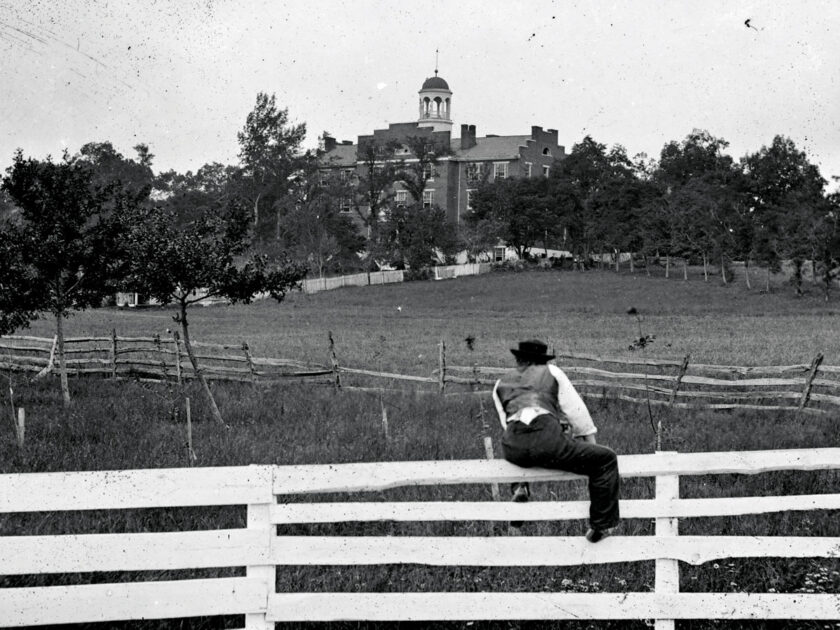
Days after Carleton’s reports appeared in the Journal and were reprinted by other newspapers, Mathew Brady’s team arrived with a wagon laden with photographic equipment to bring images of the battlefield into the homes of Americans. One of the glass negatives they produced is this view of a man perched on a rail fence, his back to the viewer, looking toward the Seminary. The dimensions of the negative indicate that the photographers intended it for stereoscopic viewing, a conclusion reinforced by the composition, with its clearly defined foreground, middle ground, and background—and surviving period prints.

While Brady’s team composed the scene behind the fence and a man, believed to be a photographer’s assistant, climbed the rails in preparation for the exposure, surgeons and attendants cared for hundreds of wounded patients inside the building.
Investigating the Image
Blooming daisies scattered along the base of the split-rail fence lend support to Carleton’s observation. The rails, painted white and nailed securely to the posts, are sturdy enough to support the weight of a man. They show no evidence of battle damage.
The individual straddling the top rail is posed to accentuate the stereoscopic effect. Balancing his weight with one hand on the rail and the other on his knee, his pork-pie hat shields him from the summer sun. The absence of a coat and his rolled-up shirtsleeves suggest he dressed down to cope with the heat. His polished shoes show no hint of mud spatters or exposure to the elements.
The foreground also features a second split-rail fence, weathered and unpainted. The rickety rails, some missing, are not nailed to the posts but instead slipped through holes bored into them. Its dilapidated condition suggests age rather than battle damage. The fence may date to a tree-planting project by the Class of 1844, or perhaps to earlier landscaping efforts associated with the construction of the main building in 1832.
Between the two fences, directly in front of our sitter, stand saplings supported by wooden stakes. Mature trees also occupy this enclosed space, to the left of the composition. It is a reasonable assumption that these are fruit trees planted years earlier to provide food for seminarians and staff.
The middle ground of the image, between the weathered rail fence and the white picket fence nearer the building, is an expanse of lawn. Where the level ground meets the slope, the grass appears matted. Codie Eash, Director of Education and Interpretation at Seminary Ridge Museum, suggests this flattening may mark the traces of wagons.
The Seminary dominates the background. True to Carleton’s description, the grounds are dotted with trees of various sizes, their dense foliage providing relief from the summer sun.
A trio of soldiers stand beneath the trees beside a worktable, directly in the line of sight of the man straddling the fence. The man on the right, coatless, poses with a bass drum slung over his shoulder, his hands supporting the strap. His two companions, one wearing a coat and the other without, stand with their arms crossed. These soldiers are believed to be Pennsylvania militia musicians.

Paul Bolcik, a keen observer of wartime photography whose investigations have appeared in the Center for Civil War Photography’s Battlefield Photographer and Military Images, suggests these musicians may have been detailed as nurses. He also notes that they stand about 75 yards from where Brady’s photographers created the well-known and frequently published image of the three Confederate prisoners. Given the short distance between the two locations and the photographers’ determination to document the battlefield, Bolcik believes the two negatives were likely made less than an hour to no more than an hour and a half apart. He also wonders whether these men crossed paths with the Confederates.
The white picket fence adjacent to the men shows signs of wear. Yet, aside from a few gaps and several sections out of alignment, it remains in surprisingly good condition considering the recent combat.
Following the picket fence to the left, toward the point where the sloping lawn meets the level ground, and just below the right-facing branch of the tree at the far right of the foreground, is a rectangular object lying in the grass. Eash and Kaleb Kusmierczyk, Director of Museum Operations, suggest it may be a pew removed from the chapel on the building’s fourth floor. The possibility brings to mind the well-known series of photographs, made 10 months later and 135 miles due south, of Lt. Gen. Ulysses S. Grant, Maj. Gen. George G. Meade, and their staffs seated on pews taken from Massaponax Baptist Church in Spotsylvania County, Va.
Opposite the picket fence, inside the yard in front of the building, portions of tents are visible through the branches. Eash and Kusmierczyk believe these glimpses of white canvas reveal seven tents that formed part of a miniature tent city on the grounds.
The Seminary building stands remarkably intact despite its precarious position during the recent battle, emerging largely unscathed from the artillery fire and musketry that engulfed it.

The first floor’s light-colored stone exterior contrasts with the darker brick walls of the upper stories. A window at the corner nearest the viewer opens into the kitchen, where shapes suggesting a woman in silhouette wearing a ubiquitous bell-shaped dress can be seen, observe Eash and Kusmierczyk. The figure could be caretaker Mary Ziegler, one of several women inside the building. According to an anecdote by her son, Hugh, Ziegler had left a beef roast in the kitchen when forced to evacuate on July 1.
The brick walls enclosing the upper three stories (there are four in total, plus the attic) show no visible evidence of damage. However, trees on the right side of the frame obscure a significant crack in the building’s north wall, which faces the town. Eash and Kusmierczyk attribute this damage to Union artillery fire and not the approximately 18 Confederate cannons positioned close to the Seminary.
Their research identified two accounts describing shells striking the building: one by U.S. Christian Commission delegate Andrew Cross, who interviewed Union artillerists, and another by 1st Lt. Jeremiah Hoffman of the 142nd Pennsylvania Infantry, who was wounded during the first day’s fighting and housed inside the Seminary during the rest of the battle.
Hoffman shared this note in an account written before his death in 1867, and published in The Gettysburg Magazine in 2000. The story, “Ordeal in the Lutheran Theological Seminary: The Recollections of First Lt. Jeremiah Hoffman, 142nd Pennsylvania Volunteers,” by Michael A. Dreese, includes this anecdote: “The Rebel batteries were placed so near the corners of the building that their shot several times grazed the corners of the house. Our own men drove them away from their guns repeatedly. The accuracy of our fire can be judged from the fact that the Rebs were driven from their guns without destroying the building.”
Hoffman also recalled that three shots entered the building, including a large solid shot that penetrated the brick walls into a closet without breaking through the door.
The windows, like the walls, are largely intact. Those standing open may have been raised to relieve the summer heat rather than shattered by shot or shell. The exceptions are the two prominent arched windows. Structurally, they are less stable than the square and rectangular window openings that dominate the building. The window in the north wall is entirely devoid of glass panes and its accompanying grilles, or muntins. This damage may be explained by the artillery fire believed responsible for the nearby crack. The other arched window, centered on the front facade, appears to have a single broken pane. It is also possible that the pane is intact, its dark appearance caused by the reflection of tree branches.


The two-stack chimney between the arched windows shows signs of damage. The stack to the viewer’s right is missing several bricks from one section at the top, and the masonry along its left and right edges appears looser than that of the stack to the left. There is no evidence of debris on the roof, suggesting the broken bricks either fell to the ground or were removed by someone inspecting the damage.
The cupola, protected from lightning strikes by a rod and cable, has a section of copper sheathing on the dome twisted upward—a clear sign of artillery fire. Below the dome, inside the observation deck and behind the railing to the viewer’s left, a dark shape is visible. Its purpose is not known. It may be a tarp or other material used to protect the floor and roof from the elements until repairs could be made.
Union Presence in the Cupola
The copper-domed cupola, with its wooden arches and slender columns, lent a touch of 19th-century elegance to the Seminary and the Gettysburg skyline. It is easy to imagine peaceful days when students and faculty contemplated their faith while gazing across fields, orchards, hills, and valleys. During the battle, however, the cupola served a far different purpose—as a key post for Union and Confederate observers as the armies struggled for supremacy.

Its use during the Gettysburg Campaign dates to June 30, 1863. That evening, near the Seminary, Brig. Gen. John Buford, commanding the First Division of the Army of the Potomac’s Cavalry Corps, met with one of his brigade commanders, Col. Thomas C. Devin, whose scouts had been screening Confederate movements. Buford’s state of mind and the discussion were later recalled by the Signal Corps officer assigned to his command, 1st Lt. Aaron Brainard Jerome Jr. Writing soon after the war, Jerome remembered that Buford expected an attack as early as the following morning, before Union infantry could arrive. Devin confidently assured Buford he could manage the Confederates for another 24 hours. “Buford answered: ‘No, you won’t. They will attack you in the morning and they will come booming—skirmishers three deep. You will have to fight like the devil to hold your own until supports arrive. The enemy must know the importance of this position and will strain every nerve to secure it, and if we are able to hold we will do well.’”
Jerome added that after Buford returned from Devin’s quarters, “he ordered me, then first lieutenant and signal officer of his division, to seek out the most prominent points and watch everything; to be careful to look out for camp-fires, and in the morning for dust. He seemed anxious, more so than I had ever seen him.”
The view from the cupola provided Jerome with an advantageous vantage point. He recalled climbing a ladder (others described it as a staircase) to the observation deck in fulfillment of his duties. Though the exact time he took up this position is unknown, Buford’s order to watch for campfires suggests he was there on the night of June 30.

About seven o’clock the next morning, July 1, Jerome peered through his field glass and spotted advancing Confederates. They belonged to Maj. Gen. Henry Heth’s division of Lt. Gen. Ambrose P. Hill’s Corps. Jerome immediately reported his observations to Buford, who had quartered overnight with his staff at a hotel near the Seminary.
Jerome likely relayed the information to Buford through an unnamed messenger with him in the cupola.

Buford organized his troopers, moved out to meet the enemy, and fought largely dismounted. For the next two hours, Jerome monitored the action as the blue-clad cavalrymen held their ground. It appeared that Devin’s confidence in holding the Confederates for 24 hours would prove justified. But as more of Hill’s Corps arrived on the field, increasing numbers and firepower confirmed Buford’s prediction from the previous evening.
They were going to have to fight like the devil.
Meanwhile, as Jerome scanned the landscape, he spotted a corps flag fluttering in the summer breeze and, behind it, the familiar dust clouds stirred up by marching men and galloping horses. He estimated the column was about two miles away and approaching from the direction of Emmitsburg. Jerome correctly surmised it was the I Corps. Major Gen. John Reynolds was on the way.
Jerome hurried off a messenger to alert Buford.
Before long, Buford joined Jerome, and “looking through my glass, confirmed my report, and remarked: ‘Now we can hold the place!’”
Buford, perhaps breathing a small sigh of relief, left the Seminary and returned to his command to hold the line until the infantry could be deployed.
Jerome returned to his telescope and continued to monitor Reynolds’ progress. A second message soon reached Buford: Reynolds was about five minutes away, with his corps a mile behind.

Buford returned to the Seminary and rejoined Jerome in the cupola. Peering intently through the telescope, he watched the I Corps draw closer with every step.
Jerome recalled what happened next: “When Reynolds came up, seeing Buford in the cupola, he cried out: ‘What’s the matter, John?’ ‘The devil’s to pay,’ said Buford; and going down the ladder, Reynolds said: ‘I hope you can hold out until my corps comes up.’ ‘I reckon I can,’ was the characteristic reply. Reynolds then said: ‘Let’s ride out and see all about it,’ and mounting we rode away. The skirmishing was then very brisk, the cavalry fighting dismounted. Buford said: ‘General, do not expose yourself so much;’ but Reynolds laughed, and moved nearer still.”
Reynolds, like Buford, acted quickly. He sent staff aides galloping off with intelligence and instructions for subordinates and fellow commanders, then turned his attention to positioning troops to meet the immediate threat. While directing these movements, at about 10:15 a.m., a bullet struck him in the head, ending the life of a talented and experienced leader at a critical moment. The groundwork he laid, combined with Buford’s dogged determination and artillery support, slowed the Confederate advance and bought valuable time for the lead elements of the infantry to arrive and deploy.
Jerome continued to report from the cupola after Reynolds’ death, relaying intelligence to Capt. Paul Babcock Jr., a signal officer attached to the XI Corps commanded by Maj. Gen. Oliver O. Howard. The general and his staff arrived on the outskirts of Gettysburg about the time of Reynolds’ death and hurried troops into action. One account notes that signals were sent from the cupola to Babcock’s position on nearby Cemetery Hill.
The exact time Jerome left the cupola before Confederates occupied the position is not known. Major Gen. Winfield Scott Hancock, who assumed overall command about 4 p.m., guided the Signal Corps in establishing its lines of communication. Jerome next appears late the following morning, July 2, transmitting from a station on Little Round Top—believed to be the first signal sent from that location.
The Cupola During Confederate Occupation
Sometime shortly after noon on July 3, British officer and observer Arthur James Lyon Fremantle and a companion left Lt. Gen. James Longstreet in search of a commanding vantage point from which to observe the Confederate advance against the Union center. According to Fremantle’s diary, an officer guided them in search of an ideal place to witness what would later become known as Pickett’s Charge. After riding for about half an hour without success, they set their sights on the Seminary, intending to watch the battle from the cupola. As they drew nearer, increasingly heavy artillery fire threatened their safety. When shrapnel from a shell wounded their guide, the two observers abandoned the attempt and sought a less dangerous location.
Though Fremantle does not mention Confederate use of the cupola, numerous personal accounts by Union and Confederate veterans place Gen. Robert E. Lee beneath its dome. These recollections continued into the early 20th century. Among them is an unsourced report published in a 1913 issue of Confederate Veteran, which stated, “The cupola was the choice observation point during the days of battle. It is stated that from it General Lee detected the weakness of the left center in the federal battle line, and that this conception caused the desperate and fatal charge of Pickett’s Division.”
Extensive research by Seminary Ridge Museum Director of Education Codie Eash challenges these claims. He cites a footnote in Volume III of Douglas Southall Freeman’s R.E. Lee: A Biography, which identifies Lee’s presence in the Seminary cupola as a myth, and suggests that later accounts likely confused it with the cupola atop the Almshouse on the opposite side of town. Freeman cited the manuscript of Lee aide Walter Taylor as the source for the footnote. However, Eash was unable to locate this reference in Taylor’s surviving papers.
“The cupola may never have hosted a Confederate general, but surviving accounts place junior officers and enlisted men from both armies within its narrow confines.”
Others stopped short of naming names, instead emphasizing the Seminary’s importance as an observation point for the Army of Northern Virginia. In Volume III of Battles and Leaders of the Civil War, published in 1884 and based on The Century War Series, the editors added a caption to an engraving of the Seminary stating that “it was the chief signal-station and observatory for the Confederates” during the second and third days of the battle. The illustration and caption accompany Maj. Gen. Henry J. Hunt’s narrative of the first day’s fighting. A similar statement appears in Volume VIII of Francis Trevelyan Miller’s The Photographic History of the Civil War.
The cupola may never have hosted a Confederate general, but surviving accounts place junior officers and enlisted men from both armies within its narrow confines.
The aforementioned 1st Lt. Hoffman of the 142nd Pennsylvania Infantry suffered a hip wound during the first day’s fighting and was transported by horse to the Seminary. He recalled that fellow Union soldiers feared their own artillery had targeted the building. After discussing how to alert the cannoneers to cease firing, they fashioned a red hospital flag from a petticoat belonging to the absent hostess, Mary Ziegler. “I was the only officer in the room and the men turned to me. So we agreed that a red flag must be hoisted, and by dint of strict orders and threats of punishment in case of disobedience, we were able to persuade a soldier to mount the cupola, and to hoist thence the largest pieces he could tear from the garment.”
The number of soldiers emboldened by the hospital flag—or simply driven by curiosity—who climbed into the cupola is unknown. Two surviving accounts by soldiers who watched portions of the battle from the observation deck suggest that many did.
During the afternoon of July 2, a corporal in the Third Company of the Richmond Howitzers, 1st Virginia Artillery, observed Gen. James Longstreet’s artillery bombard Union positions at the Peach Orchard and Houck’s Ridge. William Spottswood White recalled in an account published two decades later, “I procured a good field-glass, and taking position in the cupola of the Seminary watched the movements of both armies with feelings of no little interest.” He added, “The roar of the artillery is sublimely terrific; ever and anon the plunging, rolling musketry fire of the infantry can be heard sweeping down the valley, and the earth shakes and trembles ‘neath the continued shock.”
The following afternoon, Elisha Rice Reed, who served in the ranks of the 2nd Wisconsin Infantry and had suffered gunshot wounds in both legs during the first day’s fighting, recalled in an undated account, “I happened to be up in the cupola of the Seminary and had a good view of Pickett’s charge. There was also a rebel Lieu’t in the cupola. A dozen Yanks in the cupola rejoiced exceedingly when they saw the result, but the rebel Lieu’t saw nothing that made him rejoice. We went below and ‘told the boys.’ The boys rejoiced with a loud noise. Then the rebel Lieu’t came in, slowly, sadly, and silently.” Reed went on to describe the scene in the chapel, where the lieutenant vented his frustration over the failed assault.
Tracing the Image’s Publication History
Though familiar to today’s students of the Civil War, this image has been overshadowed by other photographs since the negative was made.
The view is not included in the original 14-card set of Brady stereographs published in the summer of 1863. Its earliest documented appearance dates to June 1865, as part of the Photographic History: The War for the Union series of more than 1,000 stereographs published by Edwin and Henry T. Anthony of New York City. It appears as negative No. 2393, the number etched on the right side of the glass plate and listed in Anthony’s catalogs.


The War Department’s purchase of a portion of the Brady negatives in 1875, combined with improvements in printing technology, made them available for publication in popular pictorial books commemorating the war. A review of late 19th- and early 20th-century publications—notably George Forrester Williams’ The Memorial War Book (1894) and Francis Trevelyan Miller’s landmark 10-volume The Photographic History of the Civil War (1911)—reveals that negative No. 2393 was not included.

Research into books that featured engravings based on photographs reveals that No. 2393 was seldom used as source material for illustrations. The only example identified for this study appears in Volume III of Battles and Leaders of the Civil War, adapted from The Century War Series published by The Century Magazine. The engraving reproduces only a detail of the negative, omitting the white rail fence and the man straddling it, and credits the image simply as a “war-time photograph.”
Brady No. 2393 does not appear to have been widely published during this period, either as a direct photographic reproduction or as source material for illustrations.
A similar pattern continued into the mid-to-late 20th century. In 1940, the original Brady negatives were transferred to the National Archives. Three years later, the Library of Congress acquired another significant collection of glass plates tracing its origins to the Brady/Anthony negatives. According to a report by Hirst D. Milhollen, chief of the Prints and Photographs Division, and Donald H. Mugridge, a specialist in American history, the collection changed hands six times over the decades, during which additional glass plates were added.
Among the glass plates in the Library of Congress collection is Brady No. 2393.
Leading up to the Civil War Centennial, Milhollen and Mugridge selected 1,047 glass plates and reproduced them on microfilm for wider distribution as an archival resource for researchers and the public. In their 1961 catalog, they explained that the images “have been carefully chosen to include the best and most interesting photographs of the several kinds into which the collection may be classified.”
For most of its history, Brady No. 2393 remained relatively obscure, entering the broader visual memory of the Battle of Gettysburg only in the digital age.
Brady No. 2393 did not make the cut. This likely explains why Milhollen and Mugridge did not include it in their 1952 pictorial history, Divided We Fought, and why it failed to appear in other books by subsequent authors and editors during this period.
There are exceptions later in the century. A tightly cropped version of the right side of the stereo card appears in William A. Frassanito’s landmark 1975 book, Gettysburg: A Journey in Time. It is credited to the Library of Congress. In his 1997 book, The Civil War in Depth: History in 3-D, Bob Zeller included the entire stereo card in the chapter devoted to Gettysburg. The image is credited to the collection of John Richter.
The dawn of the digital era and the rise of the commercial internet gave new life to the Milhollen and Mugridge selections, along with the remaining glass negatives that had never been reproduced on microfilm. In 2002, during the collapse of the dot-com bubble, the Library of Congress digitized its collection. About 7,000 images were made available online as broadband internet replaced slower dial-up connections and nonprofit organizations, researchers, and commercial publishers increasingly embraced digital resources.
Digitization sparked a renaissance for the Library of Congress collection, including Brady No. 2393. The resulting high-resolution digital images gave scholars, researchers, collectors, and other interested individuals the ability to enlarge and examine minute details and other aspects of Civil War documentary photography, both battlefield and portrait.
The earliest documented digital publication of Brady No. 2393 dates to 2009-2011, based on research using TinEye and the Internet Archive’s Wayback Machine. These sites served primarily as online galleries of Civil War images, with the Seminary view appearing among hundreds of thumbnails that could be enlarged for closer examination.
The earliest known focused use of Brady No. 2393 dates to 2010, when the Center for Civil War Photography included it among 23 views in its “3-D Anaglyph Photographs Exhibit.”
The year 2013 marked a significant milestone in the publication history of Brady No. 2393, with its appearance on the websites of the Seminary Ridge Museum, the National Park Service, and Encyclopedia Virginia. Five years later, in 2018, the image was added to Wikimedia Commons. Though it has since been published numerous times, it does not rank among the 25 most popular Civil War photographs reproduced in history books, according to Scott Hippensteel’s recent study in his book, Civil War Photo Forensics: Investigating Battlefield Photographs Through a Critical Lens.
Epilogue
The moment frozen in time in Brady No. 2393 lives on as an important view documenting the impact of the battle on the Seminary and its surrounding grounds.

Just a month later, in August 1863, an image by Philadelphia photographer Frederick Gutekunst pictured the fence being taken down for repairs and trees believed to be dying due to the effects of battle damage.
On Sept. 16, 1863, the last patient left. Classes resumed eight days later.
Battle scars remained visible for years to come. In June 1867, the well-known journalist George Alfred Townsend arrived in Gettysburg in advance of a visit by Lt. Gen. Ulysses S. Grant and his staff. Reporting as a special correspondent for the New-York Tribune, Townsend meandered through the town, talking with locals about the impact of the battle. His travels took him to the Seminary, where he met and interviewed Michael Jacobs, a professor at Gettysburg College and author of the 1864 book, Notes on the Rebel Invasion of Maryland and Pennsylvania.
Jacobs, 59 and in failing health, pointed out various places of interest to Townsend. “He will show you the newly-filled cavities in the seminary walls, the stumps of some broken trees, the bark of other trees that is warty and perforated from bullet wounds, and then tell you that some twenty young gentlemen are now as quietly pursuing their theological studies as when the nearness of battle disturbed them four years ago.”
Special thanks to Codie Eash, Director of Education and Interpretation at the Seminary Ridge Museum, for his body of scholarship about the Seminary and contributions to this story.
3D icon: Flaticon.com.
References: The Chicago Tribune, July 10, 1863; interview with Seminary Ridge Museum Director of Education and Interpretation Codie Eash, Director of Museum Operations Kaleb Kusmierczyk, and Military Images Senior Editor Paul Russinoff, March 27, 2026; E-mail from Paul Bolcik to the author, June 10, 2026; Hancock, Winfield Scott, “Gettysburg. Reply to General Howard,” The Galaxy (December 1876); Bates, The Battle of Gettysburg; De Peyster, Decisive Conflicts: The Gettysburg Campaign; Howard, Autobiography of Oliver Otis Howard, Major General United States Army, Volume One; Carty, Historical Sketch of the Signal Corps, 1861-1922; Fremantle, Three Months in the Southern States: April-June, 1863; The Century Co., Battles and Leaders of the Civil War, Volume III; “Lutheran Theological Seminary,” Confederate Veteran (July 1913); Cummins, “The Signal Corps in the Confederate States Army,” Southern Historical Society Papers (Vol. XVI, 1888); Eash, Codie, “Fridays on the Ridge – Did Robert E. Lee Use the Seminary Cupola?” (youtube.com/watch?v=JroHoCKP2xc); Dreese, Michael A. “Ordeal in the Lutheran Theological Seminary: The Recollections of First Lt. Jeremiah Hoffman, 142nd Pennsylvania Volunteers,” The Gettysburg Magazine (June 2000); Dreese, The Hospital on Seminary Ridge at the Battle of Gettysburg; Elisha Rice Reed Papers, Wisconsin Historical Society; White, Contributions to a History of the Richmond Howitzer Battalion; New-York Tribune, June 21, 1867; Hippensteel, Civil War Photo Forensics: Investigating Battlefield Photographs Through a Critical Lens; Frassanito, Gettysburg: A Journey in Time; Zeller, The Civil War in Depth: History in 3-D.
Ronald S. Coddington is editor and publisher of MI.
SPREAD THE WORD: We encourage you to share this story on social media and elsewhere to educate and raise awareness. If you wish to use any image on this page for another purpose, please request permission.
LEARN MORE about Military Images, America’s only magazine dedicated to showcasing, interpreting and preserving Civil War portrait photography.
VISIT OUR STORE to subscribe, renew a subscription, and more.
1 thought on “Gettysburg’s Lutheran Seminary in the Line of Fire”
Comments are closed.