

By Jan K. Herman
By mid to late April 1861, Washington, D.C., was on edge. On April 14, Fort Sumter had just fallen to Confederate forces, plunging the nation into civil war. The next day, Abraham Lincoln, in office for just six weeks, had called upon the states to enlist 75,000 volunteers to put down the insurrection.
When Virginia voted to secede on April 17, Lincoln recognized that the nation’s capital was in immediate danger from Virginia to the west and south and from a significant pro-secession population in Maryland to the north and east. The enemy surrounded the federal seat of government.
President Lincoln begged for troops to reinforce the capital’s minimal defenses. Several militia regiments, including five companies from Pennsylvania, followed by militia regiments from Massachusetts, New York, and Rhode Island, were soon on their way.
On April 19, the 6th Massachusetts Infantry arrived in Washington after the “Pratt Street Massacre” in Baltimore earlier that day. While marching between two Baltimore train stations, citizen soldiers dodged bricks, paving stones, bottles, and bullets. Southern sympathizers killed four soldiers and wounded another 31. These troops became the first casualties of the Civil War.

With the Senate in recess, the Capitol building, in the midst of a multiyear expansion, became an unlikely barracks for these traumatized, exhausted survivors, plus other regiments that required lodging. The troops were initially enthralled with the opulence of their temporary bivouac inside the Capitol’s imposing setting. In both the House and Senate wings, mock congressional sessions occurred, which were replete with speeches and debates punctuated with howls and applause and hoots of derision. Soldiers sat at various legislators’ desks, many writing letters home on congressional stationery. Chaos reigned supreme in the halls and vacant offices of the U.S. Congress.
More than 4,000 troops eventually occupied the Capitol, turning the marble halls and carpeted chambers into a filthy venue infested with lice and other vermin. One angry militia soldier eased his boredom by using his bayonet to deface the desk of former U.S. Senator Jefferson Davis. In empty committee rooms in the Capitol’s basement, ovens had been hastily constructed to provide the troops with fresh bread. Those “committee room” ovens were soon turning out hundreds and then thousands of loaves daily.
Many of the 8th Massachusetts Infantry began arriving on April 24 and were assigned to the Capitol Rotunda and the Senate Chamber for lodging. Those two prominent areas quickly became both dormitory and arsenal. Anticipating an imminent attack on the nation’s capital, but also tempting the fates, the soldiers of the 8th stacked their loaded and capped smoothbore muskets around the walls of the Rotunda. As men were bringing in additional mattresses on that first day, a stand of weapons was accidentally knocked down. One musket discharged, sending a .69 caliber round ball crashing into the ankle of 29-year-old Moses Stevens Herrick, a lieutenant in Company E, also known as the Beverly Light Infantry.

Surgeon Norman Smith of the 6th Massachusetts heard cries for help and responded immediately. He ordered men to carry the wounded officer into a nearby room, normally the office of a Supreme Court justice. Smith quickly amputated Herrick’s mangled ankle and foot. The lieutenant was then transferred to the E Street Infirmary between 4th and 5th streets, N.W., for additional care. That facility would quickly be requisitioned by the U.S. Army and turned into a military hospital.
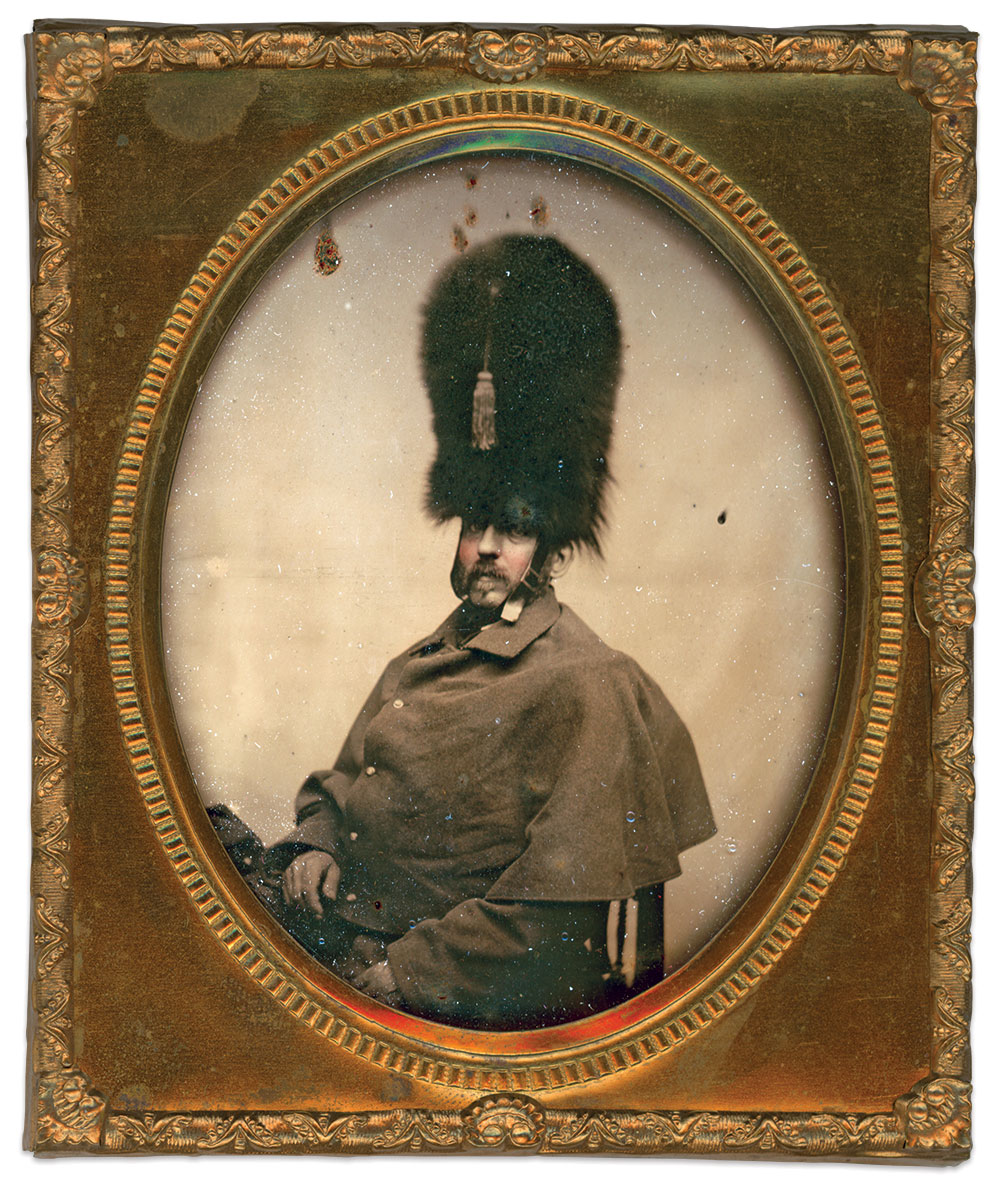
According to The History of Essex County, Massachusetts (1888), “Lieutenant Herrick bore his great misfortune bravely, only lamenting that he could not have received the wound while fighting in the field.” News reports in the aftermath note that the 7th New York State Militia stepped in with a donation of $1,000 to help Herrick as he returned to civilian life in Beverly, Mass. Before the end of the year, a Boston manufacturer of prosthetic limbs presented him with an artificial leg. A silver shield embedded in the calf included the inscription, “Presented to Lieut. M.S. Herrick by Palmer & Co., Boston, 1861.”
The level of sympathy and outpouring of support for a single amputee diminished as such surgeries soared to unprecedented levels, and the sight of military men missing arms and legs became commonplace in towns and cities across the country. Herrick’s surgery is considered to be the first of approximately 60,000 documented amputations performed during four devastating years of warfare.
Back in Beverly, Herrick reunited with his wife and children and returned to his occupation as a shoemaker. He died at age 62 on April 23, 1894, a day shy of the 33rd anniversary of his wounding in the Capitol.
References: Leech, Reveille in Washington: 1860-1865; The History of Essex County, Massachusetts; Rojo, “The First Amputation of the U.S. Civil War,” Nutfield Genealogy, May 9, 2015, as cited in D. Hamilton Hurd, The History of Essex County, Massachusetts (nutfieldgenealogy.blogspot.com/2015/05/the-first-amputation-of-us-civil-war.html); Medical and Surgical History of the War of the Rebellion; The Liberator, Boston, Mass., May 3, 1861; Boston Evening Transcript, Nov. 8, 1861.
Jan K. Herman is a longtime member of the North-South Skirmish Association (N-SSA), retired Chief Medical Historian of the Navy, and former curator of the Old Naval Observatory in Washington, D.C.
SPREAD THE WORD: We encourage you to share this story on social media and elsewhere to educate and raise awareness. If you wish to use any image on this page for another purpose, please request permission.
LEARN MORE about Military Images, America’s only magazine dedicated to showcasing, interpreting and preserving Civil War portrait photography.
VISIT OUR STORE to subscribe, renew a subscription, and more.
1 thought on “The Civil War’s First Amputee”
Comments are closed.