
By Stephen Berry and Kurt Luther
Prince Rivers (c. 1822-1887) was born enslaved in South Carolina and worked as a coachman before escaping to Union lines in 1862. He became color sergeant of the 1st South Carolina Volunteers, the first federally authorized regiment of formerly enslaved men. During Reconstruction he rose to extraordinary power: state legislator, militia general, trial justice, and mayor of Hamburg, a majority-Black town he helped govern as a functioning experiment in interracial democracy. That experiment ended in the 1876 Hamburg Massacre, a paramilitary attack that helped topple Reconstruction across South Carolina. Stripped of office, Rivers died in obscurity, driving a carriage once more.

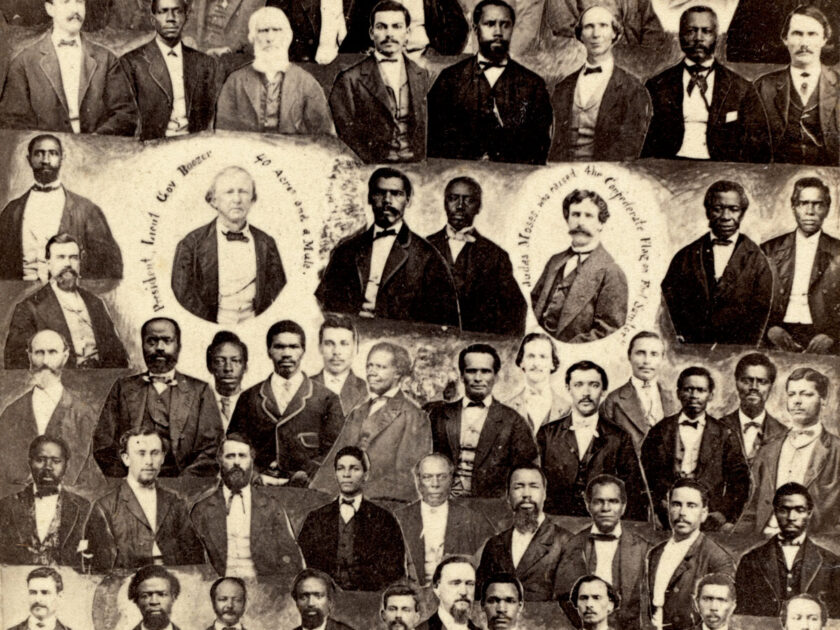
In the only surviving image we have of Rivers, he is depicted in one of the stranger scrapbook mashups ever to grace American politics. Captioned “RADICAL MEMBERS of the First State Legislature After the War,” the image depicts 63 Republican legislators cut out from their individual cartes de visite (or in some cases their caricatures) and then assembled into a single image, or composite photograph. Rivers is pictured wearing a suit in the fourth row from the top, the first individual from the left. The back of the photo lists the names of each legislator, along with each man’s race (“c” for colored or “w” for white). While there is much we do not and cannot know about this image and its origins, there is much we do know and more we can infer.
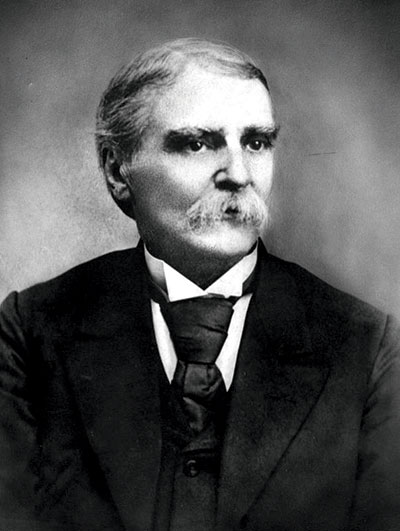
First, we know who likely made it. The oldest version of the image was copyrighted in 1868 by J.G. Gibbes, likely James Guignard Gibbes (1829-1903), son of Dr. Robert Wilson Gibbes, a South Carolina College (now University of South Carolina) assistant professor of chemistry and geology, who served two terms as mayor of Columbia and as surgeon general for the state. Dr. Gibbes was also the state printer from 1860 to 1866. The Gibbes ancestral home and textile factory on the Saluda River had been burned during Sherman’s sack of Columbia, giving the younger Gibbes a personal as well as political motivation for creating the image.
Second, we know the image took considerable ingenuity to assemble. How difficult must it have been to acquire the images of so many first-term legislators? For Rivers, as for many of these men, this may be the only photograph of them ever taken. Perhaps Gibbes paid a Columbia photographer to acquire these images? Perhaps he traded for them amid the so-called cardomania of the age—the new rave for collecting and trading military cartes de visite? Regardless, we can say this: Whoever put this together was highly motivated.
Motivated to do what? The purposes were clearly derogatory, defamatory, and potentially far worse. While the original “cut-and-paste” sheet is lost, we know the image was then photographed and disseminated throughout the state for years afterward in various sizes, from larger broadsides to foldable cardboard-backed images small enough to fit into a wallet. Virtually all of the versions use the term “RADICAL MEMBERS of the First State Legislature,” which is enough to signal political opposition. None of these men considered themselves “radicals.”
Then there are the two white men at the center of the photograph, each festooned with a handwritten caption. South Carolina’s lieutenant governor, Lemuel Boozer, is decorated with the words “40 acres & a mule.” A former slaveholder, Boozer was a steadfast Unionist and opponent of secession who became a true resistor during the Civil War, helping Union prisoners escape before erecting a freedmen’s school in his backyard. At Boozer’s burial, one of his Democratic opponents grudgingly admitted that he almost admired him. “He and I were antipodes in politics,” the friend said, “but I regarded his identification with the Republican party of this State as an act of signal moral heroism…. To be dissevered from the friends of his youth, of his manhood and advanced years; to drop the hands of his own Carolinians and grasp those of strangers; to aid in seizing the government of the dear old State from the possession of her own children to be confided to the guardianship of aliens, was indeed almost to tear his body and soul asunder. But still he did it….”

The other major white figure at the center is Franklin Moses, Jr., an ardent secessionist from an elite Jewish family who raised the Confederate flag over Fort Sumter before dramatically reversing course. Denounced by family and friends as a racial turncoat, Moses gradually embraced the possibility of a Jewish-Black alliance, first as a matter of political expediency and finally as a matter of conscience. In 1933, a historian called him “the most perfect scalawag, perhaps, in all the South.” By 1868 Moses was both speaker of the statehouse and the organizer of the state militia, charged with protecting the rights of Black voters.
The central position of these two white men, personae non gratae to state Democrats, confirms the collage as the work of the political opposition. The image includes a caption that makes that opposition explicit: “These are the photographs of 63 members of the reconstructed South Carolina Legislature, 50 of whom are negroes or mulattoes and 13 white. 22 read and write (8 grammatically), the remainder (41) make their mark with the aid of an amanuensis. Nineteen (19) are tax-payers to an aggregate amount of $146.10, the rest (44) pay no taxes, and the body levies on the white people of the State for $4,000.00.”
“If there should ever be a black monarchy in South Carolina, he will be its king.”
While conjecture, there are reasons to believe this image was intended to do more than arouse political indignation. It may also have served as a “rogues gallery,” “mug book,” and “hit list,” in much the same way that the American army would later, during the Iraq War, produce and distribute a deck of “personality identification playing cards” with Saddam Hussein as the Ace of Spades. Is it really a coincidence that seven of the men in this collage were assassinated?
Regardless, it is significant that Rivers sits on the main row, immediately to the left of Boozer, as the symbolic right hand of the legislature. Including all the men the Democratic opposition most hated, this image also reveals all the men the Democratic opposition most feared. Clearly, they were scared of Rivers.
They had reason to be. Rivers’ own colonel once said of him that “if there should ever be a black monarchy in South Carolina, he will be its king.” During Reconstruction, Rivers ruled the freedom town of Hamburg as “The Black Prince” and “The Power of Aiken County.” He is largely forgotten now—but the men who assembled this composite did not forget him, and the seat they gave him at the legislature’s right hand is a perverse measure of how much they feared him.
References: Saluda Factory Historic District, South Carolina Department of Archives and History; Coddington, Ronald S., “Cardomania!: How the Carte de Visite Became the Facebook of the 1860s,” Military Images, (Summer 2016); Proceedings in the General Assembly and Supreme Court of South Carolina, on the Death of Hon. Lemuel Boozer, Judge of the Fifth Judicial Circuit; Rubin, South Carolina Scalawags; Brooks, South Carolina Bench and Bar, Vol. 1; Bagget, The Scalawags: Southern Dissenters in the Civil War and Reconstruction; Woody, Robert H., “Franklin J. Moses, Jr., Scalawag Governor of South Carolina, 1872-1874,” North Carolina Historical Review (April 1933); Ginsberg, Moses of South Carolina: A Jewish Scalawag During Radical Reconstruction.
Stephen Berry is Gregory Professor of the Civil War Era at the University of Georgia. This piece is partially excerpted from his new biography of Rivers, The Original Black Panther: Prince Rivers and the Lost City of Hamburg, published by UGA Press.
Kurt Luther is an associate professor of computer science and, by courtesy, history at Virginia Tech. He is the president of The Photo Sleuth Foundation, a nonprofit organization with a mission to rediscover the names and stories of unknown people in historical photos through research, technology and community. He is a MI Senior Editor.
SPREAD THE WORD: We encourage you to share this story on social media and elsewhere to educate and raise awareness. If you wish to use any image on this page for another purpose, please request permission.
LEARN MORE about Military Images, America’s only magazine dedicated to showcasing, interpreting and preserving Civil War portrait photography.
VISIT OUR STORE to subscribe, renew a subscription, and more.