
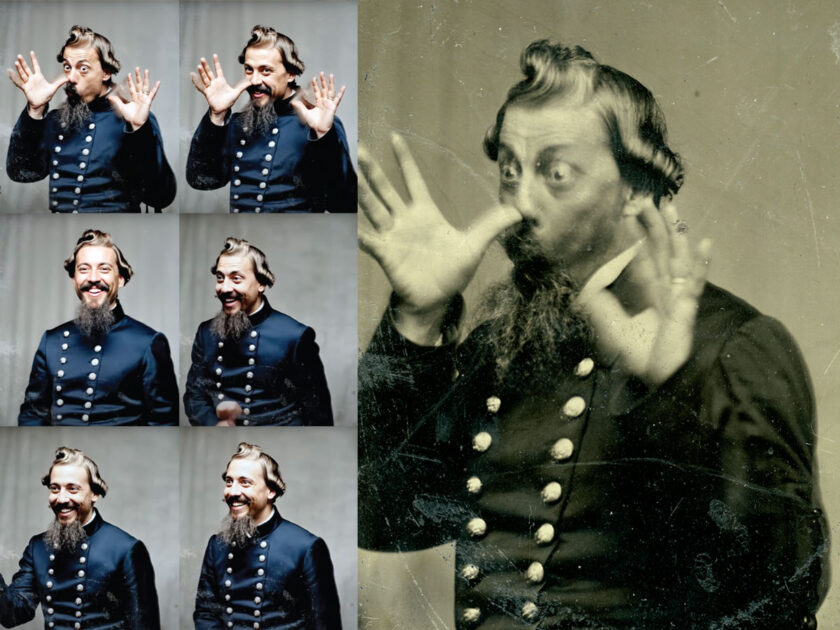
The emerging genre of historic photographs brought to life through AI touched me personally when an image in my collection appeared on the YouTube channel History in Motion. I watched with astonishment as the Union officer in my tintype, frozen in time, thumbing his nose at the camera, transformed to full color and completed the gesture, turned, and smiled.
I reached out to History in Motion and began a discussion that culminated in a two-hour conversation on Zoom. I learned that the individual behind the channel, a soft-spoken, young Englishman who keeps to himself, is fascinated with 19th-century military images from around the world. He was open to notes about minor imperfections in colorization and AI interpretation in the animation of my image, and to learning about the vibrant community of caretakers of these images. As fellow YouTubers, we compared experiences about our audiences and how to engage them. We’ve stayed in touch.
Our conversation sent me back to the origins of photography. In 1839, the world hailed Daguerre’s harnessing of the sun’s rays as a miracle. Naysayers feared a dystopian society, worrying that photography blurred the lines of reality and fretted about job losses for artists. Both sides recognized that photography was a life-altering technology.
Early on, these pioneer photographers, who often described themselves as artists, tinted likenesses on plates and paper with pigments—the first colorists. As the medium evolved through the 19th and into the 20th centuries, advances in technology resulted in natural color. The advent of personal computing in the 1980s introduced Photoshop, fueling modern colorization of historic images. Just a few years ago, we saw digital tools used to animate faces and expressions. Now, artificial intelligence reimagines still images as short videos, like those on History in Motion and a growing number of YouTube channels. This is only the beginning.
Artificial intelligence has its critics—just as photography did in 1839. Will the bond between 19th century photography and today’s animated interpretations fray and break, leaving us in a state of altered reality untethered from authenticity? Will the livelihoods of those who showcase, interpret, and preserve historic images be lost? I think not.
I am optimistic that History in Motion and similar endeavors will drive our curiosity about the past and help keep history relevant for future generations.
Ronald S. Coddington
Editor & Publisher
SPREAD THE WORD: We encourage you to share this story on social media and elsewhere to educate and raise awareness. If you wish to use any image on this page for another purpose, please request permission.
LEARN MORE about Military Images, America’s only magazine dedicated to showcasing, interpreting and preserving Civil War portrait photography.
VISIT OUR STORE to subscribe, renew a subscription, and more.
1 thought on “Reflections on Generative AI”
Comments are closed.