
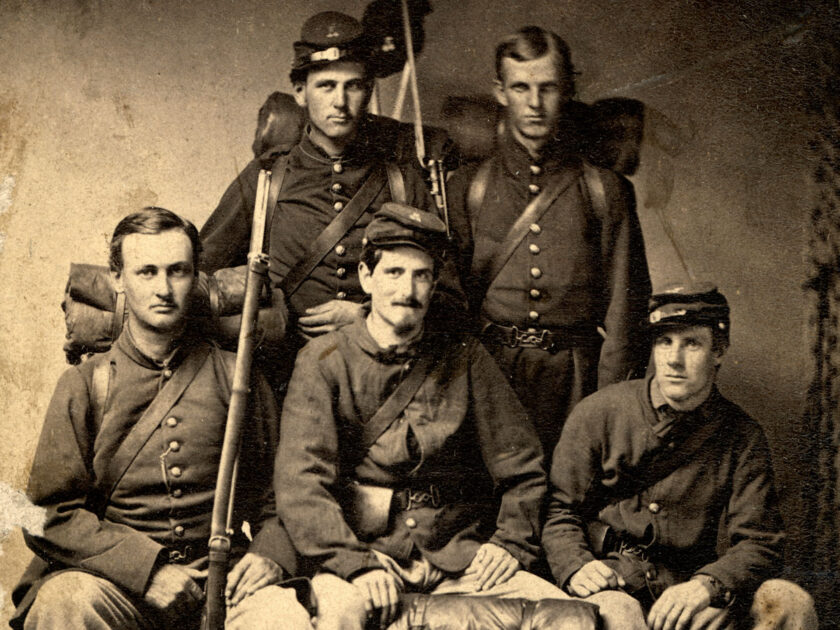
Civil War images speak to us in unique and varied ways. The cover photograph for this issue tells the story of five Union citizen‑soldiers who belonged to the same mess, were at the beginning of their service, and posed with the weapons and field gear of the day. Their faces, their equipment and long arms invite us to consider how comradeship, routines of camp life, and readiness for combat looked during soldier’s journey.
I’m thrilled to share that this cover study launches a wider exploration of how soldiers prepared to march and fight. In “Our Mess,” Michael R. Cunningham, Ph.D., studies a group portrait from the Rick Carlile Collection picturing pards from Company F, 44th Massachusetts Infantry—men photographed with Enfield rifles and Short’s Patent knapsacks, their gear arranged with the kind of care that signals both pride and instruction. Cunningham teases out what the image tells us about early‑war organization, regimental culture, and the practical demands of service. He then widens the frame in “Marching Order!” to survey more portraits from the Rick Carlile Collection from across the Union posed with gear—knapsacks, canteens, bayonets, haversacks, and more—offering a visual primer in how a Federal soldier actually looked when stepping off toward history.
Generative AI Meets 19th Century Photography
This issue opens with an Editor’s Desk reflection on today’s generative‑AI tools that animate 19th‑century photographs. We situate these tools within the long history of photography and public engagement—celebrating new ways of seeing while underscoring the obligation to disclose methods, test assumptions, and keep faith with the historical record. That ethic carries forward into Photo Sleuth, where Kurt Luther presents a hands‑on guide to using modern tools in Civil War research: reverse‑image search, facial‑recognition workflows, backdrop matching, prompt hygiene, bias checks, and cautions. The result is a clear statement of best practice: embrace innovation, but let evidence lead.
Words, Meanings, and the Press
In Military Anthropologist, we examine how key terms—“Contraband,” “Fugitive Slave,” “Colored Troops,” and “Freedmen”—rose and fell in U.S. newspapers during the war years. The Newspapers.com data reveal shifting language that mirrors policy, progress, and public perception. Read alongside our features on U.S. Colored Troops, the chart becomes more than a visualization: it’s a map of how a nation learned, sometimes haltingly, to speak about freedom and service.
Caregivers and Citizens
Two columns center the people who made military care possible and, in doing so, widened the circle of American citizenship. The Citizenry by Elizabeth A. Topping profiles nine women identified as nurses at York U.S. Army Hospital, likely connected to the Ladies’ Aid Society and the aftermath of Gettysburg. Their portraits are a ledger of skill and resolve. In Women of War, Melissa A. Wynn follows Louisa May Alcott from Washington’s wards to the pages of Hospital Sketches and onward to her advocacy for women’s rights—a life of service, authorship, and reform.
Valor and Leadership, or Conspicuously Absent
Battle leadership and decoration thread through several columns. In The Honored Few, Evan Phifer (his inaugural column) recounts how John B. Fassett led the 39th New York to retake the guns of Watson’s Battery near the Trostle farm at Gettysburg on July 2, 1863—gallantry recognized with the Medal of Honor. Our Vignette by Scott Valentine spotlights Col. Samuel A. Duncan and his leadership of the 4th and 6th U.S. Colored Troops at New Market Heights, a fight bound forever to Sgt. Maj. Christian Fleetwood’s medal‑earning courage. Most Hallowed Ground follows Franklin Y. Commagere—14th Ohio, 67th New York, 6th U.S. Colored Cavalry, and, later, the 7th U.S. Cavalry—who had a habit of disappearing from his commands.
Arms, Equipment, and Portraiture
Collectors and living historians will find a trove of columns to education and raise awareness. Phil Spaugy’s Of Arms and Men studies Company B, 9th Pennsylvania Cavalry on Lookout Mountain—Starr carbines in hand—just before Kilpatrick’s riders push into Sherman’s March. In Material Culture, Frederick C. Gaede and Paul D. Johnson examine Col. William d’Alton Mann’s shoulder‑sling accouterment concept that sought to move weight off the waist—an inventive idea trialed in select units but never standardized. In Antebellum Warriors, Ron Field investigates an image of a South Carolina militiaman with a palmetto‑plumed shako, triple‑breasted coat, leather stock, civilian trousers, and an 1807‑pattern stirrup‑hilted sword. And in Behind the Backdrop, Buck Zaidel chases a Hartford studio’s camp‑scene background—likely by Nelson A. Moore—as its visual language echoes in Ohio and Philadelphia, revealing networks among wartime photographers.
Lives in Full: A Poet, Wig-Waggers, and Rangers
Biographies are always full or unpredictable and unexpected journeys. In “The Bayard of the Volunteer Army,” I follow Brig. Gen. William Haines Lytle from the command of the 10th Ohio Infantry to his national renown as a poet. He received a gold Maltese cross in August 1863 and fell at Chickamauga weeks later; his verse helped shape how a grieving public remembered him. “On Quinby’s Watch” traces Lt. Ira Quinby of Colorado, an acting Signal Corps officer whose work during the 1864 Battle of Westport helped stall Price’s Raid—the “Gettysburg of the West.” And in “Mary’s Album,” Bob Iwig opens the keepsake of a Harper’s Ferry teenager to find faces of two Loudoun Rangers—Union cavalrymen who operated where Mosby’s rangers and White’s Comanches turned countryside and crossroads into contested ground.
Collectors, Hermits, and the Afterlives of Objects
History survives because people preserve artifacts and tell stories about them. In Collecting Civil War Artifacts Before the Centennial, Norman Delaney reminds us how families, early pickers, Bannerman catalogs, and antique shops shaped the pre‑1961 collecting world. Passing in Review turns to Timothy Renner’s I Have Never Minded the Loneliness, a gallery of 37 hermits—including Gettysburg’s Hermit of Wolf Hill—whose lives refract the era’s echoes. Stragglers brings us singular portraits submitted by ur subscribers, including Kentucky campaigners, a sailor of Asian heritage, a split‑screen soldier shown on camp and on campaign, and a federal at Point Lookout. Finally, The Last Shot arrests us with a ninth‑plate ambrotype of an unidentified Confederate ready for his first fight—Bowie knife, single‑shot pistol, tinware, and a rough wool jacket.
Thank you, as always, for sustaining Military Images with your subscriptions, feedback, and other expressions of support. If a story here sends you back to your own albums, attics, or archives, let us know what you find. 19th century photographs keep history alive.
Ronald S. Coddington
Editor & Publisher
SPREAD THE WORD: We encourage you to share this story on social media and elsewhere to educate and raise awareness. If you wish to use any image on this page for another purpose, please request permission.
LEARN MORE about Military Images, America’s only magazine dedicated to showcasing, interpreting and preserving Civil War portrait photography.
VISIT OUR STORE to subscribe, renew a subscription, and more.