
By Kurt Luther and Bryan Cheeseboro
Group portraits of U.S. Colored Troops (USCT), like all photos of USCT, are rare, and identifying their subjects rarer still. Back in 2015, this column named an officer in a group portrait taken at Philadelphia’s Camp William Penn that served as the basis of a famous USCT recruiting poster—“Come and Join Us, Brothers.” Such discoveries have been few and far between. To our knowledge, it has been decades since a previously unknown USCT group portrait has surfaced. In this column, we will tell the story of a photo sleuthing collaboration that spanned multiple years and led to the identification of not one, but three newly discovered USCT group portraits.
The story began in the fall of 2023. Bryan was scouring the Internet for Civil War photos when he stumbled across a low-resolution image of an unfamiliar USCT group portrait. The image, credited to the Lowndes County (Ga.) Historical Society & Museum Archives, showed a group of 21 enlisted USCT and a tall Union officer standing at parade rest in front of a barracks building. Several of the noncommissioned officers hold Model 1840 swords pointed at the ground. The soldiers are infantrymen, based on the hunting horn insignia visible on many of their forage caps, though the specific regiment numerals and company letters are hard to discern. The officer wears a chinstrap-style beard with no mustaches and the shoulder straps of a second lieutenant.

The photo’s caption described the men as members of the 104th U.S. Colored Infantry (USCI). However, Bryan’s experience suggested otherwise. He immediately recognized similarities in composition and location between this photo and another, well-known group portrait of members of Company E, 4th USCI, standing at parade rest in front of a barracks building. That photo was taken by William Morris Smith on November 17, 1865, at Fort Lincoln, part of the Union’s Defenses of Washington, D.C. Smith, who worked for Alexander Gardner’s studio, is known to have photographed multiple Civil War fortifications around Washington in 1865, including Forts Totten and Stevens (August), Woodbury (November 1), Tillinghast (November 10), Lincoln (November 17), Slocum (November 24), and Corcoran (November).
Most of the men Smith photographed in these D.C.-area forts were USCT. To understand why this happened, we must first remember that the Civil War was a war that was never declared nor undeclared, and its ending was not as clear cut as with the formal surrenders of the defeated in previous and later wars. The Civil War ended in stages, most notably with the April 1865 surrenders of Gen. Robert E. Lee’s Army of Northern Virginia at Appomattox Court House, Va., and Gen. Joseph E. Johnston’s army at Bennett Place, N.C. Surrenders of smaller, lesser armies would come later that year.
Though thousands of Confederates had laid down their arms at once, stragglers and “Unreconstructed Rebels” remained, and with them the possibility of the rebellion sparking up again. But with the Confederacy effectively destroyed, many White U.S. Army soldiers, especially those coming up at the end of their terms of service, were anxious to muster out and go home. The assassination of President Abraham Lincoln showed that the war was not quite over, and threats to Washington remained.
In the fall of 1865, it was decided to garrison some of the forts around Washington with soldiers of the USCT. Since these were men who enlisted later than most White soldiers, many USCT regiments had not mustered in until 1863 or 1864. It was more convenient to use them in the Civil War Defenses of Washington than men anxious to muster out. Any effort to keep them in the army past their term of service could bring a challenge from the congressional representatives of the veterans. Given these circumstances, the answer was to use the U.S. Colored Troops. These were men who could not vote and had little to no political power. Many of them had been enslaved before joining the army and either had no homes to return to or no desire to return to the places where they had lived in bondage. Staying in the army meant a job with pay, even if the peace they guarded did not yet offer them the same freedoms they defended.
Two regiments were selected for postwar duty garrisoning selected forts in the Civil War Defenses of Washington: the 4th USCI, organized in Baltimore, Md., in the summer of 1863, and the 107th USCI, organized in Louisville, Ky., one year later. The 4th was assigned duty in forts north of the Potomac River, the then-rural part of the District of Columbia, and the 107th in the forts south of the river, i.e., in Northern Virginia.

With this historical context in mind, Bryan speculated the mystery photo might show another company of the 4th USCI. He contacted the historical society and received a higher-resolution version of the photo. Bryan noticed that the top of the photo, an albumen print, showed traces of a period ink inscription, though only the bottom half was visible. Flipping the image horizontally, a single cursive word became clear: “Slocum.” A former board member of the Alliance to Preserve the Civil War Defenses of Washington, Bryan immediately connected the name to Fort Slocum, a Union fort in Northeast Washington. The 104th USCI was organized in Beaufort, S.C., and never left the state, giving more reasons to doubt this unit identification. He shared his early findings in Stories of the United States Colored Troops, a USCT-focused Facebook group, on September 19, 2023—a post we will return to later.

The historical society also told Bryan that the photo was not held in their collections, but rather came from the Chicago Public Library (CPL), a sprawling library system that includes 77 locations and over five million books. Bryan contacted CPL and shared his theory with the special collections staff there. Morag Walsh, a senior archival specialist, provided a quick digital snapshot of the original print. Walsh explained that the library acquired the print from Swann Galleries in 1997 and the item description came directly from their auction listing. It read:
U.S. 104th Colored Infantry at Ft. Sloan, South Carolina. With a hand written inscription in the negative signed with the initials W.M.S. which are those of William M. Simons, 2nd Lieutenant of the 104th. Lt. Simons is apparently second from the left. Acquired by purchase at Swann Galleries April 17, 1997/81, one of two photographs from this unit. The 104th was mustered at Beaufort, [S]. C. between April 28 and June 25, 1865. They were attached to the Dept. of the South. Garrison and guard duty at various points in South Carolina until mustered out on February 5, 1866.

The auction’s description of the photo is completely incorrect. Bryan could find no trace of a “Fort Sloan” in South Carolina, which appeared to be a misreading of “Slocum.” However, the lead on the initials “W.M.S.” caught his attention. Examining the partial inscription more closely, he confirmed the initials were present, but doubted they were the officer’s name. Rather, they connected back to the 4th USCI portrait by William Morris Smith. Smith had inscribed his initials on the glass negative of that photo, along with several others in the grouping he took while visiting Civil War fortifications around Washington in 1865. Based on these clues, including the WMS inscription and the similar barracks setting, Bryan concluded that the CPL print showed USCT stationed at a fort in Washington, photographed by William Morris Smith. But which USCT, and which fort? The trail went cold for the next two years.
In January 2026, Kevin Chapman, a co-moderator of the Stories of the USCT Facebook group, bumped Bryan’s post, asking for an update. Consequently, Kurt Luther, who had joined the group after Bryan’s post and completely missed the discussion about the Fort Slocum photo, saw it for the first time, and our collaboration began in earnest. Having previously written MI columns about both USCT group portraits and Civil War-era forts around Washington, Kurt was instantly curious. Examining the photo Bryan uploaded, he noticed the partial inscription also included a handwritten date, similar to Smith’s other D.C. fort photos. This one appeared to read November 24, 1865—just a few days after Smith’s visit to Fort Lincoln.

Kurt also recalled that Edward Longacre’s regimental history of the 4th USCI, A Regiment of Slaves (2003), detailed how the companies of the 4th were split up and assigned to different D.C.-area forts after the war ended. Company D and the 4th’s regimental headquarters, which included Medal of Honor recipient Sgt. Maj. Christian Fleetwood, were sent to Fort Slocum. Inspecting the soldiers’ hat brass, Kurt noticed several letters that strongly resembled a “D.”
Furthermore, Kurt knew of a photo of the 4th USCI at Fort Slocum in the Library of Congress collections, featuring a group of White officers and several Black noncommissioned officers, including Fleetwood. The group was photographed by William Morris Smith and had the same date of November 24, 1865. Standing beside Fleetwood was the same officer with the chinstrap beard in the CPL print. Kurt shared his findings with Bryan, first in the Facebook thread and then over emails and phone calls. Based on the new evidence, we felt confident identifying the CPL photo, for likely the first time in modern history, as Company D of the 4th USCI, photographed at Fort Slocum by William Morris Smith on November 24, 1865.
Our sleuthing, however, was just getting started. As Bryan shared his CPL email exchanges with Kurt, our attention was drawn to the digital snapshot provided by the archivist. A second albumen print appeared to be peeking out behind the Co. D photo, and the item description suggested there were two USCT photos in the auction. Kurt followed up with the CPL staff and requested a digital snapshot of the second photo. When it arrived, we were blown away. It was another, completely new USCT group portrait.
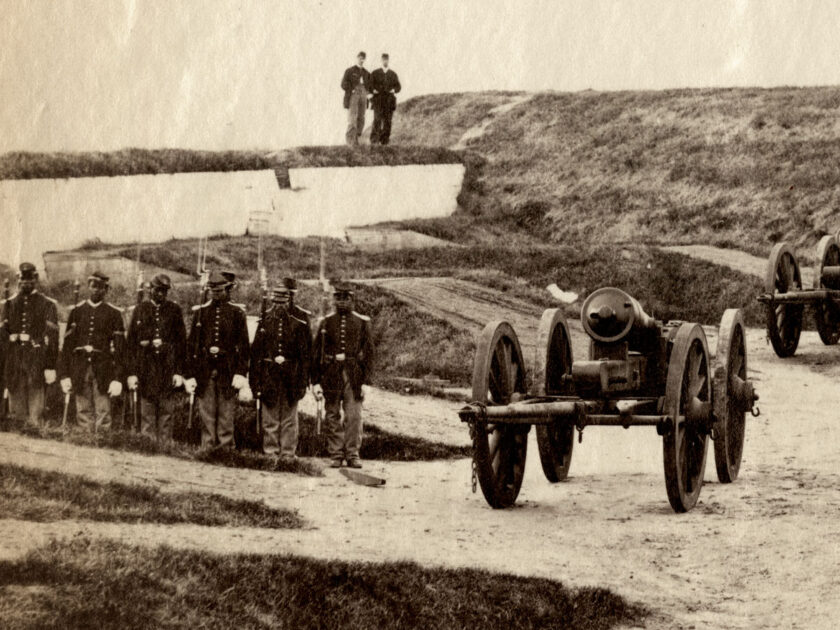
This new photo, like the first one, was an albumen print showing USCTs in a fort. However, the scene was quite different from the Fort Slocum or Fort Lincoln images. The camera was positioned farther back from the troops, providing a wide view of the setting, showing earthworks, two large cannons on carriages, and a well. A formation of at least eight enlisted soldiers, including two noncommissioned officers, stood at attention in the middle ground of the photo, while two officers posed casually on a wall in the background.
Best of all, this photo included a clear period inscription on the top. It read, “Fort Tillinghast + Guard Cold 107th 11/10/65 WMS.” Fort Tillinghast was a lunette in the Union defenses of Washington, located in present-day Arlington, Va. Blueprints for Fort Tillinghast in the National Archives match the structure seen in the photo, including the covered well. Bryan’s research indicated that Company I of the 107th USCI was stationed at Fort Tillinghast. To our knowledge, this is the first known photograph of that fort. Aside from perhaps an occasional CPL patron, we don’t believe this photo has ever been published or widely viewed by the public.


We had only just identified photos of these two regiments when Kurt received a serendipitous email from Bob Zeller, president of the Center for Civil War Photography. Zeller had been contacted by Dr. April Watson, senior curator of photography at the Nelson-Atkins Museum of Art, in Kansas City, Mo. Watson was conducting research for an upcoming exhibit on abolition and photography and came across an intriguing photo in the museum’s collections.
The albumen print, labeled simply, “Black Civil War Soldiers,” and attributed to Alexander Gardner, showed a large group of USCT seated in front of a barracks building. Watson instantly noticed the similarities to William Morris Smith’s well-known photo of Company E, 4th USCI at Fort Lincoln, and reached out to Zeller for more information. Although this print bore no inscription, Zeller strongly suspected it was also photographed by Smith during his tour of D.C.-area forts and likely depicted soldiers of the 4th USCI. He copied Kurt on his reply, opening the door for additional sleuthing.


We took one look at the Nelson-Atkins photo and knew immediately that we had never seen it before. We also knew this photo was just as remarkable, if not more so, than the other two. Thirty-two USCT sat on wooden benches in three rows, with their legs crossed and hands folded on their laps. There were several noncommissioned officers, and most soldiers wore shoulder scales and hat brass indicating Company H of an infantry regiment. In the far left of the back row, a bearded first sergeant cradled a sword in his lap. Seated on the opposite end of the back row, we were astonished to see a young African American woman wearing a dress and a solemn expression. Her role within the group is uncertain, but her inclusion in the photo suggests it was important. Perhaps she was a laundress, nurse, or cook serving alongside these soldiers.
Beyond the unidentified woman, the photo held other unsolved mysteries. If we could identify the USCT regiment, that could also provide a lead about the photo’s location. Unfortunately, the image file originally emailed by Watson was too small to discern the numerals inside the hunting horns on the soldiers’ caps. Her staff sent a high-resolution scan, and we eagerly zoomed in to inspect it. While many of the numerals were obscured or blurred, one near the middle of the photo looked strikingly like a number 4. If these soldiers were also part of the 4th USCI, then this would become the second new group portrait we had identified in the span of just a few weeks. Further, we knew from Longacre’s A Regiment of Slaves that Company H of the 4th USCI served at Fort Stevens, site of the only Civil War battle to take place in Washington, D.C., and where President Abraham Lincoln came under enemy fire from Confederate sharpshooters. This would make the Nelson-Atkins print one of the only known wartime views of Fort Stevens, and perhaps the only photo of USCT at that location. For Bryan, who grew up near Fort Stevens, the location had personal significance.
This news seemed almost too good to be true, so we tempered our enthusiasm with caution about confirmation bias. Kurt decided to run an experiment to test his theory. In the Civil War Faces Facebook group, he posted a cropped image of just the soldier’s cap showing the hunting horn, regiment numeral, and company letter. Providing no additional context, he asked, “What number do you see inside the horn?” The question drew 48 responses within a day, and every person reached the same conclusion: It was a 4. Our hunch supported by the unbiased wisdom of the crowd, we felt justified concluding the photo depicted Company H, 4th USCI at Fort Stevens, with William Morris Smith as the photographer. Bob Zeller, who was the first to theorize the connection to Smith and the 4th USCI, published the photo on the cover of the April 2026 issue of Battlefield Photographer, teasing the more in-depth investigation published here.
Thus, within the space of just a few weeks in early 2026, we had helped identify three unidentified or misidentified, unpublished group portraits of USCTs in the Civil War Defenses of Washington. We were able to identify the regiment, company, fortification, photographer, and even some specific dates for each of these albumen prints. We are grateful to Bob Zeller, April Watson and the Nelson-Atkins Museum staff, Morag Walsh and the Chicago Public Library staff, and members of several Civil War-focused Facebook groups for making these discoveries possible. Of course, as photo sleuths, our next project focuses on identifying the individuals pictured in these images and telling their stories — the solemn young woman, the bearded first sergeant, the tall lieutenant, and their comrades. We also hope to locate the original glass negatives, which may hold further clues.
Meanwhile, we will be keeping our eyes open for more USCT group portraits. If three can turn up in one year, surely there are still others waiting to be rediscovered.
Kurt Luther is an associate professor of computer science and, by courtesy, history at Virginia Tech. He is the president of The Photo Sleuth Foundation, a nonprofit organization with a mission to rediscover the names and stories of unknown people in historical photos through research, technology and community. He is a MI Senior Editor.
Bryan Cheeseboro is a historian of the American Civil War. He has written for the Emerging Civil War blog. His presentations to the Rock Creek, D.C. Civil War Round Table include the programs “Outside of Lincoln’s White House: Civil War Men and Women of the D.C. Metro Area;” and “Fourscore and Five Years Ago: Finding the American Revolution in the Civil War.” In March of 2019, he was requested to speak to memorabilia collectors at the first-ever presentation of “Civil War Photo Talks, part of the Civil War Faces Photo Show & Sale,” presented by Military Images magazine. He was the subject of the article “The Hands-On Historian” in the Spring 2021 issue of Civil War Monitor magazine.
SPREAD THE WORD: We encourage you to share this story on social media and elsewhere to educate and raise awareness. If you wish to use any image on this page for another purpose, please request permission.
LEARN MORE about Military Images, America’s only magazine dedicated to showcasing, interpreting and preserving Civil War portrait photography.
VISIT OUR STORE to subscribe, renew a subscription, and more.