
By Michael R. Cunningham, Ph.D., featuring images from the Rick Carlile Collection
 Countless Civil War soldiers sat for photographic portraits to keep their images fresh in the minds of family and friends at home. Yet the realities of military life could make it challenging to have such images made. When soldiers were not marching or fighting, they were kept busy drilling and on fatigue duty. A leave authorized by an officer or sergeant was required to pay a visit to a local photographic artist in a building in town, or even in a tent on the edge of the bivouac.
If a soldier secured a pass, he might think twice about taking with him his 10-pound musket, waist belt with cap box, bayonet and scabbard, five-pound cartridge box, three-pint water canteen, haversack and knapsack.
Painted cloth haversacks were issued to hold food, cooking gear and extra cartridges. Knapsacks generally were made of painted canvas but could be made of gutta percha or leather and were used to carry spare clothing; toiletries; correspondence material such as a pen, bottle of ink, pencil, paper, envelopes and stamps and other sundries. In addition, the soldier needed to carry the material used to bed down for the night. This included a five-pound wool blanket and what the Quartermaster Department called a “Rubber Poncho Tent Blanket” and soldiers called a “gum blanket.” That was a sheet of cloth covered with vulcanized rubber, with brass grommets on the sides, and sometimes a poncho slit in the middle for the head.
Early on, baggage wagons transported tents. Beginning in 1862, infantrymen were issued a portion of a two-man cloth tent called a shelter half which they carried themselves. In the winter, a greatcoat with cape added to the load. As a consequence, few were motivated to haul 30 to 50 pounds of trappings to the photographer’s studio, making images of soldiers in full marching order uncommon.
Photographs of those who made it into the studio lugging the extra weight have been a focus of Military Images Senior Editor Rick Carlile. Representative images from his collection are featured here.
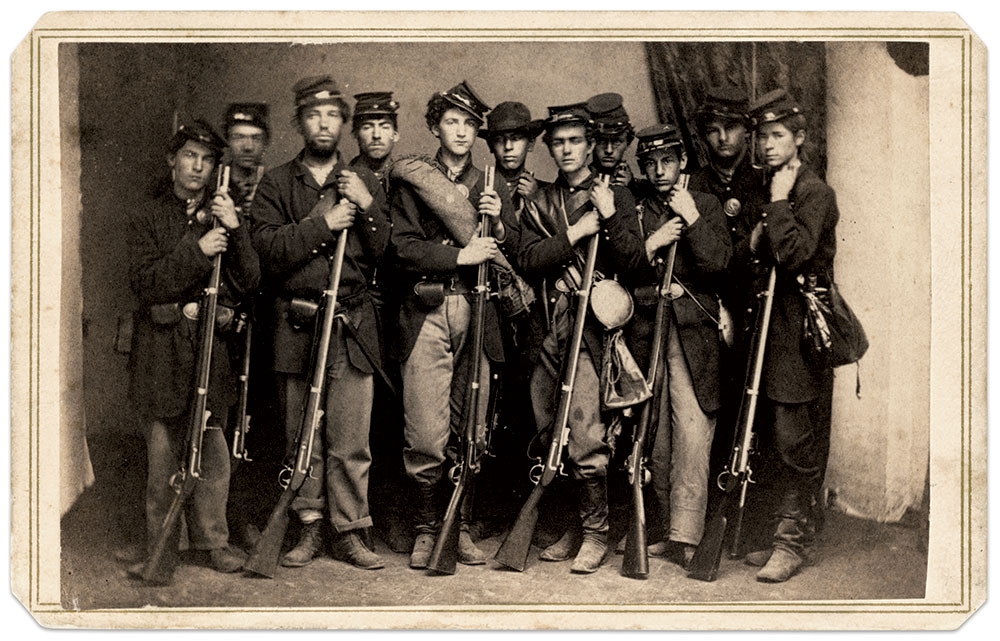
Hoosier Warriors and Union Guardians
An Indiana squad is armed with Model 1842 muskets rifled post-production and furnished with long-range rear sights. Many wear privately purchased flannel sack coats. Two carry blanket rolls, one using a non-regulation wool blanket with multiple stripes near the end and the other a gum blanket or rubberized poncho. Two of the 1857-pattern smooth-sided canteens have lost their wool covers.
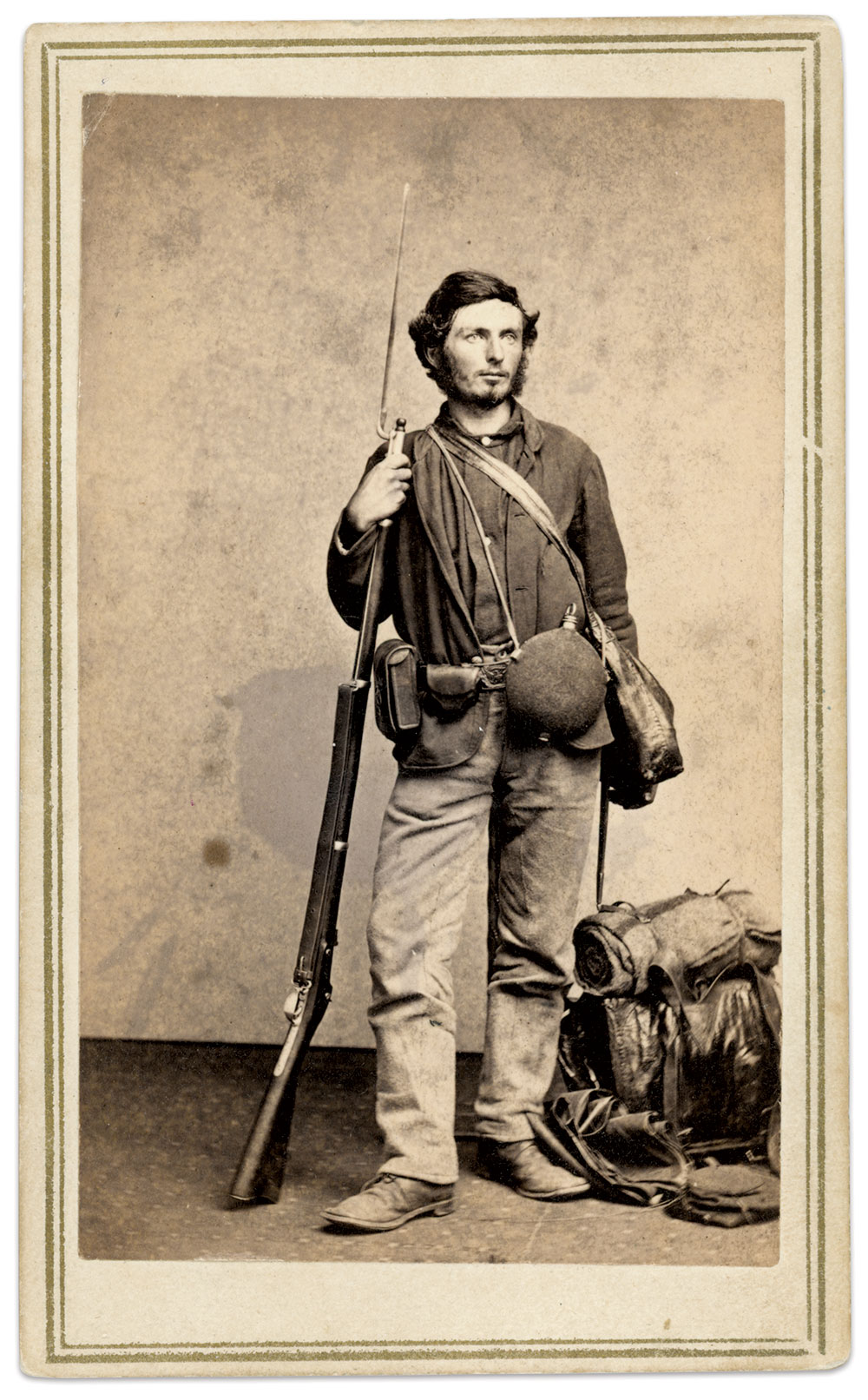
“Sherman’s Armee”
An inscription on the back of the mount identifies this man as a bummer in “Sherman’s Armee.” This is no bandbox soldier; he has seen the elephant. He wears an 1858-pattern sack coat over a placket-front shirt. His sky-blue trousers, meant for mounted troopers, have an extra layer to prevent saddle chafing—also favored by seasoned foot soldiers. He wears standard-issue bootees. Around his waist, a Pattern 1851 eagle plate secures his cap box, .58-caliber cartridge box, and bayonet scabbard. The curvature of the barrel bands points to a Model 1863 Springfield rifled-musket; a wooden tompion protects the bore. Also visible are V-shaped shoulder-strap attachments of the 1855-pattern knapsack topped by a blanket. A gum blanket and forage cap lie beside the knapsack.
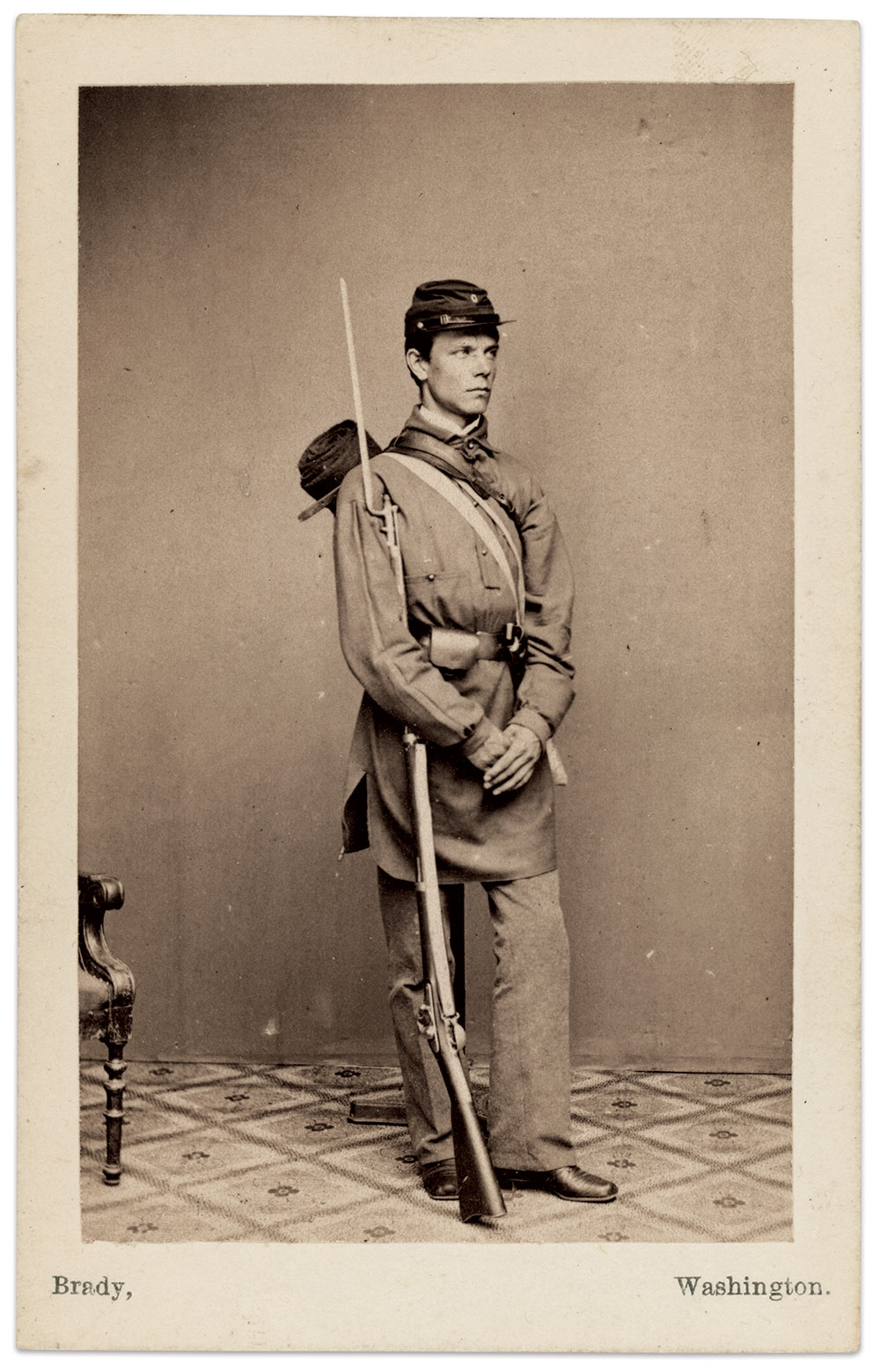
A First Defender from the 1st Rhode Island
William S. Smith, a private in the 1st Rhode Island Detached Militia, posed for his portrait in the D.C. studio in the war’s early days. He is dressed in the practical pullover blouse with generous skirts designed by then Col. Ambrose E. Burnside based on his military experiences in the West. Also of note is Smith’s state issued cap with the metal company letter C, red poncho-style blanket slung over his back, and a revolver. The Rhode Islanders spent their three-month enlistment in Washington and fought in the First Battle of Bull Run. Smith survived and reenlisted for another three-month term in 1862 as a first lieutenant in the 10th Rhode Island Infantry. He left the regiment as a captain and disappeared from state and federal records.
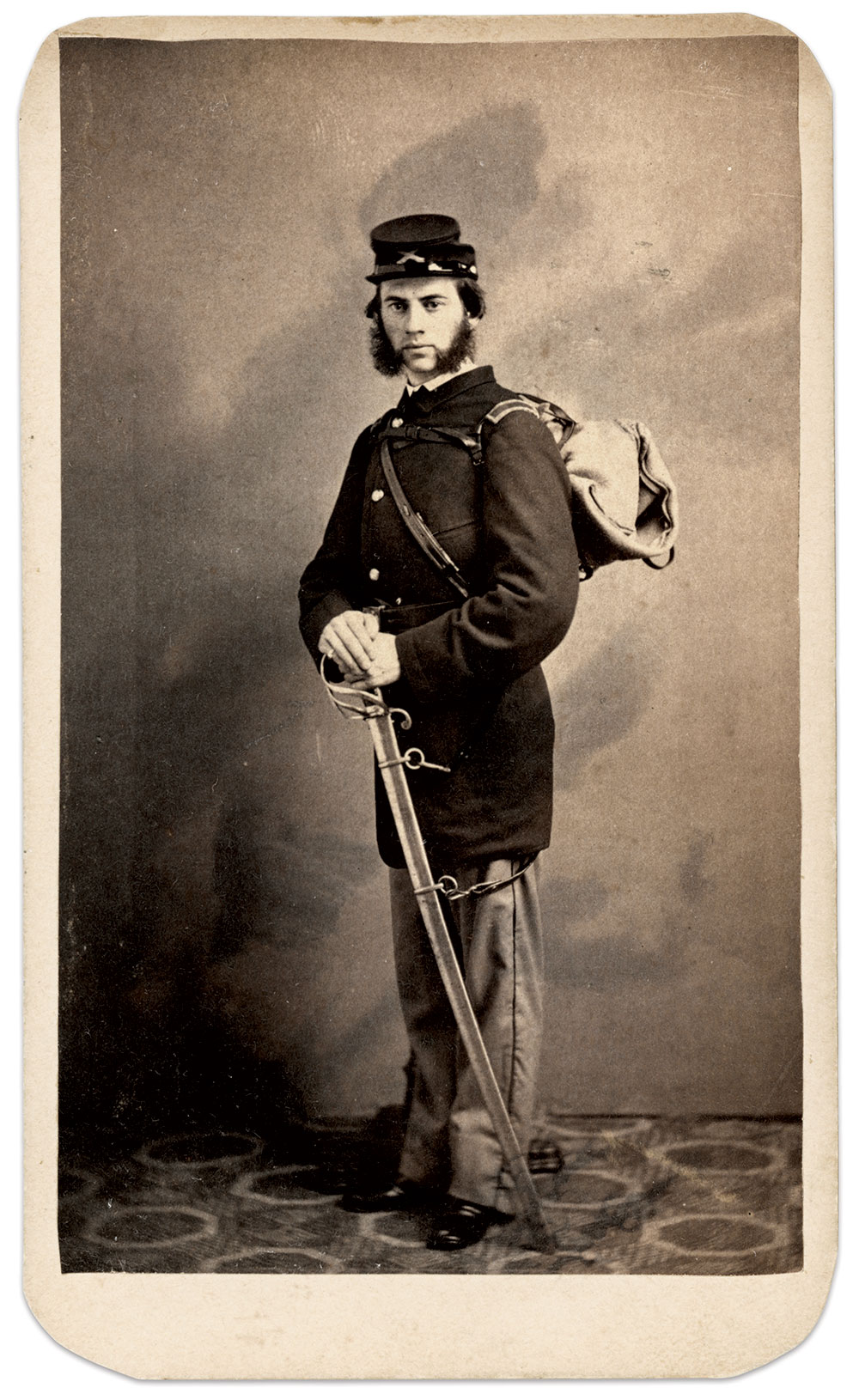
Artillery Officer Carries His Own Baggage
Civil War officers were authorized to use wooden trunks on regimental wagons, but experienced officers still carried essentials. To help them, Schuyler, Hartley & Graham and other outfitters offered a shoulder accouterment—a set of belts to carry a blanket and overcoat. This artillery second lieutenant is equipped for marching with his bedding on his back, his sword belt at his waist, and a Model 1833 Dragoon saber at his side. Officers furnished their own uniforms and equipage; this man chose a high-crowned forage cap with a flat visor and crossed-cannon insignia, a long flannel sack coat more comfortable than a tight-chested frock coat, and sky-blue trousers with narrow red piping along the outer seam.
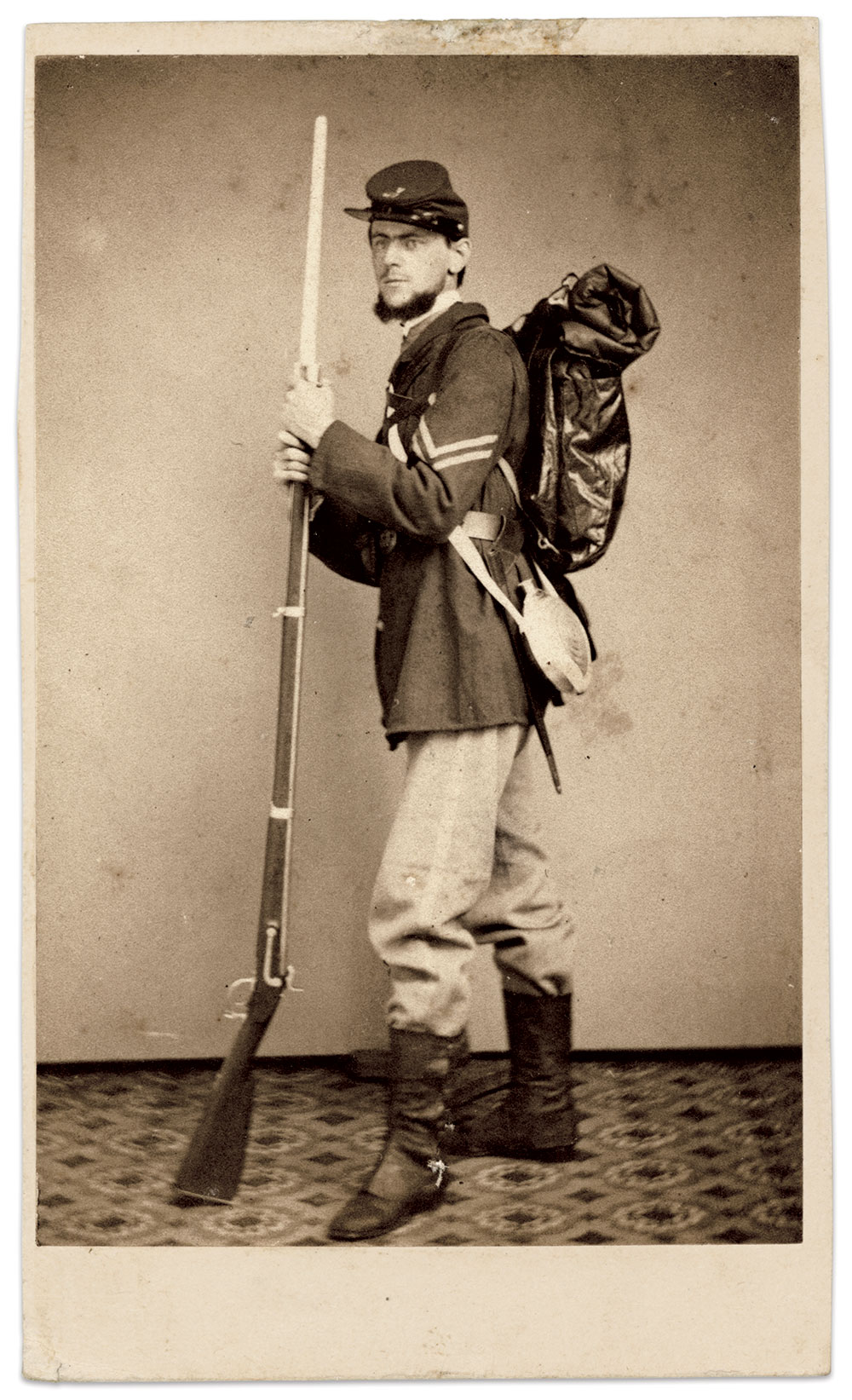
A Corporal Prepared for Picket Duty
A corporal, photographed in Philadelphia, stands in a relaxed yet vigilant pose, as if on picket. He wears a commercial forage cap, standard-issue sack coat, and trousers. The trouser cuffs are protected by leather leggings issued to some regiments in 1861-62. He holds a Model 1842 .69-caliber musket, common in the war’s early years. His canteen bears impressed concentric circles, likely from a Philadelphia contractor. The knapsack does not appear regulation and may be a Short’s patent; it is topped by a blanket wrapped in a gum blanket.
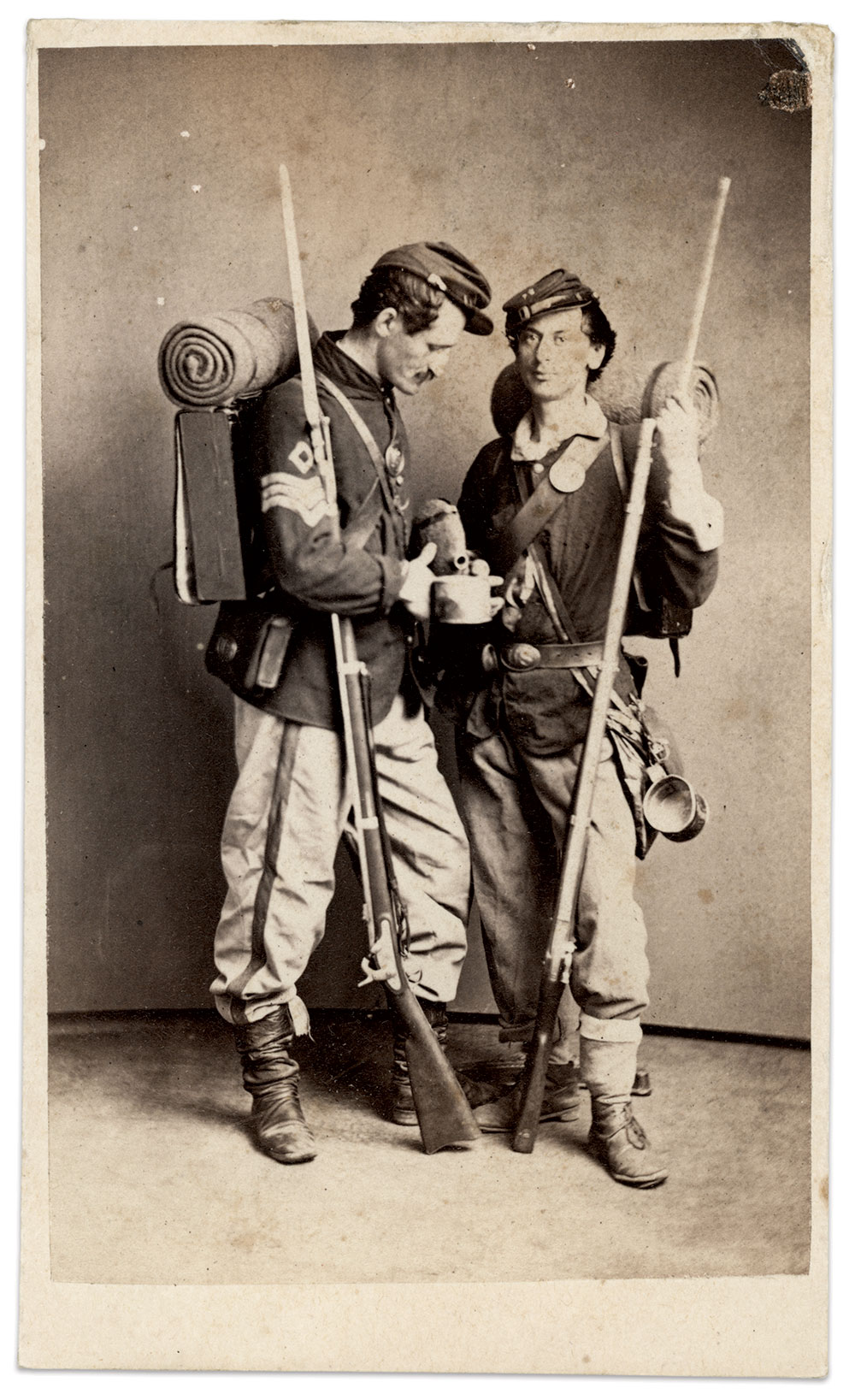
Halt on the March
A first sergeant and private posed in a Buffalo, N.Y., studio, yet they could be campaigning in Virginia. Both wear 1858-pattern forage caps, dark indigo sack coats, and sky-blue trousers. The sergeant tucks his trousers into his boots; the private, in issue brogans, pulls his socks over his trousers—both to deter insects and nettles in the field. They carry Model 1861 Springfield rifled-muskets, .58-caliber single-shot percussion-cap arms, with 18-inch Model 1855 bayonets. They tote 40 rounds in a leather cartridge box slung left shoulder to right hip, fitted with a Pattern 1839 U.S. oval plate and a Pattern 1826 eagle plate. The private’s painted-canvas haversack, Pattern 1857 canteen, and tin dipper are visible; the sergeant uses his, as if pausing on the march. He also carries a painted-canvas knapsack with a wooden frame and a blanket strapped on top.
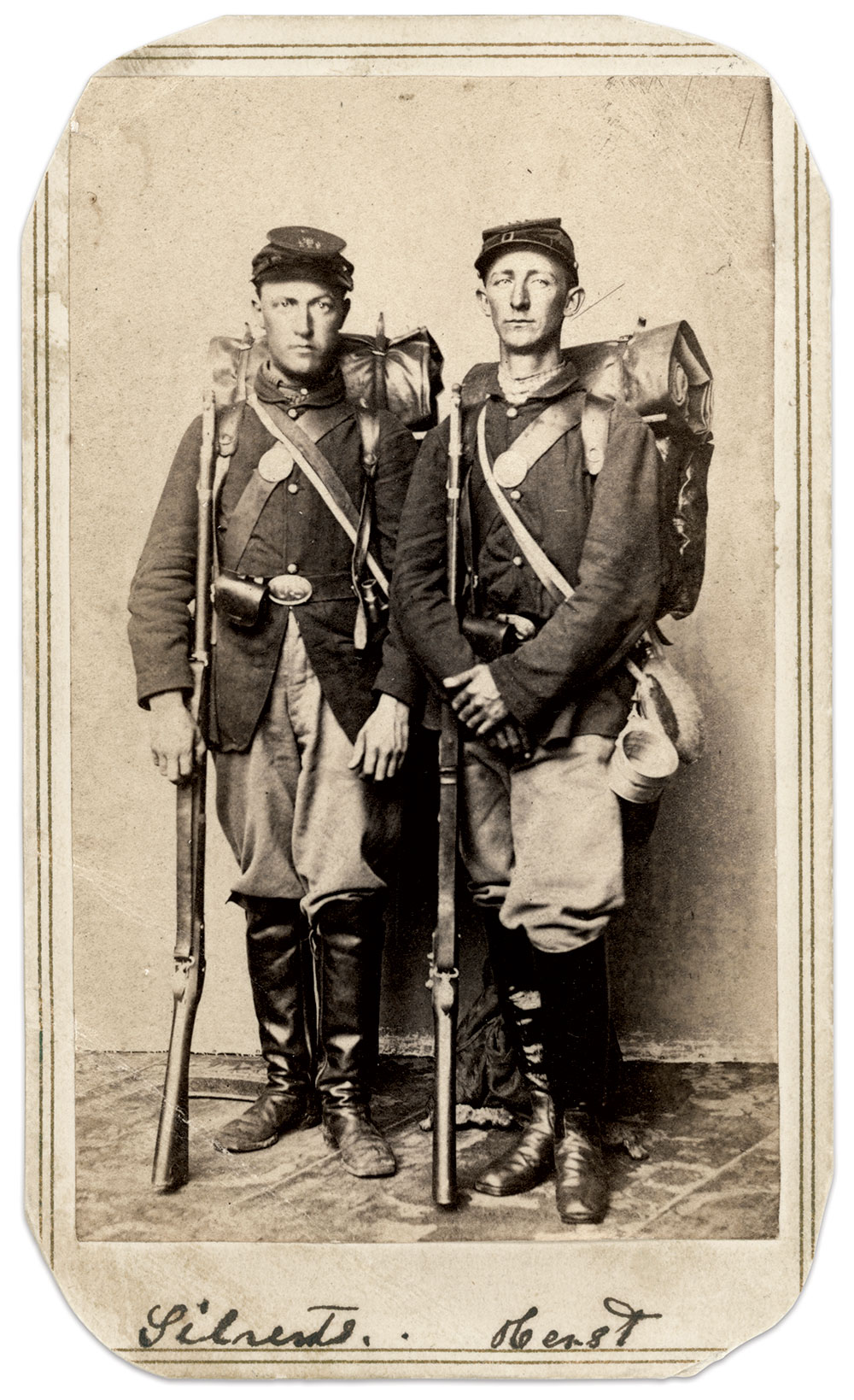
Capital Protectors
The two privates in Washington, D.C., share the same uniforms, arms and accouterments as their “Halt on the March” comrades-in-arms, but with a few differences. Rather than stiff box knapsacks, they carry the Pattern 1855, regulation U.S. Army-issue, double-bag knapsacks with soft sides of painted canvas. Their blankets are rolled with gum blankets or ponchos. Both wear tall, privately purchased boots. The names inscribed along the bottom of the mount hint at their identities.
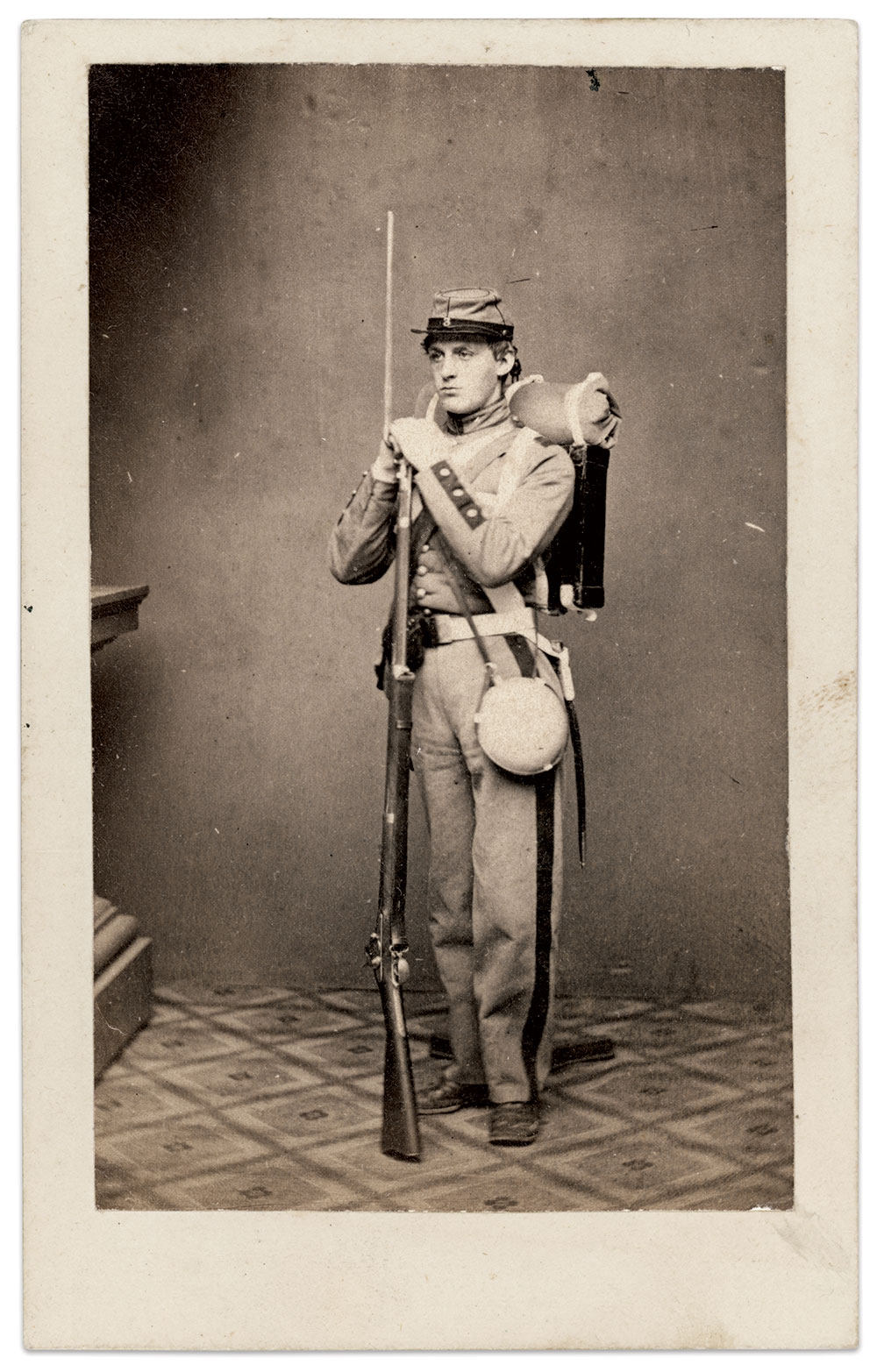
Vintage 1861
This Empire State soldier’s cap marks him as a member of the 3rd Company, 7th New York State Militia. He carries a Model 1855 rifled-musket with Maynard tape primer and wears a white baldric for the bayonet with a cartridge-box strap. Gear includes a gray-painted two-pint canteen and a knapsack with blanket lashed on top.
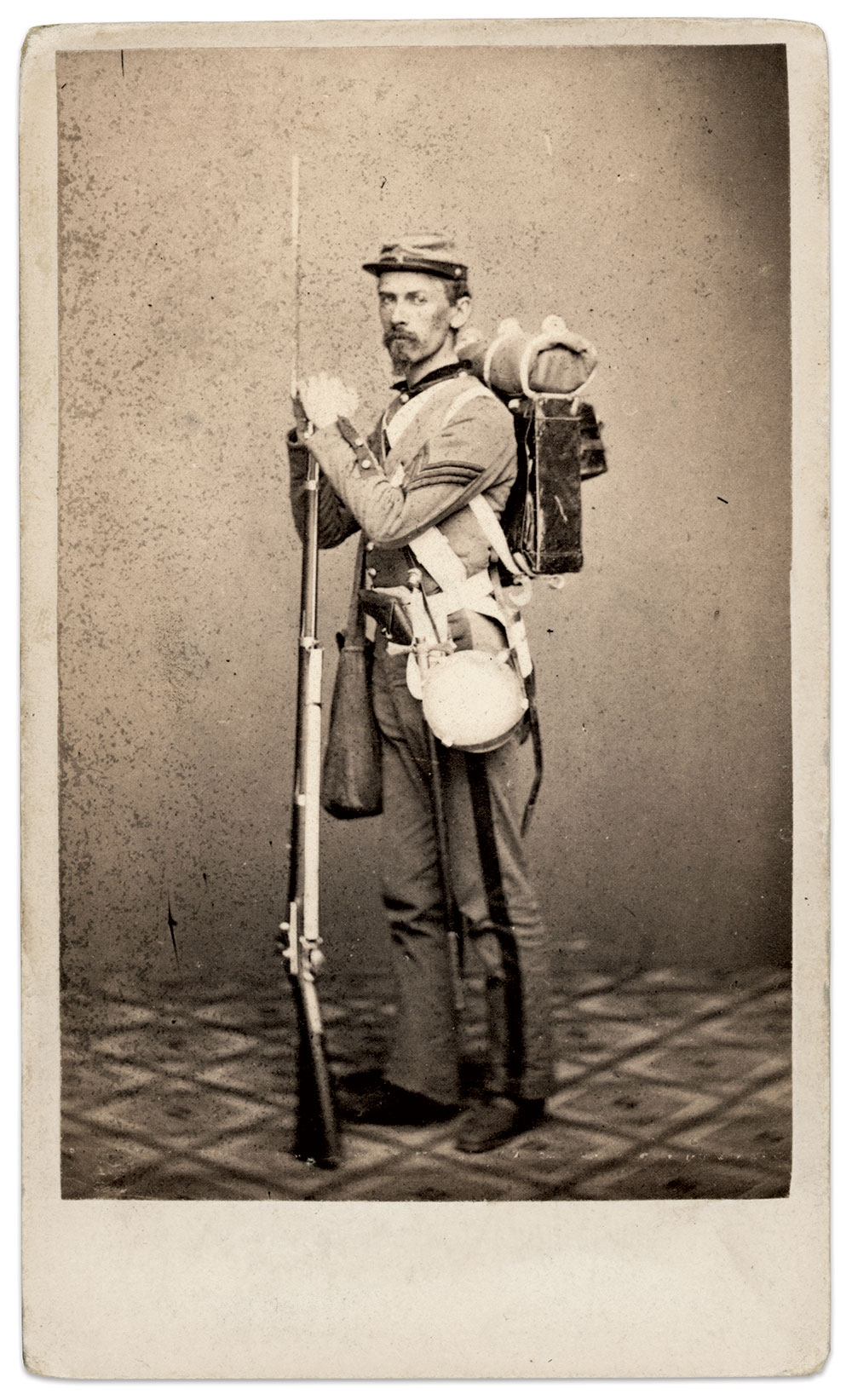
7th NCO
Sergeant Joseph Doré (1832–1902) of the 7th New York State Militia served in the 1861–63 call-ups. He carries a knight’s-head NCO sword, a pistol, and a japanned mess kit on a New York-style knapsack closed with a rear flap against his back—unusual, but it gave the public-facing side a smooth look.
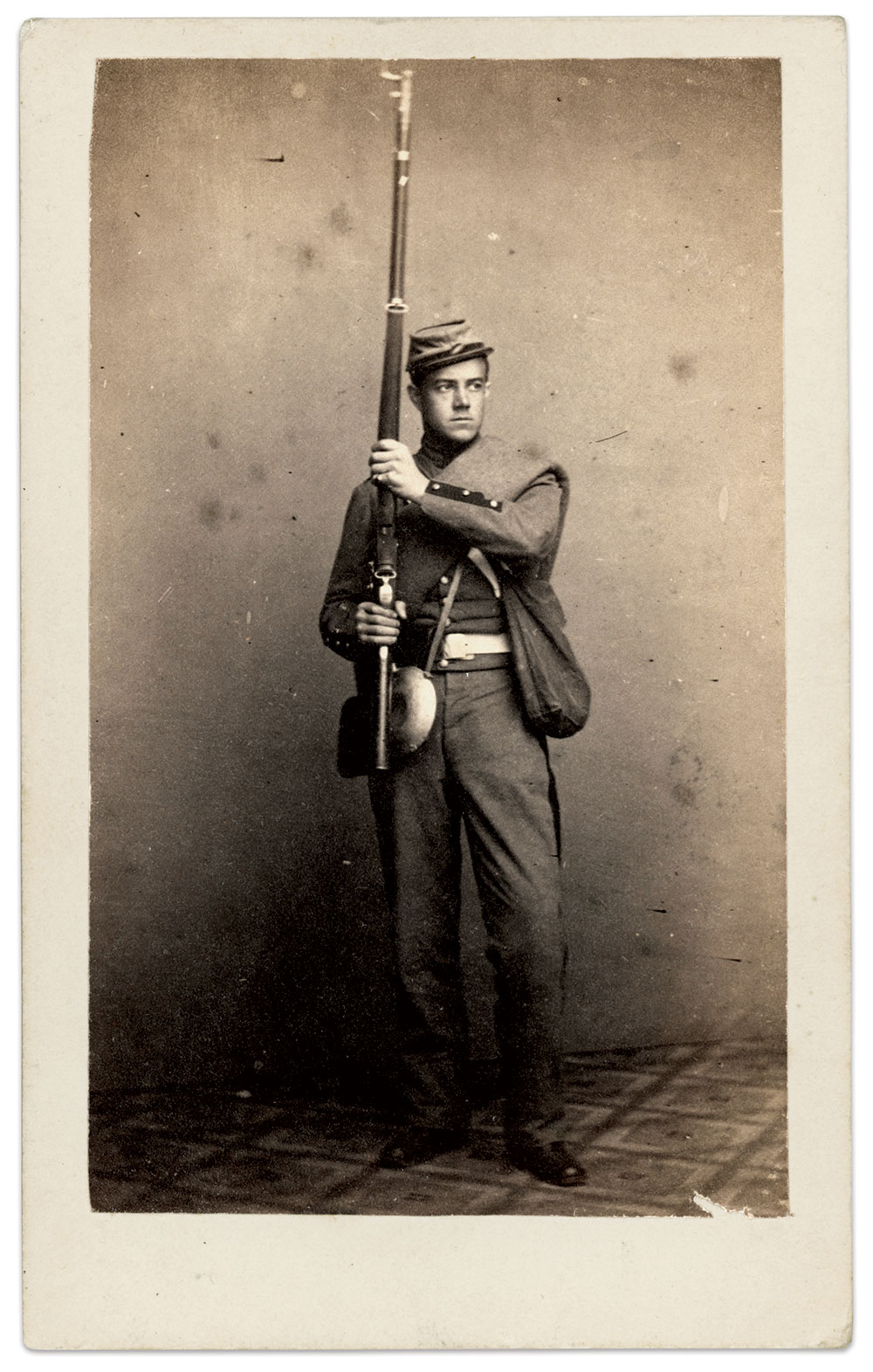
Excelsior!
The 7th New York State Militia was a silk-stocking regiment based in Manhattan. While most of the Union army wore blue, the regiment retained its prewar gray kepis and uniforms with black trim. Called up in April 1861, it rushed to the capital to defend it against secessionists and returned in summer 1863 to protect New York City during the draft riots. This private poses vigilantly with his Springfield rifled-musket. Because knapsacks could be uncomfortable, some soldiers rolled belongings in a blanket and wore a “horse collar” over the shoulder. This soldier’s blanket lacks extra gear, but his canvas haversack appears full.
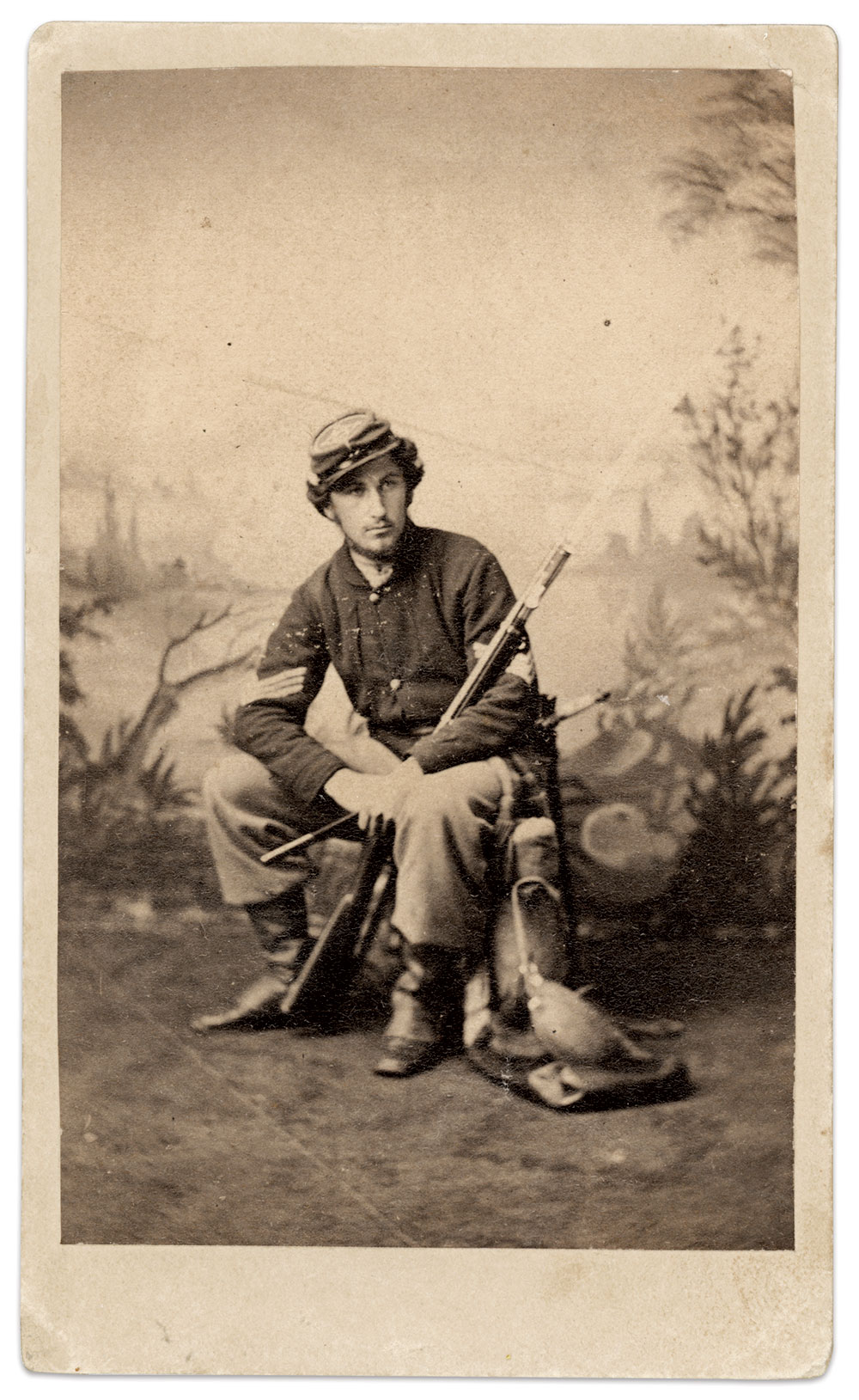
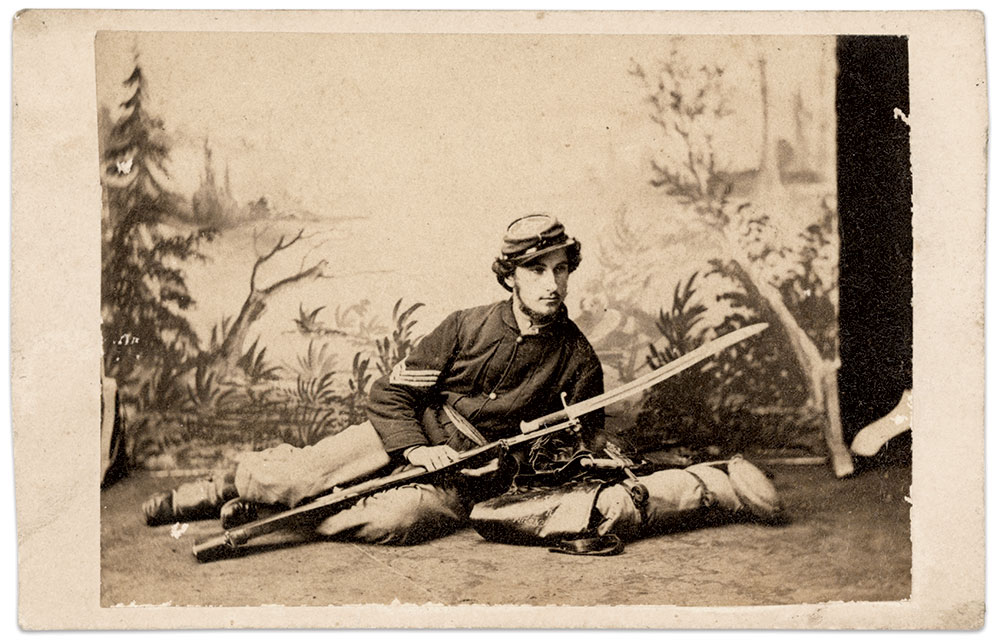
Activated for the Confederate Invasion of 1863
Sergeant William S. Sturgis Jr. (1842–1936) of the 22nd New York State Militia posed for these portraits between his three-month 1862 activation at Harpers Ferry and a monthlong 1863 call-up during the Gettysburg Campaign. He wears a sky-blue kepi with chasseur trim, sky-blue baggy chasseur trousers, leather leggings, a standard 1858-pattern sack coat and a waist sash. He carries a Pattern 1856 Enfield short rifle with saber bayonet and an ivory-handled light sword—an indication of his noncommissioned officer rank. Sturgis’ black canvas knapsack, with bedding strapped on top, bears his name and unit in white paint. An oblate-spheroid canteen and haversack are also visible.
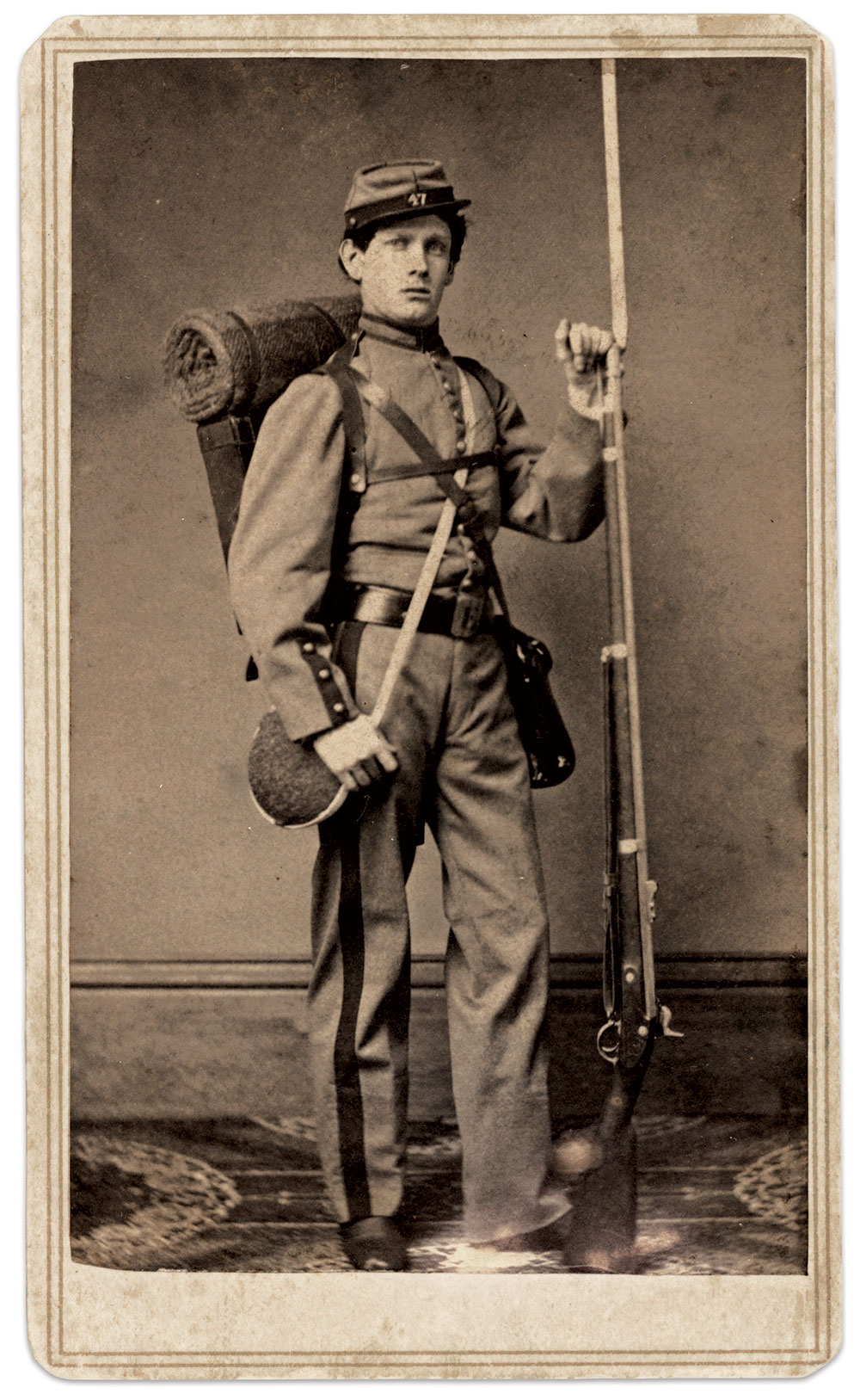
Private Lincoln, 47th NYSM
Henry Freeman Lincoln (1843–1922) of Company B, 47th New York State Militia, wears a uniform identical to that of its counterpart, the 7th—gray kepi, jacket and trousers with black trim. He rests a hand on a Model 1855 Springfield rifled-musket with long-range rear sight, Maynard tape primer, and a matching bayonet with an 18-inch blade. His backpack is the New York-style box pack with black-enameled canvas over a wooden frame; it has two cross-chest straps that buckle together rather than hook to the waist belt. A federal-issue striped blanket is strapped on. Private Lincoln’s belt plate suits Company B, but the belt lacks the customary cap box. The cartridge box and bayonet scabbard could ride on the belt or on shoulder slings, but neither is present. On his shoulders hang an 1857-pattern oblate-spheroid canteen with jean-cloth cover and cotton sling where the cartridge box would be, and a leather sling holds a haversack of rubber-treated or painted canvas. Lincoln later served in the 95th New York Infantry and the U.S. Navy.
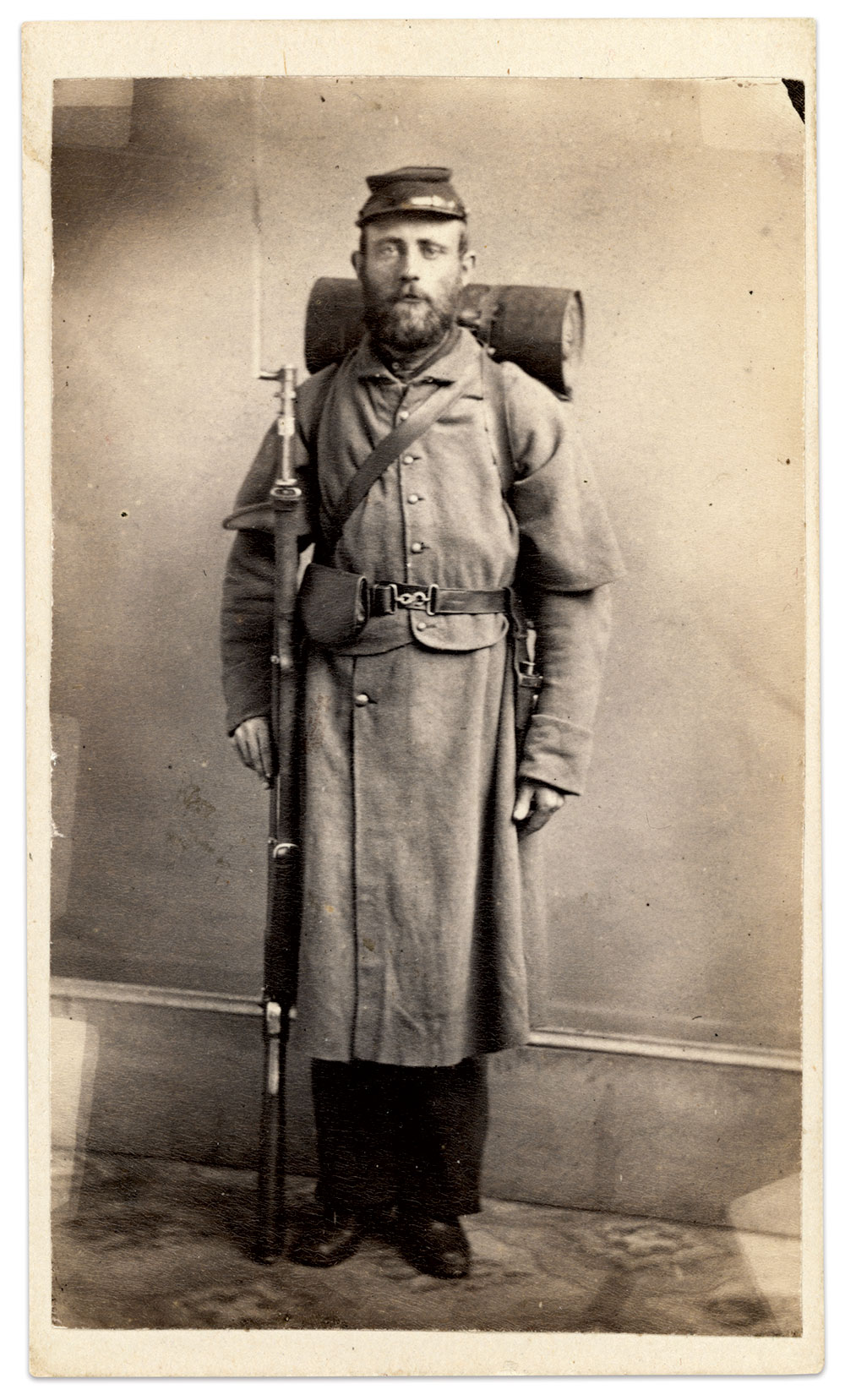
Overcoat on the March
This federal soldier is ready for cold-weather campaigning. The most interesting aspect of the pose is that he wears his cartridge box, waist belt and knapsack over his five-button overcoat cape for foot troops, rather than beneath it. He has wrapped his painted-canvas ground cloth around his wool blanket and strapped both to his knapsack, which may be a product of the English firm Isaac & Campbell, judging by the narrow shoulder straps and the absence of chest straps. His Pattern 1853 Enfield rifled-musket, waist belt with snake-buckle, and other accouterments are all British. His dark-blue trousers postdate the December 1861 change to sky-blue, but existing stock continued to be worn throughout the war.
Ready to Serve
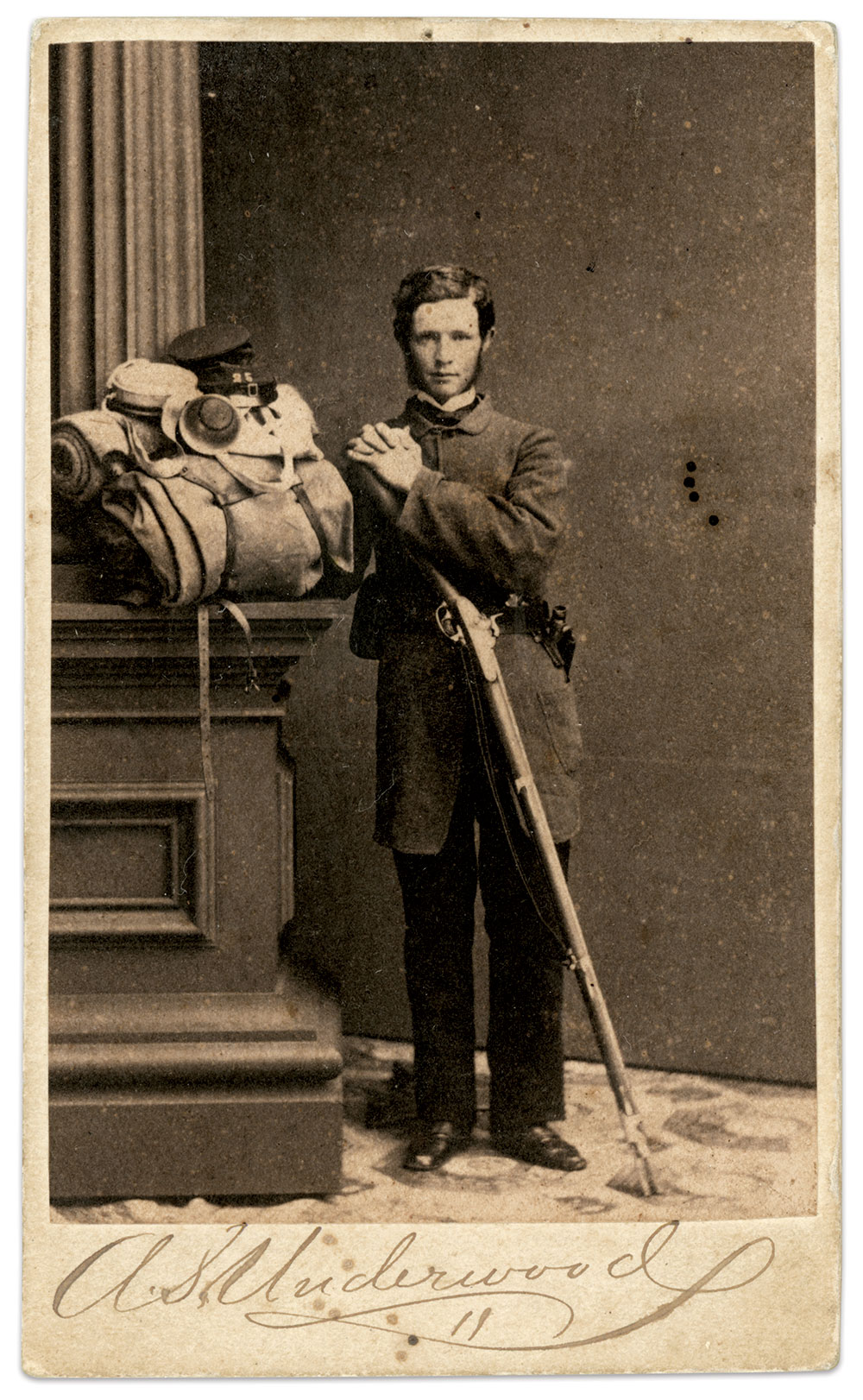
Photographed in 1861, Allen Stevens Underwood (1837–1873) of the 25th New York State Militia served three months in the Defenses of Washington. He wears a privately purchased sack coat—longer, with external patch pockets not on the issue coat—dark-blue trousers, and a McDowell-style forage cap with tall crown, crescent brim, and brass “25.” Resting on the column are his non-regulation, soft-sided knapsack and a white canvas haversack. Strapped to the knapsack are a blanket on top and an overcoat in front. Also visible are a militia-style tin-drum canteen and a Mix-patent tin cup with curved sides, its blackened bottom suggesting boiled coffee. He is armed with a Model 1842 Springfield musket, matching bayonet, and a percussion pistol tucked into his belt, which holds a cap box and a .69-caliber cartridge box. Underwood later served three years in the 153rd New York Infantry, rose to first lieutenant, and mustered out in 1865 at Savannah.
A Minute Man of 1861
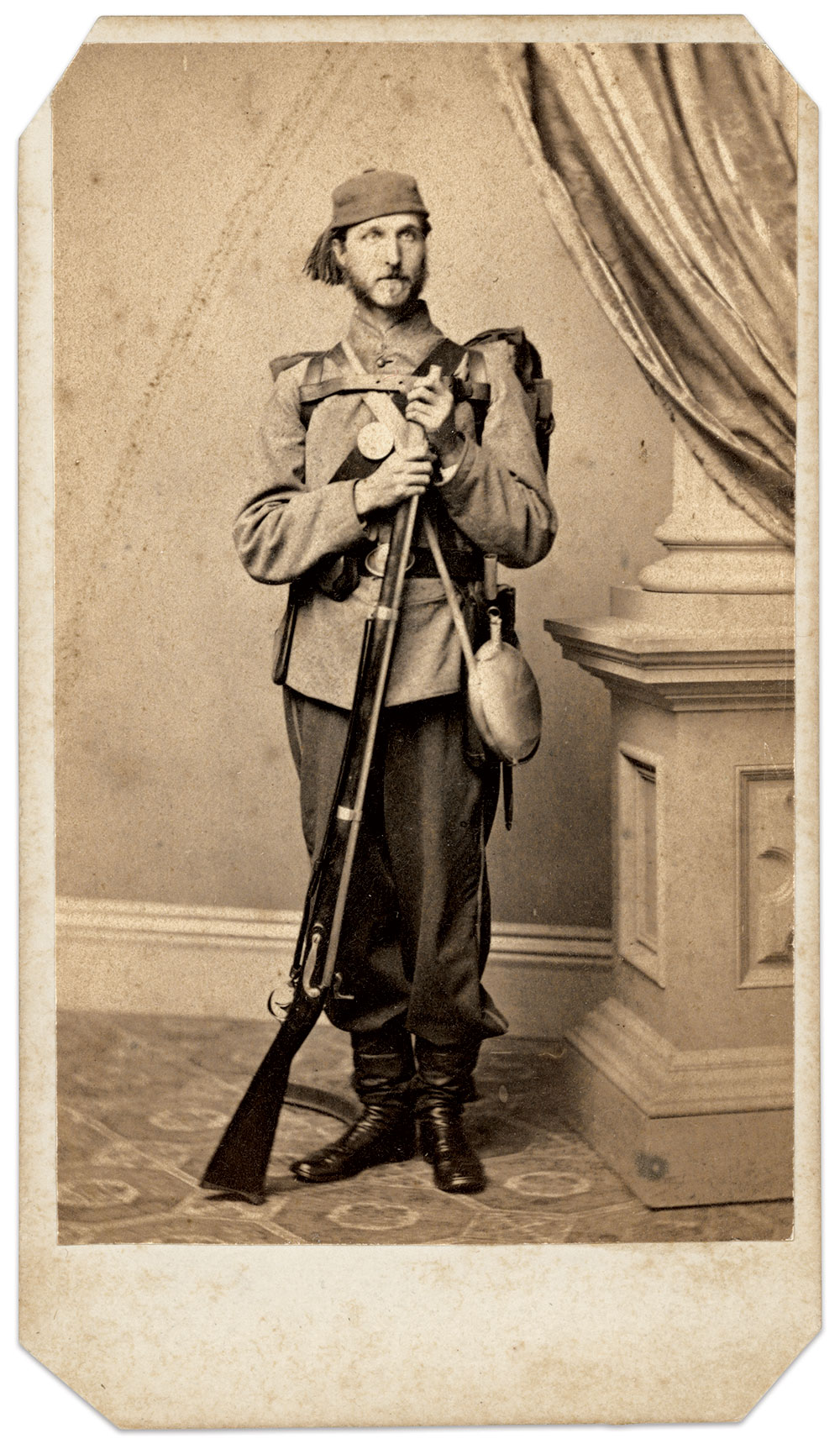
Boston clerk Charles Perkins Trumbull (1830–1896) answered President Lincoln’s first call to arms in April 1861. He joined the 6th Massachusetts Infantry and, on April 19, marched through Baltimore, Md., where a mob of Southern insurrectionists attacked; four were killed and 36 wounded. Trumbull was uninjured. He later reenlisted in the 34th Massachusetts Infantry and was promoted to quartermaster sergeant. Trumbull wears the uniform issued to the 6th in 1861, which included a fatigue fez caps with tassels. He holds a Model 1816 Springfield musket converted to percussion, and carries a 3-pint canteen, a haversack, and a cartridge-box sling with a Pattern 1826 eagle plate. His U.S. oval belt plate and belt carry a cap box and bayonet scabbard for a Model 1816 bayonet. He also carries a knapsack and blanket; narrow shoulder straps and buckled cross-chest straps suggest a prewar Massachusetts knapsack rather than federal issue.
The Avenger
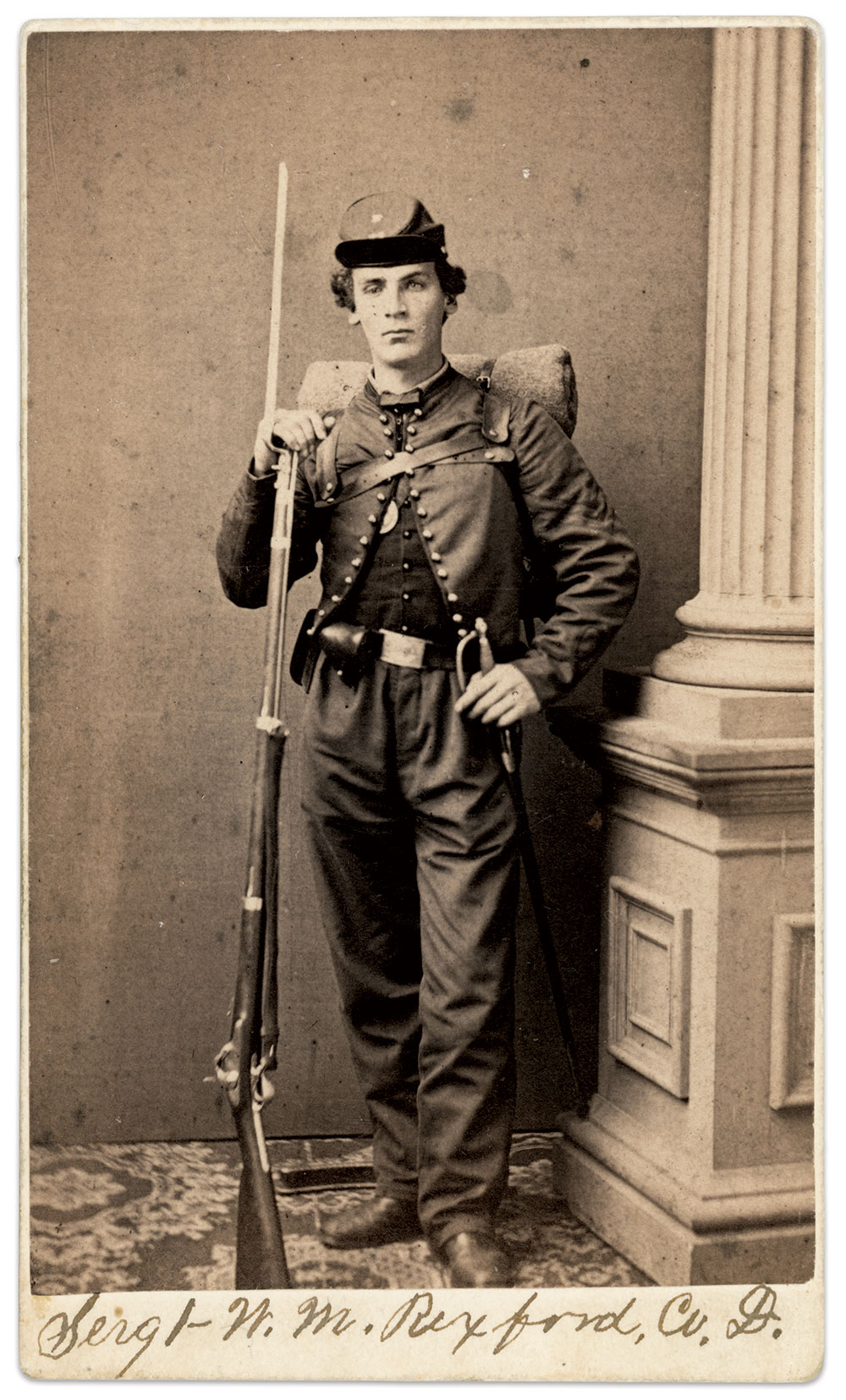
William Mangum “Willie” Rexford (1841-1902) was a confident 20-year-old when he enlisted in August 1861. The regiment he joined, as a sergeant, was the “People’s Ellsworth Avengers,” a unit raised to avenge the murder of Zouave leader Elmer E. Ellsworth by a secessionist in Alexandria, Va. The unit served under the formal title 44th New York Infantry but displayed its heritage with Zouave coats trimmed in red and dark-blue trousers. Rexford enhanced his appearance by wearing his cartridge-box sling under his jacket and by flipping up his issue forage cap visor at a jaunty angle. He carried his cap box and Model 1840 noncommissioned officer’s sword on a waist belt closed by a Pattern 1851 eagle plate. His shoulder arm was a Model 1855 rifled-musket with bayonet. Rexford’s readiness for action is suggested by his pose with knapsack and rolled blanket. He later served as an officer in two New York regiments: captain and major in the 146th, and lieutenant colonel in the 131st.
Chasseur on the Move
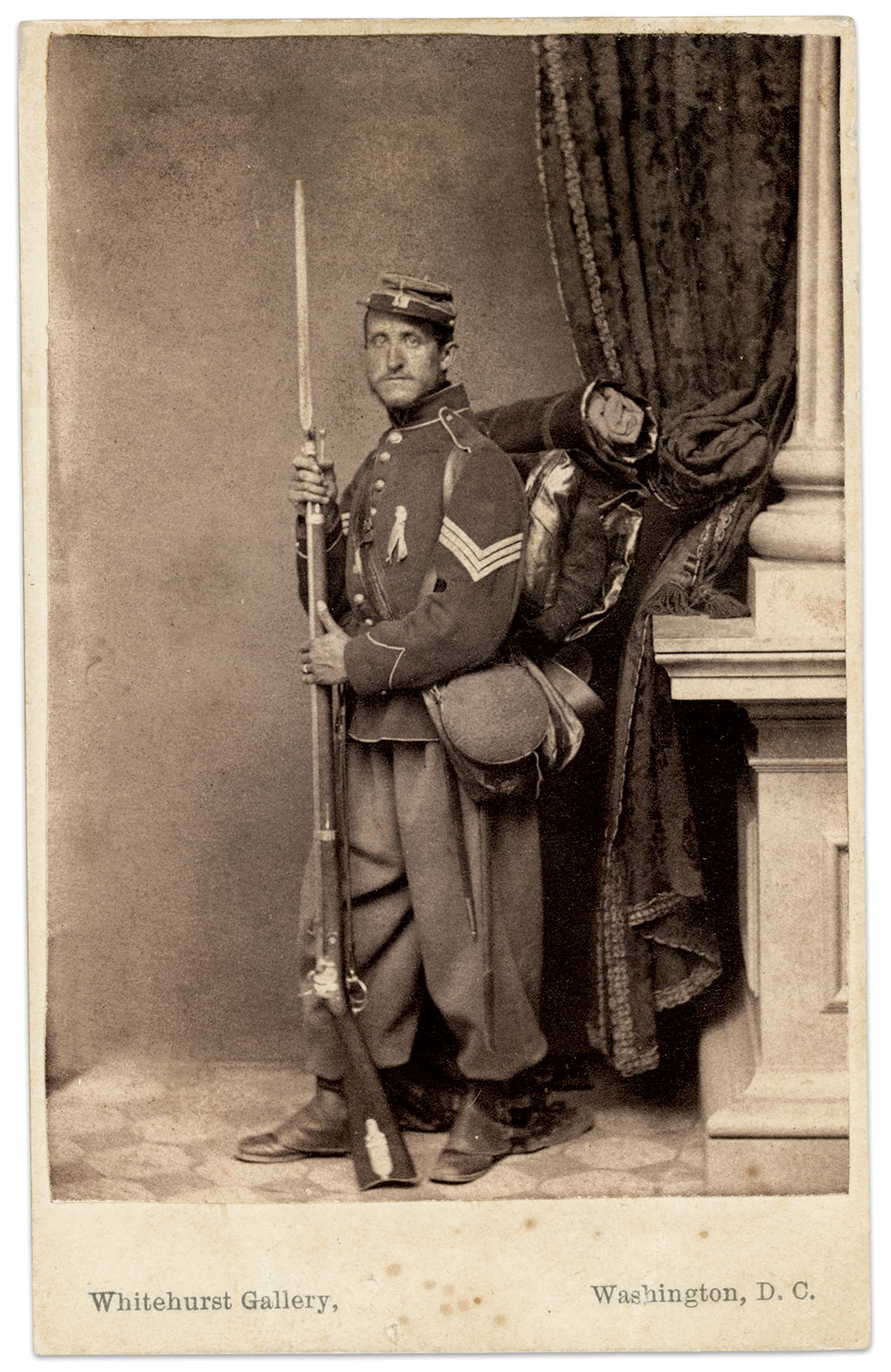
This distinctly uniformed sergeant with the number 12 on his cap marks him as a member of the 12th New York State Militia. He wears a blue chasseur jacket with shoulder tabs, sky-blue baggy trousers and a light-blue cap with a dark-blue band and light cord. He carries a Model 1855 rifled-musket and is fully equipped for the march with a painted-canvas haversack, a smooth-sided canteen with a cloth cover, and a mess kit—pan and cup—strapped to the knapsack’s bottom. The knapsack is a Pattern 1855 double-bag model, which appears to have an overcoat sandwiched between the front and back bags. A gum blanket and a wool blanket are strapped on top, presenting a remarkably complete kit. The Brady imprint on the mount suggests a three-month call-up in April 1861, but the name on the back—F.L. Vielté Jr.—does not appear on the roster.
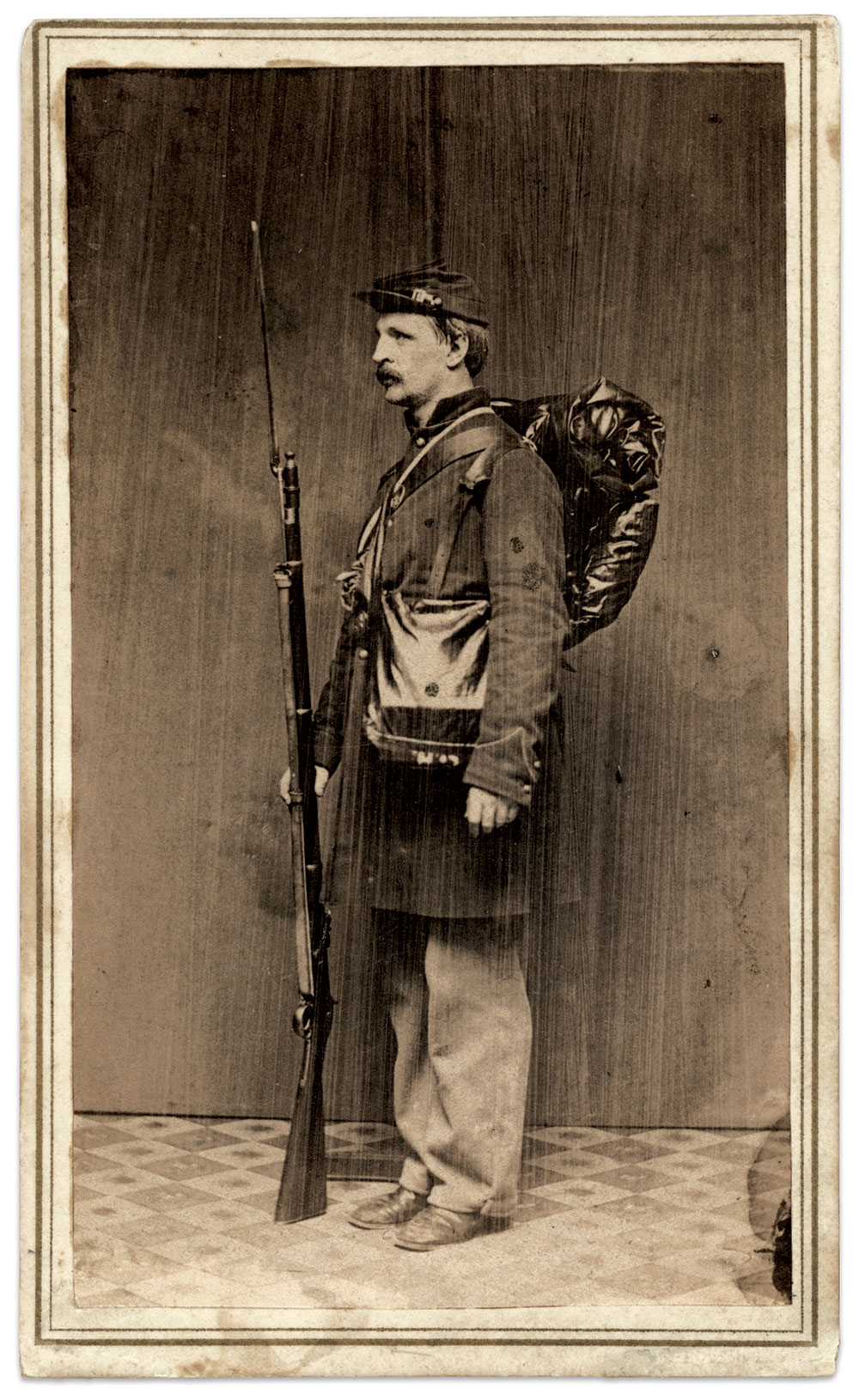
Yonkers Finery
Prosperous-city soldiers bought their own gear. Posed in Yonkers, N.Y., this private wears a haversack with oilcloth flap. His knapsack appears rubber-coated, matching his gum blanket. He carries a Pattern 1853 Enfield rifled-musket with bayonet and tompion—a plug protecting the muzzle. A cartridge-box strap with Pattern 1826 eagle plate also seems federal issue, as do his cap, coat and trousers.
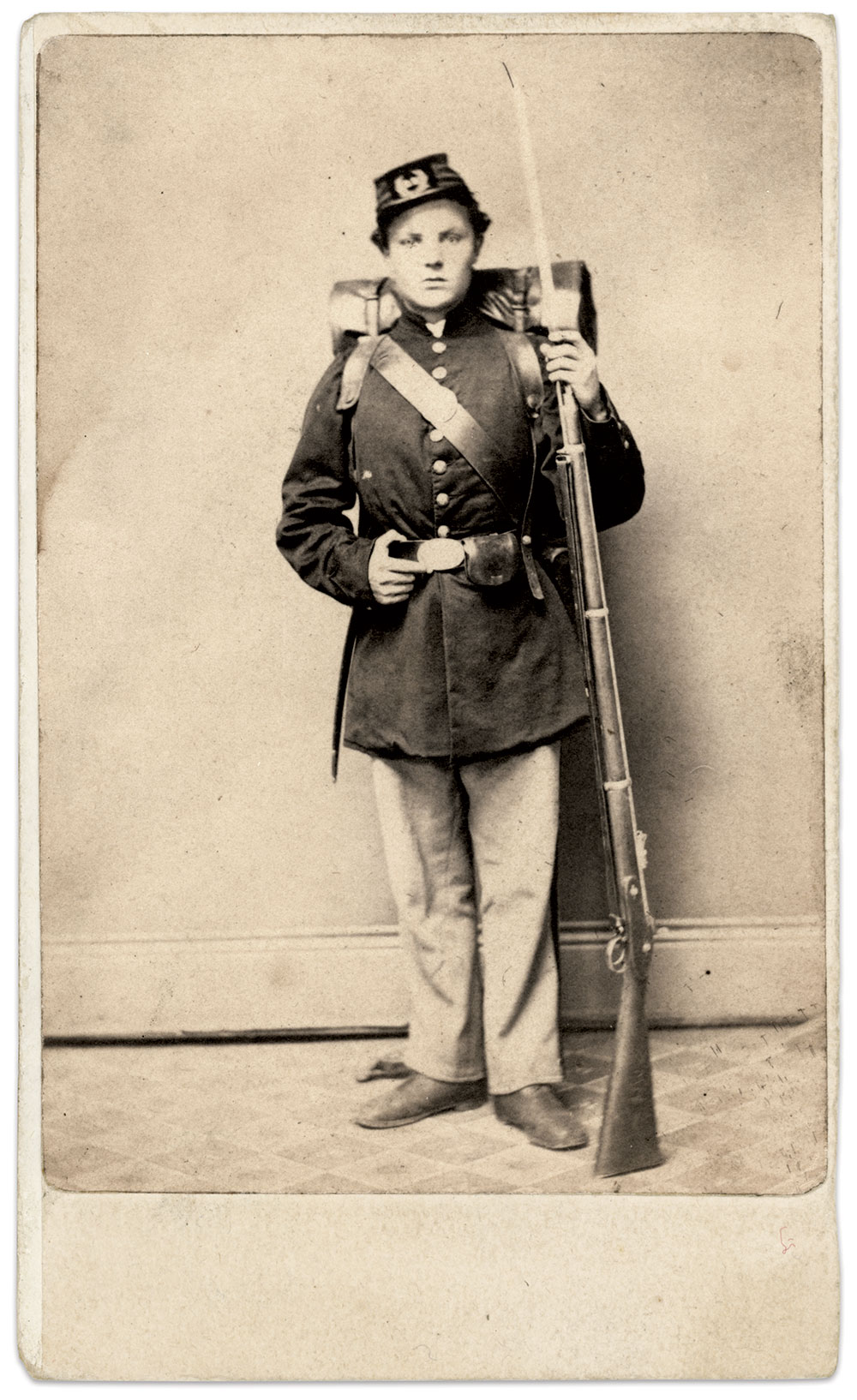
A Swedish Immigrant and a 100-Days Soldier
Swedish immigrant and Chicago resident Claës Henning Forsgard (1843–unknown) enlisted for 100-day service in May 1864, mustering into Company I, 132nd Illinois Infantry. The regiment garrisoned Paducah, Ky., until it mustered out in October. During that time, Forsgard received corporal’s chevrons and posed with his knapsack and gum blanket—without a haversack or canteen. He is armed with a Model 1853 Enfield rifle and bayonet. His coat and trousers were federal issue, topped with a privately purchased kepi with chasseur trim and a staff officer’s U.S. wreath on the front. Though privates were not authorized to wear such headgear, officers often overlooked the rule. Forsgard presented this image to his teenage brother, Oscar, according to an inscription on the back of the mount.
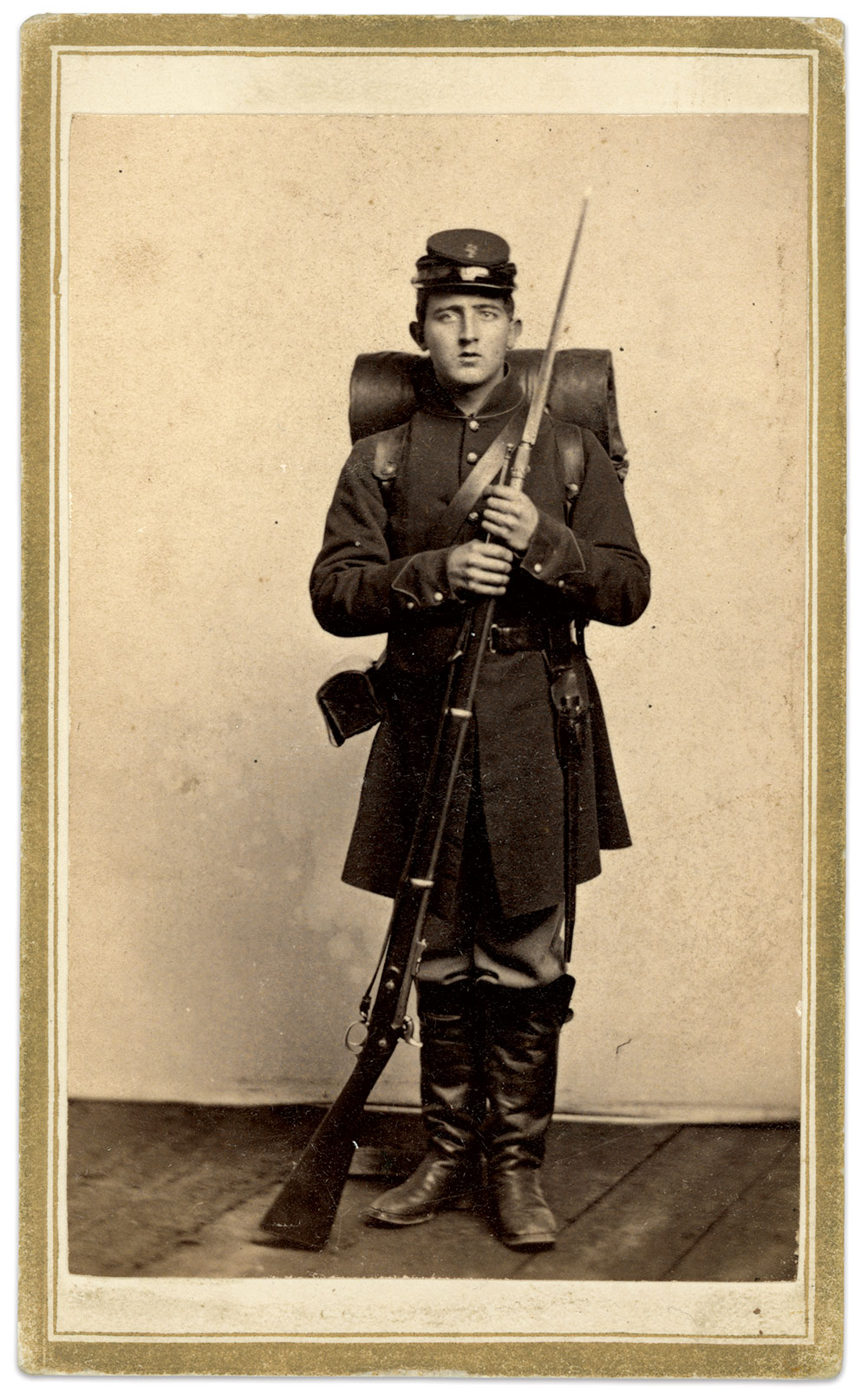
Stalwart Defender of the Union
George Washington Wiggin (1840-1905) served in the 4th and 6th New Hampshire Infantries from 1861 to 65. He wears a commercially made forage cap with a bound brim (minus the NHV hat brass often visible on the hats of Granite State volunteers), a federal-issue coat and trousers, and British arms and accouterments. His long arm is a Model 1853 Enfield with an angular bayonet. A New Pattern 1859/60 pouch on a shoulder sling rides at his right hip; a curved pouch on his snake-buckle belt has a longer flap than the British Pattern 1856/57 percussion-cap box. At Wiggin’s left hip is a bayonet frog with a removable scabbard for the Model 1851 bayonet. He carries a blanket wrapped in a gum blanket and a knapsack—too little is visible to tell whether it is British or American.
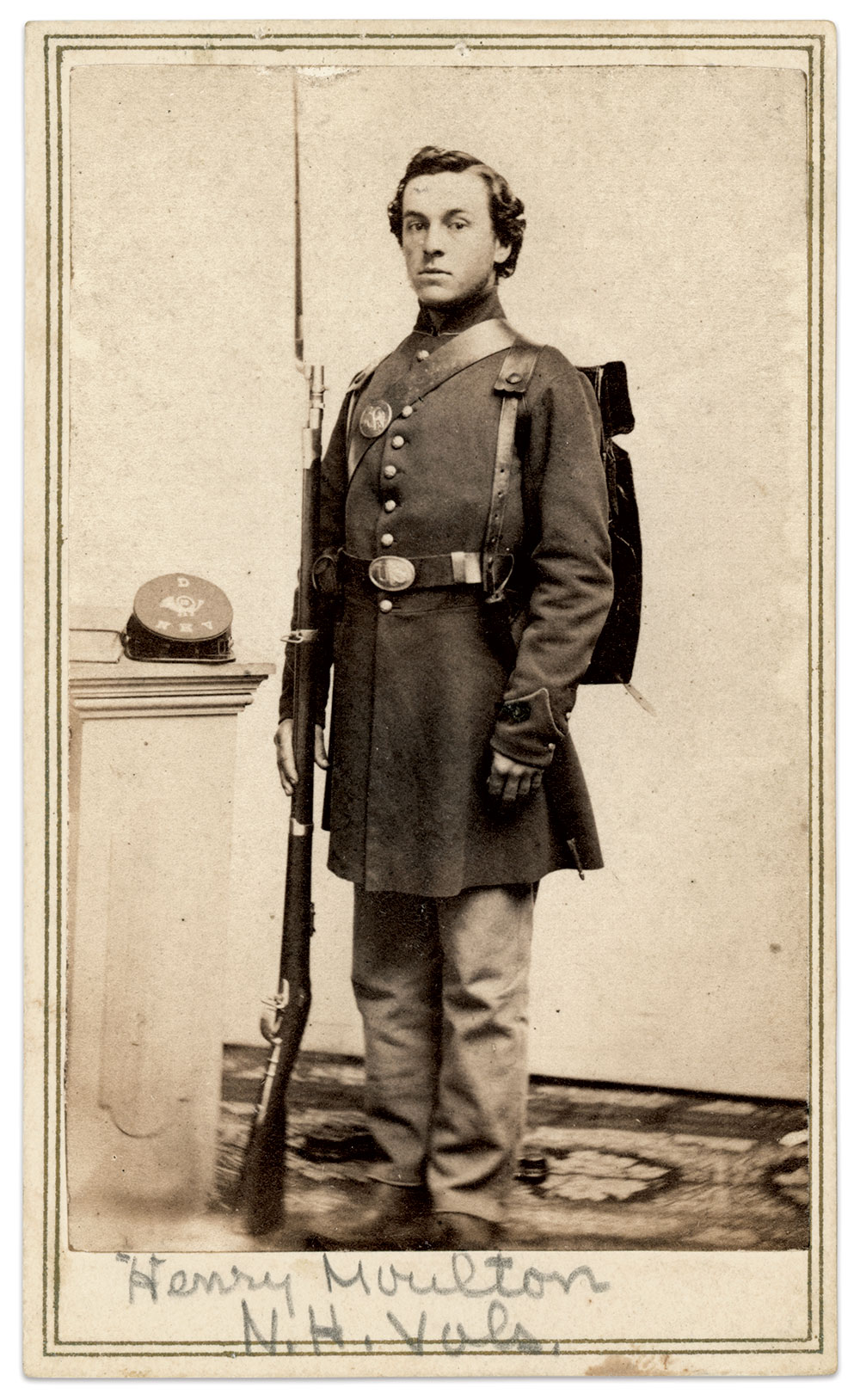
Granite State Volunteer Who Perished in 1863
Henry Moulton enlisted in Company D, 16th New Hampshire Infantry, in October 1862. Like other Granite State volunteers, he wore a commercially made forage cap with a false-embroidered French horn, company letter, regimental numeral and “NHV” on the crown. His coat, trousers and accouterments were standard federal issue. He carries a Pattern 1855 double-bag knapsack, its brass J-hooks on the front straps looped under the waist belt, forcing the belt high on the waist. The awkward setup reflects that the J-hooks were meant to fasten to brass slides on the Pattern 1855 Rifleman’s belt to balance the load. But the Rifleman’s belt carried a frog for the large, heavy Model 1855 saber bayonet, whereas Moulton’s European musket used a smaller, lighter angular bayonet. As a result, he was issued a waist belt that did not mate properly with his knapsack. These and other strains of military life took their toll; Moulton died of disease in May 1863 at Butte La Rose, La.
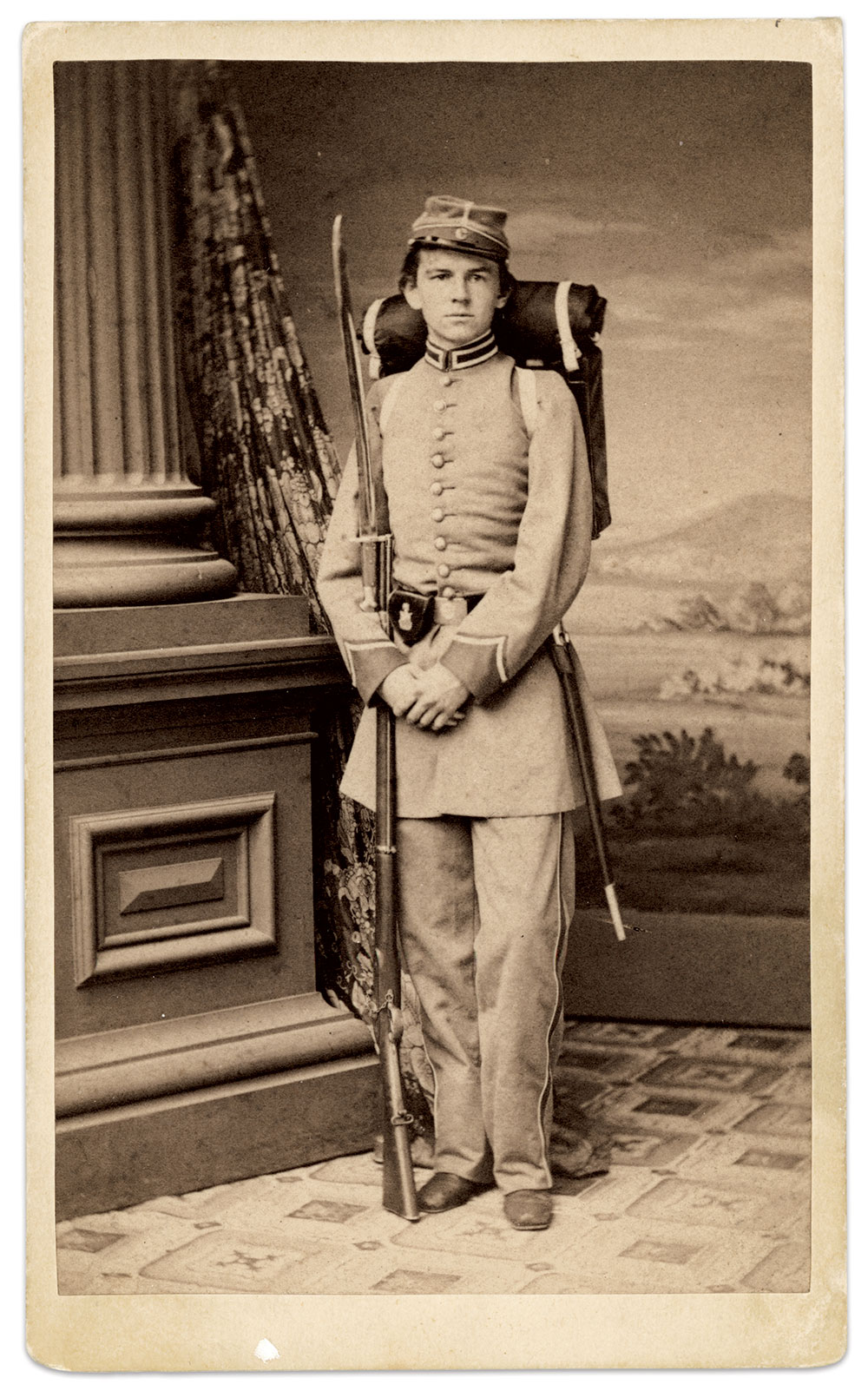
A Strawberry Gray
This member of the 22nd New York State Militia is pictured during the regiment’s first activation in 1861. Popularly known as the “Second Northern New York Regiment,” “Union Grays,” and “Strawberry Grays,” the latter nickname matches his distinctive uniform: a gray frock coat with a red collar and cuffs, and gray trousers with a wide red stripe, all accented with cream-white trim. Note the company letter—C—on the belt plate and kepi. The men purchased their own Pattern 1856 Enfield short rifle and saber bayonet. The long bayonet scabbard on the belt proved unpopular. Also on the belt is a cap box bearing the New York State seal. His wooden-framed knapsack, covered in black-enameled canvas, likely bore the regiment’s number on the front flap; a blanket sits on top, secured by white leather straps.
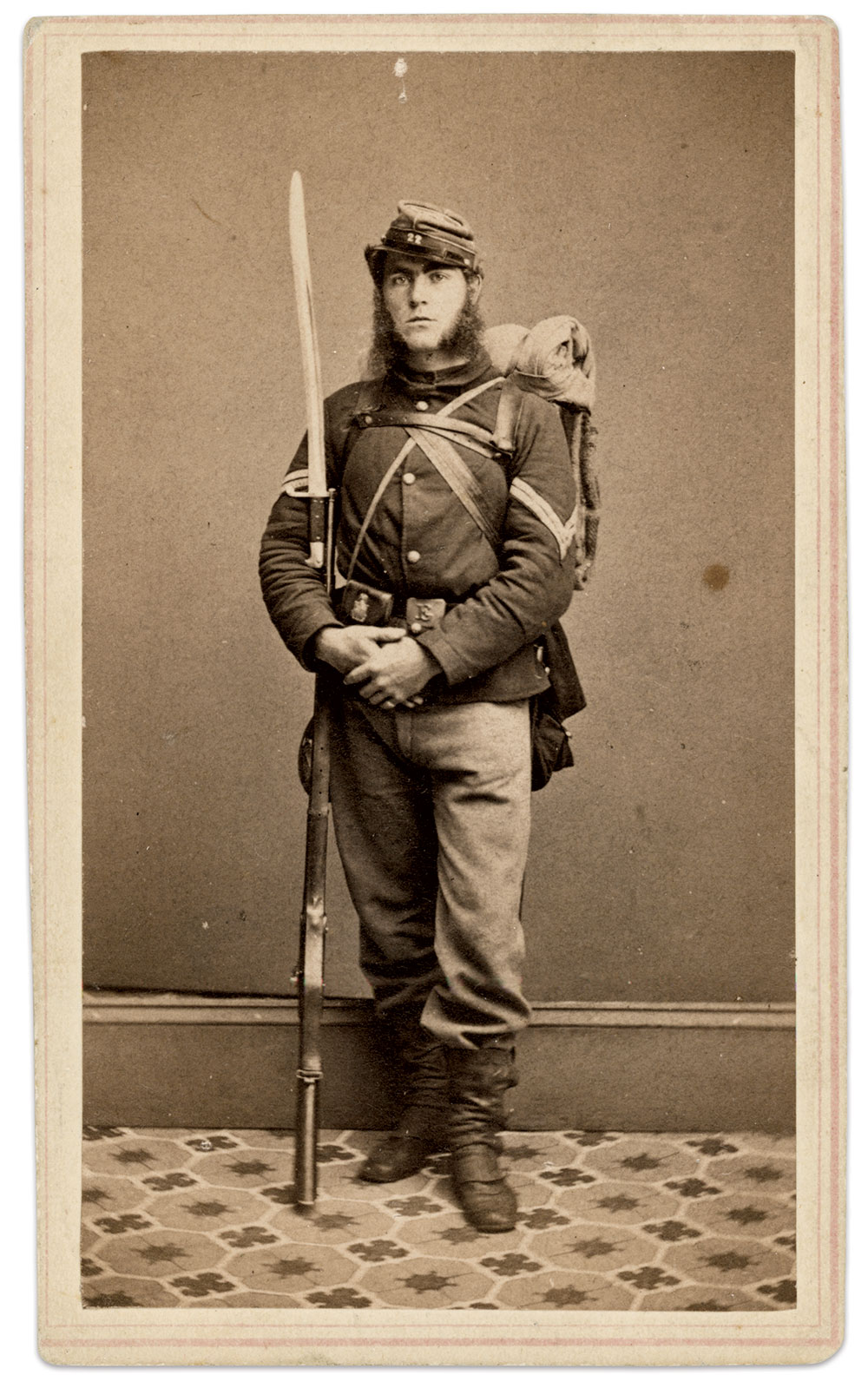
Post Strawberry Gray
This 22nd New York State Militia corporal is pictured after the regiment moved south and abandoned its distinctive gray and red frocks and pants in favor of the Pattern 1858 federal issue sack coat and Pattern 1861 sky blue trousers shown here. He retains the gray kepi with red band and crown, but has replaced the company letter with a brass 22. He also wears the privately purchased Company E waist belt plate and cap box with New York state seal. On his right shoulder is a painted canvas haversack and on the other is the cotton sling of a canteen, while his right arm hugs his Pattern 1856 Enfield short rifle. He carries a Pattern 1855 knapsack with its belt hooks fastened horizontally. The knapsack appears to hold an issue blanket under the flap, and a white shelter half on top. Leather gaiters complete the look.
SPREAD THE WORD: We encourage you to share this story on social media and elsewhere to educate and raise awareness. If you wish to use any image on this page for another purpose, please request permission.
LEARN MORE about Military Images, America’s only magazine dedicated to showcasing, interpreting and preserving Civil War portrait photography.
VISIT OUR STORE to subscribe, renew a subscription, and more.
1 thought on “Marching Order! A glimpse of what federal soldiers looked like as they marched into battle— and into history”
Comments are closed.