By Elizabeth A. Topping
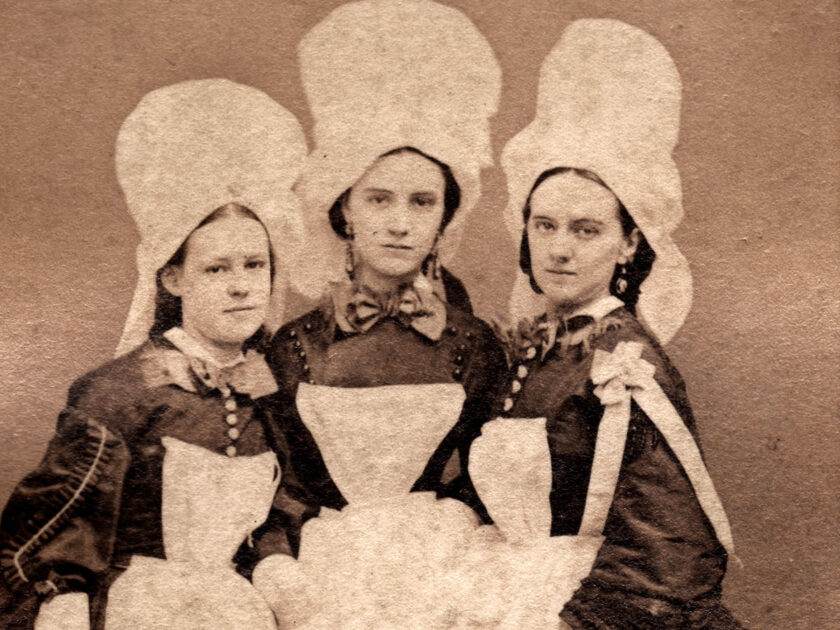
The unidentified young ladies in these photographs are often misidentified as Civil War nurses. However, with a turn of the carte, one can discern from the photographer’s imprint that the images were taken at the New York Metropolitan Fair—and the inscription “Waffle girls.”

Further research uncovers an illustration in Frank Leslie’s Illustrated Newspaper, dated April 23, 1864, of the Normandy Confectionery booth, showing the costume the attendants wore, which matches what we see in the photographs.
A book, A Record of the Metropolitan Fair in Aid of the United States Sanitary Commission Held at New York, in April, 1864, provides context:
And then there was the Normandy table, which was really one of the most attractive spots in the Fair—a corner of the Restaurant where several young ladies, attired as peasant-girls of Normandy, and conspicuous by means of its pretty and picturesque cap, baked and dispensed delicious gauffre cakes to the wise. Those who saw that charming corner, and tasted those cakes, will scarcely need to be reminded of the Normandy table. To the less fortunate it must be explained that gauffre cakes are a sort of waffle of less gross and material formation than the ordinary, and that when taken hot from the griddle they are deftly rolled up and administered by the attendant cigar-wise between the lips of the recipient. When it is considered that the attendants here were young ladies in a peculiarly quaint, picturesque, and becoming costume, and that they seemed heartily to enjoy their novel position, it will be easily believed that they and their cakes were eagerly sought for night after night by the same delighted gentlemen.

In summary, these pretty girls, who portrayed young, working-class Frenchwomen in their “grisette aprons and jaunty coiffures,” were trained to act as table waiters in the Dining Hall festooned with flags and garlands, and not as nurses working long hours in hospitals under difficult and acutely distressing conditions.
Elizabeth Topping has been a reenactor and living historian for more than 25 years. Her collection and research focuses on the social and material history of the Civil War years. Her initial study centered on the subject of prostitution, which ultimately led to research on abortion, birth control and childbirth, female job opportunities and working conditions, medical treatment for poor and insane women, class and sex restrictions imposed on 19th-century females, the roles actresses played in society, and the parts women played in aiding the war efforts. Elizabeth enjoys sharing her expertise and artifacts for use in television programs, museums, magazines, conferences and roundtables.
SPREAD THE WORD: We encourage you to share this story on social media and elsewhere to educate and raise awareness. If you wish to use any image on this page for another purpose, please request permission.
LEARN MORE about Military Images, America’s only magazine dedicated to showcasing, interpreting and preserving Civil War portrait photography.
VISIT OUR STORE to subscribe, renew a subscription, and more.