
By Michael R. Cunningham, Ph.D., featuring an image from the Rick Carlile Collection
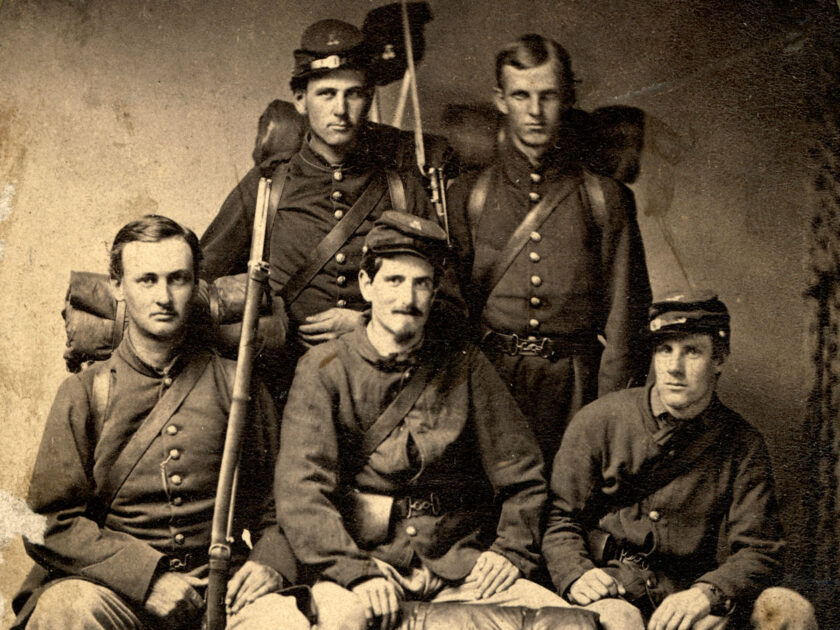
Five gallant patriots who put aside their personal ambitions in order to defend the Union left behind an enduring record of their service—and an indelible image of the material culture that surrounded them as they accomplished that noble goal.
On the back of the mount of this albumen photograph is inscribed “Our Mess/Co. F. 44th Mass. Infantry/New Berne N.C/1862-63” and their names.
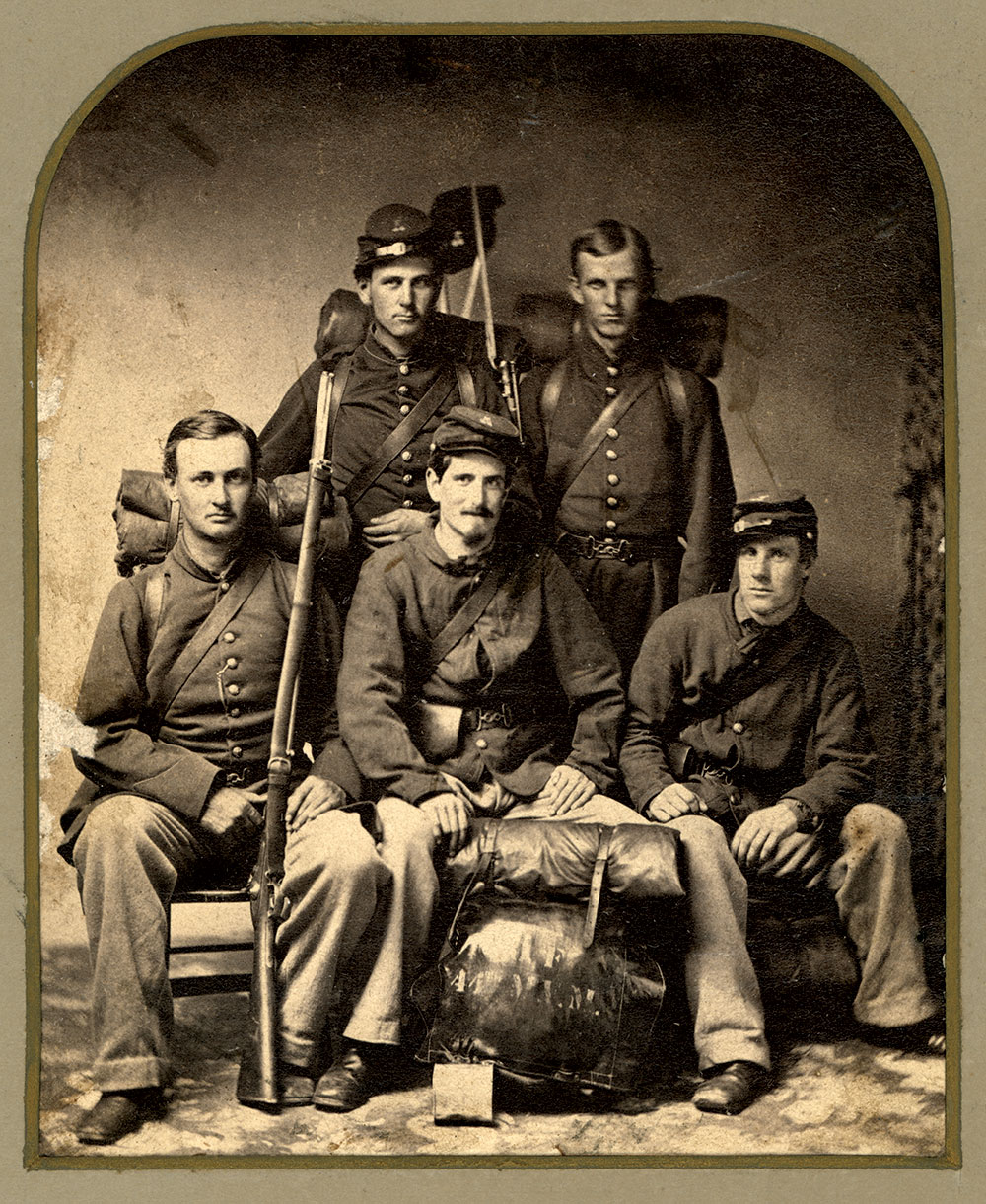
Front Row
Herbert Sleeper (1841-1874) sits on the left. The son of a former mayor of Roxbury, the 21-year-old law student survived the war only to die of a hemorrhage in his early thirties.
In the center, with his hand resting on a knapsack, sits William H. Tweed (1840-1873), a 22-year-old Boston clerk who served his full nine months in the 44th. A year later he returned to the army as a corporal in the 42nd Massachusetts Infantry, another nine-month’s regiment. The 42nd spent the majority of its time on guard duty in Maryland and the Shenandoah Valley. Tweed mustered out with his comrades in November 1864.
Edward Jarvis “Ned” Bartlett (1842-1914) sits on the right. He served the longest and achieved the highest rank of all his messmates. In April 1862 he left his job as a Concord clerk for a one-month enlistment in the 4th Battalion of Massachusetts Infantry before enlisting in the 44th. Bartlett took a yearlong hiatus before accepting a second lieutenant’s commission in Company E of the 5th Massachusetts Cavalry. He mustered out in October 1865.
Back Row
Standing on the left is Benjamin Apthorp Gould Fuller (1843-1925), a 19-year-old Maine native who clerked in Boston when he mustered into Company F, he settled in Washington state after the war.
Next to him is Herbert Osborne (1843-1889), a 19-year-old clerk in Somerville. He walked away from the safety and security of that position when he mustered into the 44th, designated a nine-month regiment, on September 12, 1862.
Privates Sleeper, Tweed, Bartlett, Fuller and Osborne participated in operations in North Carolina during the fall of 1862. After arriving at New Bern in late October, the 44th joined a two-week expedition to Rawle’s Mill and Tarboro, fighting a brief engagement that left two dead and six wounded. In December, the regiment joined Maj. Gen. John G. Foster’s raid toward Goldsboro to destroy a railroad bridge, disrupt supply lines, and investigate Confederate ironclad construction. They missed the action at Kinston on December 14 but fought hard at Whitehall two days later. At the start of the battle, Foster sent a detachment including Companies A and G of the 44th forward on the main road as a feint, encountering Confederate fire across the Neuse River. The main body of the regiment advanced toward the railroad bridge and faced Confederate infantry and artillery on the opposite bank of the river, losing eight killed and 10 wounded.
The colonel commanding the 44th, Francis L. Lee, expressed his pride in a letter to friends that made its way into the Boston Daily Evening Transcript: “The regiment, at Whitehall, were behind a fence on the river shore, and the rebels, in an entrenchment of logs and fascines [small bundles of sticks] on the other shores, about 300 yards off, and both sides kept up a steady fire. My men behaved splendidly, cool and courageous—they did just what I ordered.”
The 44th and the rest of Foster’s forces returned to New Bern on December 20. The Goldsboro Raid successfully destroyed the Wilmington & Weldon Railroad bridge and cut off Confederate supply lines into Virginia for a period of two weeks.
After a quiet winter, the 44th went on a February 1863 foraging trip from Plymouth, N.C. Company F, with Company B, were posted to Batcheller’s Creek until May, while the rest of the regiment helped defend Little Washington during its April siege, then destroyed works at Hill’s Point. Returning to New Bern as provost guard, the 44th left for Beaufort in June and mustered out in Boston days later, having lost 11 men in combat and 30 to disease or accidents.
About the Uniforms, Equipment and Weapons
The men of the 44th wore comparable uniforms and equipage throughout their service. Sleeper, Tweed, Bartlett, Fuller and Osborne are equipped with British arms and accoutrements, likely captured from a Confederate blockade runner and turned against their former owners. Their English items include the 1853-pattern Enfield rifled-musket with angular bayonet and a leather sling with a distinctive horseshoe buckle. Their leather waist belts are closed by an S-shaped snake buckle, with the tail connecting to a ring attached to one side of the belt and the head fitting into a brass ring on the other side. The waist belts also carry a small pouch that functions as a percussion cap box and a frog holding a removable leather scabbard for the bayonet, with brass collar and tip.
As an elite, silk-stocking regiment, the men are dressed in a privately purchased impression of the federal uniform. Sleeper, Fuller, and Osborne wear an 1857-pattern uniform coat made of finer material, lower, more comfortable collars, and larger, more showy chevron cuffs than the issue version. Tweed and Bartlett wear the 1858-pattern sack coat, with four buttons in front and a curved, roll collar. It is evident from the stitching that the sack coats of the 44th were machine-sewn, which means that they were not made at the Schuylkill Arsenal Depot. But not enough details are visible in the image to tell whether the sack coats or the sky-blue trousers were made by private tailors or federal contractors. Fuller wears a privately purchased forage cap with a tall crown, while Fuller is wearing a privately purchased kepi with a low, indented crown. Bartlett’s cap appears to be a Federal issue 1858-pattern forage cap. The visible caps all have brass insignia in the form of the letter “F” above the numerals “44” on the forward lip of their cloth-covered pasteboard crowns.
Prominently featured in the photograph, resting on Tweed’s knees, is a black canvas knapsack with white stencil marks identifying it to Company F of the 44th M.V.M. Fuller and Osborne have their knapsacks on their shoulders, and all three knapsacks include a wool blanket wrapped with a gum blanket with two straps holding it to the top. The men of the 44th were equipped with the best accoutrements available in 1862, the Short’s Patent knapsack. Joseph Short of New York City was granted patent 33,726, dated November 1, 1861, and patent 34,272, dated January 28, 1862; both involved improvements in knapsacks. The advances focused on the arrangement of the harness and straps, which Short designed to avoid pinching the user’s neck, shoulders, and arms. Many soldiers testified to the comfort and were willing to pay $2.00 (equivalent to $63.66 in 2025) to buy one. Massachusetts soldiers were more fortunate than most because Gov. John Andrew purchased 14,000 of these knapsacks to issue to Bay State troops.
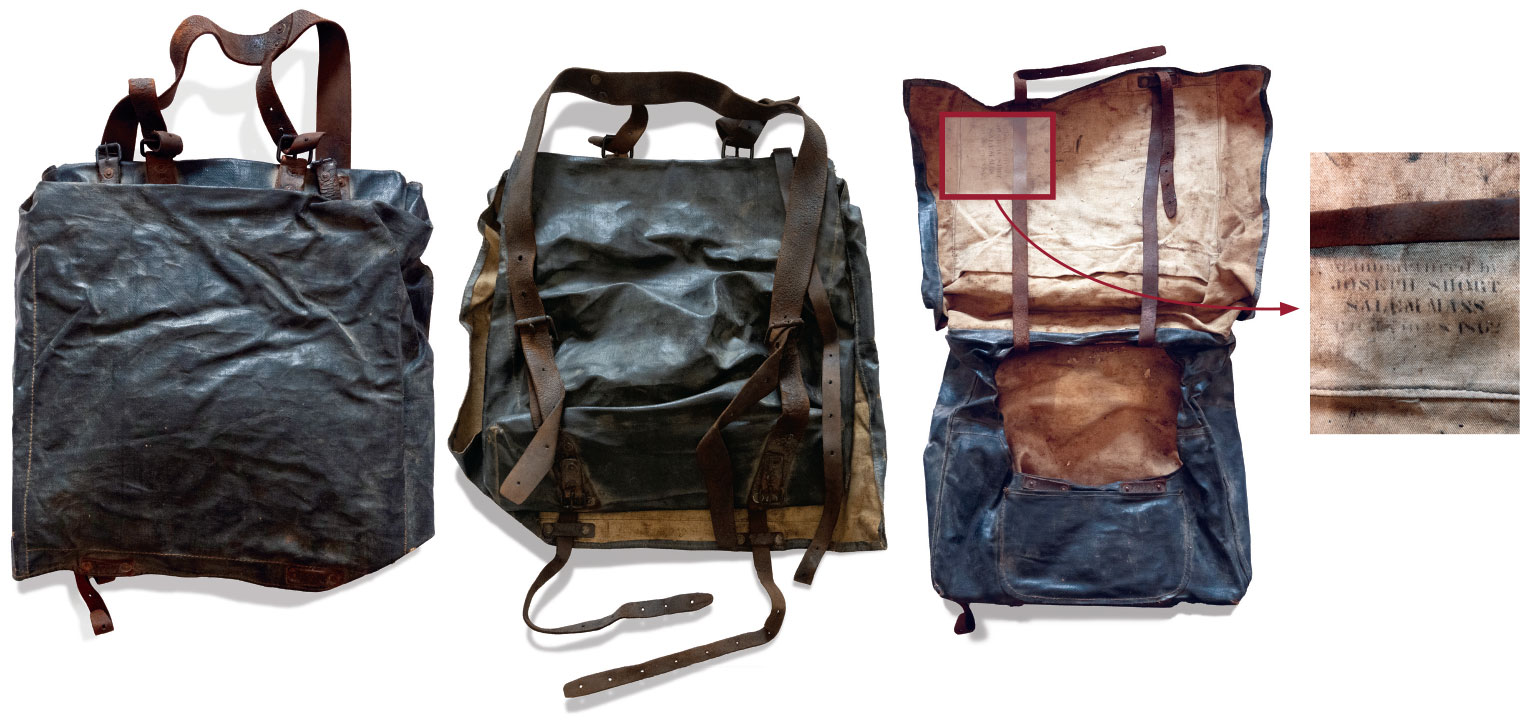
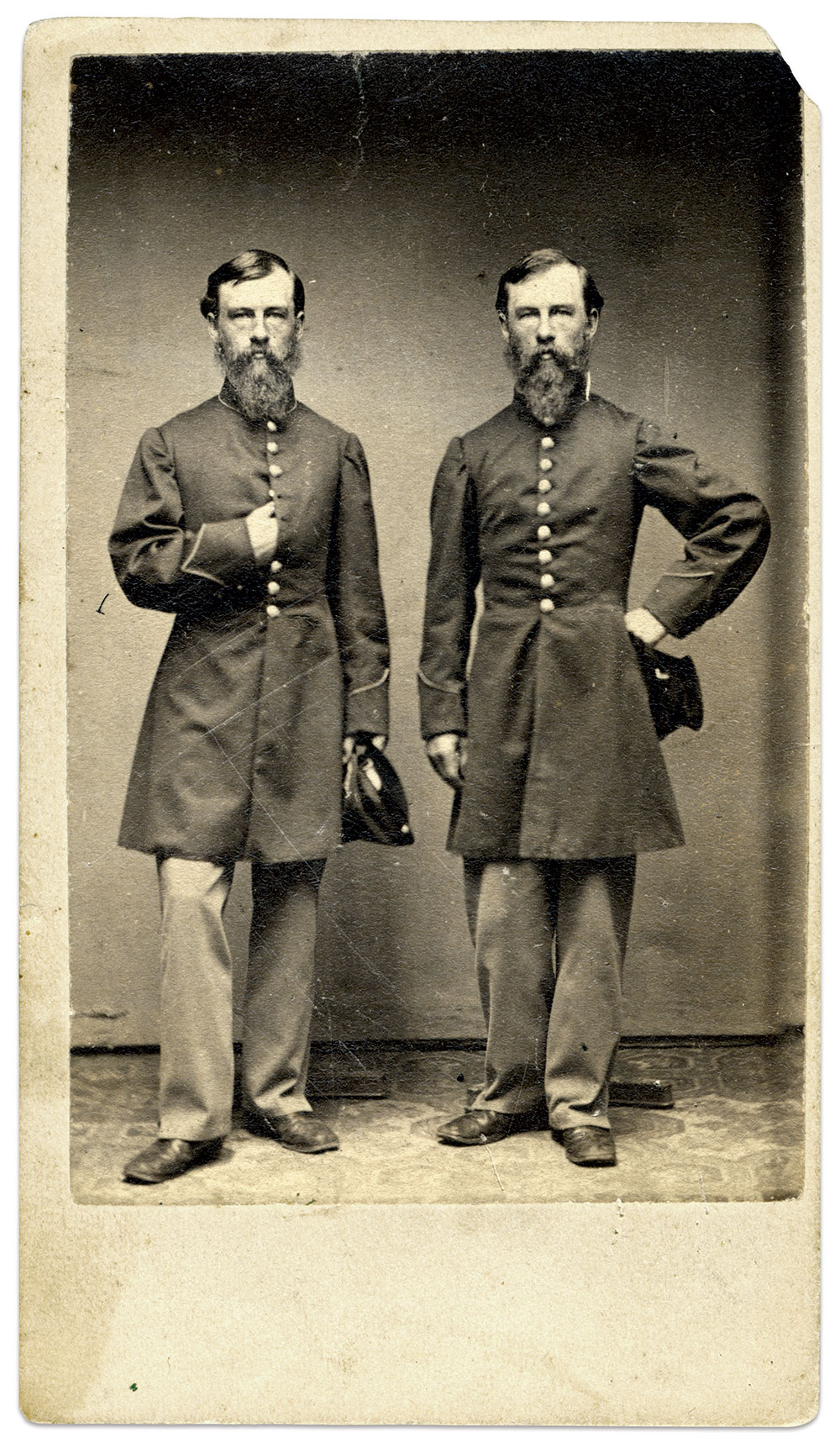
A Short’s Patent knapsack was preserved by a member of Company F of the 44th, Cyrus Cobb. He and his identical twin brother Darius were born in 1834, in Medford, Mass. Before the war, they collaborated in Boston painting portraits, large historical and religious paintings, and other commissions. Cyrus and Darius both joined the 44th in August 1862 and mustered in the following month. The brothers were noted in the regimental history for the quality of musical concerts that they provided their comrades. The boys mustered out in June 1863 and returned to their artistic careers. On January 1, 1866, they married two sisters: Cyrus to Emma Lillie and Darius to Laura Marie Lillie. From 1869 to 1879, Cyrus studied and practiced law in Boston, but he gave up the law and returned to art after a decade, achieving significant acclaim as a sculptor, while Darius focused more on painting and portraiture. Both were active in the Grand Army of the Republic, as well as in musical and literary circles in Boston. Cyrus died in 1903 and Darius in 1919.
Fortunately, Cyrus’ Short’s Patent knapsack continues to survive. It, and the “Our Mess” photograph, remind us of the contributions made by the Cobb twins and their fellow members of Company F during the Civil War.
SPREAD THE WORD: We encourage you to share this story on social media and elsewhere to educate and raise awareness. If you wish to use any image on this page for another purpose, please request permission.
LEARN MORE about Military Images, America’s only magazine dedicated to showcasing, interpreting and preserving Civil War portrait photography.
VISIT OUR STORE to subscribe, renew a subscription, and more.
1 thought on ““Our Mess”: An 1862 image captures the camaraderie, campaigns, and distinctive equipment of five pards in Company F of the 44th Massachusetts Infantry”
Comments are closed.