
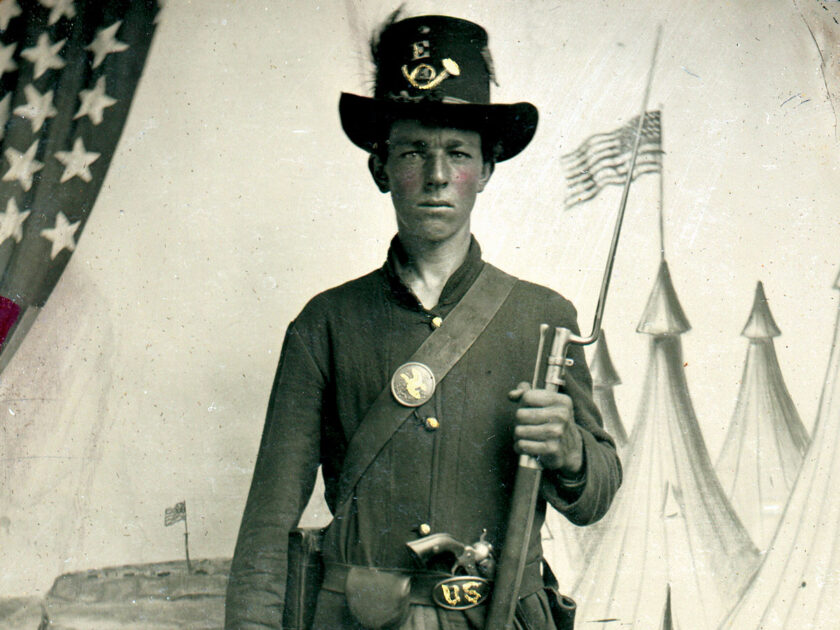
Whether posed in a studio at Indianapolis, Terre Haute, Fort Wayne, or in the field, the Hoosier soldiers who look out from these portraits represent the citizens who left farms, shops, and small towns to preserve the Union. Under the determined leadership of Gov. Oliver P. Morton—known to troops as the “Soldier’s Friend”—Indiana mobilized with speed and resolve after the firing on Fort Sumter.
By war’s end, more than 208,000 Indianans—roughly 15 percent of the state’s population—had served, with another 2,000 in naval service. They filled 129 infantry regiments, 13 cavalry regiments, and numerous artillery batteries, fighting in more than 300 engagements, largely in the Western Theater. Some 25,028 lost their lives.
Indiana’s contribution extended well beyond the ranks. Its farms supplied grain and livestock, its railroads moved troops and materiel, and Indianapolis emerged as a major training and logistics hub. Camp Morton, first organized as a mobilization center, later became one of the largest Confederate prisoner-of-war camps. At home, women organized aid societies, nursed the wounded, and sustained families and communities during years of absence and loss.
The war touched Indiana soil when Confederate cavalry under John Hunt Morgan raided the state in 1863, briefly spreading alarm before local militia and Union forces responded.
The conflict transformed Indiana—spurring industrial growth, strengthening its national influence, and leaving a legacy carried forward by Hoosier veterans.
Special thanks to Rick Brown, Mark Jones, Ron Maness, Dale Niesen, Paul Russinoff, and Phil Spaugy, who served as consultants for this gallery.
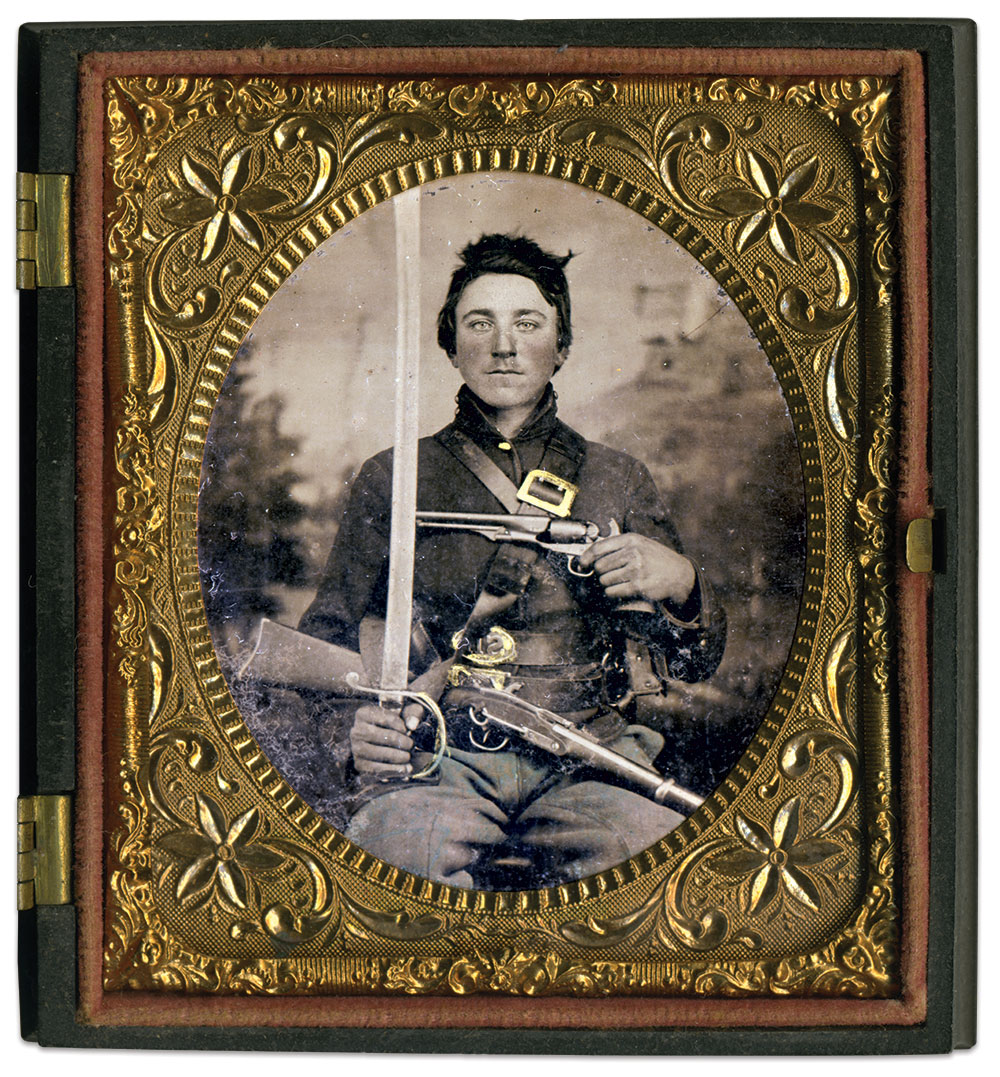
Trooper Armed With a Merrill and a Colt
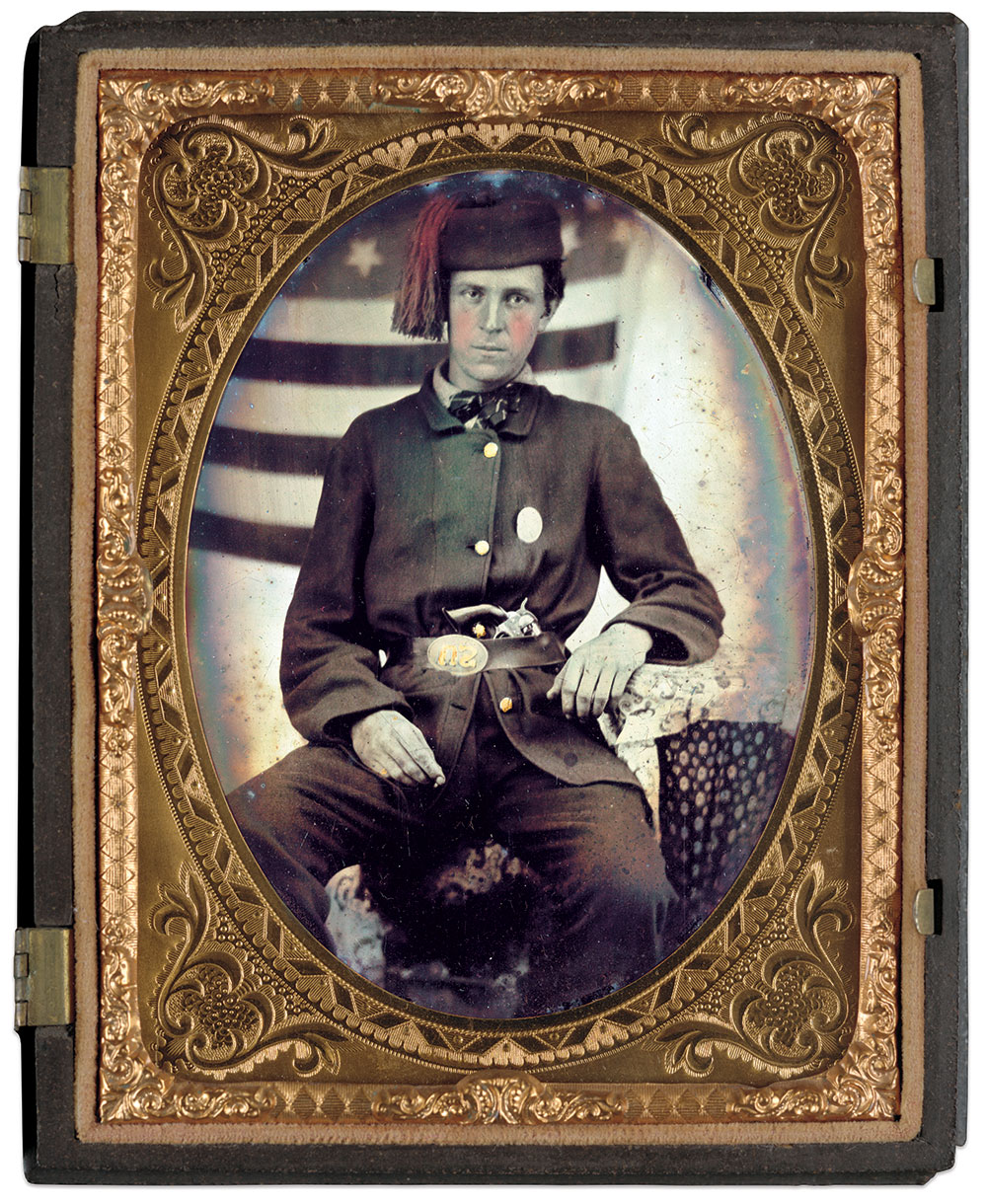
A Hoosier cavalryman stands ready, posed for action with a Merrill carbine and a .44-caliber Model 1860 Army Colt revolver. Three Indiana cavalry regiments were issued Merrills—the 2nd, 7th, and 12th.
1861
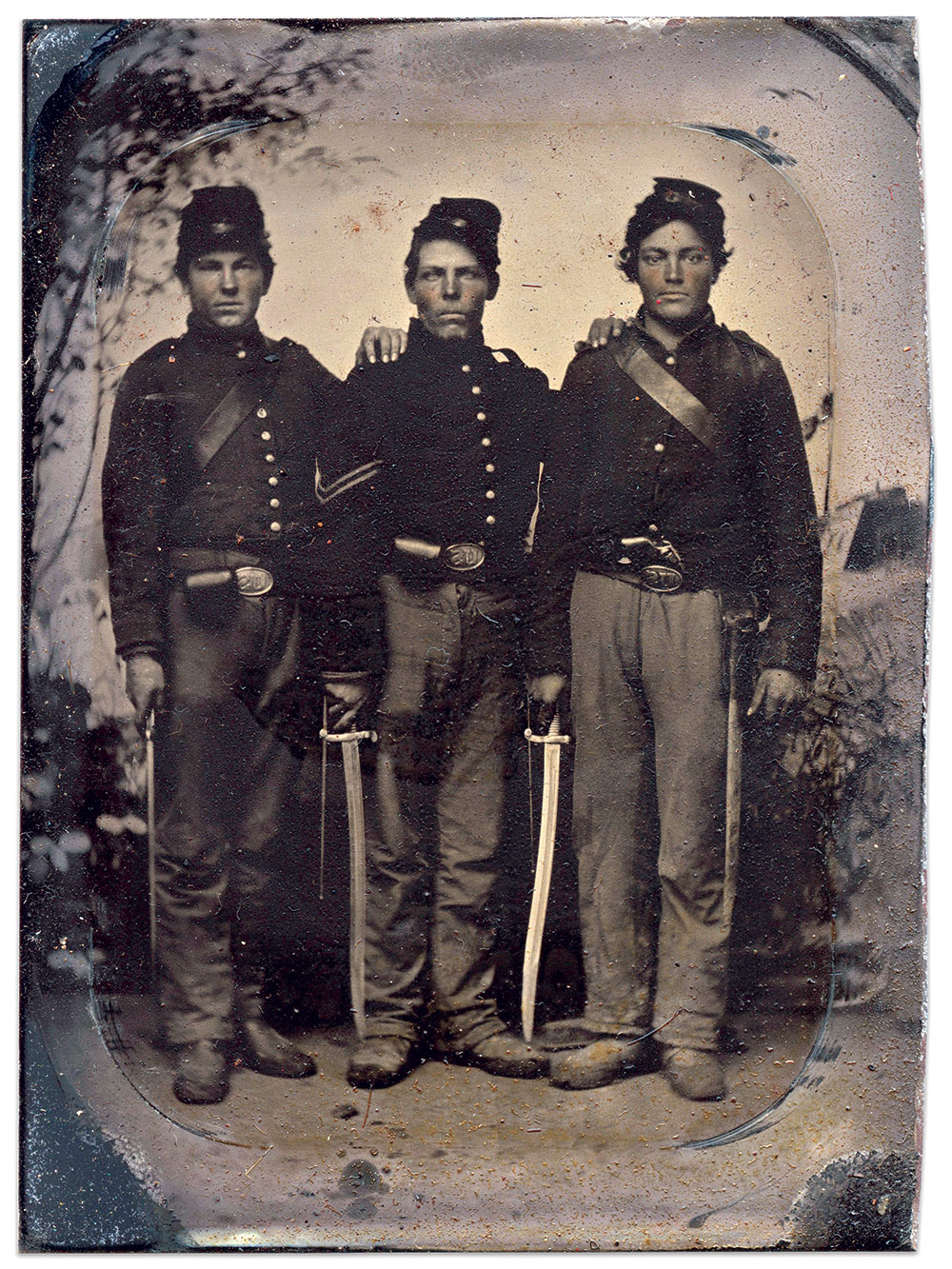
Pards at Benton Barracks
Corporal John S. Hugo and two comrades brandish sword bayonets in a photographer’s studio at Benton Barracks in St. Louis. Not shown are the Belgian-made copies of the French Chasseur Model 1859 rifles to which the bayonets were fixed. The soldier at right has an Allen & Wheelock pocket revolver tucked into his belt.
Hugo, a member of Company A, 25th Indiana Infantry, arrived in St. Louis with his regiment on December 18, 1861, after operations in Missouri. The Hoosiers wintered at Benton Barracks before departing on February 2, 1862, for Tennessee. Two weeks later, at Fort Donelson, Hugo was killed in action at age 20. He was buried on the battlefield beneath a small hickory tree, marked by a headboard bearing his name and that of Michael Chancy, a private in the same company. Their families declined the opportunity to return the bodies home, and both were later reinterred in Fort Donelson National Cemetery. Might Chancy be one of the enlisted men pictured here?
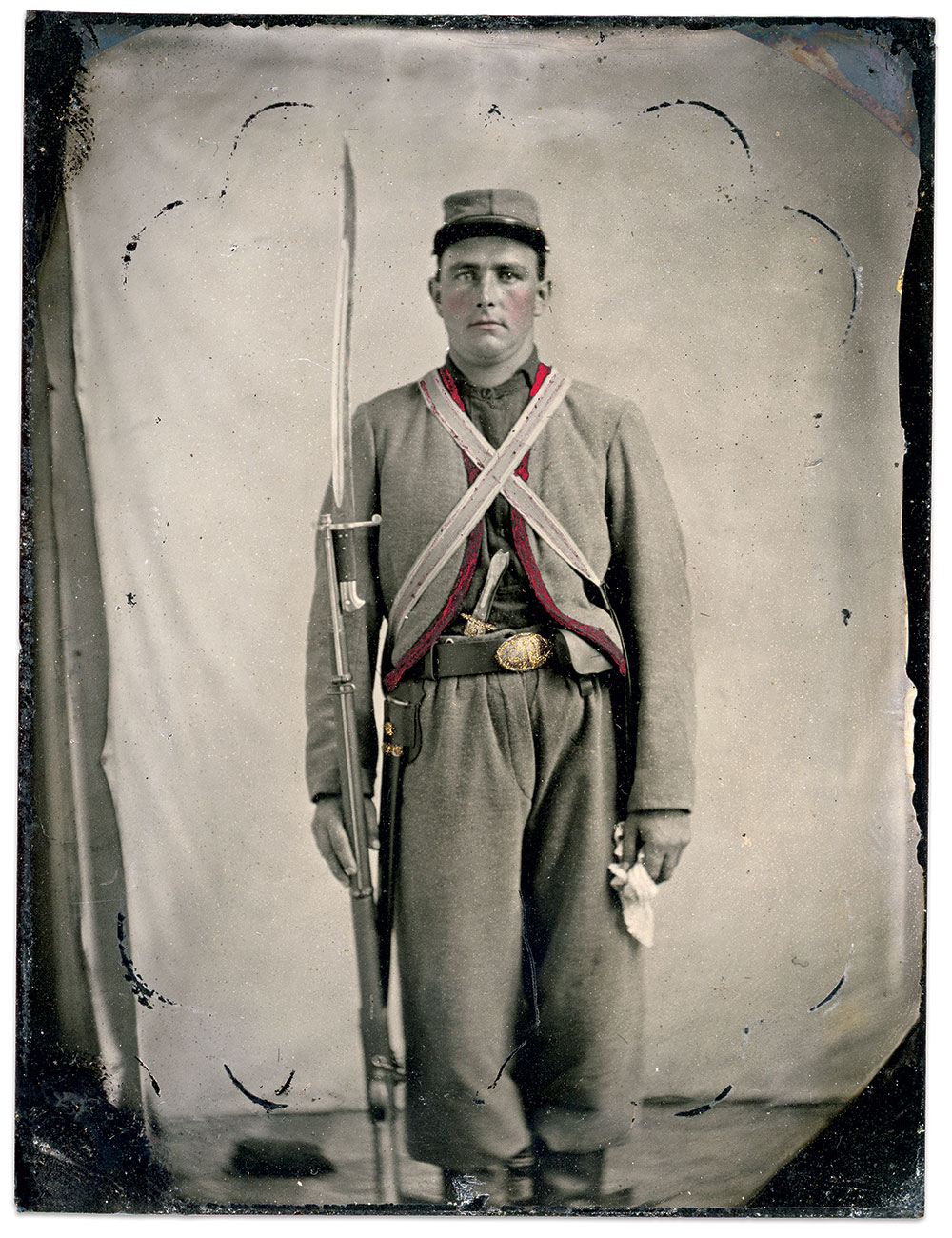
Crossbelts and a Sought-After Long Arm
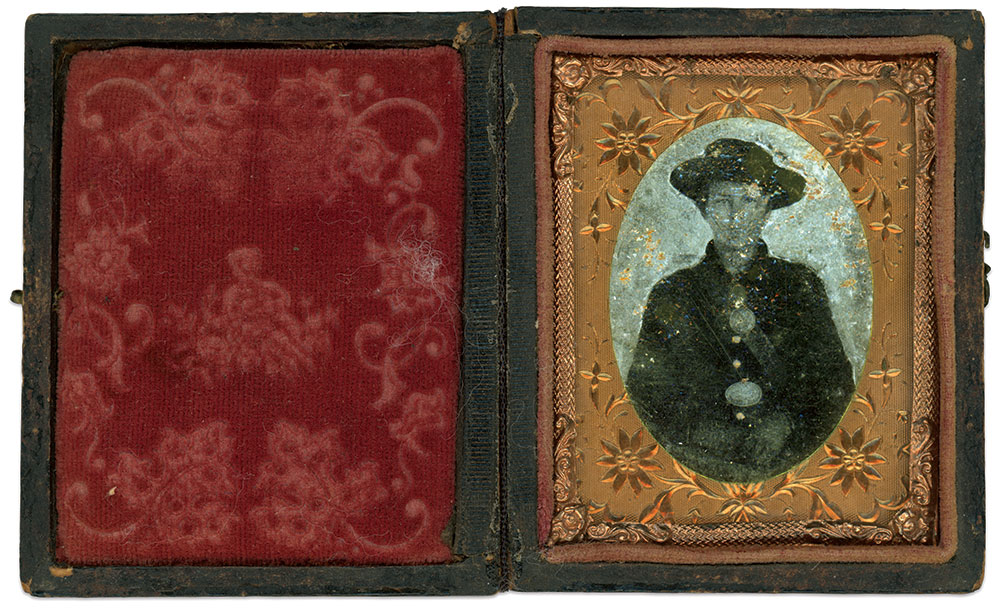
The Model P1856 Enfield rifle held by this member of the 11th Indiana suggests he enlisted during the summer of 1861 for a three-year term. These sought-after arms required time to fund and import from England and Canada, and were not widely issued until mid-1861. Also notable are his cloth crossbelts—one likely supporting a leather haversack, the other a canteen.
Pride and Patriotism
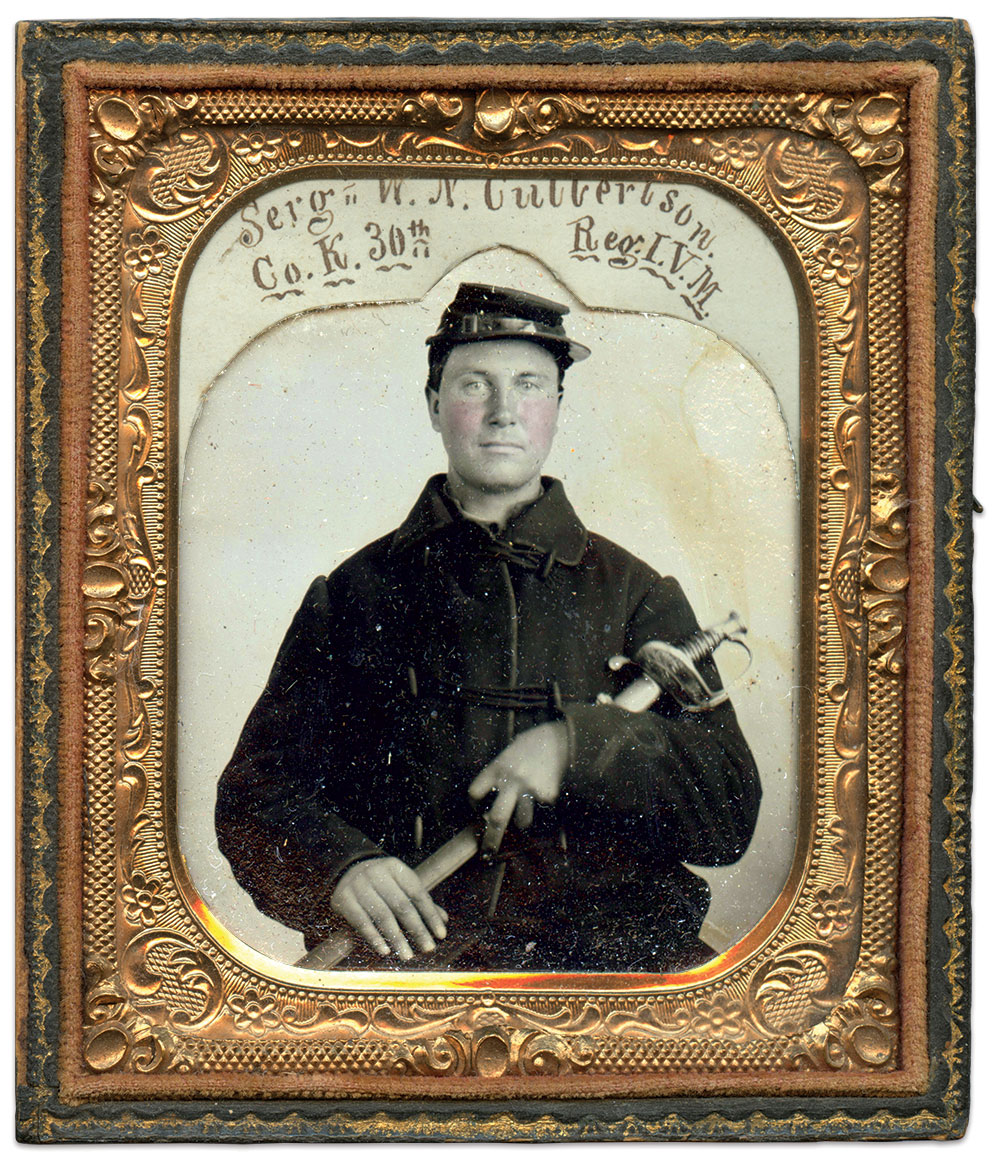
The hand-crafted paper mat framing this portrait reflects William N. Culbertson’s pride and patriotism. An Ohio-born farmer living in Elkhart County, Ind., he enlisted in September 1861 as a sergeant in Company K, 30th Indiana Infantry. The Model 1850 field and staff officer’s sword and officer’s overcoat he wears suggest the image was made in early 1863, after his promotion to second lieutenant following the Battle of Stones River but before his formal commissioning.
Culbertson commanded his company until the Battle of Chickamauga, where he was captured during the night after the first day’s fighting and imprisoned at camps in Macon, Ga., and Columbia, S.C. After the war, he returned to Elkhart County, where he died in 1917 at age 76.
He Never Left Buffalo Mountain
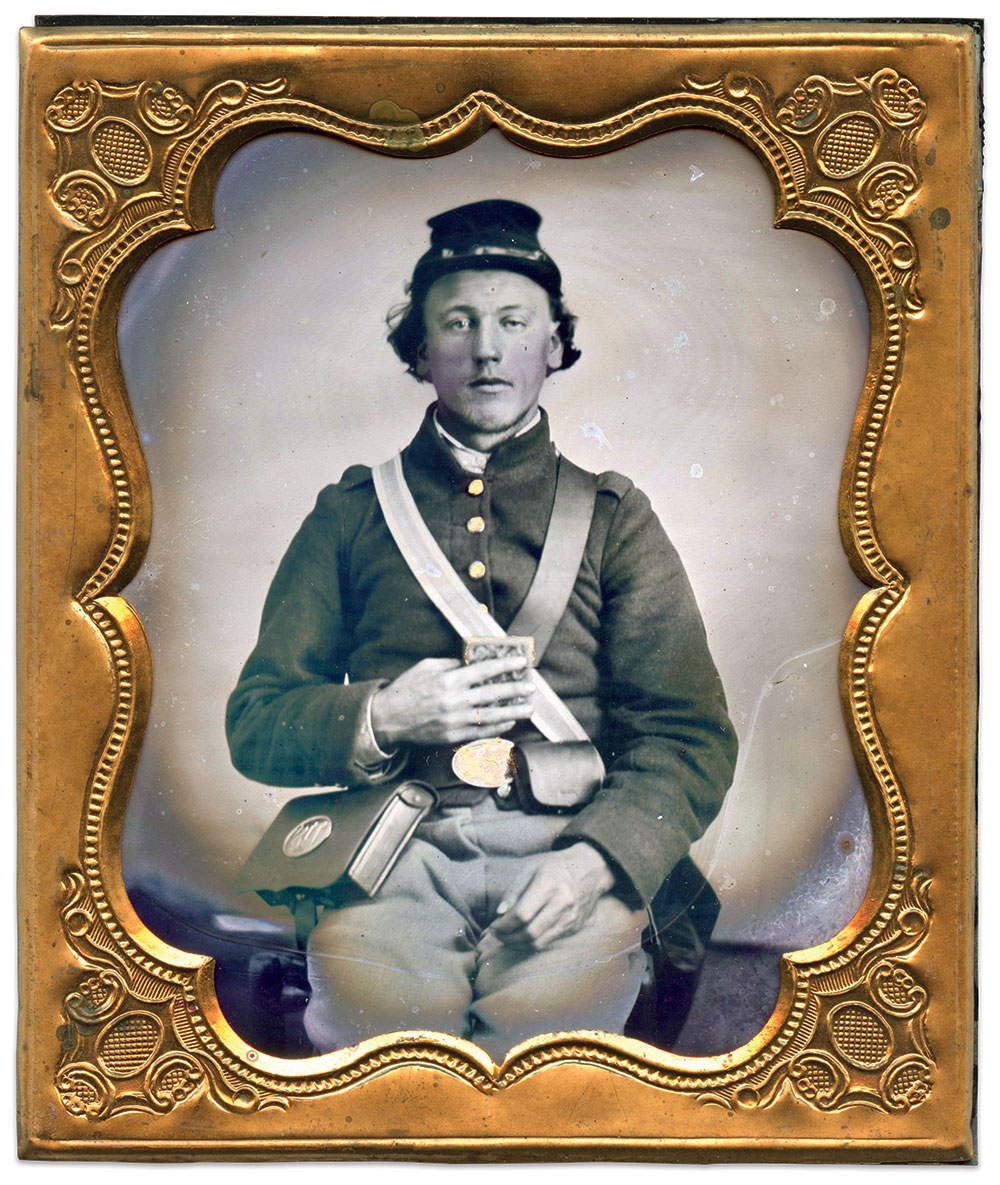
This portrait of John H. Edwards embodies the American volunteer soldier. Dressed in a pristine uniform with belt and cap box, cartridge box slung over one shoulder and a haversack over the other, he holds a photograph case—perhaps a reminder of home. Edwards posed soon after enlisting in Company A, 36th Indiana Infantry, in October 1861. The regiment went on to distinguish itself in the Western Theater. Edwards did not share in its service. Four months after his enlistment, on February 15, 1862, he died of typhoid fever at a hospital on Buffalo Mountain in western Virginia.
Wallace’s Seamstresses
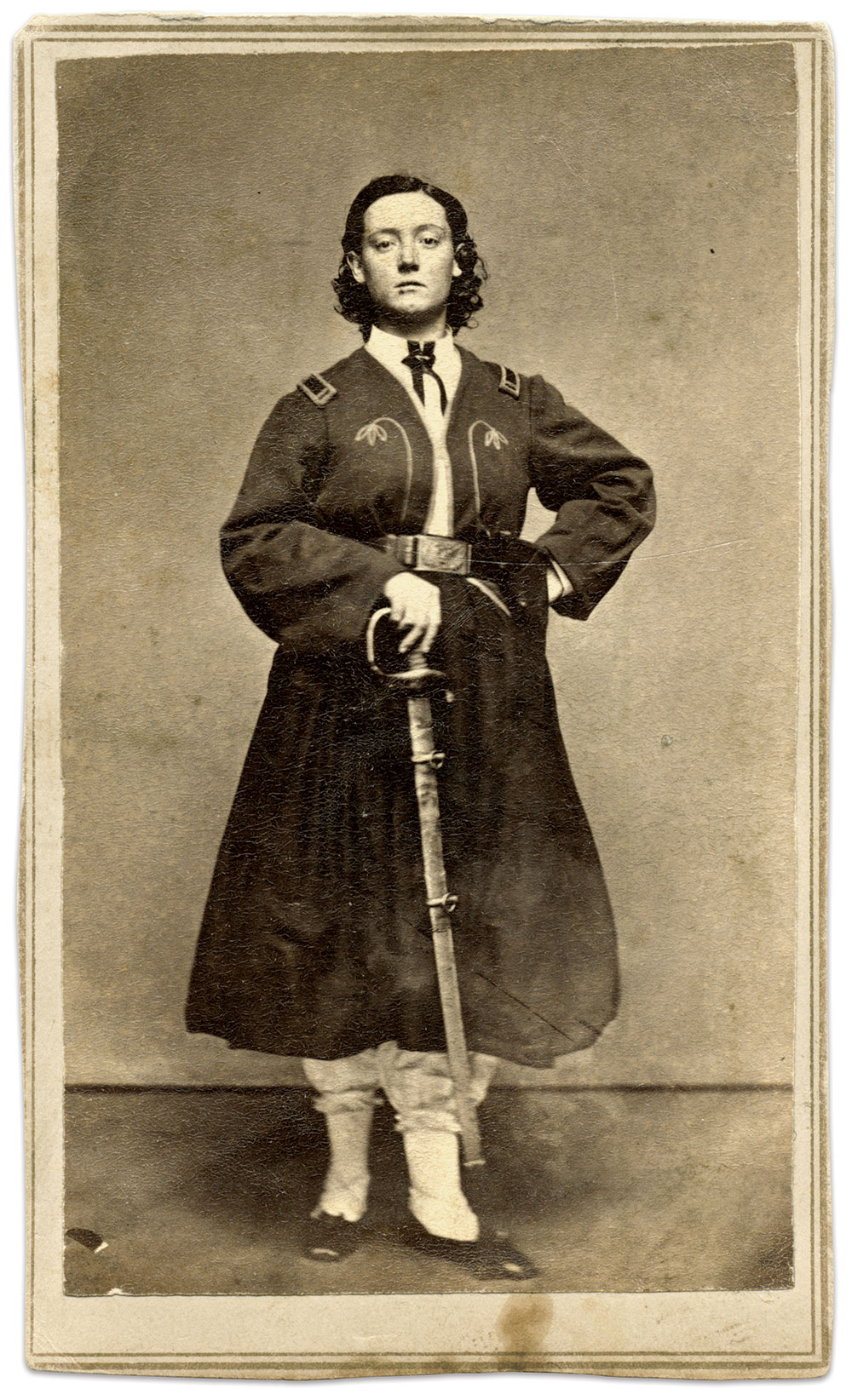
As Col. Lew Wallace and his 11th Indiana Infantry—Wallace’s Zouaves—passed through Vincennes en route to Virginia in 1861, a correspondent noted that each company “is attached a seamstress in full Zouave costume. These seamstresses are fine-looking women, and have the appearance of being fully able to endure the hardship of a soldier’s life.”
This woman may have been one of them. Her photograph appears in an album associated with the regiment, and a period inscription on the mount identifies her as Lizzie Goldsmith.
Leading His Company Forward at Philippi
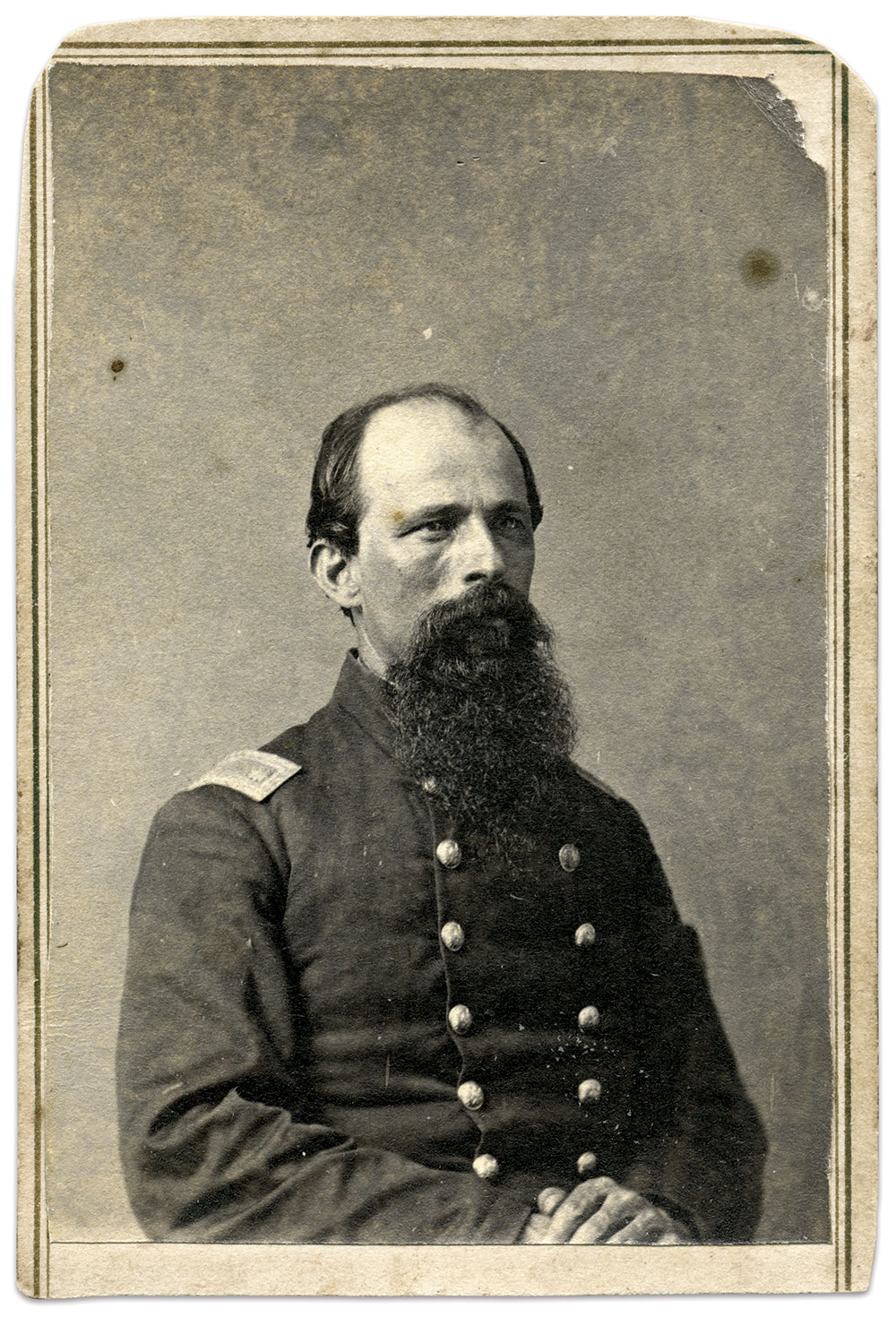
Hoosiers took part in one of the Union’s earliest successes—and what many historians consider the war’s first land battle. On June 3, 1861, at Philippi in the hills of western Virginia, Federal forces routed the Confederates in a retreat derided as the “Philippi Races.”
Among the participants was Capt. Jehu C. Hannum, commander of Company A, 9th Indiana Infantry. A 30-year-old carpenter from Delphi, Hannum had previously served in the Mexican War in the ranks of the 1st Indiana Infantry. His company commander in 1846, Robert Milroy, was now his colonel in the 9th and would later rise to major general and division command. Hannum subsequently left the regiment to serve as an officer in the 2nd and 9th Indiana Cavalry, though failing health limited his field service.
After the war, Hannum returned to Delphi and built a successful career as a contractor. He also served his community at various times as mayor, sheriff, postmaster, and fire chief. He died in 1905 at age 74.
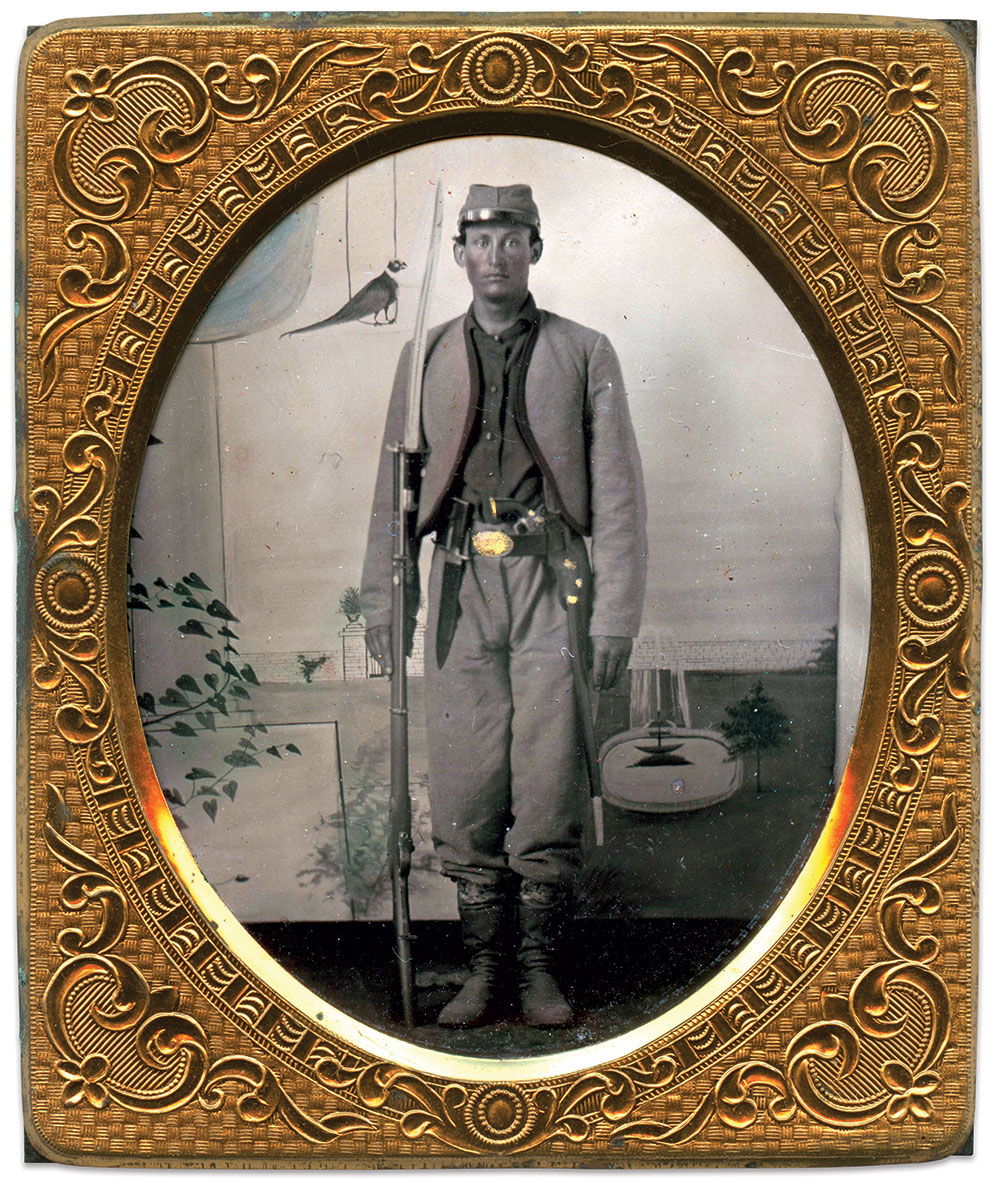
Officer Material
William Marion Apple is pictured about August 1861 at the start of his three-year enlistment in the 11th Indiana Infantry—Wallace’s Zouaves. He wears the first-pattern uniform and carries a Model P1856 Enfield rifle with sword bayonet. His martial bearing contrasts with the painted studio backdrop of a column, fountain, and perched bird. Apple rose from the ranks to first lieutenant of Company K before his term expired in 1864. He died in 1909 at age 70.
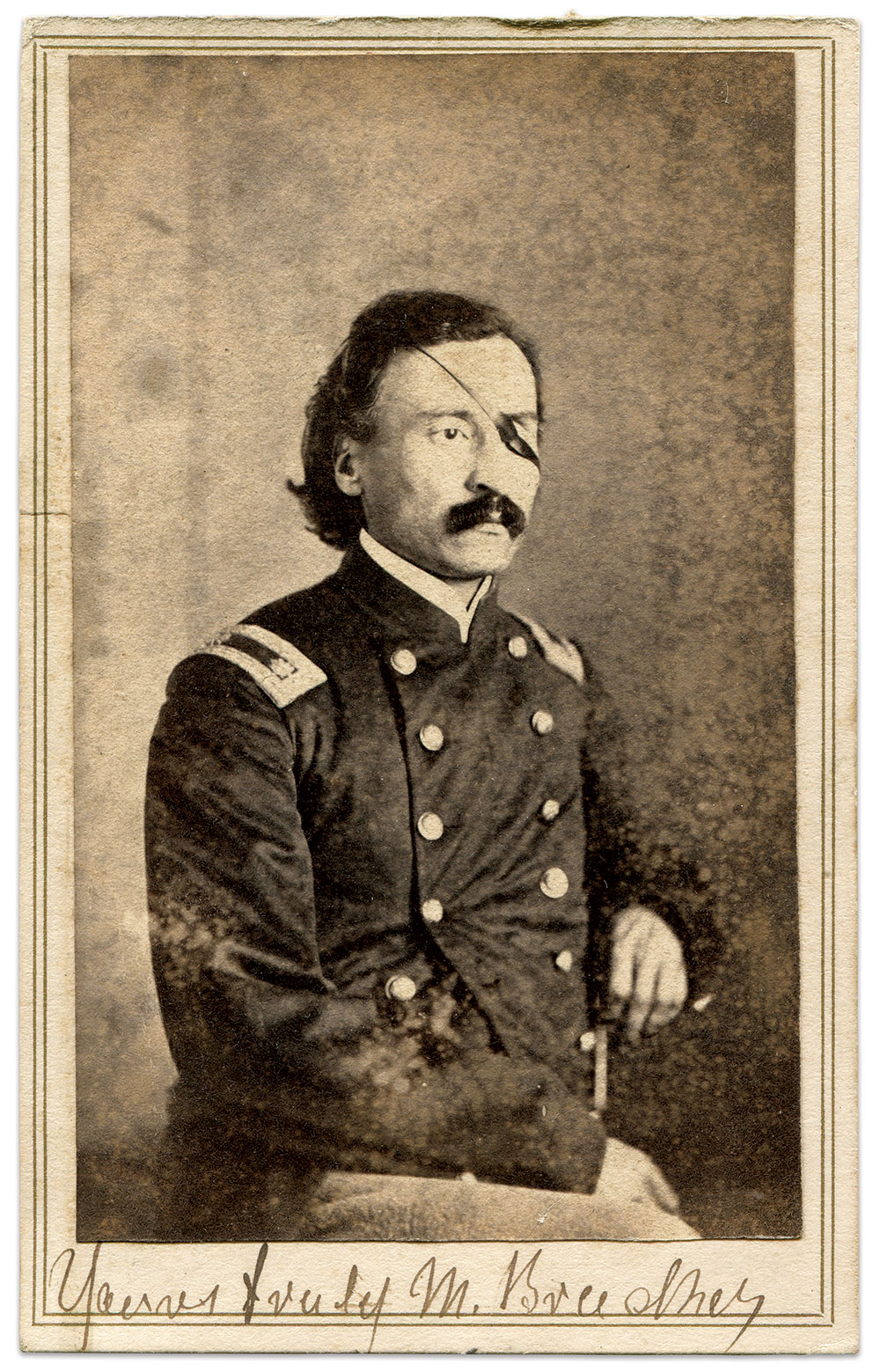
Fighting for Free Labor and His Adopted Homeland
After the failed revolution of 1848, German-born physician Magnus Brucker emigrated to Perry County, Ind. As a Republican and state legislator, he championed free labor and opposed slavery.
He entered the war as assistant surgeon of the 23rd Indiana Infantry and became surgeon, serving at Shiloh and in the Vicksburg and Atlanta campaigns. The reason for wearing an eye patch, and the nature of the assumed injury to his eye, is unknown. He also employed a Black nurse, Lucy Higgs Nichols, who became a valued caregiver.
After the war, Brucker remained active in veterans’ affairs. He died in 1874 at age 46; a Grand Army of the Republic post was later named in his honor.
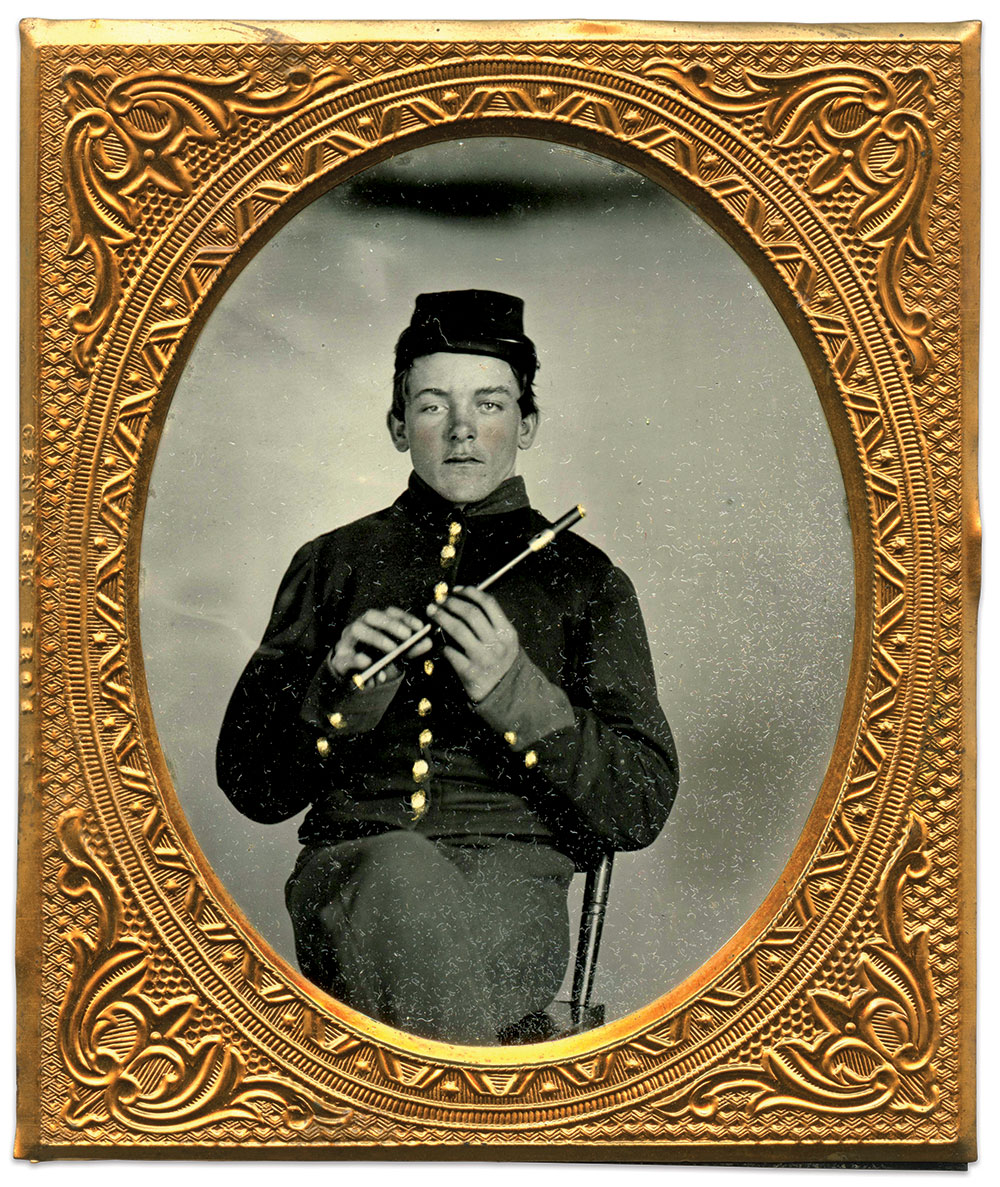
Four Years a Fifer
During four years as a fifer, William Jeffers Platt helped keep the 50th Indiana Infantry in step from Seymour, Ind., through campaigns in Kentucky, Tennessee, Mississippi, Arkansas, and Alabama. There, in the war’s final months, the regiment consolidated with the 52nd Indiana.
After mustering out, Platt returned to Switzerland County, Ind., where his family had settled after moving from New York. Perhaps inspired by his wartime travels, he later headed west—first to Missouri, and ultimately to Oakland, Calif., where he died in 1917 at age 74. He was survived by his wife, Annabelle, and their two children.
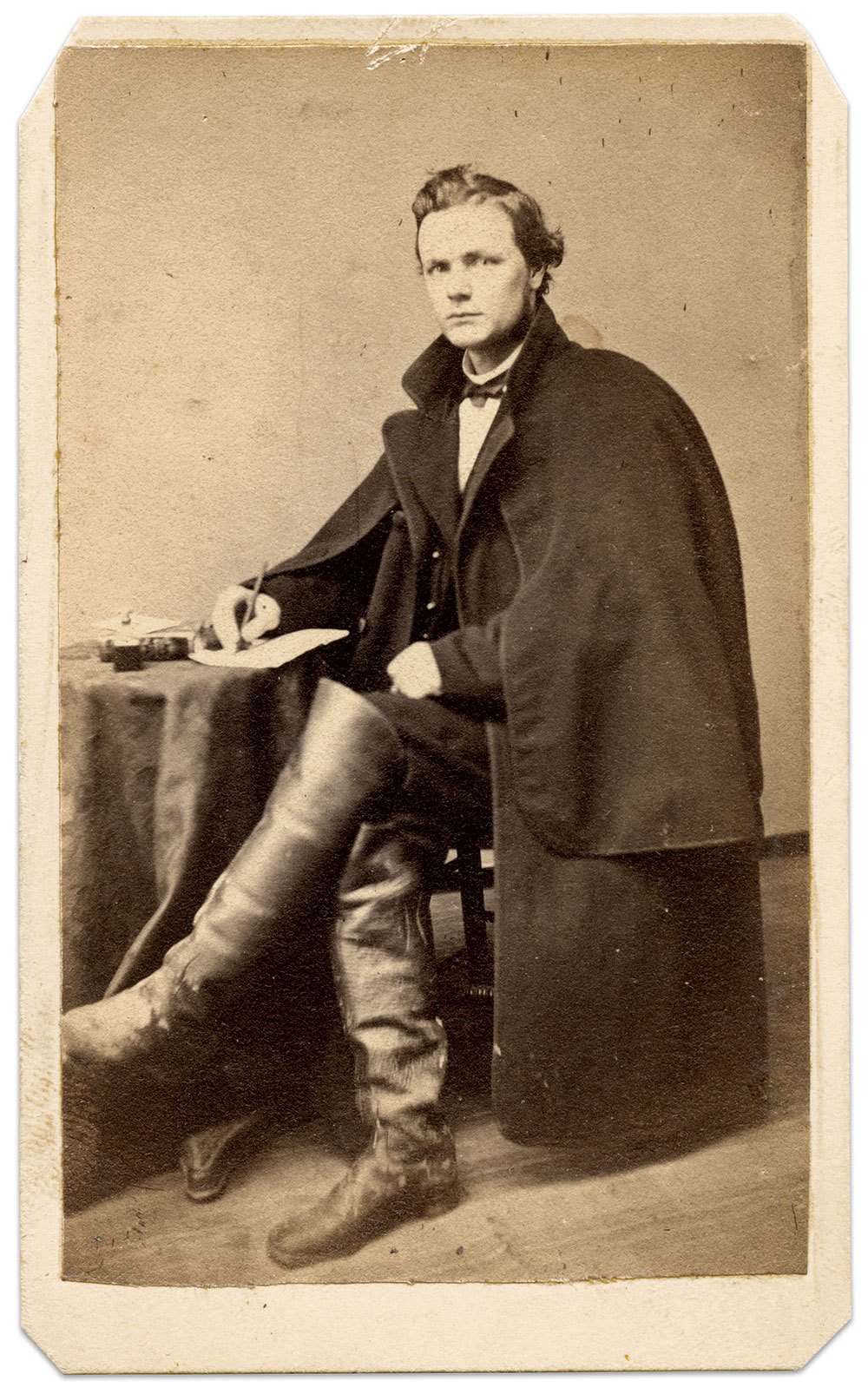
Captured While Scouting in Western Virginia
Confederate headquarters at Huntersville in western Virginia stirred as guards brought in a prisoner in irons. “That Yankee spy is here, General,” an orderly announced. The commanding officer ordered his shackles removed and guards posted at the doors and windows. The prisoner, William Baldwin Fletcher, 23, came from a prominent Indianapolis family. A physician educated at Indiana Asbury University (now DePauw) and the College of Physicians and Surgeons in New York City, he enlisted in the 6th Indiana Infantry after failing to secure a surgeon’s commission. Though he lacked musical skill, his superiors appointed him fife major, valuing instead his keen observation, writing, and mapmaking during the 1861 Western Virginia Campaign.
Captured while scouting, Fletcher was brought before Brig. Gen. William W. Loring. When the interrogation yielded no intelligence and no proof of espionage, Loring sent him to Richmond as a prisoner of war. There Fletcher cared for Union captives until his exchange in early 1862, by which time his enlistment had expired.
Offered an assistant surgeon’s post that March, he declined and returned to Indianapolis. He resumed his practice, later became a specialist in nervous and mental disorders, served in the state legislature, and died in 1907 at age 69.
1862
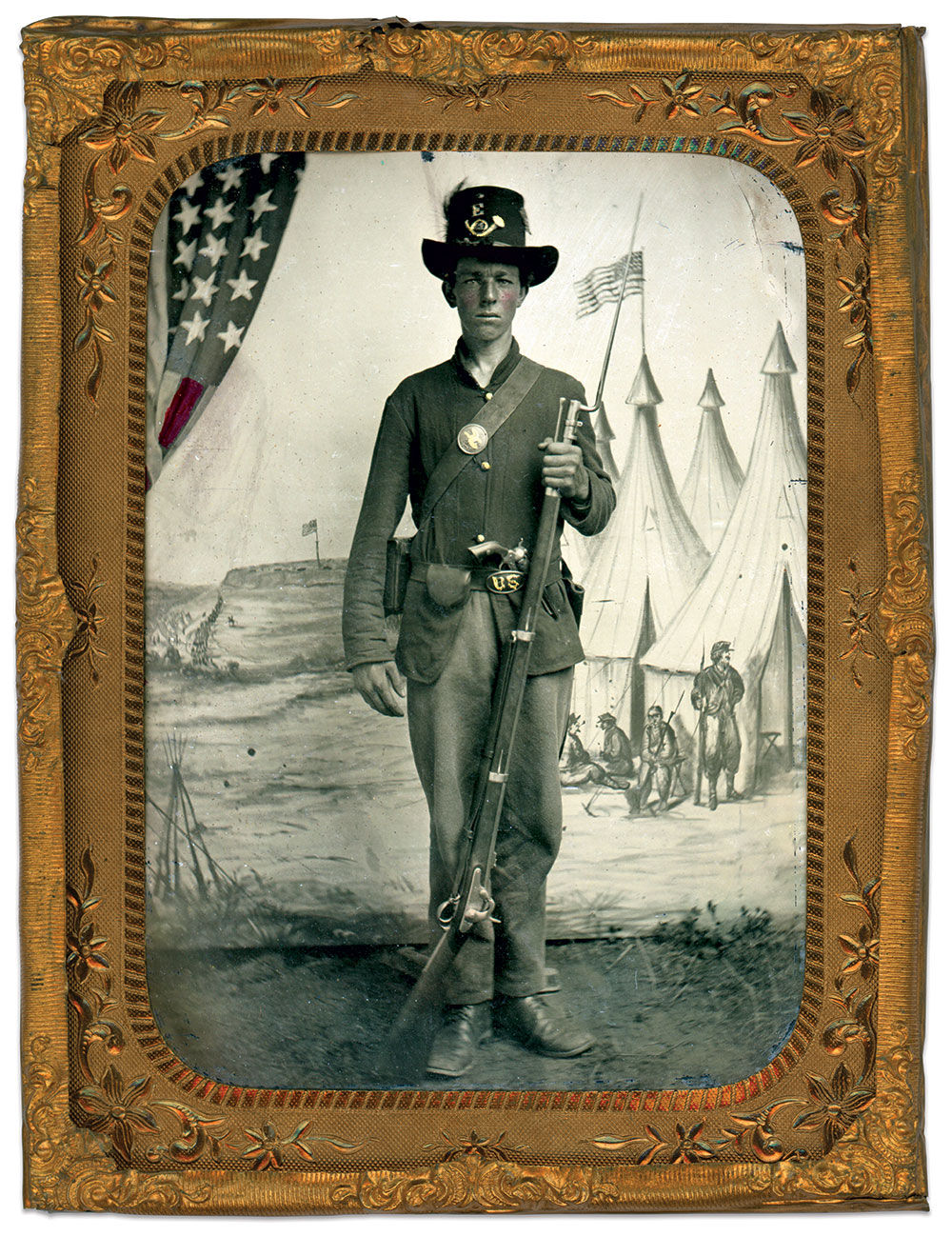
Antietam Casualty
William Henry Haney left his home in Muncie, Ind., in the summer of 1861 to enlist in the 19th Indiana Infantry. Posed here at parade rest with a U.S. Model 1861 Springfield rifle and a Whitney revolver tucked into his belt, he fought at Second Manassas, South Mountain, and Antietam. There his service ended when a Minié ball struck the lower right front of his skull, fracturing the bone.
Moved days later to a hospital in Washington, D.C., and then to Philadelphia in mid-October, Haney clung to life. Surgeons successfully removed bone fragments to relieve pressure, and he briefly retained full awareness, though they feared lasting brain injury. As his recovery faltered, severe diarrhea weakened him, and blood poisoning set in. He died on November 21, 1862, at age 21.
Haney’s remains were returned home for burial in Muncie.
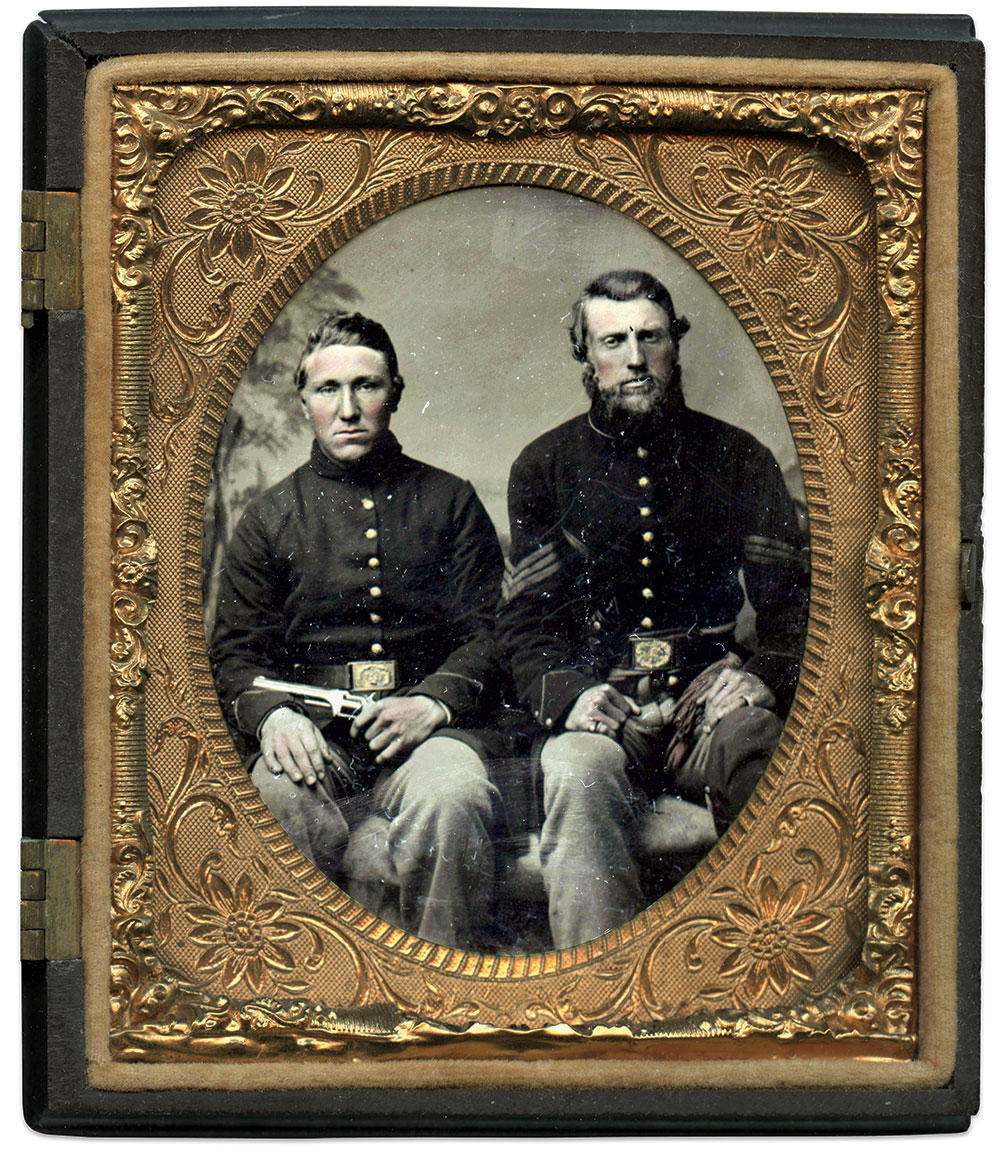
“Beloved Benjamin, 1862. He Is Gone.”
During the fierce fighting on the first day at Stones River, Pvt. Benjamin Trullinger carried the colors of his regiment, the 86th Indiana Infantry. Advancing across a turnpike and open field, the Hoosiers took position along a fence overlooking dense woods. When Confederate troops struck their exposed right flank, the regiment fought until its ammunition was exhausted, then fell back to the turnpike with fewer than half its men.
Trullinger—pictured here with a Smith & Wesson revolver and an unidentified sergeant—was killed instantly. The soldier who seized the colors after him received a mortal wound, and the flags were left behind. Trullinger was buried on the battlefield and later reinterred in Stones River National Cemetery. A note placed inside the case by a family member, Lucy Trullinger, records his loss: “Beloved Benjamin, 1862. He is gone.”
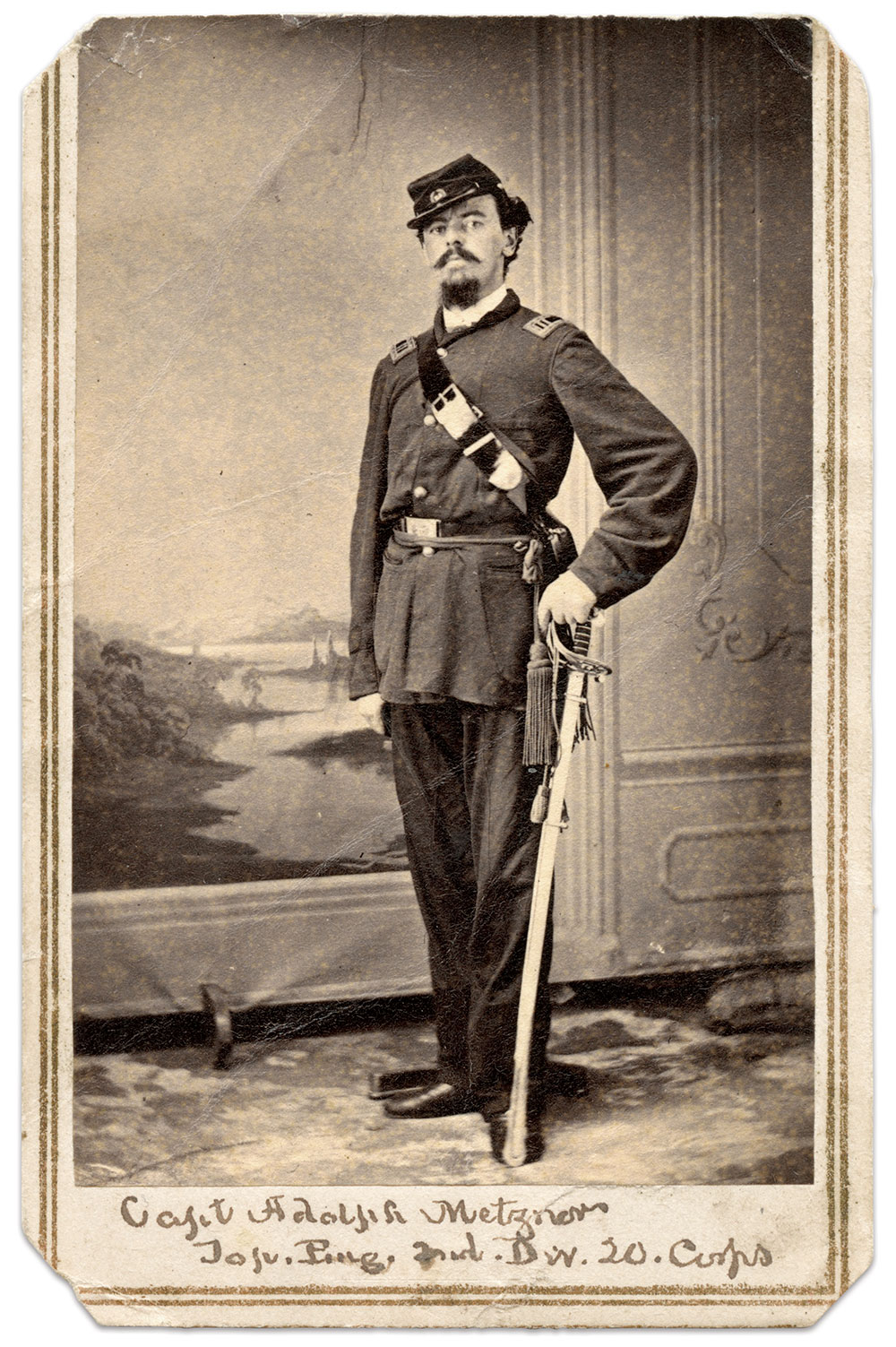
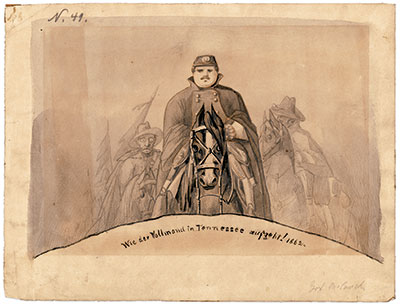
“How the Full Moon Rises Over the Hill in Tennessee!”
Captain Adolph Metzner fought in 32 engagements with the 32nd Indiana Infantry, all in the Western Theater, including Chickamauga, where he suffered a leg wound. A native of Baden-Württemberg, Germany, he immigrated to the United States in 1856 with a pharmacist’s degree and settled in Indianapolis. In 1861, he set aside his profession to serve his adopted country.
Metzner helped organize a company in the 1st German Regiment, which became the 32nd Indiana. After the war, he returned to pharmacy and also pursued pottery, earning praise for his artistic skill.
Nearly a century later, a new generation came to know Metzner through his wartime sketches, published by Michael A. Peake as Bloodshed in This War.
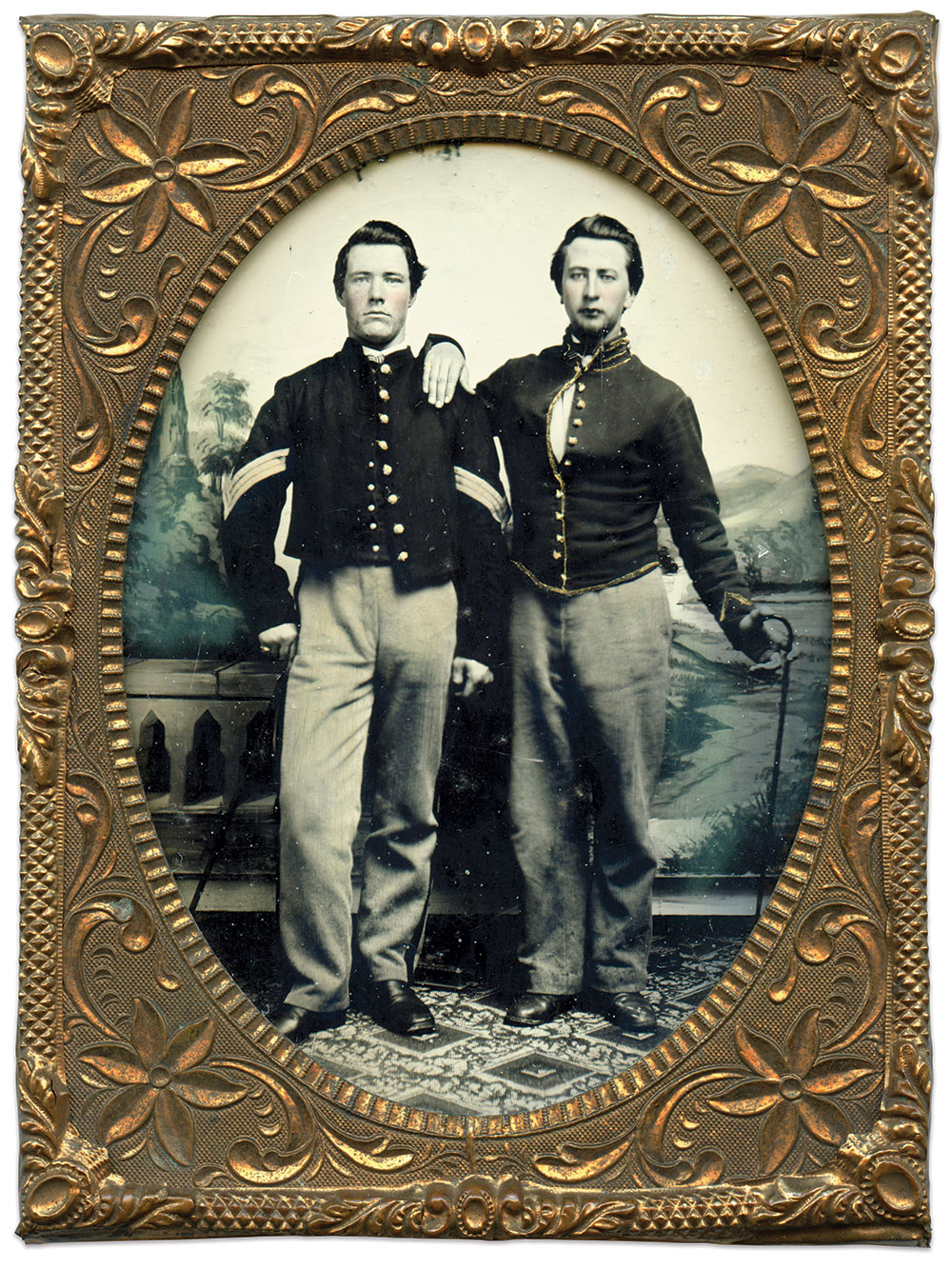
“Abe, Pull the Shuck”
At Antietam, Burlington “Burl” Cunningham, standing on the left, dashed forward under fire to save the colors of the 19th Indiana Infantry, earning a promotion from private to color sergeant. Ten months later at Gettysburg, as the regiment prepared to meet the Confederate attack on the morning of July 1, a staff officer ordered him not to unfurl the flag. Cunningham obeyed until the line formed, then turned to fellow Hoosier Abraham Jay Buckles and said, “Abe, pull the shuck.” When the banner caught the breeze, the first enemy volley struck him in the side and knocked him down. Buckles seized the colors and advanced, leaving Cunningham behind.
Hours later, to the astonishment of his comrades, Cunningham returned—the wound had stunned but not disabled him. He reclaimed the flag, only to be struck again during a renewed assault, this time severely wounded in the right leg. As Confederates passed over him repeatedly, he managed to make his way to safety.
Sent to Harrisburg, Pa., for treatment, Cunningham sat for this portrait in September 1863 with Pvt. William L. Bingaman of the 20th Pennsylvania Cavalry. Both men pose with canes.
Cunningham mustered out in September 1864 and later settled in Nebraska, where he died in 1930 at age 89. His comrade Buckles later wrote, “I can truthfully say Burlington Cunningham was as brave and gallant a soldier as the war produced.”
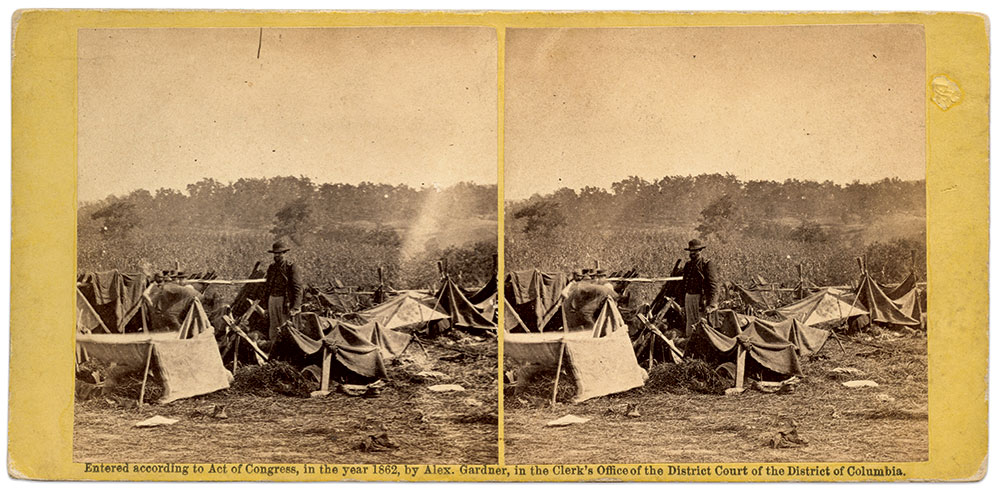
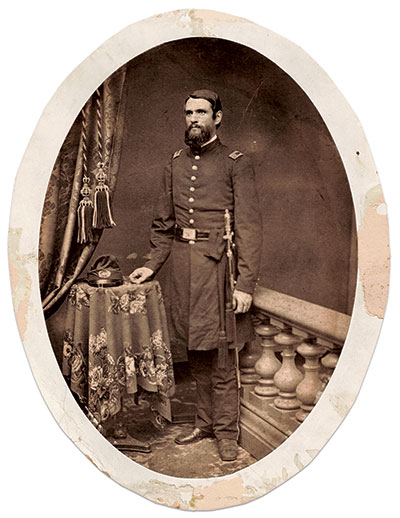
Caring for Confederates Wounded at Antietam
After Antietam, Alexander Gardner and James F. Gibson photographed Surg. Anson Hurd with patients in a field hospital on Otho J. Smith’s farm near Keedysville, Md. One of two hospitals serving Brig. Gen. William J. French’s division, it housed Confederates.
Ohio-born Hurd, 37, a warm-hearted man of efficient manners and philanthropic impulses educated at Starling Medical College, had practiced in Oxford, Ind., and served in the state legislature before the war. In 1861 he became assistant surgeon of the 20th Indiana Infantry and was promoted to surgeon of the 14th Indiana early the next year, serving at Antietam.
Two months after his Keedysville photograph, Hurd resigned due to exhaustion. In 1865 he settled in Findlay, Ohio, where he resumed practice, published medical papers, and received honorary degrees. He died in 1910, outliving two wives and survived by at least one child.
of Frederick, Md. Kevin Canberg Collection.
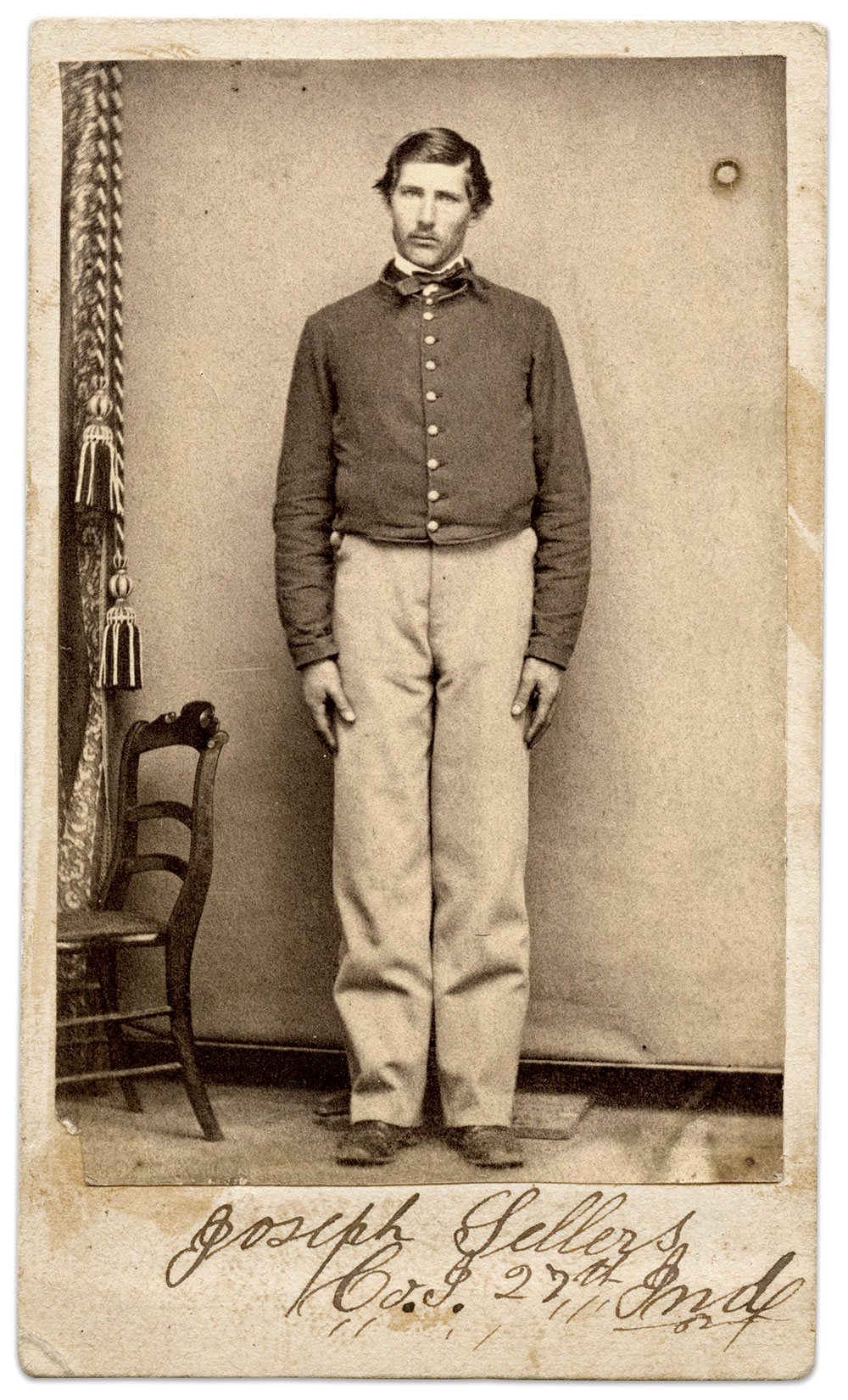
Joseph the Giant
Standing 6’3”, Joseph Sellers of Putnamville, Ind., dwarfed both comrades and the chair in this photograph gallery. A member of the 27th Indiana Infantry, he fought in major actions from Cedar Mountain and Fredericksburg to Gettysburg and later Sherman’s Atlanta Campaign after brief duty during the New York Draft Riots.
Wounded more than once, a thigh injury at Cedar Mountain spared him Antietam, but a shell took his leg at Peachtree Creek. He survived into his seventies, remembered as a respected family man. On the back of his carte de visite: “Twenty One years of age / Please be very careful to lay this in some safe place.”
The Liljenquist Family Collection at the Library of Congress.
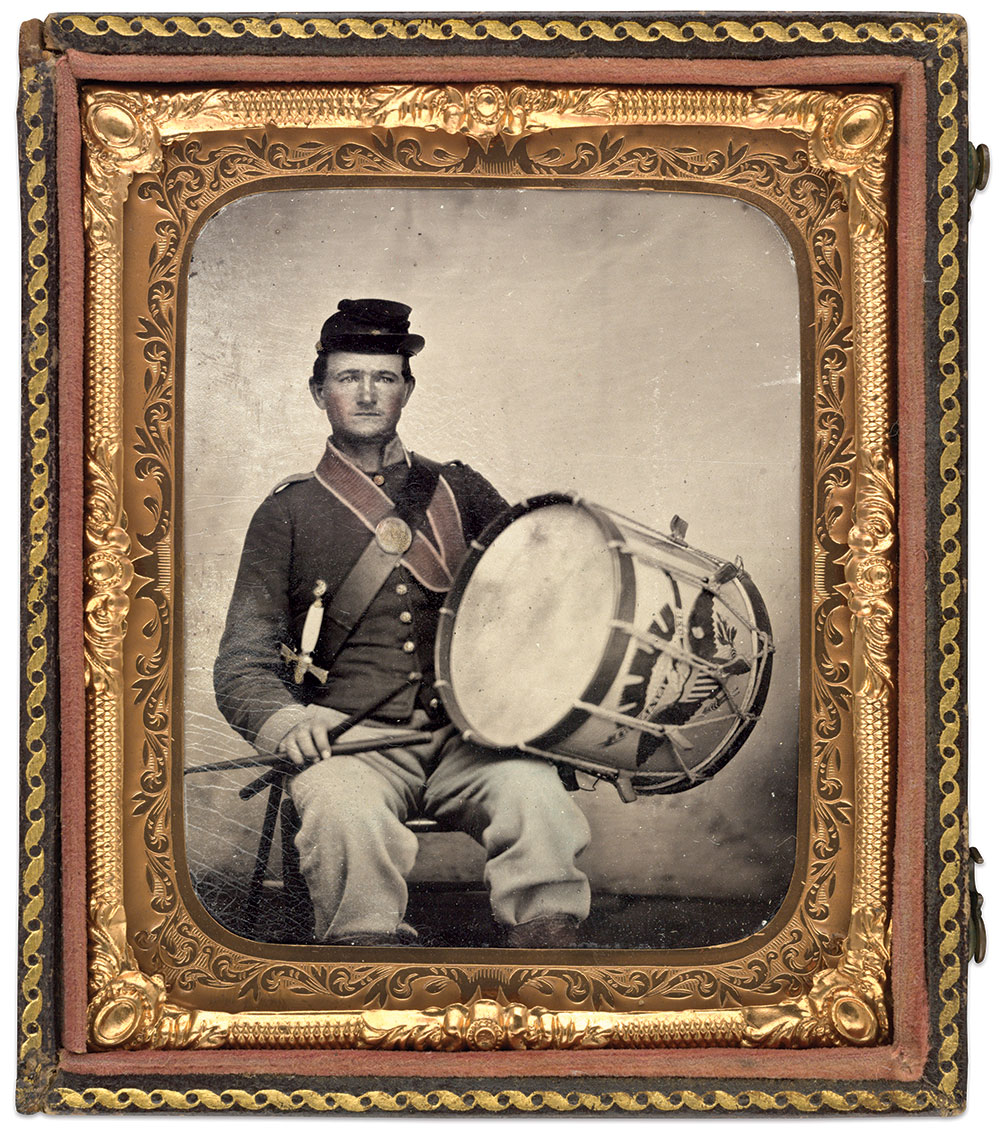
Three Months in 1862
Musician James S. Row served as a drummer in the 54th Indiana Infantry during its three-month enlistment. Row (about 1837-unknown) is pictured with a rope-tension “Eagle” field drum and a prewar knight’s-head militia sword—rather than the regulation Model 1840 musician’s sword—attached to a noncommissioned officer’s waist belt. Organized in Indianapolis, the regiment spent its first weeks at Camp Morton, the converted state fairgrounds, and the remainder in Kentucky opposing Gen. Edmund Kirby Smith’s Confederates.
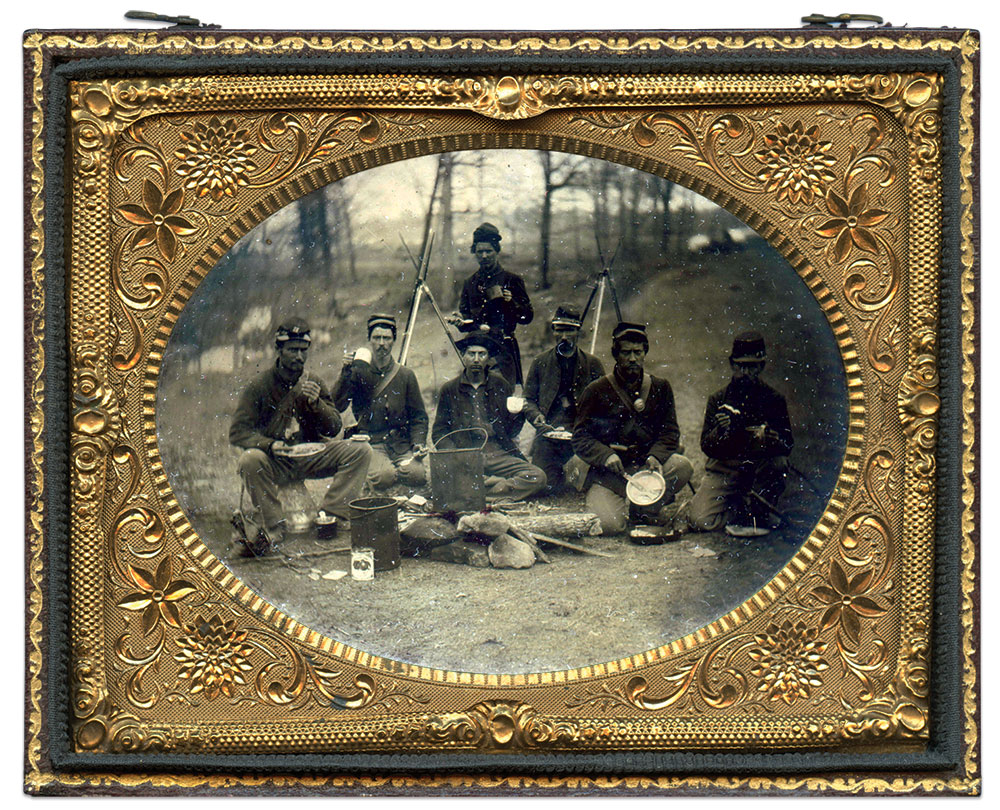
Bivouac of Mess 13
This classic camp mess scene features cooking gear and rations—stacks of hardtack, fresh bread, salt pork, and a can of fruit or vegetables. Behind the group, stacked muskets underscore the soldiers’ purpose. An inscription identifies the men as Mess 13, Company E, 12th Indiana Infantry, photographed at Warrenton, Va., where the regiment camped from April 3 to May 5, 1862, near the end of its one-year enlistment after service in the Shenandoah Valley.
Named from left are James Henry Weaver (1836–1864), Nathan Bowman McConnell (1837–1920), Lemuel “Lem” Hazzard (1842–1904), Sgt. Charles M. Davis (c. 1840–1862), George Deardorff (c. 1836–1895), Joseph S. Baker, and James H. Williams. Davis died soon after his enlistment ended. Weaver and Hazzard reenlisted and became officers. Weaver, a second lieutenant, was mortally wounded at the Battle of Atlanta on July 22, 1864.
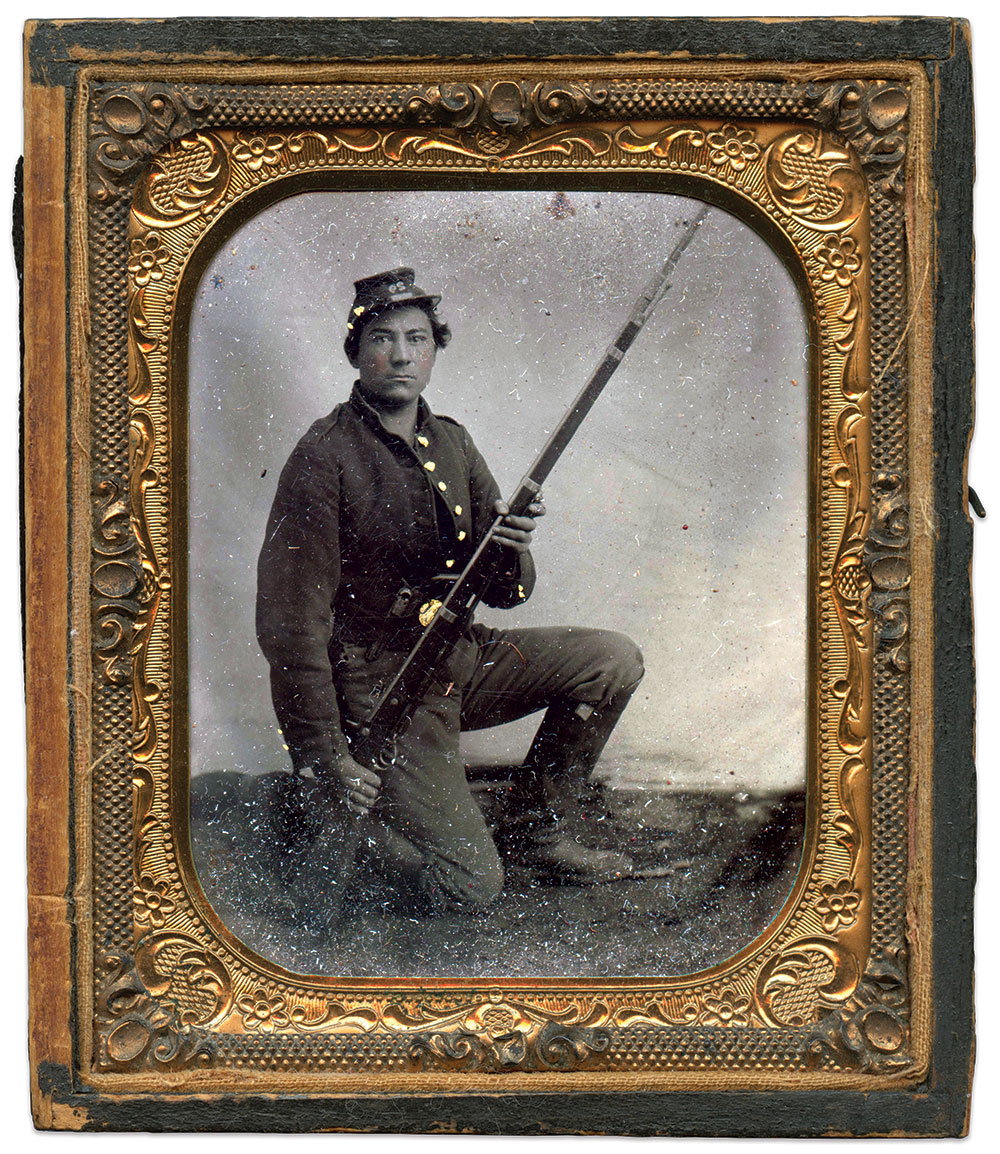
“Heavier Comes the Leaden Hail”
The 29th Indiana Infantry came under fire for the first time on the second day at Shiloh. One correspondent reported the Hoosiers fought well, charging the enemy and rallying twice under heavy musketry before holding their ground.
One of them, Jeremiah D. Snyder, a 23-year-old from Cottage Hill, Ind., completed his three-year enlistment and reenlisted for the war’s duration. Pictured kneeling with a Model 1861 Springfield rifle-musket and a Colt Model 1849 pocket revolver, he survived major battles including Stones River and Chickamauga, and mustered out as a sergeant in 1865.
After the war, Snyder became a preacher in Dakota Territory and Iowa. He died in 1900.
1863
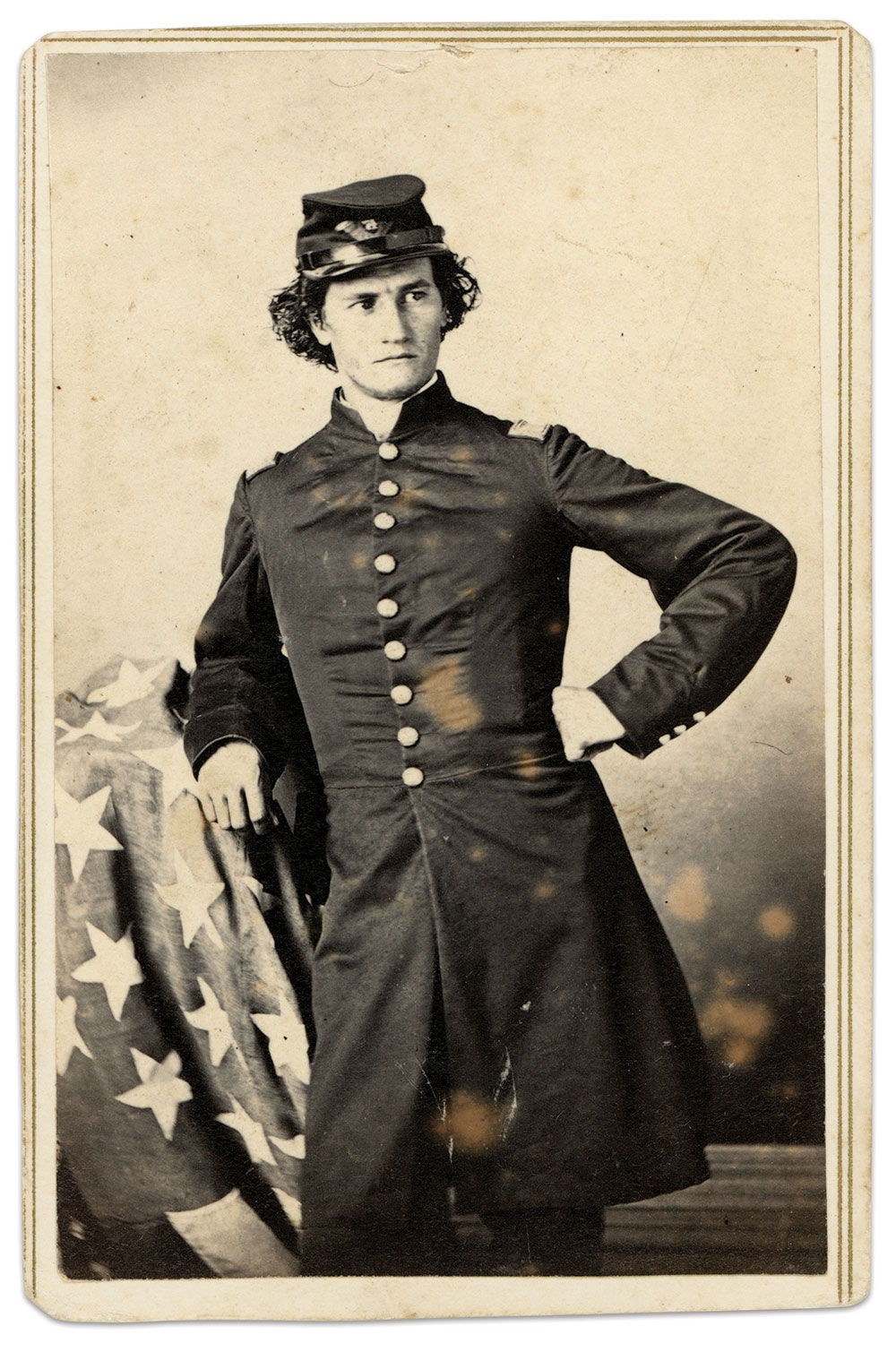
of Nashville, Tenn. Ronald S. Coddington Collection.
Wounded During the Chaos at Chickamauga
At Chickamauga on September 19, 1863, the 74th Indiana Infantry entered the fight 400 strong. After exhausting their ammunition in the morning, the men resupplied and advanced with two other regiments through dense woods about 2 p.m., driving the enemy back more than half a mile. Confederate reinforcements soon counterattacked with heavy infantry and artillery fire, forcing a retreat. The regiment lost about a third of its strength, including Capt. Andrew Staley Milice of Company A.
A peacetime bookseller and stationer in Warsaw, Ind., Milice began his service in 1861 as a second lieutenant in the state’s 12th Infantry. He had a rocky tenure, and left after the expiration of his yearlong enlistment. He returned to the army a couple months later with the 74th and prospered—until his wounding at Chickamauga. During the thick of the fight, a bullet ripped into his left shoulder. The soft lead flattened as it tore through tissue and muscles, leaving a gaping exit wound in his back. The injury ended his service.
Returning to Warsaw, he married, prospered, later moved to Riverside, Calif., and invested in an orange grove. He died in 1919 at age 80.
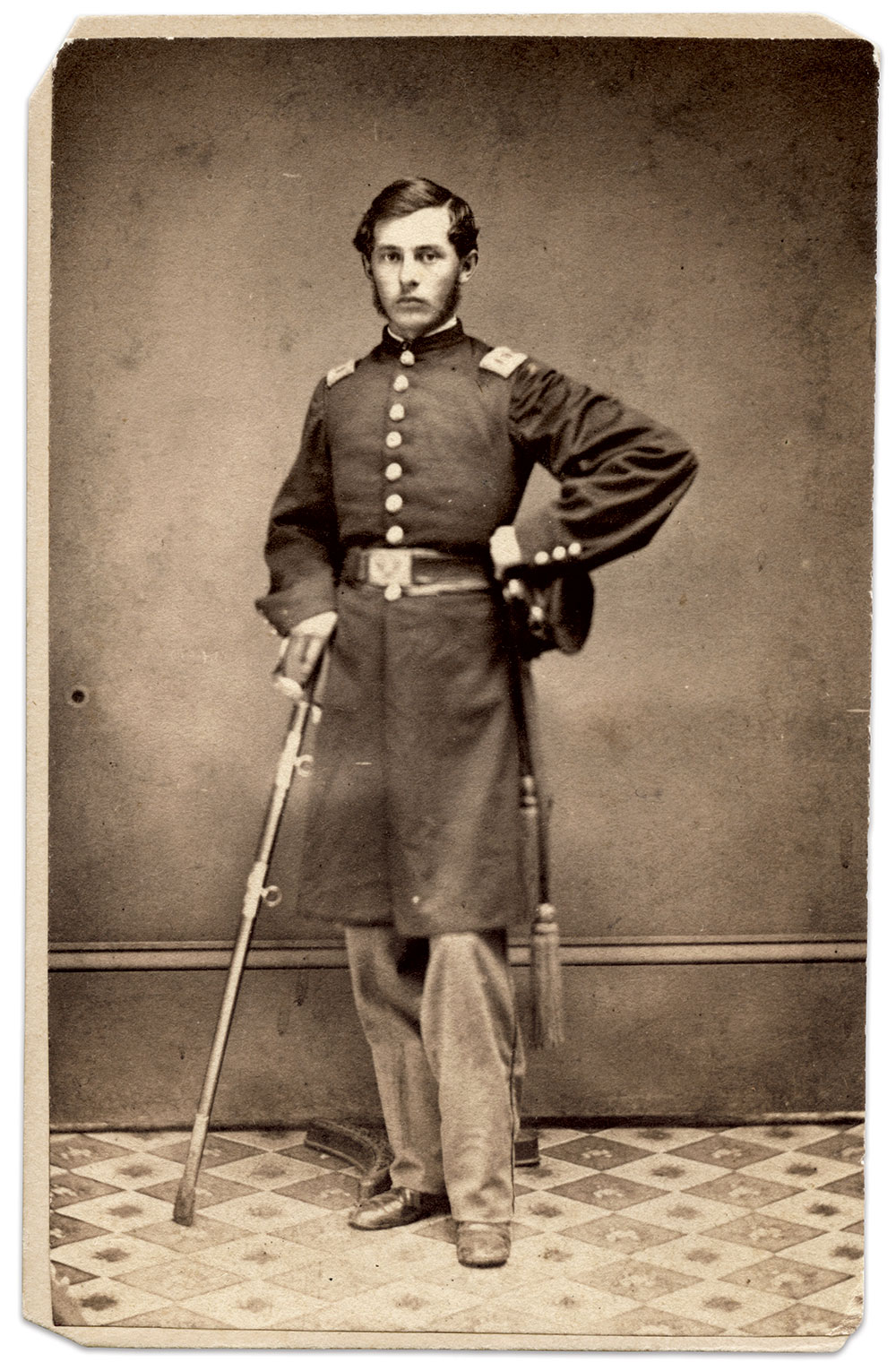
On the Steep Slopes of Missionary Ridge
Torrents of shot and shell ripped into the 12th Indiana Infantry as officers and men steadily advanced up the steep slopes of Missionary Ridge on November 25, 1863. In the middle of the maelstrom, Capt. Francis Henry “Frank” Aveline, 21, of Company B raised his sword, bent and bowed by two shots, over his head, cheering “Forward boys, keep your lines steady.” These were his last recorded words—two gunshots hit him in the head, killing him instantly. His loss sounded an especially sad chord throughout the regiment, for his comrades viewed him as one of their very best—bright, engaging, a natural leader. One friend recalled that Frank had a premonition of his death that morning.
The late captain’s father, Fort Wayne hotelkeeper Francis S. Aveline, made the trip to recover his eldest son’s remains and bring them home. Captain Aveline rests beneath an impressive monument, a broken column draped with a flag, designed by the 12th’s major, Elbert D. Baldwin, and funded by contributions from Company B. Upon the memorial is engraved Aveline’s last words and death details.
Company B went on to serve as the body guard to Maj. Gen. John A. “Black Jack” Logan. One soldier in the company attributed the honorable assignment to Aveline’s leadership, noting, “He is gone, but his works follow him.”
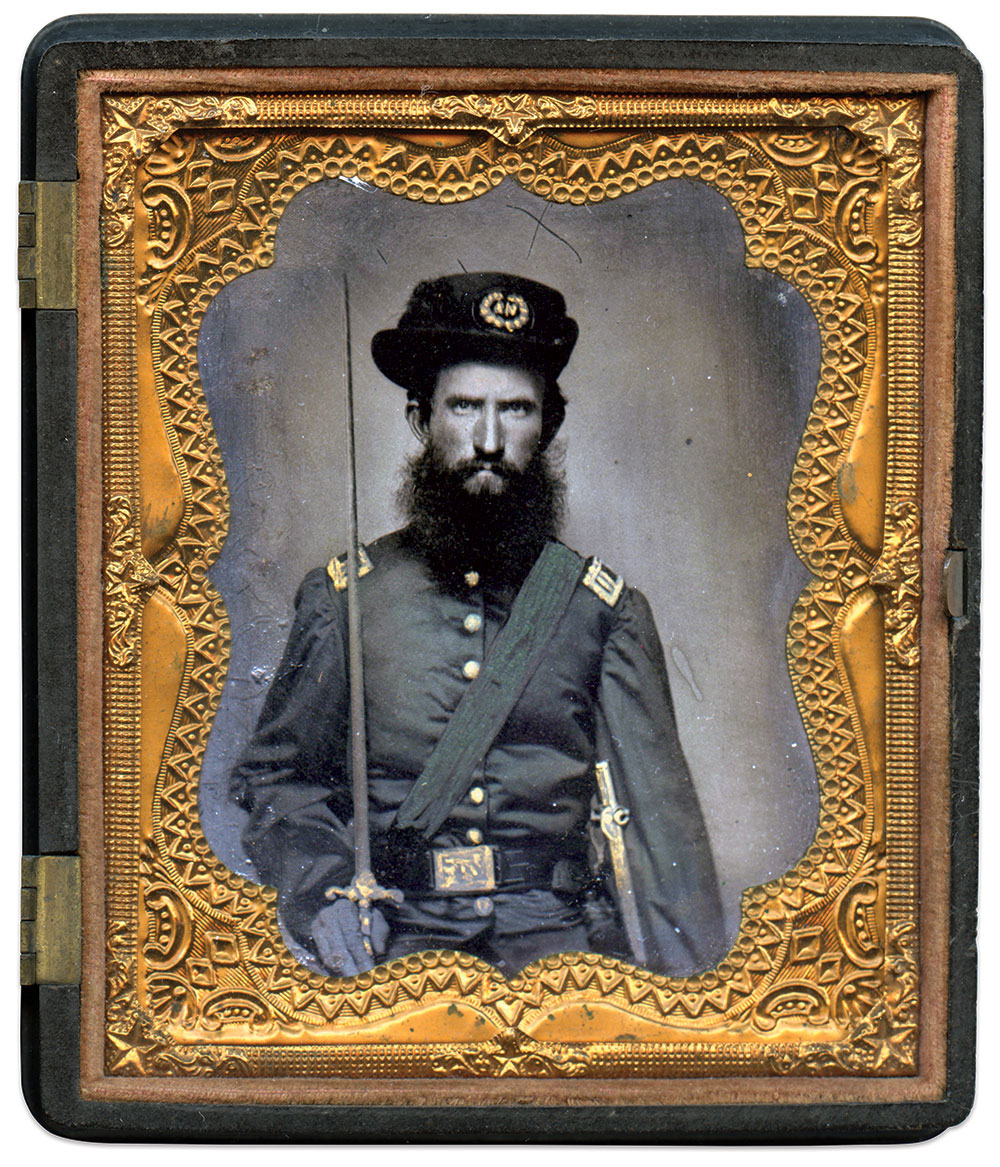
In Stonewall Jackson’s Camp
Veterans remembered Alfred B. Taylor of Kokomo, Ind., as the affable assistant surgeon who survived major campaigns—Vicksburg, Atlanta, the March to the Sea, and the Carolinas—during his service in the 12th Indiana Infantry from 1862 to 1865. Less noted is his earlier service with the same regiment from 1861 to 1862, when he held a commission as second lieutenant.
While serving in Maj. Gen. Nathaniel P. Banks’s Army of the Shenandoah, Taylor volunteered to scout Stonewall Jackson’s forces. Crossing the Potomac, he spent two weeks observing Confederate camps and mapping their positions, then swam the swollen river to report his findings. Commanders planned operations based on his intelligence, though events leading to the Battle of Ball’s Bluff on October 21, 1861, disrupted their plans.
Taylor’s courage carried him through the war. After mustering out in 1865, he became a prominent physician in Kansas City before dying of erysipelas in 1879 at age 41.
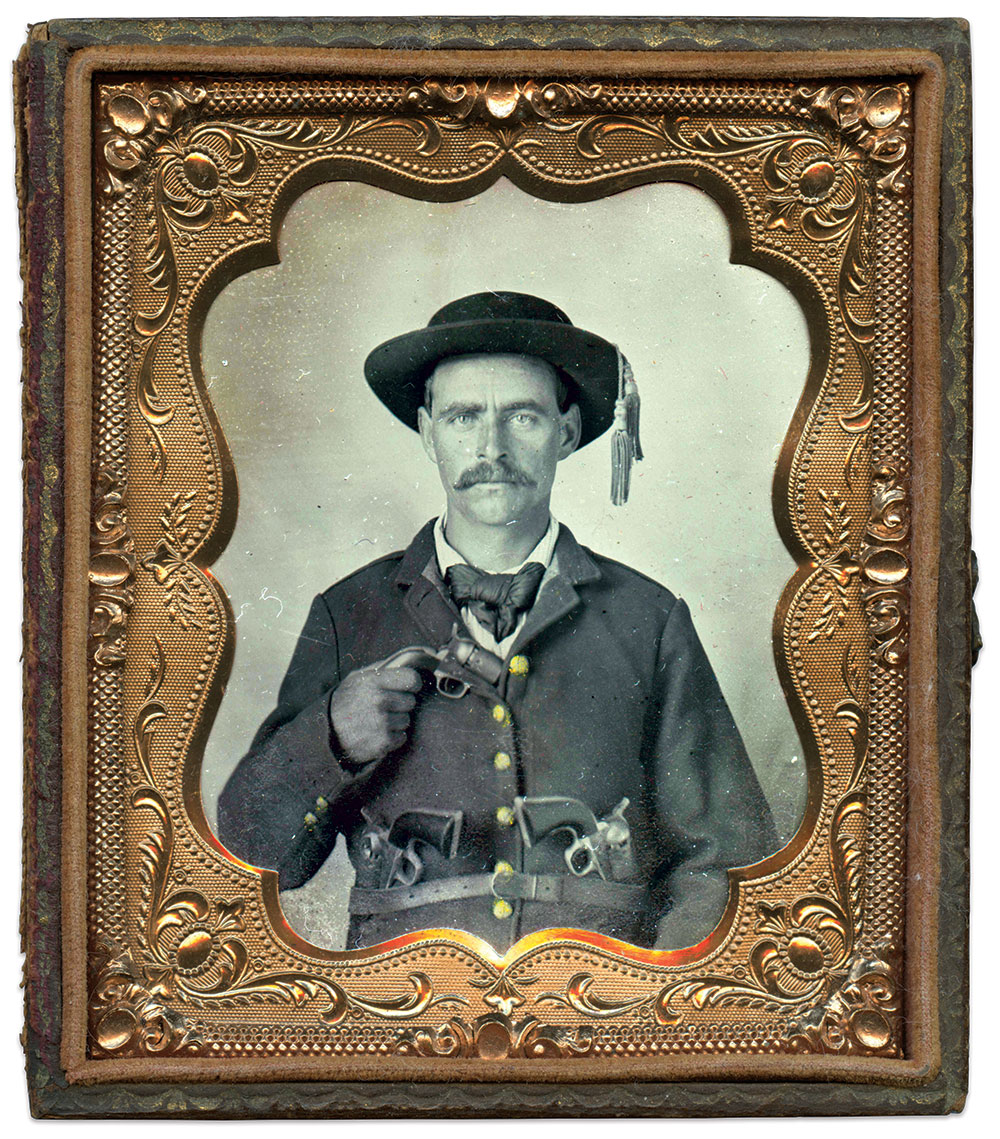
Short Term
George D. Fisher sat for this portrait after joining the 65th Indiana Infantry in August 1862. He holds a Colt Model 1849 Pocket revolver, with two Colt Model 1851 Navy revolvers tucked into his belt.
An inscription inside the case notes that he enlisted “for the term of 3 years if not sooner.” His service ended sooner—he died of disease in 1863.
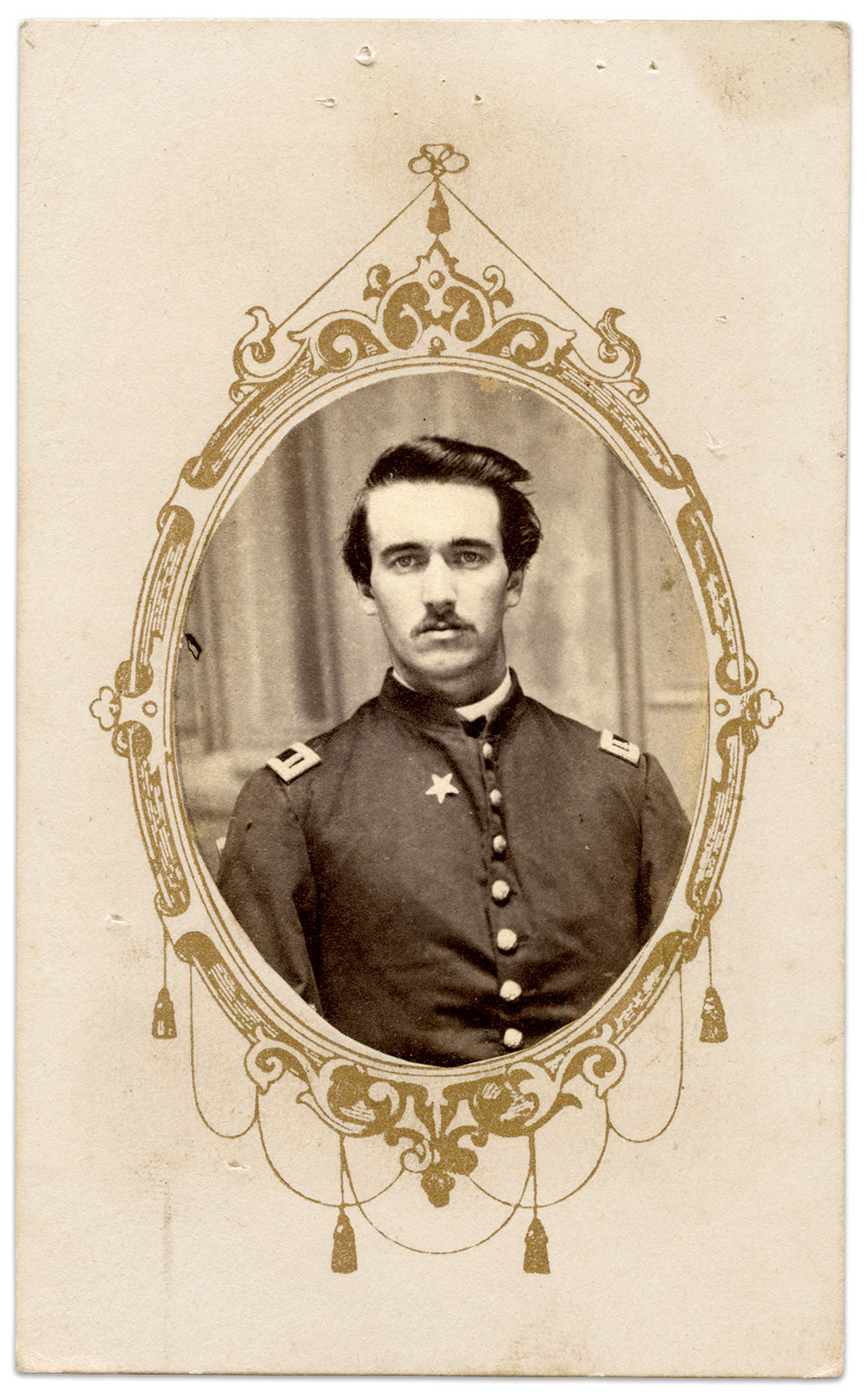
The “Educated Young Man” Who Realized the Importance of Lee’s Lost Orders
The discovery of Gen. Robert E. Lee’s Special Order 191 on September 13, 1862—later known as the Lost Orders—proved one of the most consequential intelligence breaks of the war. The document, found by three soldiers of Company F, 27th Indiana Infantry, helped shape the Maryland Campaign and the fighting at Antietam days later.
Pictured here is the senior man among them, Sgt. John McKnight Bloss, a peacetime schoolteacher from New Philadelphia, Ind. Years later, he recalled that he and his comrades were within sight of Frederick, Md., when they lay down to rest beneath the shade trees along an old fence row. While chatting with Corp. Barton Warren Mitchell, a long yellow envelope hanging in the tall grass caught his attention. Bloss asked Mitchell, who was closer to it, to hand the mysterious envelope to him. But before he could do so, Pvt. David Burr Vance reached over, picked it up, and passed it to Bloss.
“In handing it to me, two cigars fell out,” Bloss recalled, “one of which Mr. Mitchell immediately proceeded to smoke, while I read the document aloud. I saw that it was of great importance, if true.” Thus began the journey of the Lost Orders up the chain of command to Maj. Gen. George B. McClellan.
Days later at Antietam, all three men were wounded: Sgt. Bloss in both legs, Corp. Mitchell in the left calf, and Pvt. Vance in the right hand and left knee. All survived. By the time Bloss left the army in 1864, he carried scars from four battles and held the rank of captain. He died in 1905. Mitchell barely lived to enjoy peace, dying in 1868. Vance later left the regiment to become an officer in the 117th Indiana Infantry and lived the longest of the three, dying in 1917.
Inhumanity
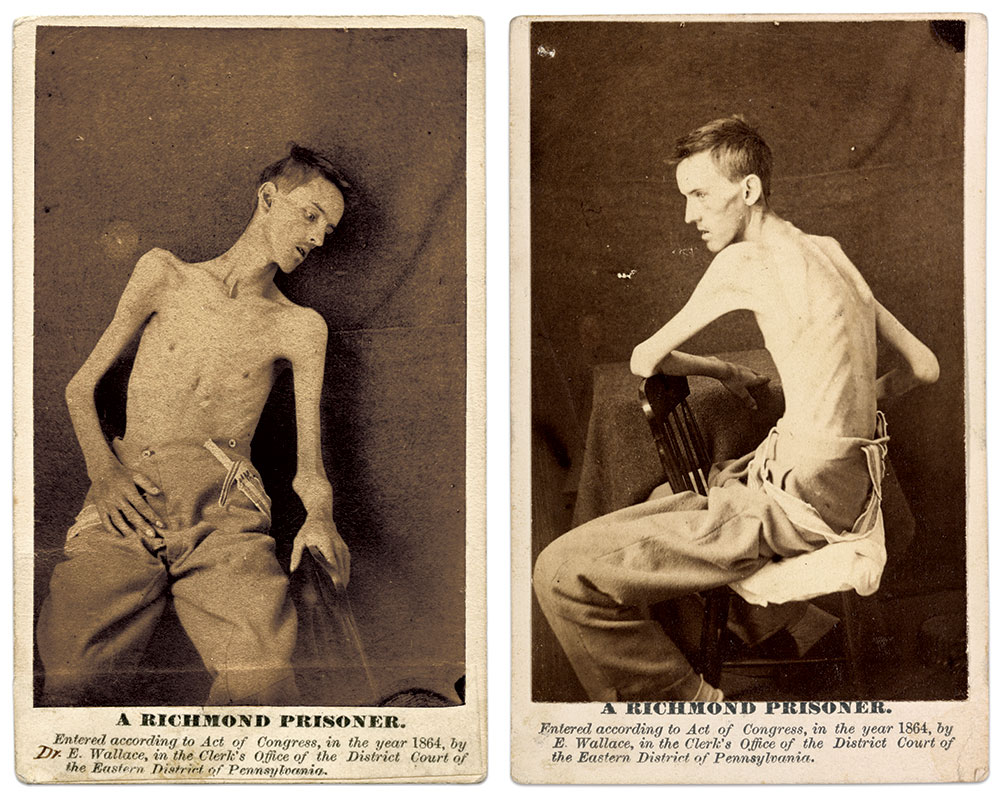
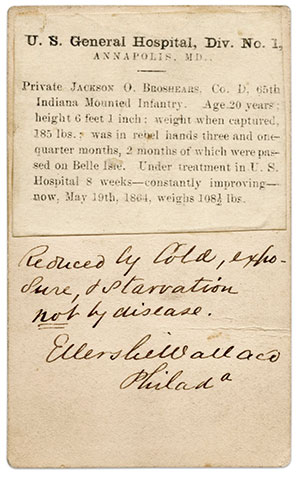
On or about Dec. 16, 1863, Pvt. Jackson Orleans Brashears of the 65th Indiana Infantry fell into enemy hands near Cedar Ford Mills, Tenn.—likely one of a dozen enlisted men from the regiment captured during the Battle of Bean’s Station and the subsequent action at Blain’s Crossroads at the end of the Knoxville Campaign. A strapping 6-foot-1-inch farm boy from Spencerville, Ind., Brashears had left home to enlist in the summer of 1862. The Hoosiers soon departed the state for Kentucky and Tennessee, engaging in active operations against guerrillas and enemy forces in the fight for Knoxville.
Following his capture, Brashears was transported to Richmond and imprisoned at Belle Isle. Exposed to cold, wet weather beneath a badly-torn Sibley tent with other prisoners, guards stripped him of his warm uniform, blanket, and equipment, replacing them with threadbare items. He subsisted on crumbs of corn bread as hunger gnawed at him around the clock. Over the course of two months, the once-healthy 185-pound youth wasted away. “I lost my appetite, and then the weakness came—oh, so bad, so bad!” he later told officials. Reduced to little more than a skeleton, Confederate paroled him.
Brashears arrived at the U.S. military hospital in Annapolis, Md., on March 24, 1864, his appearance shocking staff as other soldiers in similar condition began to arrive. In early May, Ellerslie Wallace, a Philadelphia physician and U.S. Sanitary Commission officer, met Brashears. “I carried this man downstairs in my arms,” Wallace recounted, “for he could not walk without support, and I weighed him May 10th; his weight was 108½ pounds.” Wallace added that Brashears was not suffering from any terminal illness, making clear that the sole cause of his condition was mistreatment by his captors.
Several photographs were made during the sitting and circulated widely, including Harper’s Weekly and Leslie’s Illustrated Newspaper, both of which published engravings of the emaciated prisoners, including Brashears, in their June 18, 1864, issues. Wallace’s understanding of photography’s power as documentary evidence exposed the suffering at Belle Isle and later at Andersonville, fueling public outrage and indignation.
Sent home to Spencerville, Brashears lingered until October 15. His mother, Ruth, who was with him at the end, later received a government pension for her son’s service.
Teen at Champion Hill
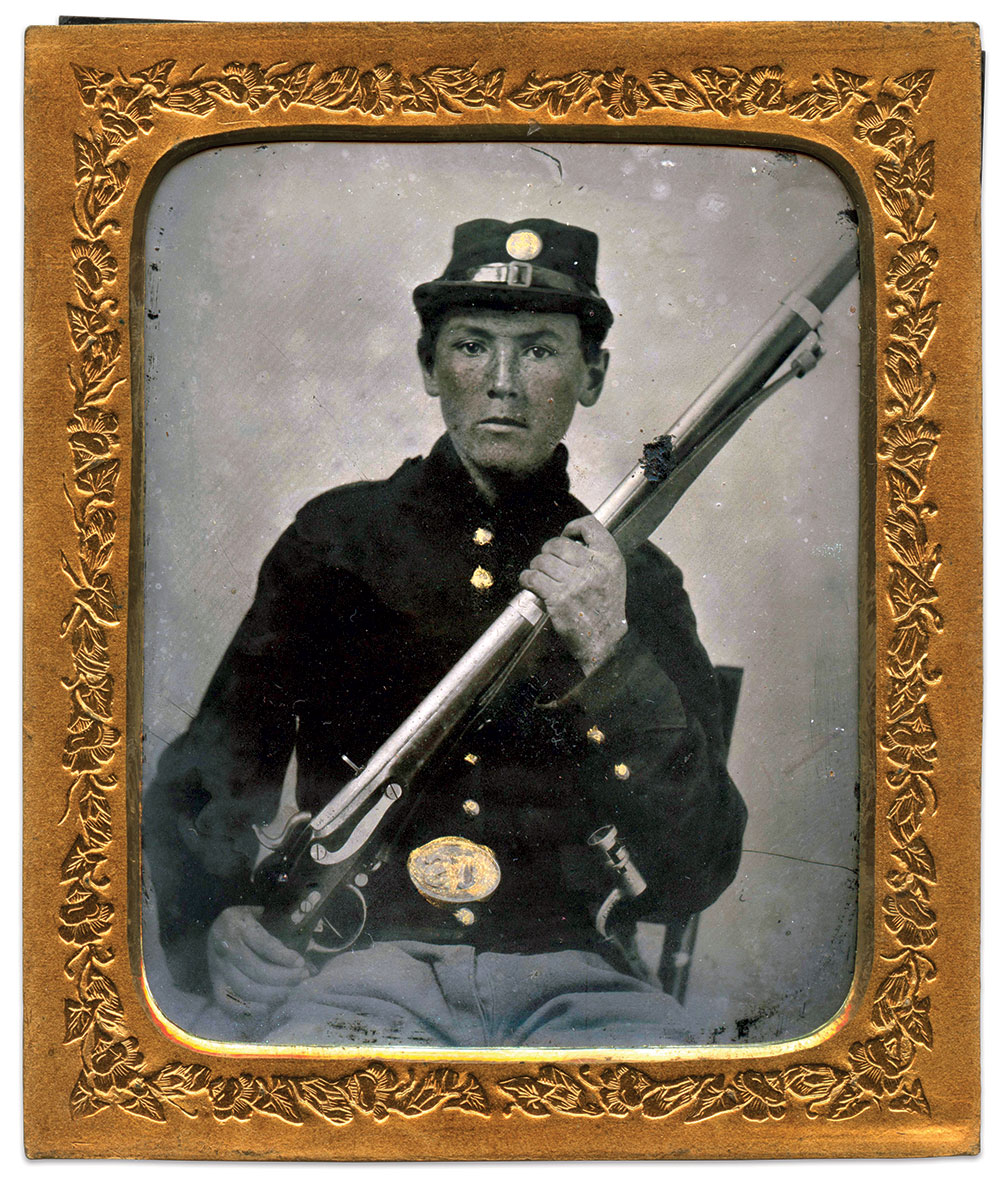
Daniel W. Thompson was about 16 when he left his widowed mother and three sisters in Oswego, Ind., in January 1862 and mustered into his home state’s 48th Infantry. He posed for this portrait brandishing a German Badenian rifled musket, Model 1813/40/52, Type 3, and wearing what may be an identification disc on his cap.
The 48th fought at the Battle at Iuka, Miss., in September 1862 and then the Vicksburg Campaign, including the pivotal engagement at Champion Hill on May 16, 1863—Thompson’s final fight. The whereabouts of his remains are unknown.
Veteran Volunteer
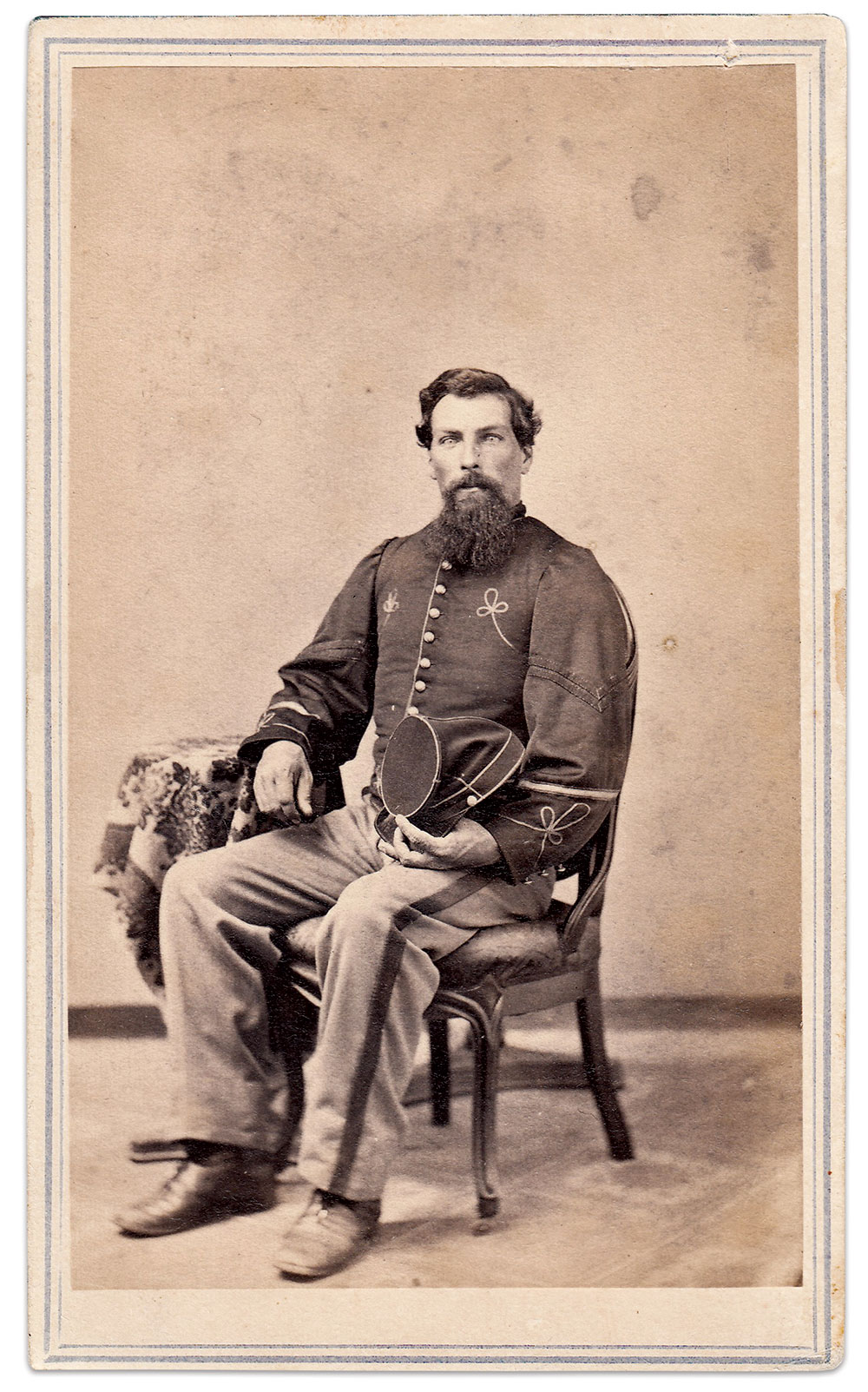
Corporal Silas Siscel of the 49th Indiana Infantry posed for this portrait wearing a quasi-Zouave uniform issued to Veteran Volunteer Regiments in late 1863 and early 1864 to honor their status and boost esprit de corps.
A veteran of the Vicksburg Campaign, he later served in Louisiana. Siscel survived the war, returned to Boonville, Ind., and died in a Soldiers’ Home in 1907 at age 77.
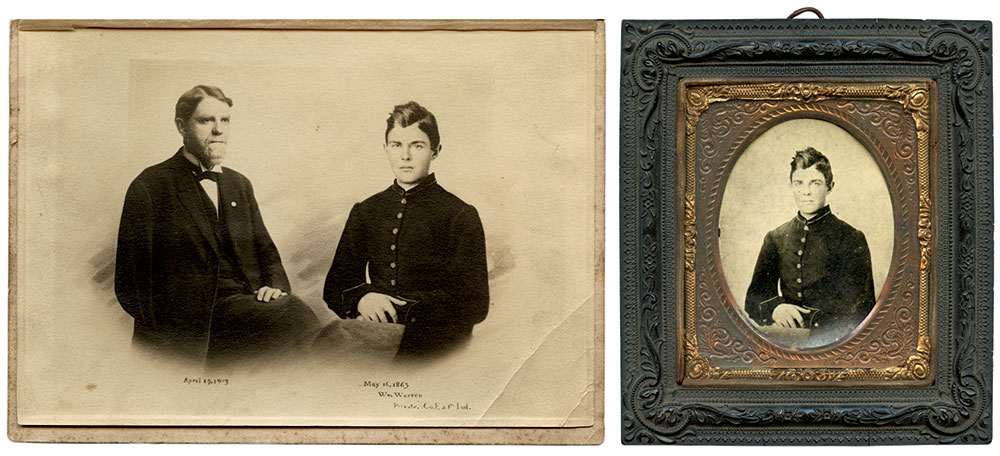
“Brave of the Bravest” at Champion Hill
The 24th Indiana Infantry lost 207 of the 500 men who marched into battle at Champion Hill on May 16, 1863—the pivotal engagement of the Vicksburg Campaign. The wounded included Pvt. William A. Warren of Company F. With his arm shattered by enemy lead, Warren lay on the battlefield with no food or shelter, exposed to the elements, until medical personnel found and loaded him into a mule-drawn ambulance.
Warren later recalled that the ambulance bumped along the hilly roads and how he was thrown out when a broken door latch failed. “I dragged myself over to the edge of the road,” Warren recalled. “I was suffering from a high fever, and the cool ground aided in lowering my temperature. A drenching rain poured down that night and washed my wounds. That saved my life.”
Rescued the next day by a passing ambulance and transported to a military hospital in St. Louis, surgeons amputated the damaged limb. A second amputation followed. During his recovery, Warren learned of the surrender of Vicksburg. He received an honorable discharge in October 1863. His captain endorsed Warren’s discharge: “His conduct has been uniformly good. He has been prompt and zealous in the discharge of his duties in camp and as brave as the bravest in battle.”
Warren went on to a long career as a bank cashier. A lover of flowers and active in veterans’ affairs, he lived until 1937, dying at age 94. He outlived his first wife and was survived by his second wife and several children.
1864
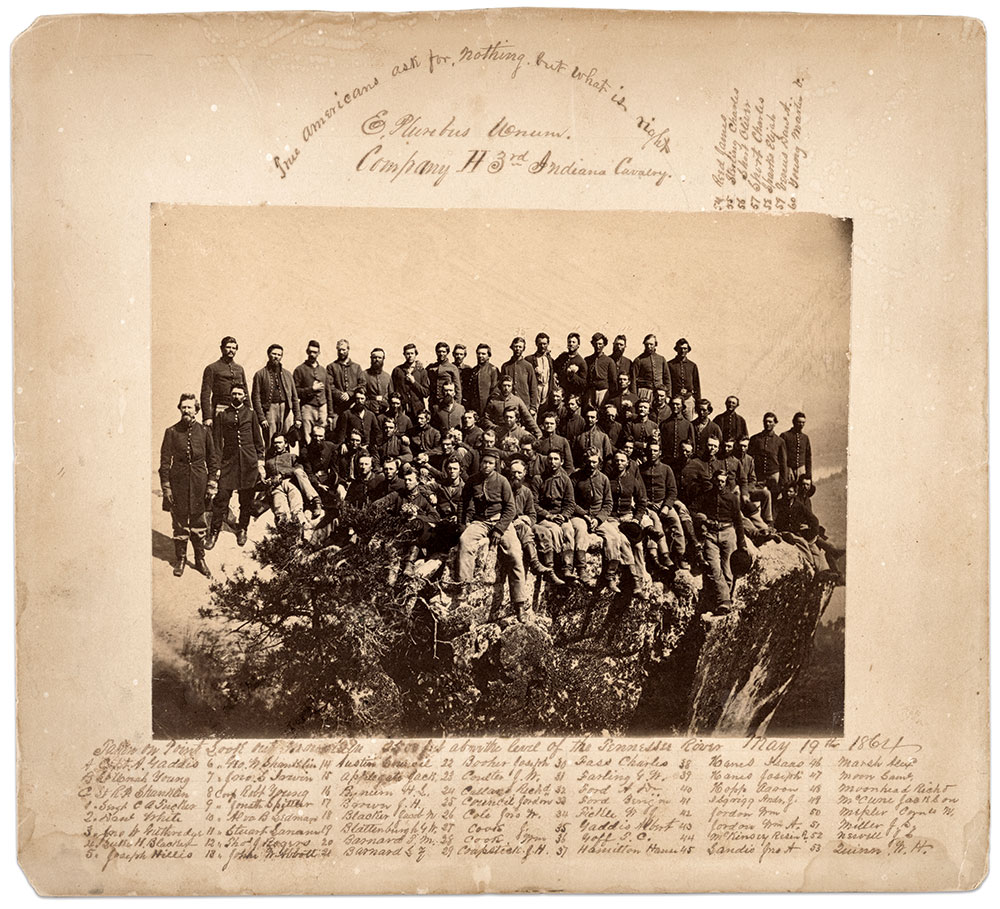
“True Americans Ask for Nothing But What Is Right”
Capt. Alfred Gaddis, at left, and Company H, 3rd Indiana Cavalry, posed for this portrait at Point Lookout overlooking Chattanooga, Tenn., on May 19, 1864. Organized in 1861, the regiment served in two wings—six companies in the East and four, including Company H, in the Western Theater. Gaddis (1821–1901), a Pennsylvania-born merchant of Frankfort, Ind., recruited the company from Clinton County in 1861. Company H spent most of its service in Kentucky and Tennessee. Soon after this photograph was taken, Gaddis was promoted to major, and the command joined the Atlanta Campaign with Brig. Gen. Hugh Judson Kilpatrick’s division of Maj. Gen. William T. Sherman’s cavalry.
An inscription on the reverse shows the image was sent to his wife, Martha Jane, suggesting Gaddis may have chosen the patriotic mottoes, “True Americans Ask for Nothing but What Is Right” and “E Pluribus Unum.”
The Liljenquist Family Collection at the Library of Congress.
“We Celebrated the 4th With a Fight”
A trooper in the 5th Indiana Cavalry wrote to the Indiana Herald on July 9, 1864, describing hard campaigning toward Atlanta. “We celebrated the 4th with a fight—lasting from sunrise until dark,” he reported, driving the enemy four miles through woods, marshes, and fields to within twenty yards of their works. The action left four wounded, including Orderly Sgt. Albert Seymour Brownson of Company D, struck severely in the right shoulder.
Brownson first enlisted in April 1861 with the 12th Indiana Infantry for a one-year term. He is pictured here in the regiment’s early Zouave uniform—its plain jacket later replaced by a more elaborate version—with a Colt Model 1849 Pocket revolver tucked into his belt.
After his wounding, Brownson was taken to a hospital in Chattanooga, where he died on August 19, 1864, at about age 23. He is buried in Chattanooga National Cemetery.
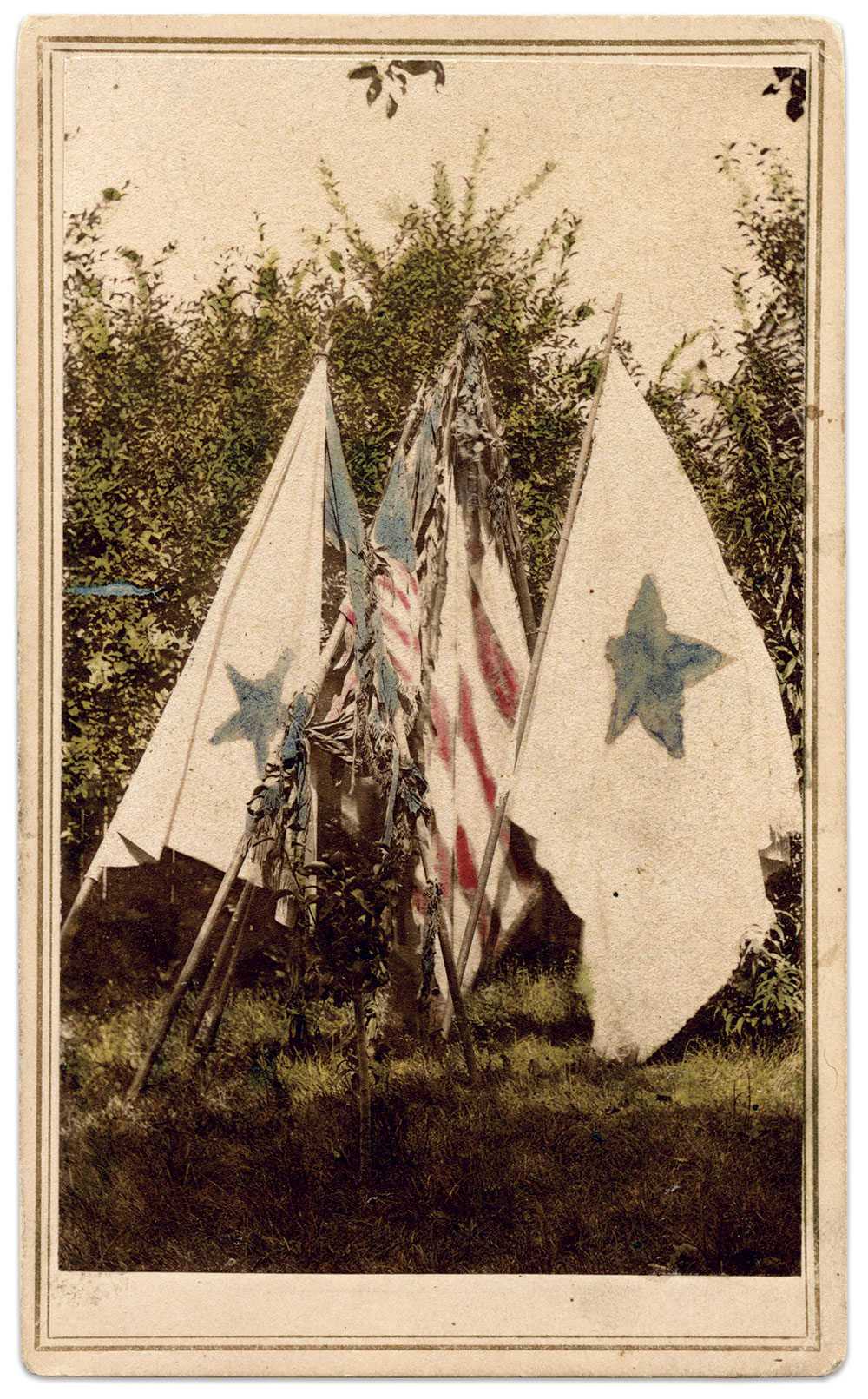
Wildcats and Blue Stars
During the 33rd Indiana Infantry’s three years and ten months of service, its men and officers campaigned across five states. The Hoosiers won their first laurels—and their “Wildcats” nom de guerre—at the Battle of Camp Wildcat in Kentucky; suffered capture by Nathan Bedford Forrest’s forces at Thompson’s Station in Tennessee; endured heavy casualties at Peachtree Creek and other operations during the Atlanta Campaign; marched with Maj. Gen. William T. Sherman to the sea and through the Carolinas; and concluded their service in the Grand Review at Washington, D.C.
This image commemorates the Wildcats’ service to their country as part of the Blue Star Division (Third Division) of the 20th Army Corps, to which the 33rd belonged from April 1864 through the end of the war.
From Gettysburg to Andersonville
The 19th Indiana Infantry lost almost two-thirds of its number on the first day of the Battle of Gettysburg. For one of those missing and captured, James Dever of Marion County, Ind., a sergeant in Company F, Gettysburg marked the beginning of a long journey as a prisoner of war that ended in his death from gastroenteritis at Andersonville on September 19, 1864. He was about 22 years old. Dever’s remains rest in grave 9,236 in the national cemetery.
Do or Die at Franklin
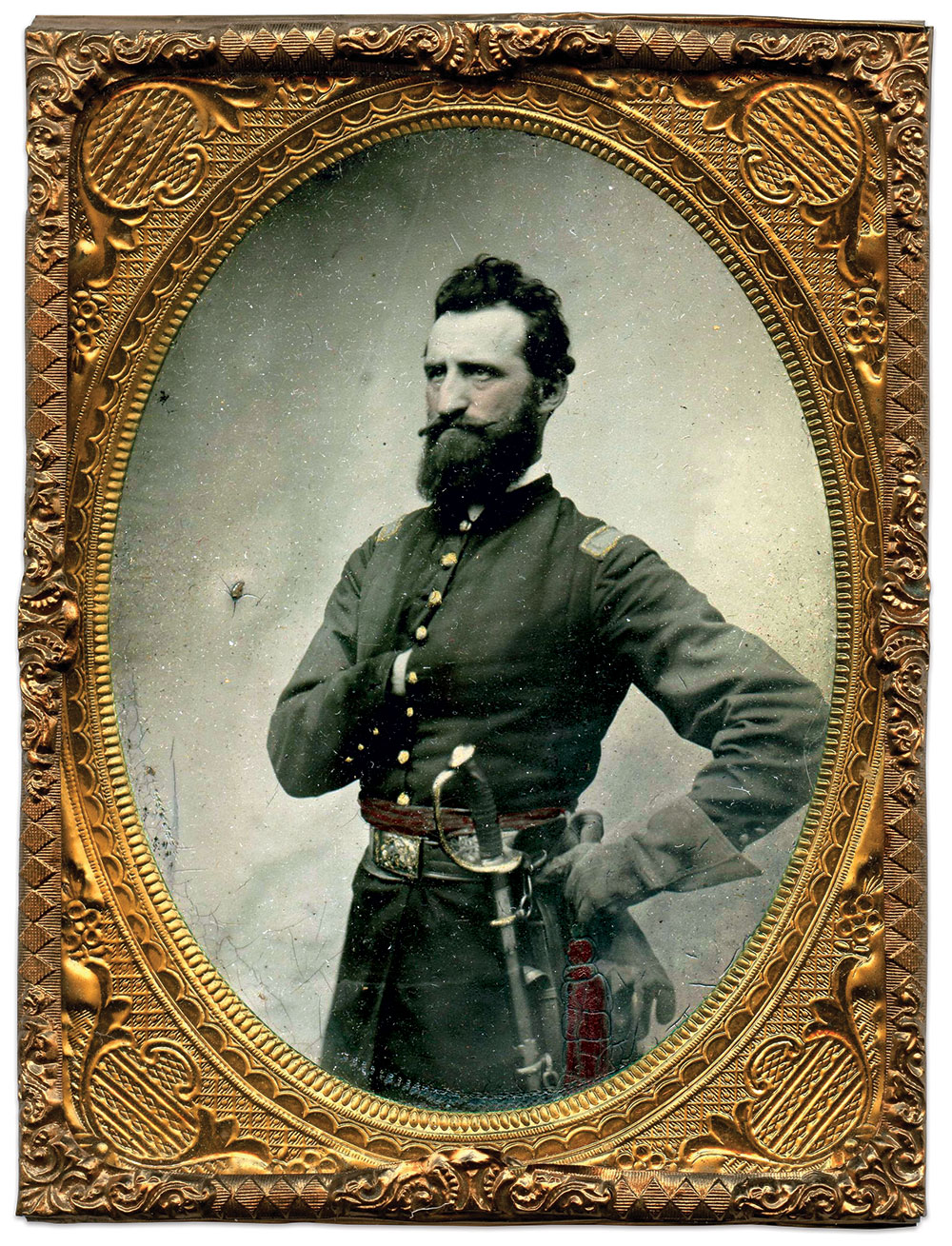
On December 3, 1864, three days after the Union victory at the Battle of Franklin, 1st Lt. Daniel Royse wrote, “We have seen the battles of Shiloh, Stone River, Mission Ridge, Perrysville, Jonesboro and others, yet such a fight as we had at Franklin we never before witnessed. Had we been driven from our lines across the river we should have been utterly destroyed. Every man felt that it was to do or die, to be victory or destruction, and the troops fought with a desperation bordering upon madness. They knew that more than two to one were against them. It was fight till we conquered, and then made good our retreat to join the balance of our army, or attempt a retreat with a victorious enemy upon us.”
Royse, an Ohio native who practiced law in Lafayette, Ind., began his army service in early 1862 as sergeant major of the 40th Indiana and advanced to first lieutenant and adjutant. He suffered minor wounds during the Atlanta Campaign: At Resaca, a shell fragment struck his left arm, and at New Hope Church, a musket ball grazed his head.
At Franklin, Royse served as an aide-de-camp to Brig. Gen. George D. Wagner, a fellow Hoosier in command of a division. His leadership came under criticism from fellow general Jacob Cox, though other officers defended Wagner’s conduct.
After the war, Royse returned to Lafayette and law, and rose to clerk of the state’s Supreme Court before his sudden death in 1881 at age 49.
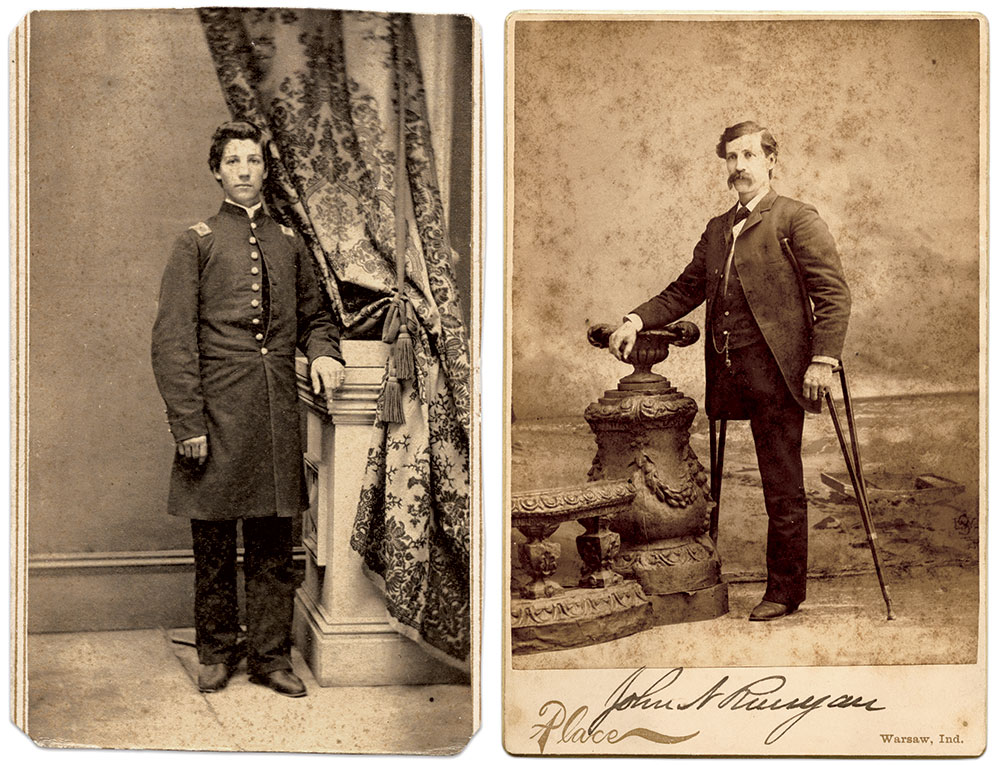
both of Warsaw, Ind. Rick Brown Collection of American Photography.
Severely Wounded in Front of Kennesaw
The 74th Indiana Infantry spent June 14, 1864, skirmishing near Marietta, Ga. Only one man was wounded: A Minié ball struck 18-year-old 1st Lt. John Nelson Runyan of Company A in the right leg. He had enlisted three years earlier—at age 15—for a one-year term in the 12th Indiana Infantry, then joined the 74th as a sergeant. One writer noted, “The seasoning process through which recruits must pass was a severe one for these boys, but they grew strong and became the most valuable and efficient soldiers.”
Runyan became an officer, and his service ended with an amputation and recuperation at a hospital on Lookout Mountain in Chattanooga. He telegraphed his father, Peter, at home in Warsaw, who came to his side. Unimpressed with the hospital quarters, Mr. Runyan arranged for his son’s care in the home of a loyal Union family.
Runyan later recalled, “One day while thus seated, the ligature sloughed off the artery and the blood spurted all over bed and wall. The lady gave a war whoop, I gave a yell, and soon the room was full of people. Quick action with a tourniquet stopped the flow of blood and my life was saved. A few days after, my father arranged to take me home, which was done by placing me on a cot, hiring men to carry it to and from trains, and transporting me in an express car.”
Runyan survived the journey home and went on, in 1886, to become postmaster of Warsaw, a position his father had held years earlier by appointment of Abraham Lincoln. Runyan lived to age 78, dying on Christmas Day, 1924.
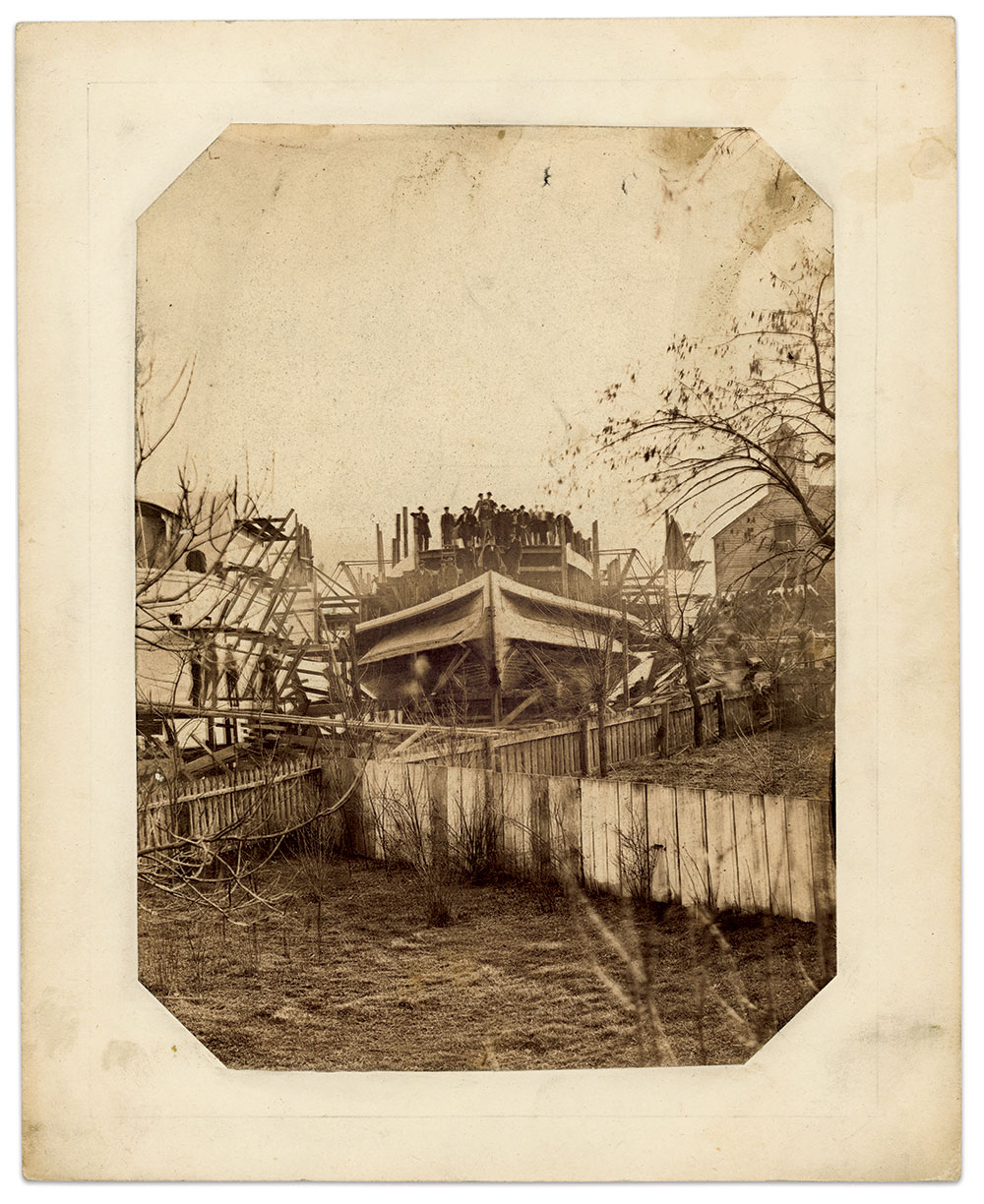
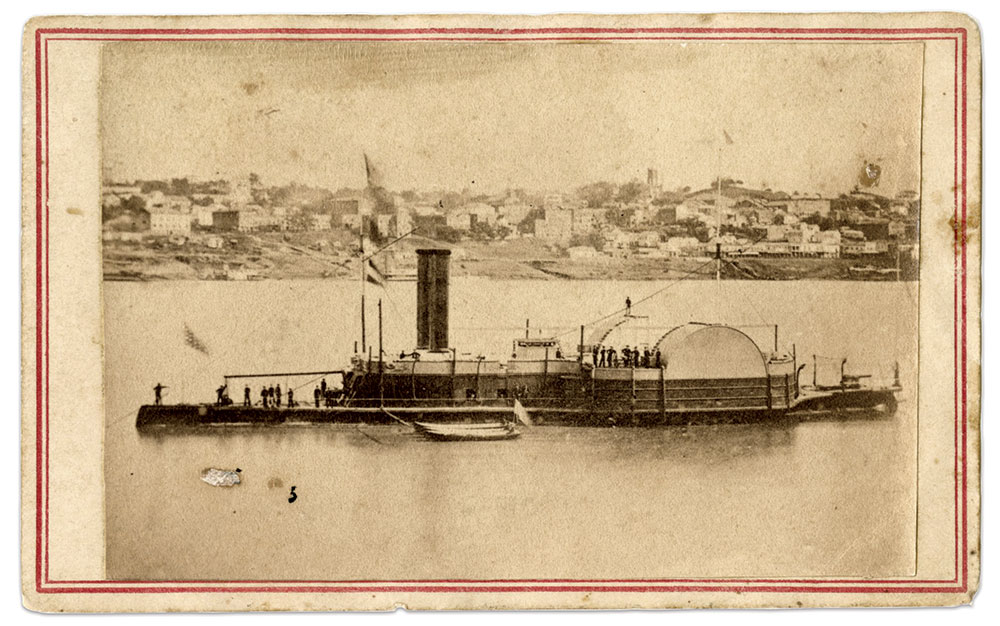
The Ram Vindicator on the Stocks at New Albany
The U.S. steam ram Vindicator is pictured here an hour before it slid into the Ohio River at New Albany, Ind., on January 28, 1864. On hand for the launch was Roland J. “Rollin” Germain of Buffalo, N.Y., a lawyer and inventor. His interest in the power and speed of steam engines resulted in patents and design changes to the Vindicator and a sister vessel, the sidewheel ram Avenger. Both vessels joined the Mississippi River Squadron and participated in numerous operations as part of the Brown Water Navy. 1871 proved a fateful year for the inventor and his rams—the decommissioned Avenger ceased operations, the Vindicator, now a ferry boat, suffered severe damage in a tornado, and Germain died in a railroad accident.
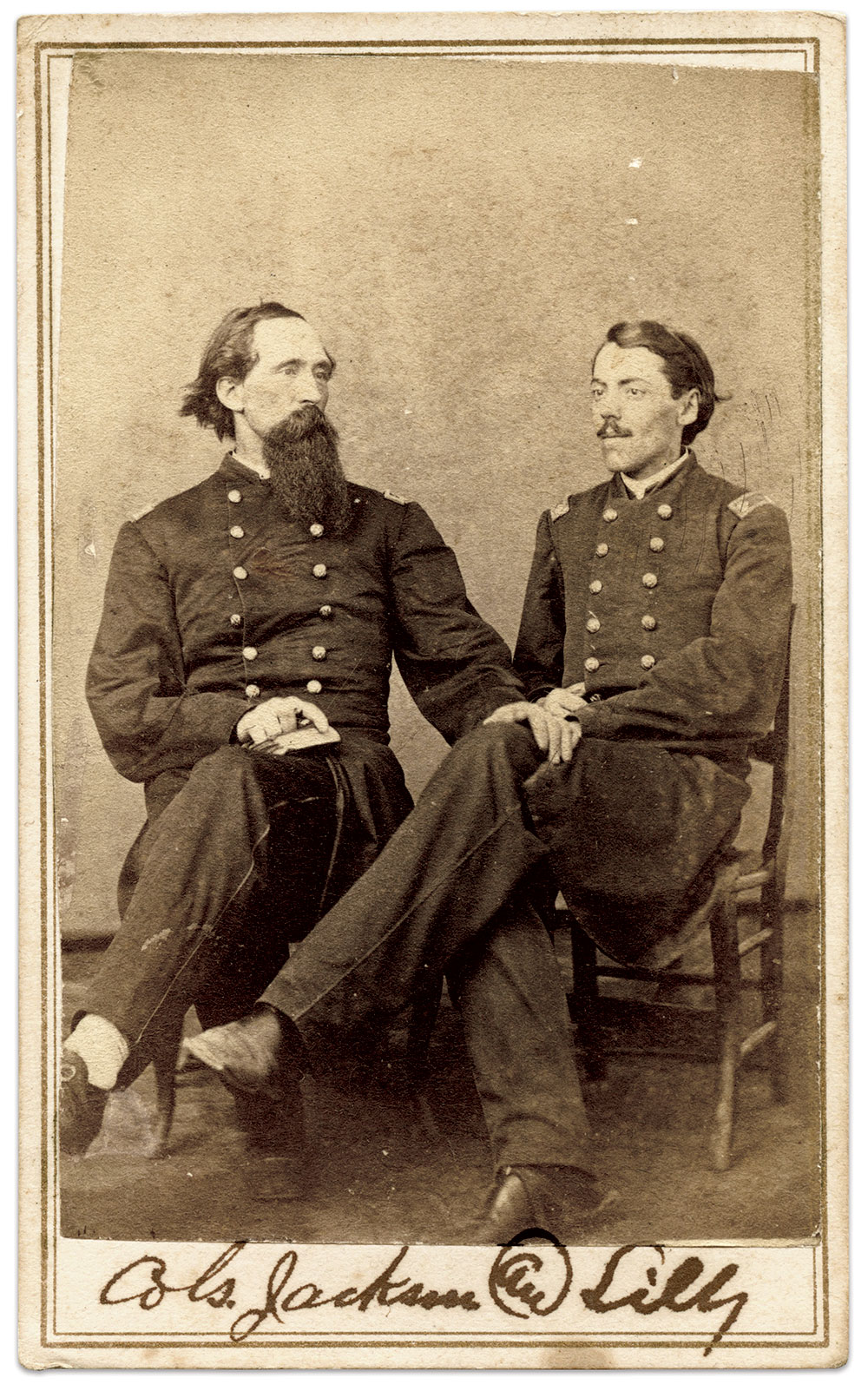
Two Gallant Leaders, Two Different Personalities
To these two officers belongs a significant share of the credit for organizing the 9th Indiana Cavalry in mid-1864. Both were respected veterans of earlier Hoosier regiments.
George W. Jackson, on the left, the senior commander, was known as the “Old Colonel,” though only 32 years old. Intelligent but not formally educated, he possessed a nervous disposition, prone to irritability, that sometimes led him to say or do things that gave offense. Yet he could be generous to his friends and was always a leader in combat. After the 9th mustered out, Jackson disassociated himself from his former command. He died in 1912.
Seated beside him is the 9th’s original major, Eli Lilly, seven years Jackson’s junior. Educated at Indiana Asbury University (now DePauw) and having completed an apprenticeship as a chemist and pharmacist, Lilly brought his abilities as a hustling entrepreneur to the regiment. After the war, he founded the pharmaceutical company that bears his name, became a major civic leader and philanthropist, contributed to the regimental history, and remained active in veterans’ affairs until his death at age 59 in 1898.
1865
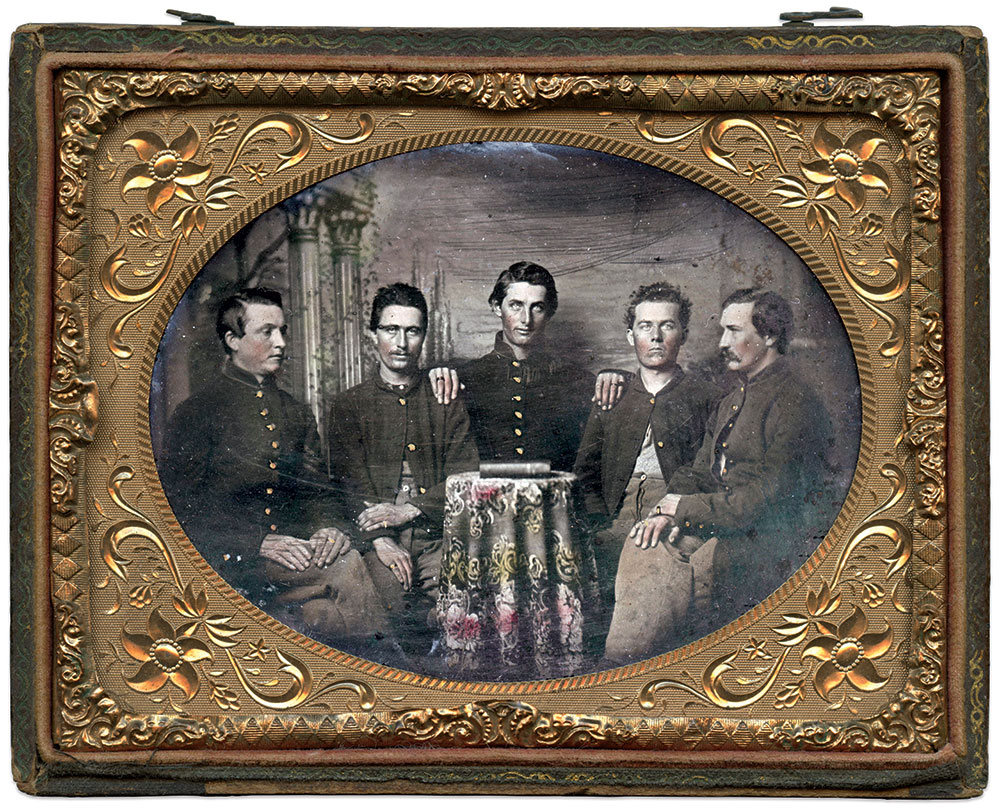
“In Memory of Some Friends”
Five Henry County Hoosiers sat for this portrait during their service in the 54th Indiana Infantry. They are, from left, Sgt. William Snideman (1839–1890), Pvt. John Walker (life dates unknown), Pvt. Stephen A. Laboyteaux (1840–1925), and Musician Arthur M. Lakey (1844–1922), all of Company A, and Pvt. Samuel Hoover (life dates unknown) of Company B.
The 54th’s enlistment, from 1862 to 1863, included the Battle of Chickasaw Bayou at the start of the Vicksburg Campaign.
An inscription inside the case that houses this tintype notes that it was received by Odessa Laboyteaux, Stephen’s wife, on October 15, 1865—Odessa, “in memory of some friends.”
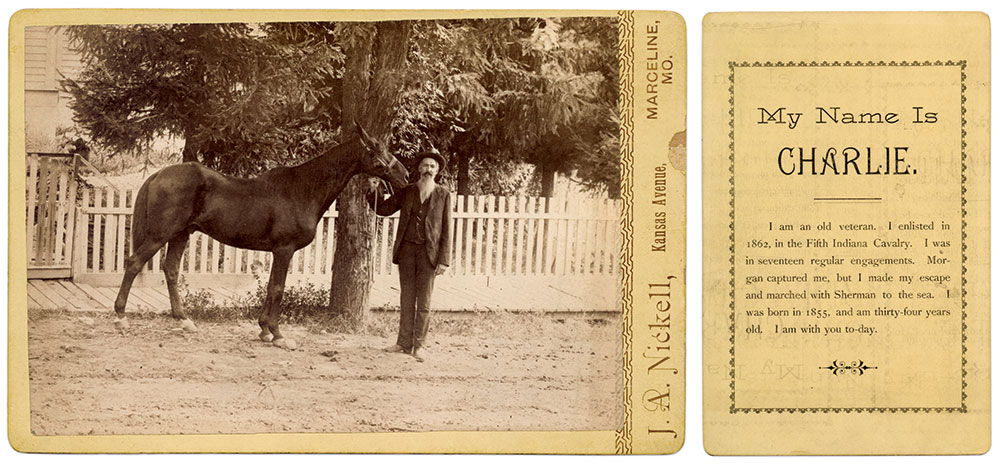
“My Name Is Charlie”
The imprint on the back of this circa 1889 cabinet card honors a war horse and suggests that his rider distributed the photograph at a regimental reunion: “I am an old veteran. I enlisted in 1862 in the Fifth Indiana Cavalry. I was in seventeen regular engagements. Morgan captured me, but I made my escape and marched with Sherman to the sea. I was born in 1855 and am thirty-four years old. I am with you today.”
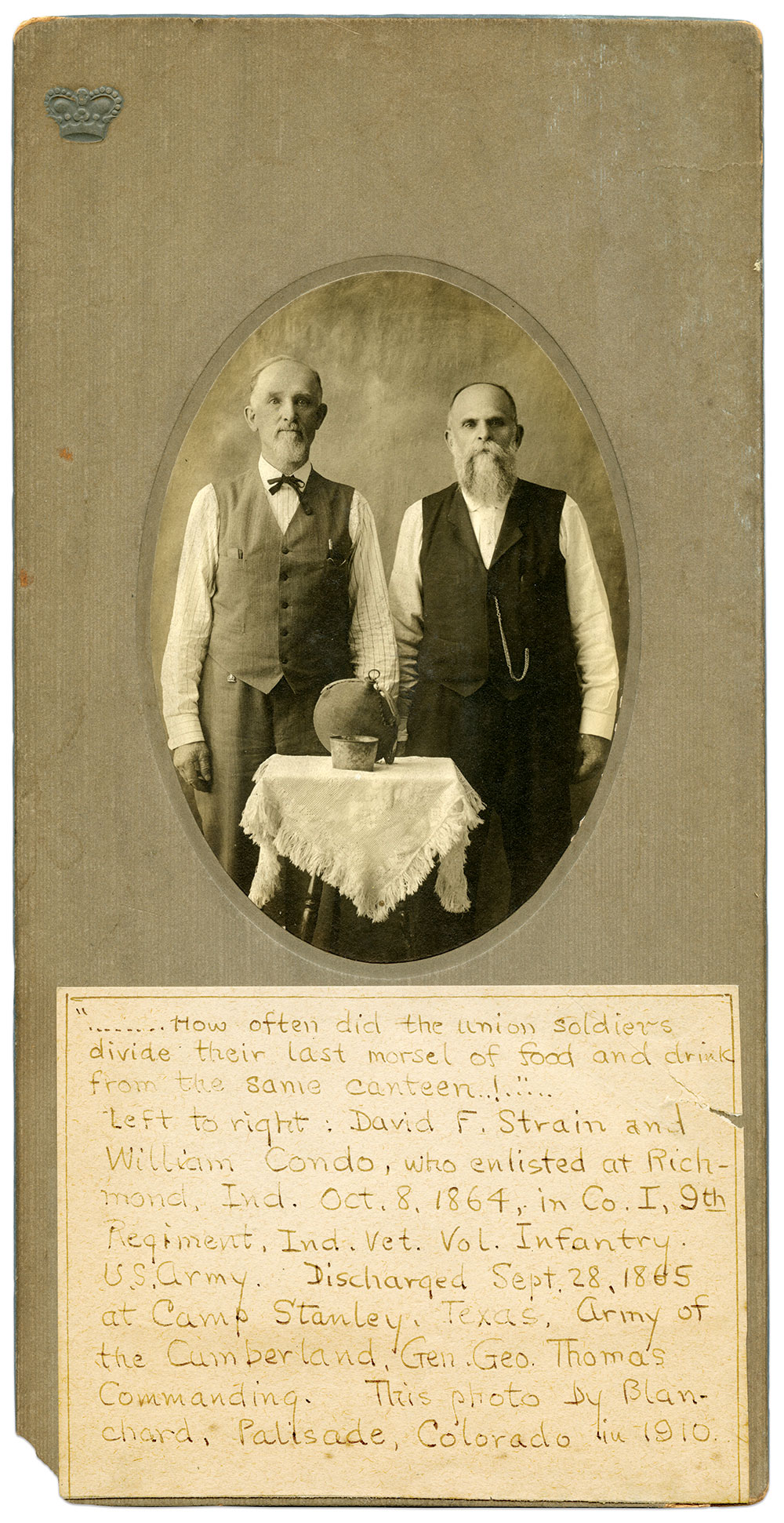
Forever Pards
War comrades and lifelong friends, David Fletcher Strain, left, and William Condo posed for this portrait about 1910 to commemorate their service in the 9th Indiana Infantry from 1864 to 1865, with duty in Tennessee and Texas.
Each had earlier military experience. Ohio-born Strain (1845–1925) served six months in the 5th Battalion Ohio Cavalry in 1863. Condo (1841–1932), an Indiana-born blacksmith then living in Pennsylvania, enlisted for three months in a Pennsylvania regiment in 1861 and the 106th Indiana Infantry during the 1863 emergency following John Hunt Morgan’s raid.
Active in the Grand Army of the Republic, the two posed for this photograph in Colorado, where Strain had relocated. This example is his copy.
SPREAD THE WORD: We encourage you to share this story on social media and elsewhere to educate and raise awareness. If you wish to use any image on this page for another purpose, please request permission.
LEARN MORE about Military Images, America’s only magazine dedicated to showcasing, interpreting and preserving Civil War portrait photography.
VISIT OUR STORE to subscribe, renew a subscription, and more.
1 thought on “Hoosiers: Indiana Faces of the Civil War”
Comments are closed.