
By Buck Zaidel
At first glance, the painted backdrop in a studio portrait can seem little more than theatrical scenery—stylized tents, patriotic military elements, and simple landscapes. Yet, these primitive elements can be transformed by lens choice, focus, and the placement of the sitter and backdrop into something far more persuasive. What begins as a simple backdrop becomes an illusion, tricking the viewer’s eye from a photographer’s studio into a soldier’s camp.
Examples from Johnson’s Star Gallery in Indianapolis illustrate the difference. The proprietor, C.A. Johnson, studied photography in 1841 in Paris. He may be the same photographer who practiced his craft during the 1850s in Batavia, N.Y., and Madison, Wis. Johnson’s gallery, located on 55 West Washington Street, employed 15 men early in the war, but army enlistments deprived him of workers. By the summer of 1862, he could muster only five or six men and made up the difference by hiring women, who he trained.
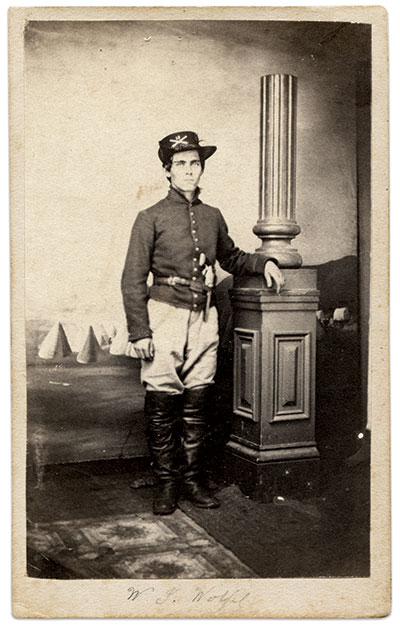
These soldiers, all photographed at Johnson’s Star Gallery, pose before the same backdrop. Each image reveals the painting at a different point of focus, from sharp to soft areas of visibility.
Private William J. Wolfe (1844-1902) of the 18th Indiana Battery, Col. John T. Wilder’s Brigade, stands beside a pedestal and unfinished column in this carte de visite. His right foot rests on a patterned carpet. Several features of his presentation stand out; black polished knee-high leather boots, the rakish hat with artillery branch of service, stamped brass insignia, and one large pistol tucked into his non-regulation waist belt. Other notable features are his fixed gaze and chiseled visage. Some crudely painted Sibley tents, drawn as mere cones, reveal the camp scene painted on the canvas backdrop.
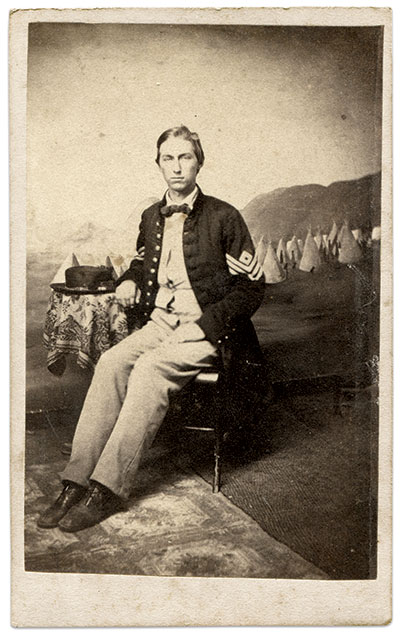
Another carte pictures an unidentified first sergeant wearing a frock coat. He strikes a relaxed pose in a wooden spindled chair, with one hand on his lap and the other resting on a floral patterned table cloth near his hat. His brogans and carefully combed hair complete his presentation to the camera. In the background beyond the carpet and some fabric floor covering more of the backdrop that Johnson used to enliven his images is now visible. Additional Sibley tents with shadowy figures interspersed add to the military camp scene. The prominent hill rises beyond his shoulder and perhaps a different variety of tent or covered wagons adds a stretch of horizontal plane at the edge of the distant camp. The hilly section of the far background is bereft of detail and is presented more softly, with less contrast, setting it back in the distance.
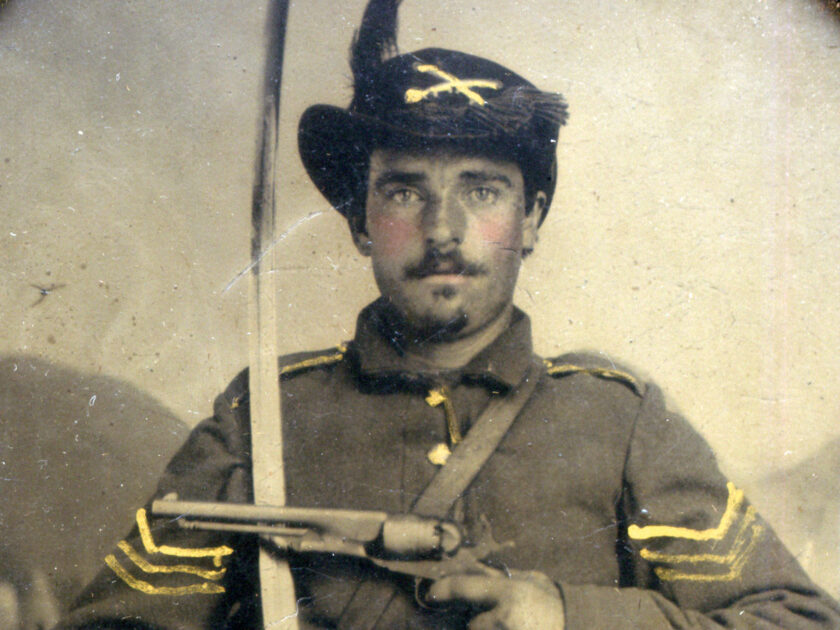
The third image is a tintype of Sgt. Austin Mason (1842-about 1884) of the 5th Indiana Cavalry. He is seen holding his sword upright with a sword knot hanging off the hilt. The top of his high leather boots are just visible. His steely gaze peers out from below the brim of a worn hat adorned with a tasseled hat cord, cavalry brass hat insignia and a prominent black feather. His gaze was not the only steady part of his pose as he holds a large Colt Army revolver rock solid across his chest allowing the pistol to be wonderfully presented to the camera. A new feature comes into view as more of the backdrop is seen, a simple pointed hill in the distance. The delicate applied color to the sergeant’s cheeks, the table cloth, along with gilt applied to color the chevrons, belt buckle, sword hilt and buttons finely completes the trooper’s portrait.
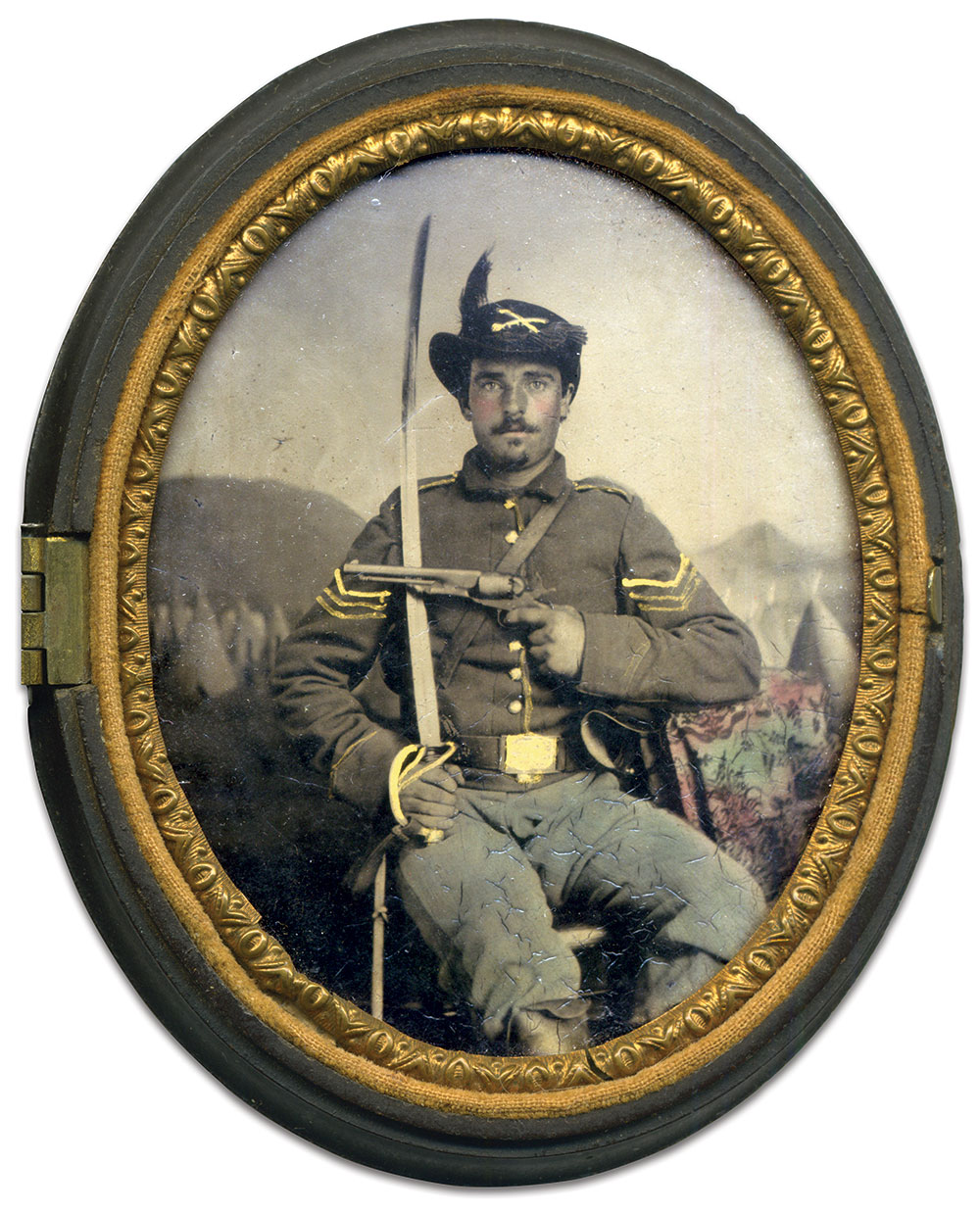
An interesting visual phenomenon takes form in Mason’s portrait. With the subject seated nearer the camera and closer to the backdrop, the camp scene, in a softer focus that blurs its primitive qualities, now frames our sitter, who appears to have just been taken on a campground—not a photo studio in a bustling metropolis.
In summary, the backdrop appears less realistic in the cartes, and more convincing in the tintype. A softer focus and careful control of depth of field transform it into a more realistic environment, adding dimension and elevating the portrait’s aesthetic impact—surely the aim of every photographic artist of the era. At the same time, the lens preserves remarkable clarity in Sgt. Mason and his equipage. The balance between sharp foreground detail and the scaled, receding painted figures makes this image a fine example of Civil War–era studio photography—and a credit to C.A. Johnson and his team in Indianapolis.
Huzzah to the Hoosier photographers!
Buck Zaidel is a MI senior editor. He is a co-author, with Dione Longley, of Heroes for All Time: Connecticut Civil War Soldiers Tell Their Stories.
SPREAD THE WORD: We encourage you to share this story on social media and elsewhere to educate and raise awareness. If you wish to use any image on this page for another purpose, please request permission.
LEARN MORE about Military Images, America’s only magazine dedicated to showcasing, interpreting and preserving Civil War portrait photography.
VISIT OUR STORE to subscribe, renew a subscription, and more.