
By Kurt Luther
Historians estimate that at least 400 women presented themselves as men and fought in the Civil War, on both sides of the conflict. Verified period portraits of these female soldiers are rare. A notable example is Private Albert D.J. Cashier (née Jennie Hodgers), who served three years in the 95th Illinois Infantry. Two period images are known to exist of Cashier in uniform: a tintype in the Gilder Lehrman Institute collection and what appears to be a carte de visite dated November 1864 and republished in a newspaper article.
Even contemporary portraits of Civil War women soldiers can have questionable authenticity. Multiple carte de visite views of Frances Clayton (or Clalin) in a dress, and as her alter ego “Jack Williams” in a Union uniform, wearing a broad-brimmed hat with cavalry brass and holding a sword, can be found in the collections of The Met, the Library of Congress, the National Gallery of Art, and elsewhere. However, the widely circulated portraits, by Samuel Masury of Boston, were taken years after her claimed service, according to the American Battlefield Trust, and “the authenticity of her story has been questioned by historians.”
Similarly, a lithograph of Loreta Janeta Velazquez as 1st Lt. Harry T. Buford of the Independent Scouts, C.S.A., complete with double-breasted Confederate uniform coat, kepi, and an impressive mustache and goatee, was published in her biography over a decade after the war. Yet as William “Jack” Davis has written in his 2016 book, Inventing Loreta Velazquez, many of her claims are contradictory, and her Civil War service cannot be proven.
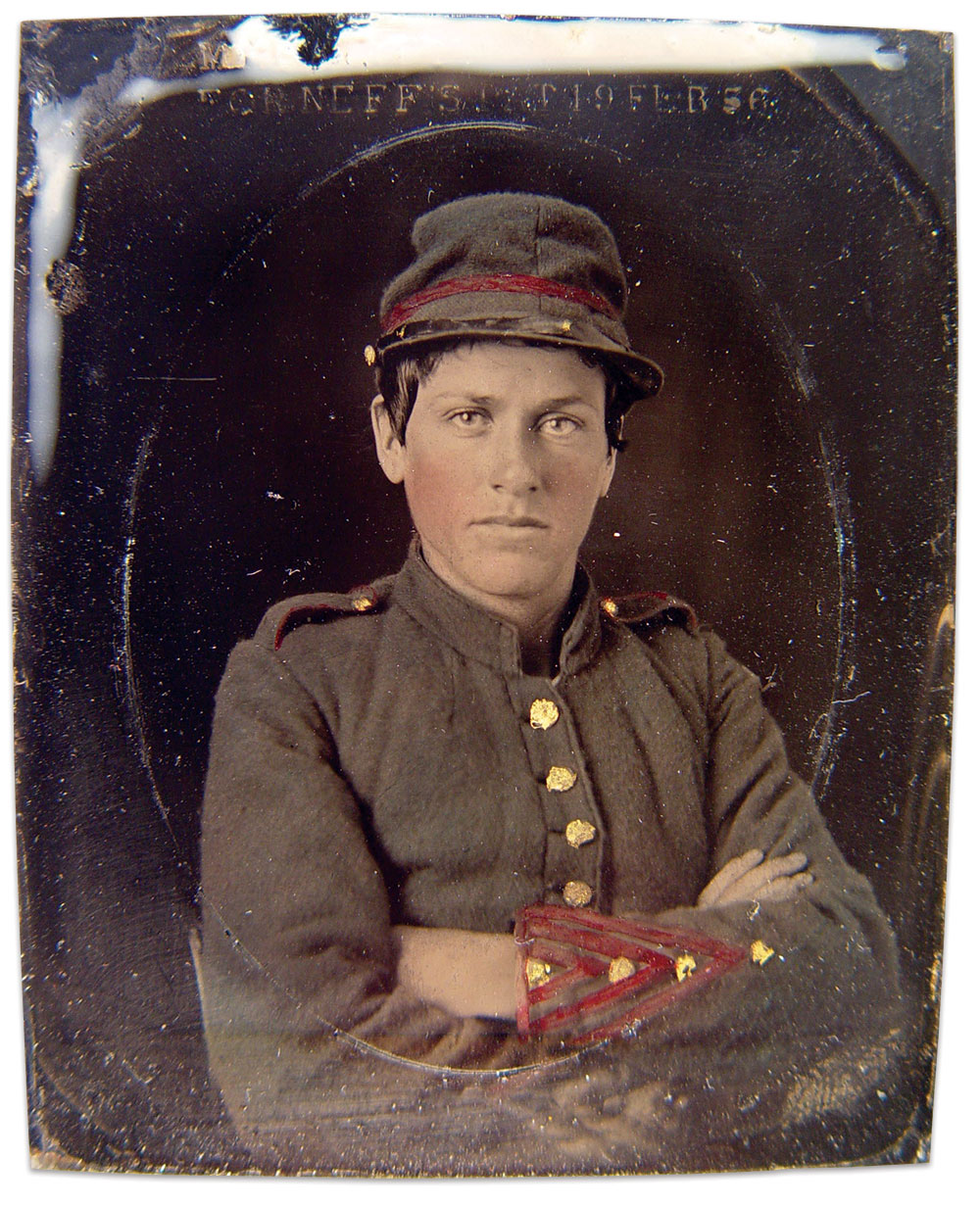
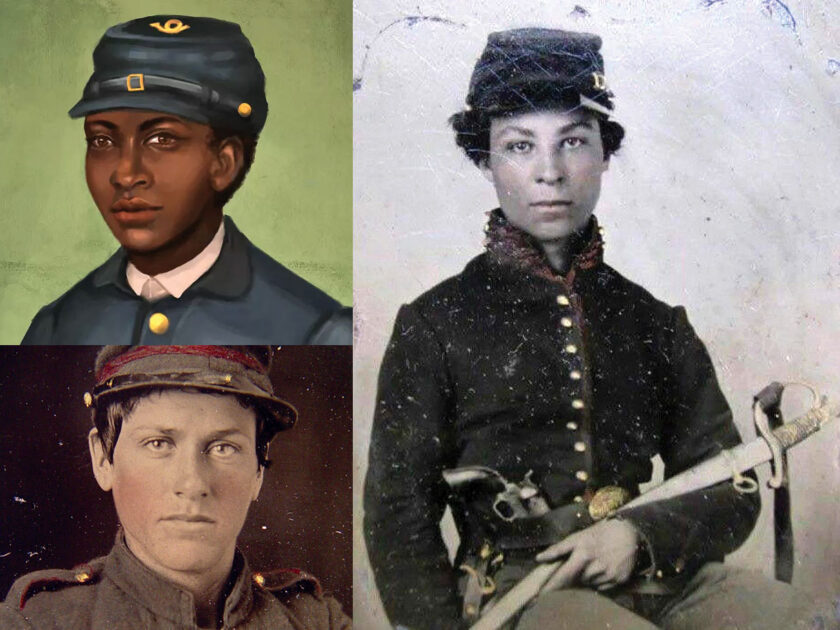
For other female Civil War soldiers, the questionable portraits came about in more modern times. A tintype of Pvt. Lyons Wakeman (née Sarah Rosetta Wakeman), who served in the 153rd New York Infantry until dying from illness in June 1864, remains in her family’s possession. However, web searches for this soldier’s name now bring up a second image that is widely circulated online but clearly incorrect. The misattributed photo is a tintype in the Liljenquist Collection of the Library of Congress showing an unidentified Confederate soldier wearing a red-tinted artillery uniform. The error seems to have originated in an August 2017 blog post that includes the Confederate artilleryman photo with the caption, “Another photograph of a Civil War soldier, rumoured to be Sarah Rosetta Wakeman.” The rumor then spread to a 2019 Reddit post; a 2023 article on Vintage Everyday, a website whose Facebook page boasts over 220,000 followers; and beyond.
One of the most remarkable examples of modern misidentifications of Civil War-era women soldiers concerns Cathay Williams. According to Meg Groeling of Emerging Civil War, Williams was born into slavery in Missouri in 1844. In 1861, the Union army occupied Jefferson City, Mo., where Williams lived and worked as a house slave on a nearby plantation. Col. William P. Benton, commander of the 8th Indiana Infantry, designated her and other enslaved African Americans in the area as “contraband.” The teenage Williams reluctantly traveled with the army for the rest of the war as a cook and laundress, moving from Arkansas to Louisiana, Georgia, and finally, at the war’s end in 1865, returning to Missouri, at Jefferson Barracks. The latter was the headquarters of the 38th U.S. Infantry, one of the new, segregated “Buffalo Soldier” regiments of Black soldiers.
In November 1866, Williams disguised herself as a man with the pseudonym “William Cathey” and successfully enlisted as a private in the 38th Infantry, making her the only documented woman to enlist in the Regular U.S. Army during the 19th century, and the only known female Buffalo Soldier. By her own account, she was motivated by the promise of a steady paycheck and the encouragement of a cousin. She joined Company A and served two years in Missouri, Kansas, and New Mexico before growing tired of army life. Williams feigned several types of illness, she later recalled, until her secret was finally discovered at a military hospital, and she was discharged in October 1868. After the war, she lived in Colorado and St. Louis, Mo. Her applications for an invalid pension in the 1890s were denied, not because the federal government disputed her service as William Cathey, but rather that examiners weren’t convinced she was disabled by it. Her final years are sparsely documented, but recent research by local historians suggests she may have died in 1911, in Pueblo, Colo.
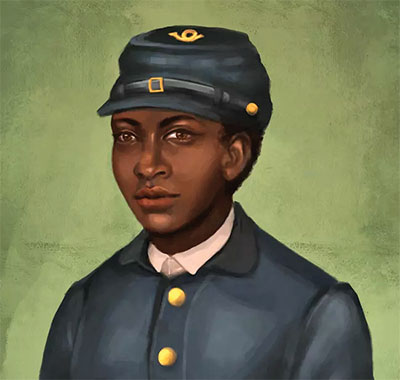
Given Cathay Williams’ fascinating life story, many modern readers are curious to glimpse this resilient woman who repeatedly reinvented herself to survive, from an enslaved girl to a Civil War contraband, and ultimately to a Buffalo Soldier. Unfortunately, the historical record has little to offer, other than textual records describing her height, complexion, hair and eye color. The National Park Service (NPS) notes on its Fort Union National Monument website, “There are no known images of Private William Cathay.” Likewise, historian Frank Schubert writes in Voices of the Buffalo Soldier (2003), “There are no photographs or other contemporary visual images of Cathay Williams.” Both sources instead offer painted depictions of Williams in uniform, the former by Mary Feitz and the latter by William Jennings. Today, however, these artistic interpretations are frequently overshadowed by a widely published photograph claiming to show the real Cathay Williams. Unfortunately, the photo is not actually her.
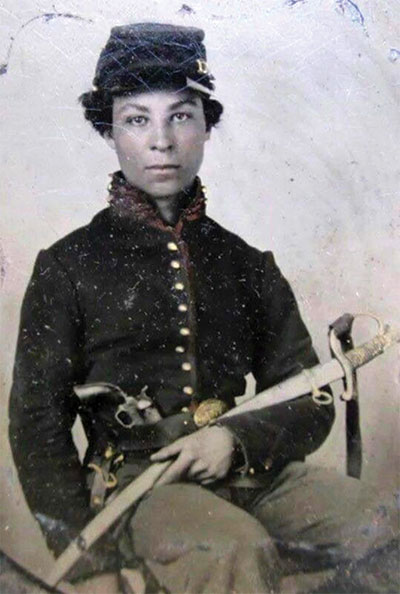
The photo depicts Cathay Williams in uniform, presumably as Pvt. William Cathey. The oldest example of this photo I can find online dates to a June 3, 2021, post in a public Facebook group called “The Civil War Buff.” The post’s title identifies the photo’s subject as “Cathy [sic] Williams” and a “rare picture of a Black female Union soldier 1862.” But Williams became a Buffalo Soldier in late 1866. She was never a Civil War soldier, and in 1862 she was still a contraband working for Col. Benton. Nevertheless, the post’s photo quickly went viral online, and was extensively reshared on Reddit, Facebook, Instagram, YouTube, and other social media platforms throughout 2021-2022. By 2023, it had spread to history and news websites. Artists began painting and colorizing tributes to Cathay Williams using the photo as an inspiration. Perhaps most troublingly, the photo began appearing for sale in dozens of eBay and Etsy listings, ranging from $10 to $25 each, including framed printouts, trading cards, coffee mugs, and at least one reproduction cabinet card, all of which remain available in 2026.
Unfortunately, this “rare picture” is clearly fake, failing from both a historical and technical perspective. Historically, the image portrays a young Black woman with short hair tucked into a forage cap, seated and wearing a Civil War-era federal mounted service (shell) jacket with red-tinted artillery piping on the collar and trim. A pistol is tucked into her belt, and a Model 1840 light artillery saber is cradled in her lap. An artillerist’s shell jacket and saber make no sense for a Buffalo Soldier belonging to an infantry regiment, who would have worn a frock or sack coat.
Technically, the image also shows obvious signs of manipulation. The subject’s head is disproportionately large for her body, and uniform details like the forage cap’s visor and chin strap are distorted. These visual artifacts (errors) are characteristic of early AI image-generation and digital editing techniques common when this image first surfaced in 2021. It’s unclear if the lower half of the photo comes from a real Civil War tintype—if so, I haven’t been able to find it yet—or is also AI-generated.
The visual legends surrounding Cathay Williams and other female soldiers illustrate how our deep-seated desire to put a face to a hero can override our commitment to the truth. In an era of AI and social media sharing, digital manipulations and misidentifications are created in seconds but can masquerade as history for years. Yet, the legacies of these extraordinary women are compelling enough on their own without needing visual embellishment. The historical record may lack verified portraits for many of these soldiers, but by stripping away the myths, we can honor the truth of the women who lived the history.
Kurt Luther is an associate professor of computer science and, by courtesy, history at Virginia Tech. He is the president of The Photo Sleuth Foundation, a nonprofit organization with a mission to rediscover the names and stories of unknown people in historical photos through research, technology and community. He is a MI Senior Editor.
SPREAD THE WORD: We encourage you to share this story on social media and elsewhere to educate and raise awareness. If you wish to use any image on this page for another purpose, please request permission.
LEARN MORE about Military Images, America’s only magazine dedicated to showcasing, interpreting and preserving Civil War portrait photography.
VISIT OUR STORE to subscribe, renew a subscription, and more.