
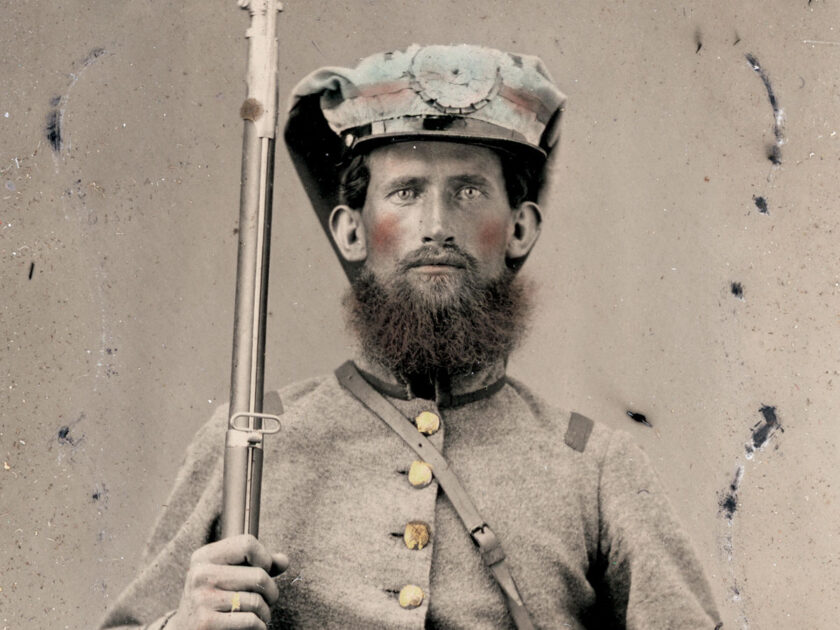
By Ron Field
During a lifetime of collecting, Paul Reeder has brought together a unique collection of Confederate imagery, a representative selection of which is showcased here. Each image tells the story of an individual. They reveal details about how the Southern soldier was clothed, armed, and equipped, and how he posed before the camera. Present are officers in frock coats based on the Uniform and Dress of the Army of the Confederate States published in 1861. Enlisted men proudly pose in militia garb from the days before the war, or in plainer quartermaster attire issued from central clothing depots in Richmond, Columbus, Ga., or Atlanta. The variety of weapons illustrates the difficulties the South experienced arming its men. This also indicates the extent to which guns were supplied as props by enterprising photographers. Attempts to overcome the reversing effect of the ambrotype process on military equipment are present in several instances. Southern patriotism is on display with secession cockades, or First National flags either in miniature attached to jacket or cap, or as a gallery backdrop. The author is indebted to Senior Editor Phil Spaugy, Contributing Editor Ron Maness, and Tim Prince of College Hill Arsenal and the Antiques Roadshow for expert advice.
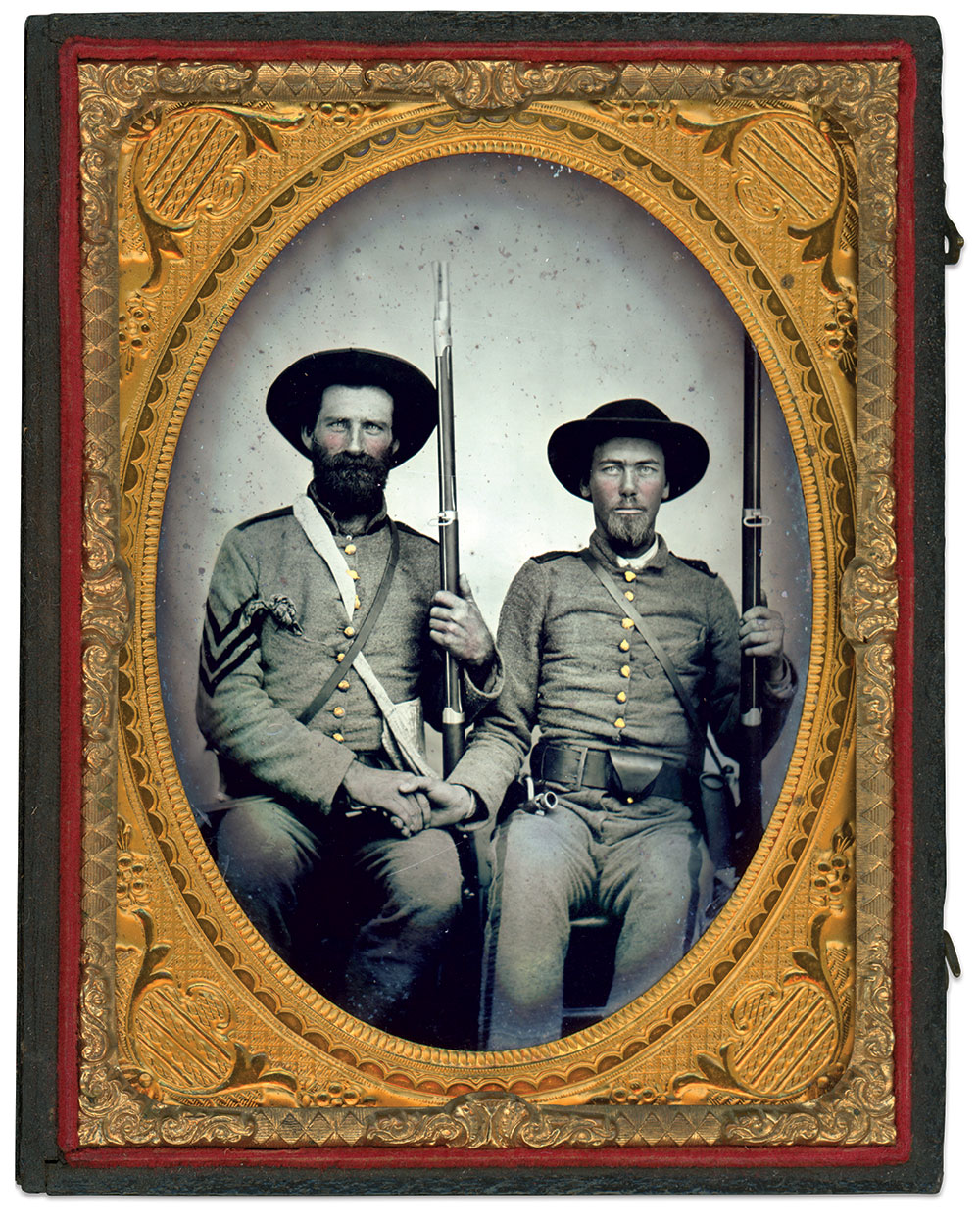
Hand-Shaking Pards
Bonded by comradeship, these two unidentified Southerners shake hands as they stare into the camera lens. Likely North Carolinians, they wear the “second state pattern” jacket authorized in early 1862, with black or dark blue straps on the shoulders for the infantry branch of service. The sergeant at left is equipped with a white cloth haversack, the strap of which he has fastened between his jacket buttons in order to keep it from slipping. A narrow leather strap over his other shoulder supports a canteen. A handkerchief protrudes from a small slit breast pocket. The private at right also has a leather strap supporting a canteen, and wears a wide leather waist belt with large frame buckle, to which is attached a Pattern 1850 cap pouch, cartridge box, and socket bayonet in scabbard. Their dark-colored brimmed hats are likely quarter-master issue. Both men are armed with Model 1822 smoothbore muskets.
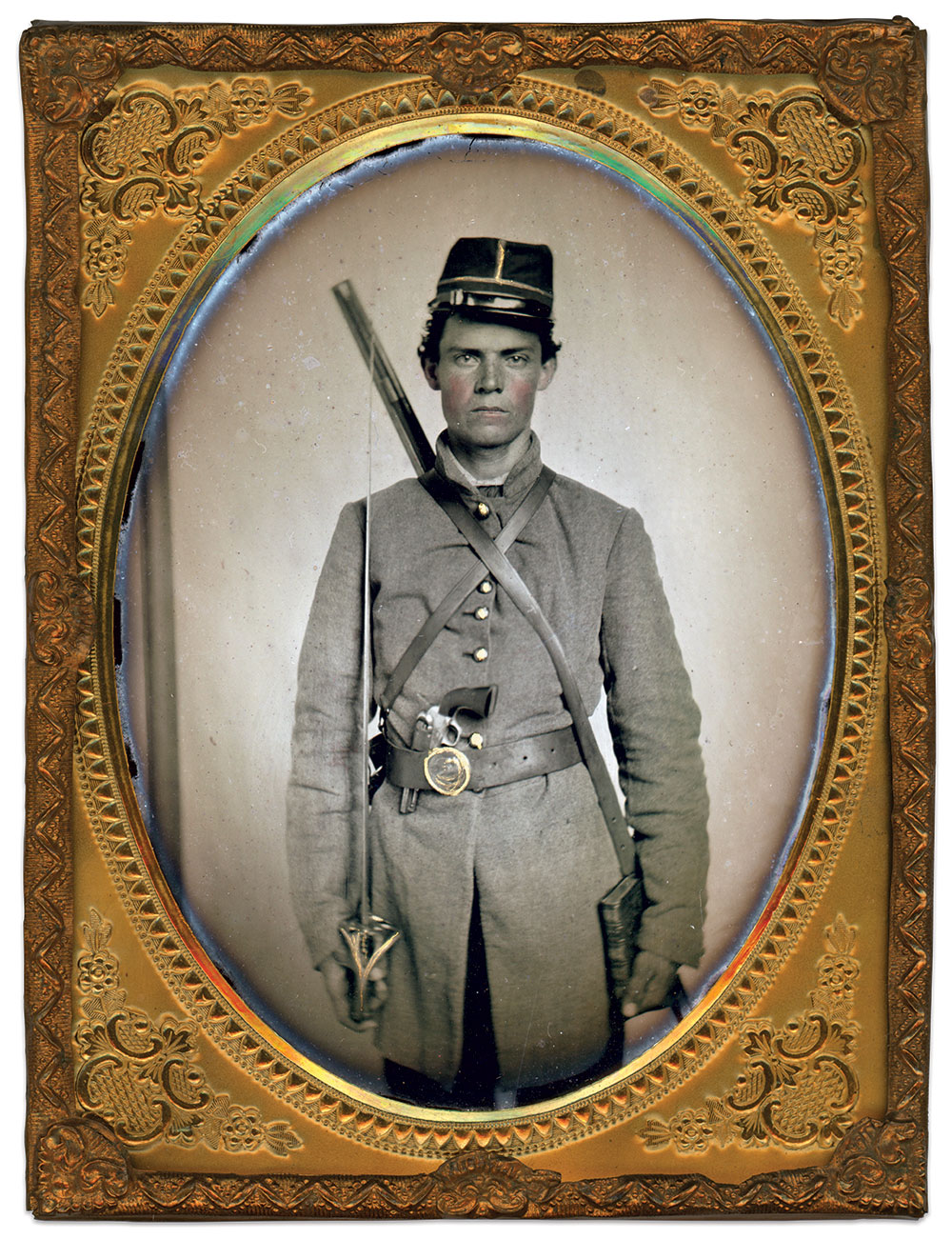
Sword, Guns, and Book
Many mounted units wore frock coats at the war’s outset and before the general availability of quartermaster-issue clothing. This private wears a plain gray frock and a high-crowned and trimmed Pattern 1858 forage cap. His musket is slung in what was known as the Old British Grenadier-style, which has left his hands free to hold a cavalry saber. The book may be a tactical manual. A Colt Pocket revolver is stuck in his belt.
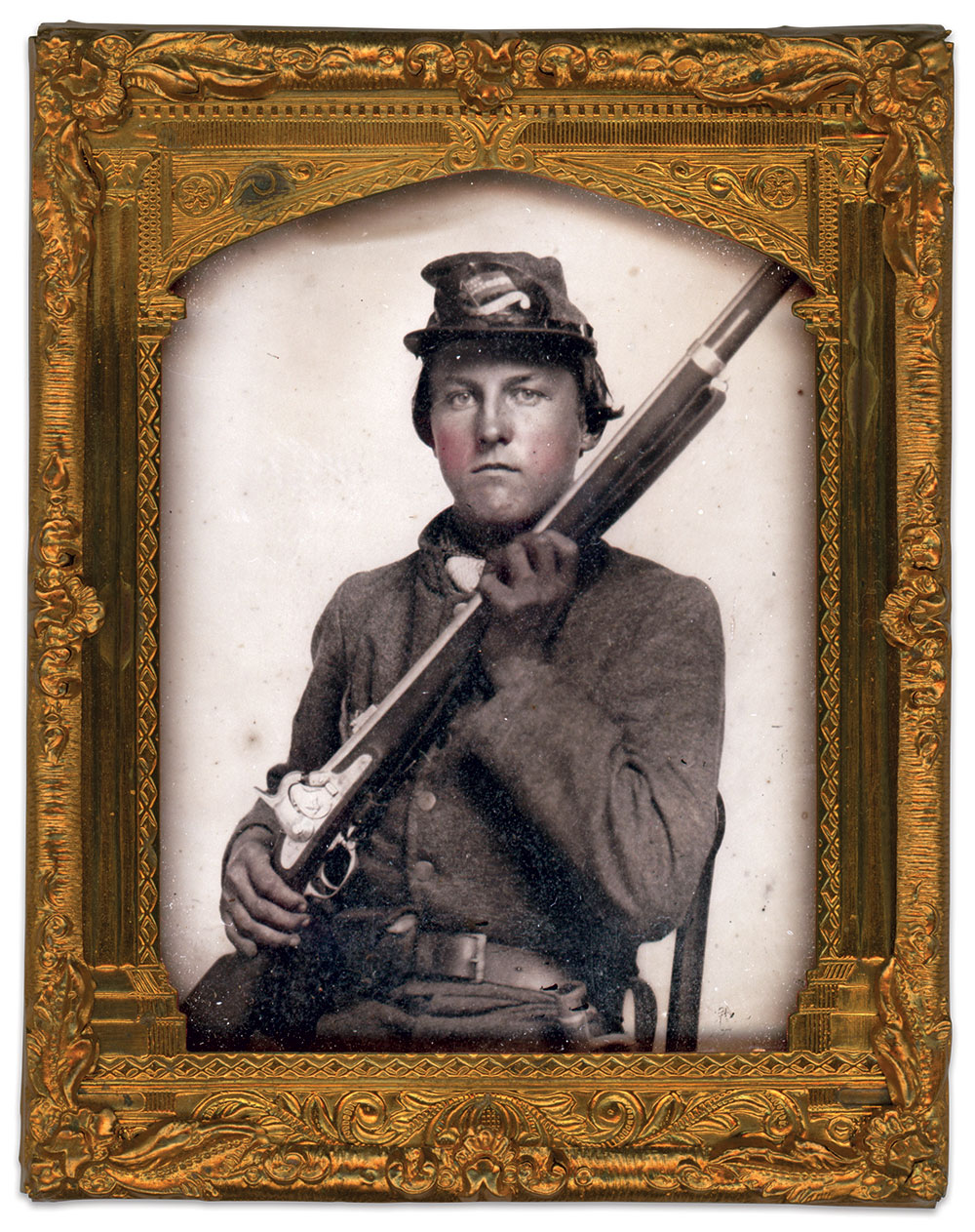
Patriotic Flag Patch
Displaying a First National over a scroll on a patch attached to the front of his Pattern 1858 forage cap, this unidentified volunteer was previously published in William A. Turner’s Even More Confederate Faces in 1983. He wears a plain woolen jacket and holds a Model 1855 rifle musket with leather sling attached. Fastened with a roller buckle, his waist belt carries a cap pouch and socket bayonet in its scabbard.
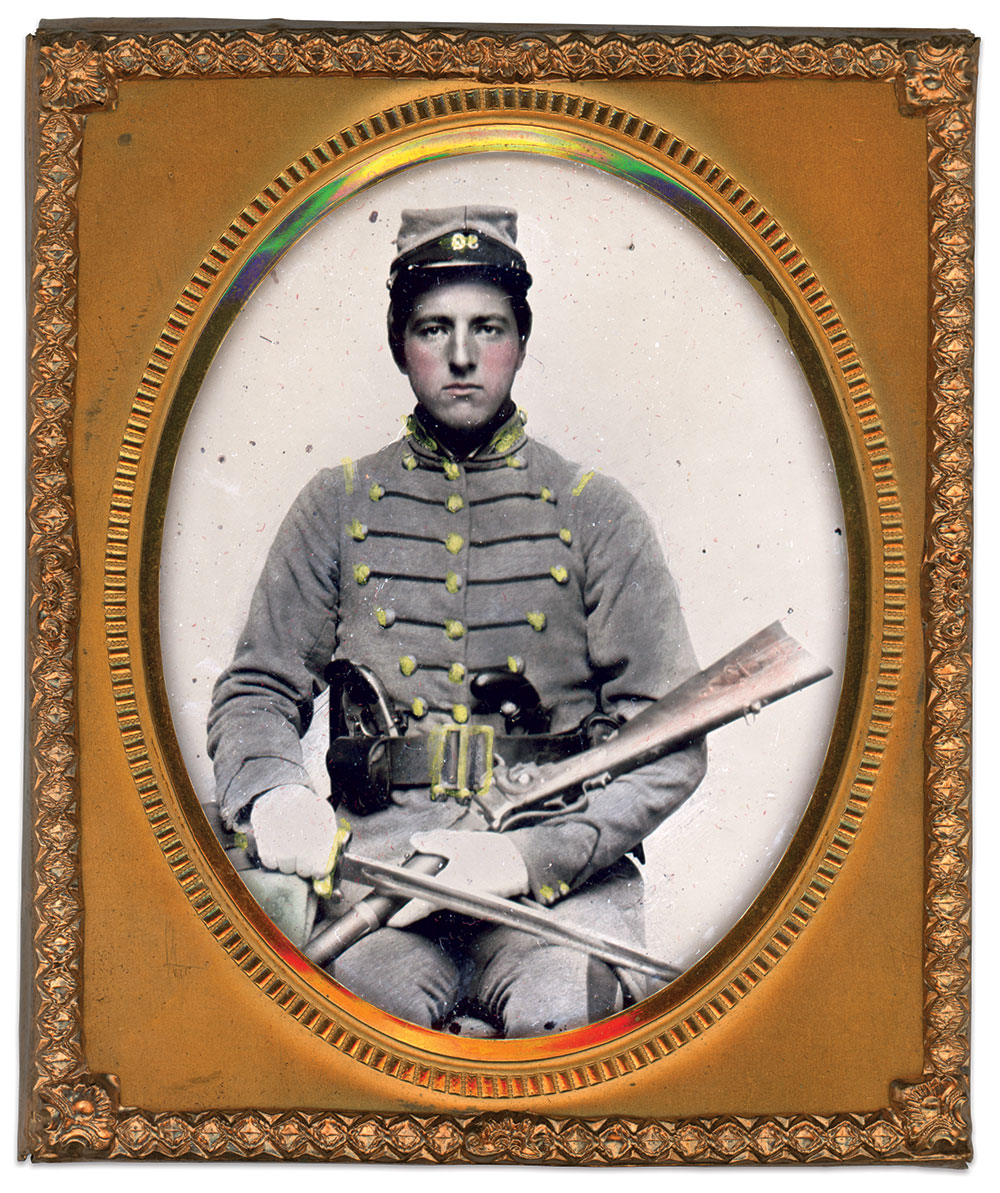
Southern Guardsman?
With cap letters possibly indicating “Southern Guard,” this unidentified volunteer wears a heavily-trimmed full-dress coat complete with brass shoulder keeps through which to attach epaulettes. He has two civilian “Boot” single-shot pistols stuck in his Pattern 1855 Rifle Belt with cap pouch and cartridge box, and holds a Model 1859 Sharps carbine and Model 1855 rifle bayonet. The mix of arms suggests they are photographer’s props.
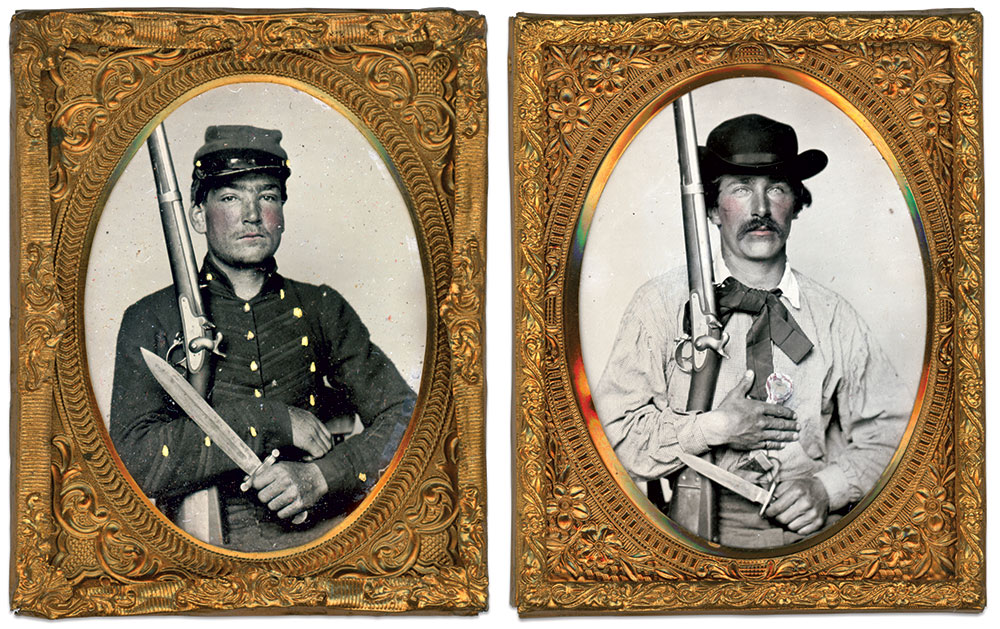
Volunteers in the Shenandoah Valley
Armed with Model 1841 “Mississippi” rifles and knives, these Southern volunteers sat for their likenesses in a photographer’s studio believed to be in Staunton, Va. If so, did they fight in Gen. Stonewall Jackson’s 1862 Valley Campaign? The man on the right poses with a small, red, white and blue tinted secession cockade attached to his fine checked shirt. Arms also consist of a clip-pointed Bowie knife with hardened leather sheath tucked in the waist band of his pants. His brimmed hat and large neck-tie are of civilian origin. The other man wears a heavily trimmed jacket likely worn by his militia company before the war, or obtained on enlistment in 1861, and gray forage cap with dark band. He holds a Model 1832 artillery short sword.
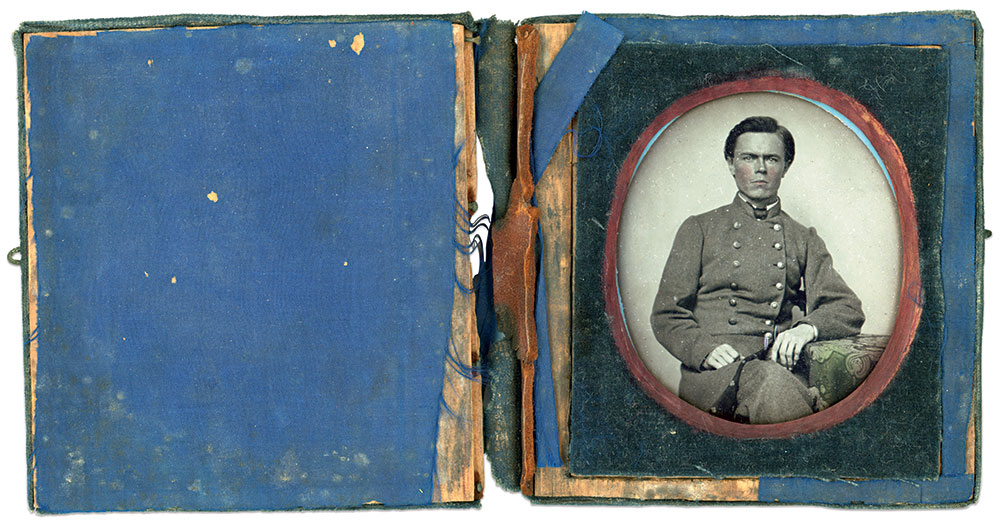
Floral Lining, Handmade Case
The open skirts of the plain double-breasted coat worn by this Southern soldier reveal a floral-patterned lining, which may have been by choice or necessity based on a shortage of suitable lining cloth. The two rows of seven, two-piece, convex buttons of unknown pattern conform to the 1861 uniform regulations. The hand-crafted case illustrates supply issues that plagued the Confederacy—the result of the Union’s effective naval blockade and successful occupation of Southern lands.
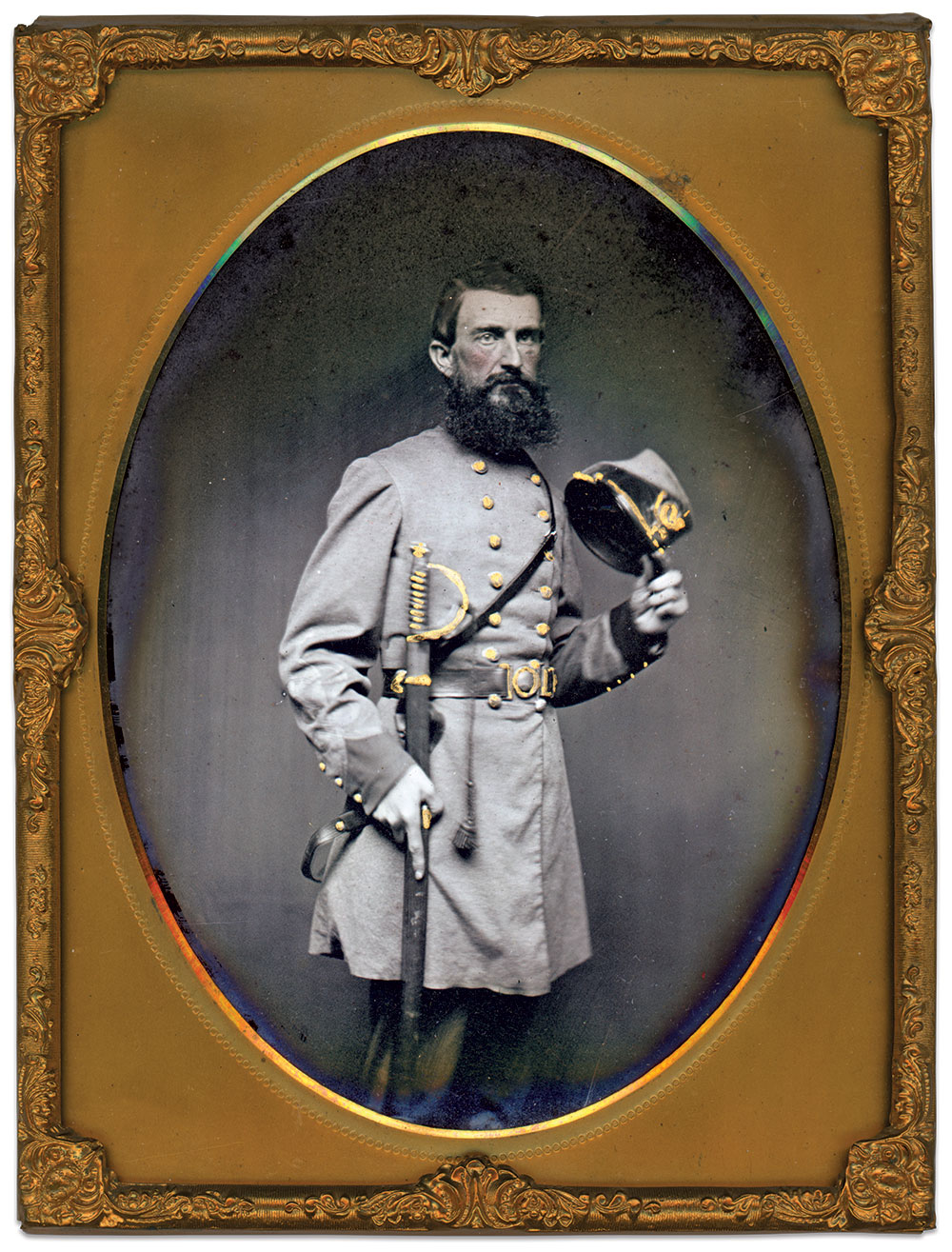
Well-Mannered Officer with an Uncommon Sword and Buckle
Distinguished by the Pattern 1851 “Looped“ Horn insignia on a cap with inverted V-shaped band at front, this infantry officer wears a Confederate regulation frock coat with braid very faintly visible on his sleeves. His sword and belt plate were produced by the College Hill Arsenal in Nashville prior to the occupation of the city by Union forces on Feb. 25, 1862. His foot officer’s pattern sword has an un-ornamented pommel which is typical of College Hill Arsenal blades. A sword knot hangs delicately from its hilt. The two-piece plate on his belt likely has “CSA” on its tongue disc, a wreath on its outer ring, and patterned belt loops.
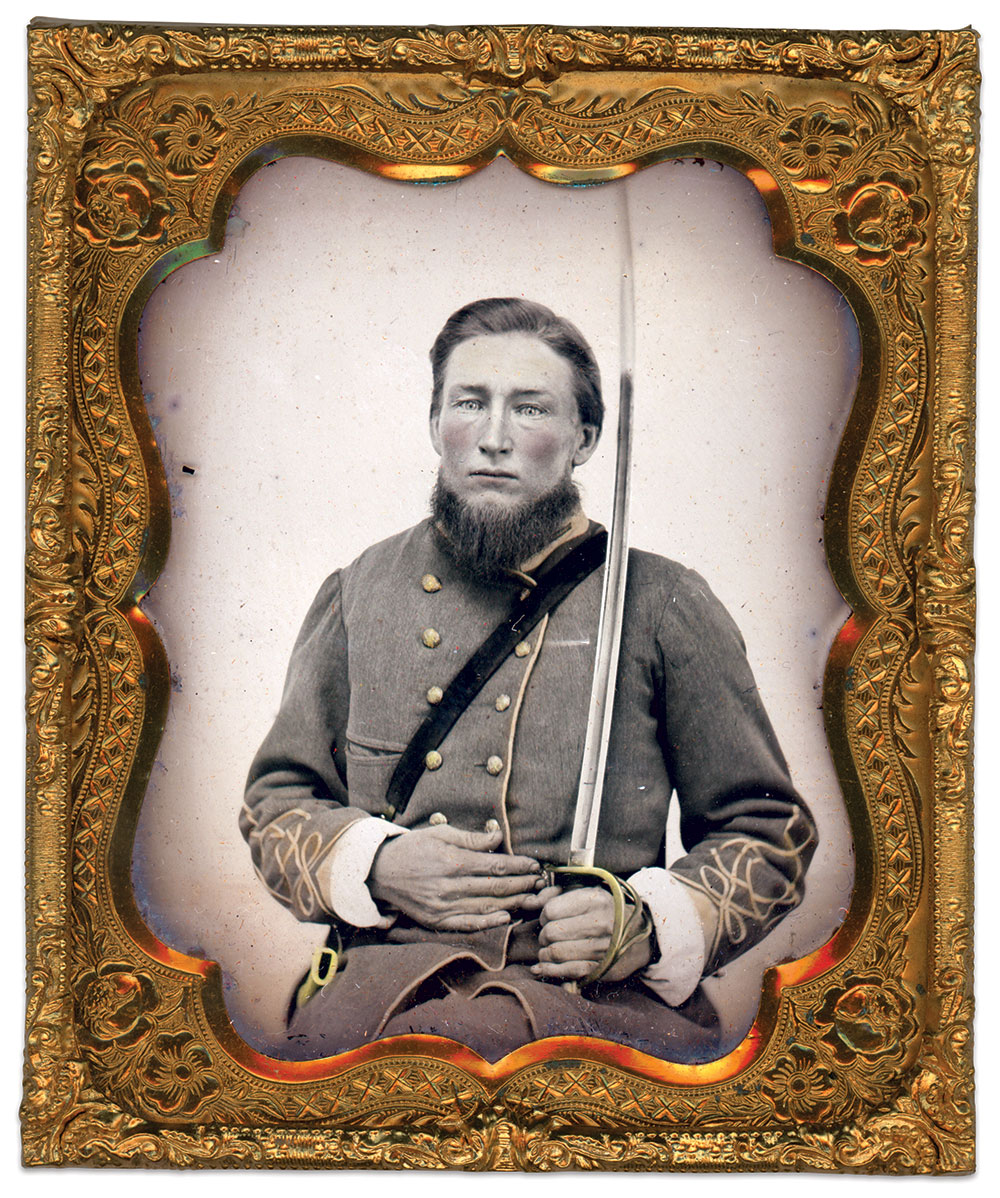
A Cavalry Officer and His Weapon
Previously published in William A. Turner’s Even More Confederate Faces in 1983, this cavalry lieutenant wears a coat based on the uniform regulations of 1861 with the addition of a slit breast pocket. His white shirt sleeves are folded back over his cuff facings which, along with his collar, appears to be a light color and likely yellow for his branch of service. A leather shoulder strap supports the weight of a Model 1860 enlisted men’s cavalry saber.
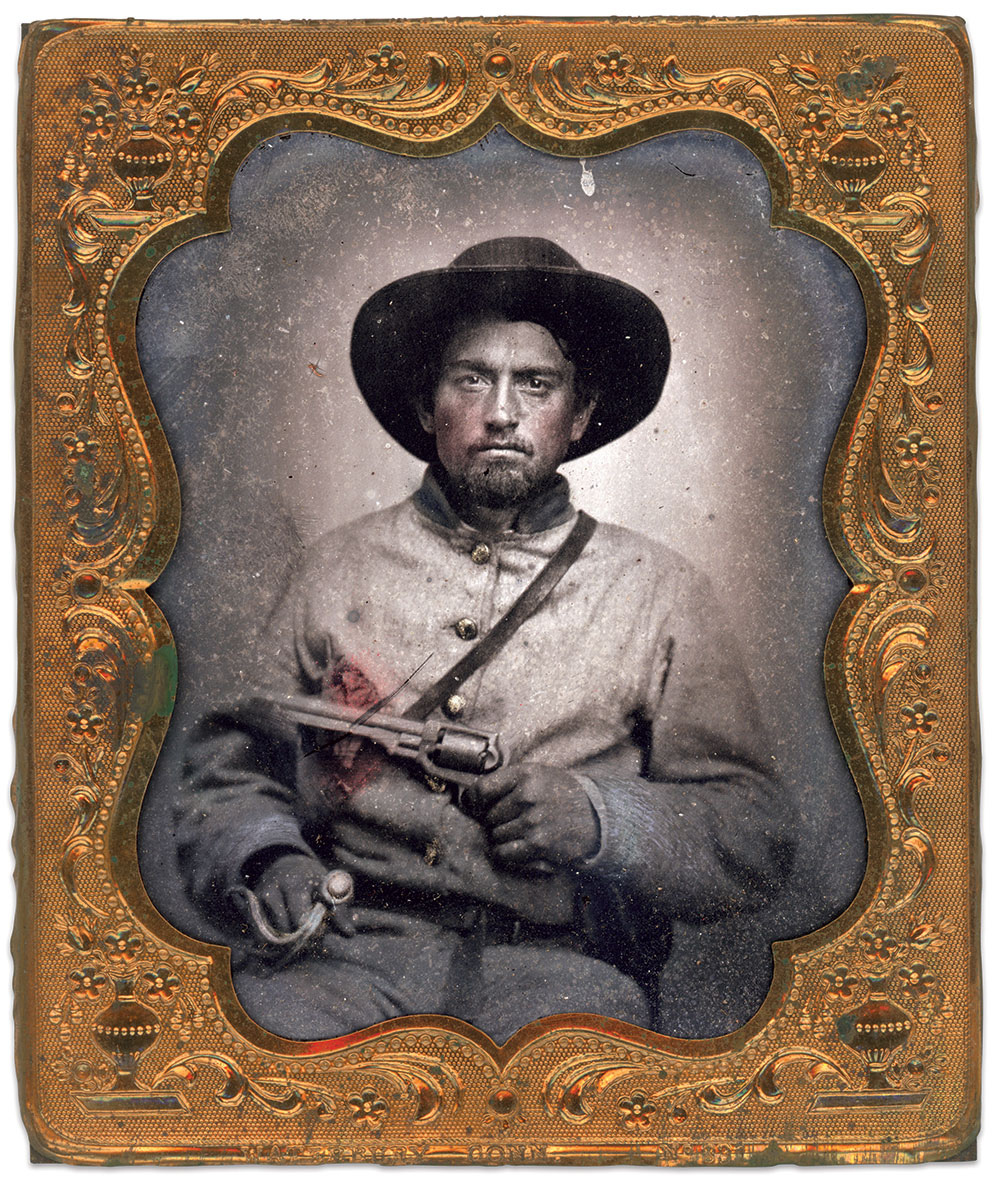
Determined Trooper
Posing proudly with a Whitney revolver and saber, this Confederate cavalryman wears a six-button jacket, or roundabout, with blue facing on collar and cuffs of the type issued to the Army of Tennessee by the Columbus Depot. A shoulder strap supports his saber belt, which has a roller buckle. A red-painted favor or handkerchief is draped out of a breast pocket.
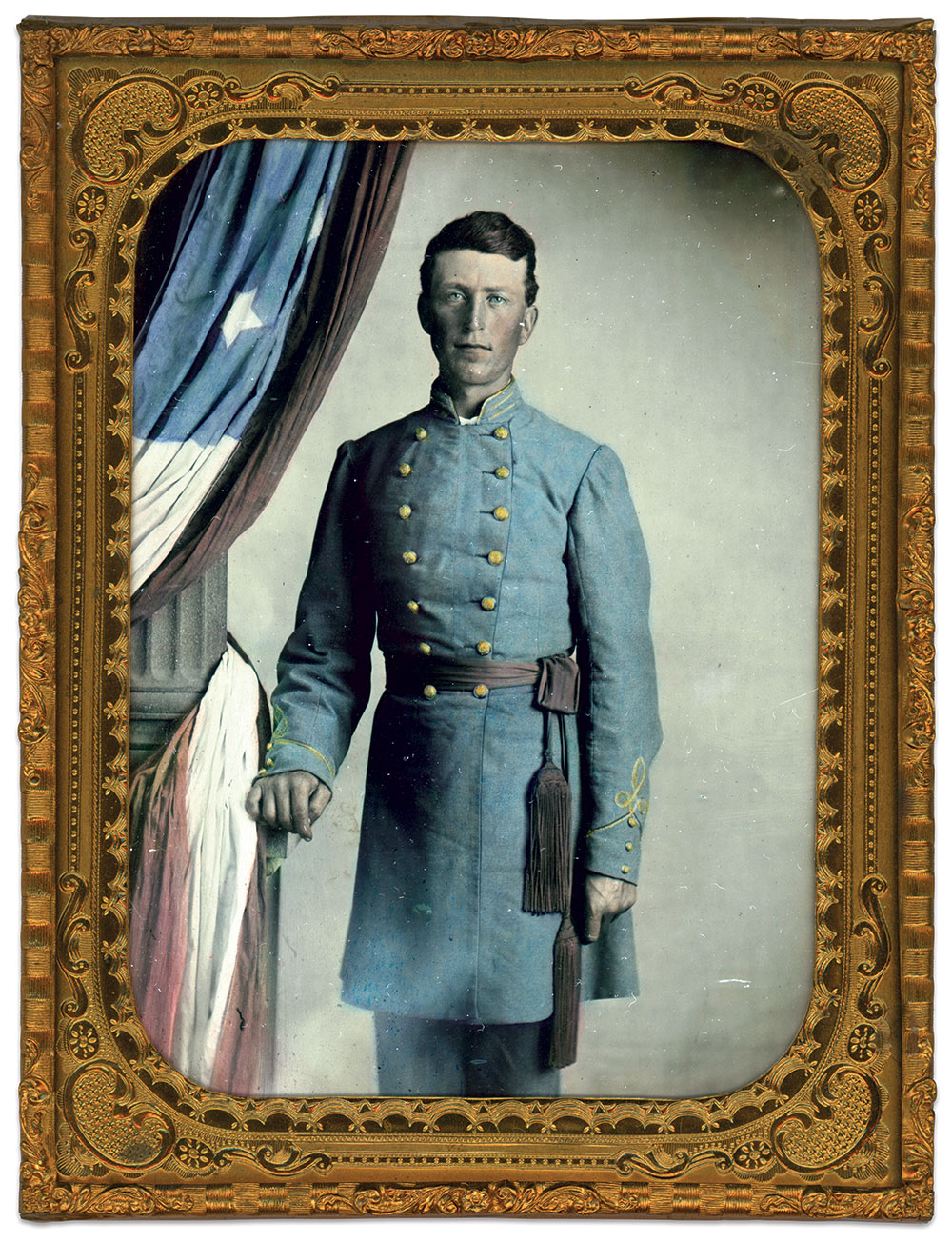
A Lookout Artilleryman
Standing next to a First National flag draped around the photographer’s prop, 26-year-old 1st Lt. Richard Levens “Dick” Watkins (1836-1894) wears a regulation officer’s frock coat complete with two rows of seven buttons, collar bars, and gold braid on his sleeves. Part owner and operator of a hardware store in Chattanooga, Tenn., before the war, he helped organize the Lookout Artillery in May 1862. By November of that year, this battery reported an aggregate of 144 men, armed with two six-pounder smoothbore guns, and two 12-pound howitzers, with 41 horses and 23 mules. Initially serving in the Chattanooga area, it was then stationed at Canton, Miss., and later at Demopolis, Ala. During the spring of 1864 the unit joined the Army of Tennessee and fought in the Atlanta Campaign. During March 1865, it was part of the Artillery Reserve in the defenses of Mobile, Alabama. Escaping when that city fell, the remnants of the Lookout Artillery were part of the force surrendered by Gen. Richard Taylor at Montgomery, Ala., on May 4, 1865.
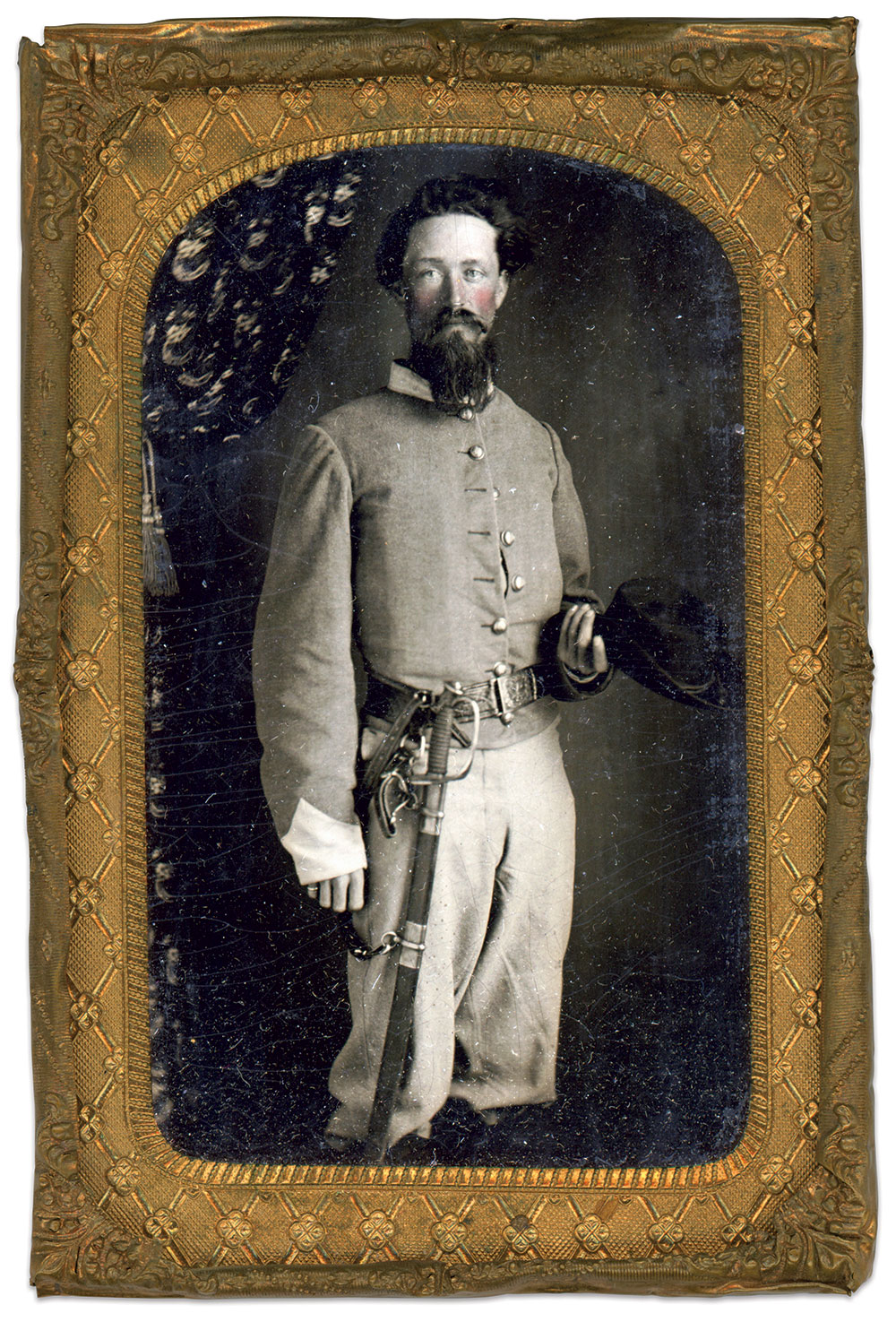
Kentucky Partisan
William Wallace Faulkner served as a first lieutenant in the Kentucky State Guard in April 1861. In the spring of 1862, he recruited Faulkner’s Partisan Rangers in west Tennessee and northern Mississippi, which disrupted Union supplies and communication lines. Captured at Island No. 10 in October 1862, he was exchanged and back in action by the end of the year. He commanded Faulkner’s Kentucky Partisans during the siege of Vicksburg. In late 1863 he was appointed colonel and raised the 12th Kentucky Cavalry, which joined Nathan Bedford Forrest’s command and mustered into service in January 1864. This unit fought in all of Forrest’s campaigns until August when Faulkner was wounded at Harrisburg, Miss. He met his end in March 1865 when deserters murdered him in Dresden, Tenn. Photographed in 1861, Faulkner wears a jacket with cavalry facing on collar and cuffs, and holds a plain hat. He carries a Model 1840 Foot Officer’s sword. A Pattern 1851 plate bearing an eagle and wreath fastens his belt. He has allowed the attached shoulder strap to hang loose below his belt.
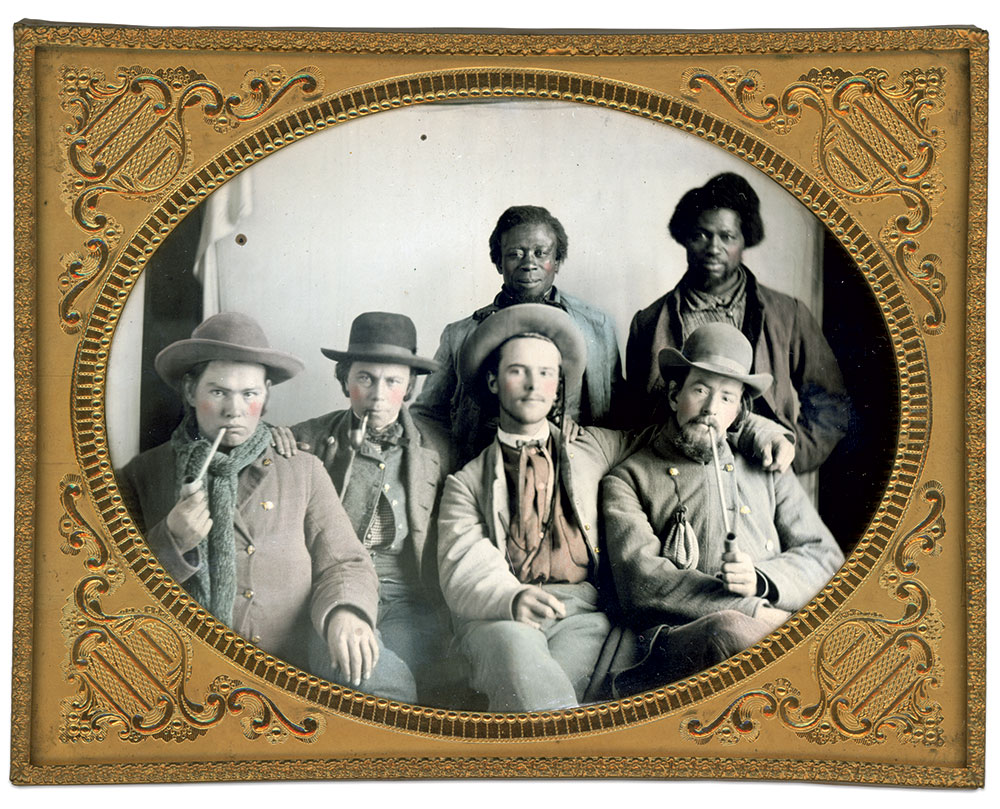
Soldiers and Servants
This group of Confederates, plus their two slaves or servants, have the appearance of those who served with the 43rd Battalion Virginia Cavalry under Col. John S. Mosby. Another source suggests the soldiers are Tennessee troopers. The seated men wear double breasted uniform coats, with two showing a vest and civilian shirt underneath, and have a range of civilian brimmed hats. Three are smoking clay pipes and the man at right conveniently has a tobacco pouch suspended from a coat button. Although African Americans with the Confederate army often wore a semblance of uniform, the man standing at left appears to be wearing civilian clothing, while the man on the right may wear a uniform coat over a civilian vest.
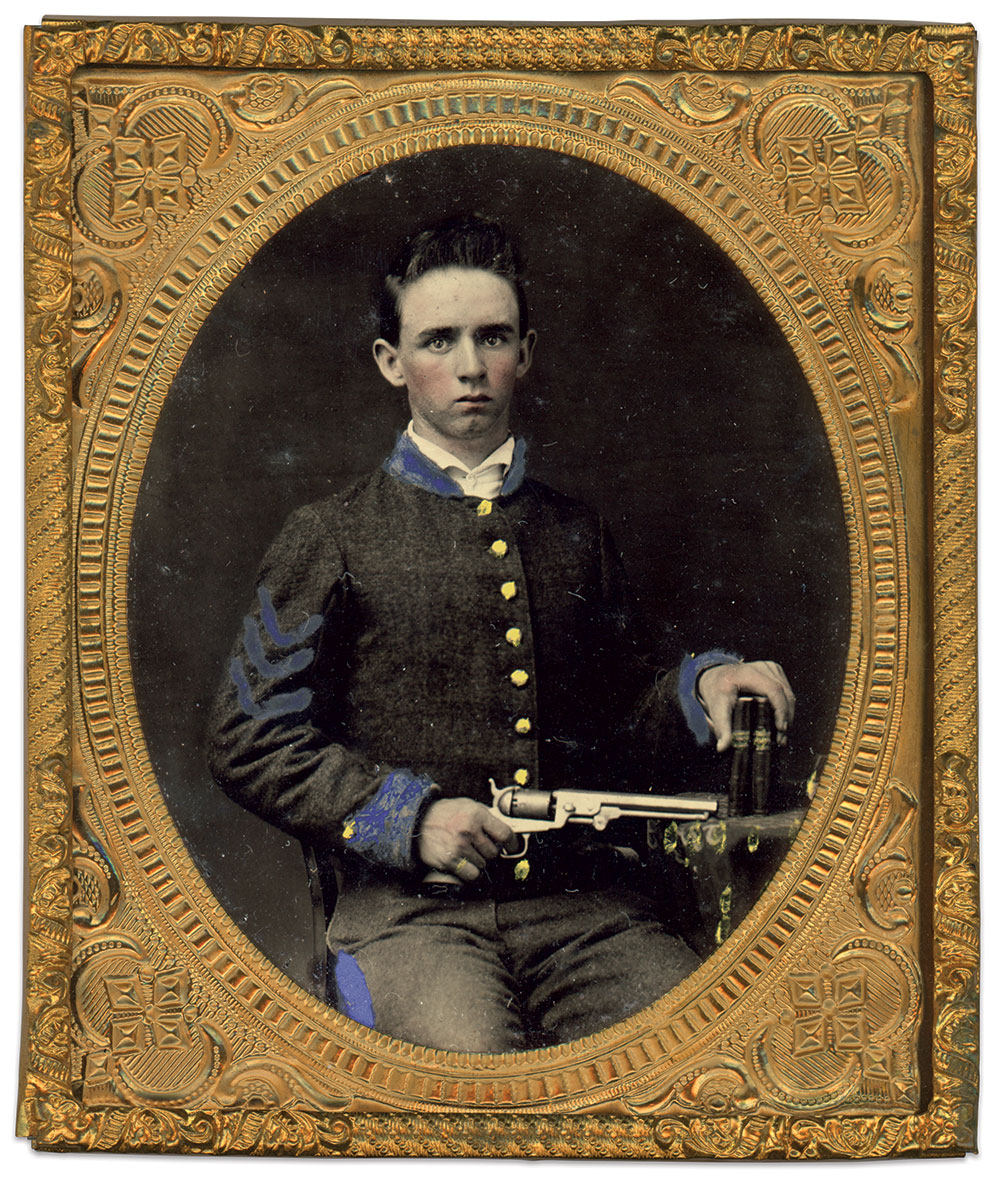
“Taken Sept, 1861 Memphis Tenn.”
An inscription inside the case of this image notes where and when the soldier posed for his likeness. A colorist has indicated that the collar and cuffs on this volunteer’s nine-button jacket were blue, plus wide seam stripes on his trousers, which may indicate he belonged to the infantry. A single button attached to the point of his cuff facing is occasionally seen in early war images of Tennesseans. He poses holding a Model 1851 Colt Navy revolver, and grasps two slim, gold embossed volumes which may have been military manuals.
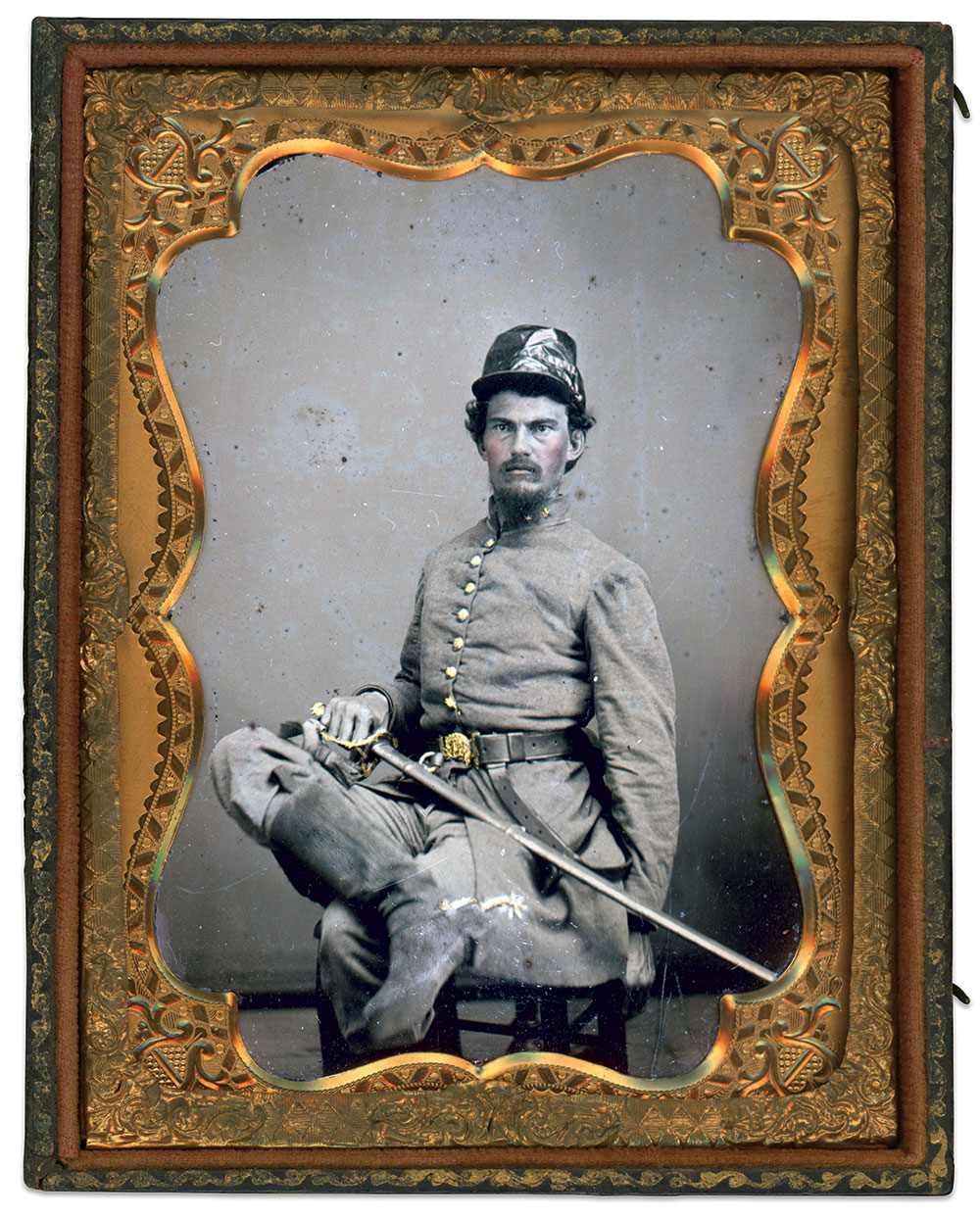
Casually Posed Lieutenant Colonel
This unidentified lieutenant colonel wears a cap of silk oil cloth and a plain frock coat with rank indicated by two stars on his collar. He attempted to overcome the lateral reversing effect of the ambrotype process by wearing his belt upside down, as indicated by the leather strap which should be worn over his shoulder but is hanging below his belt. His saber may be a cavalry model. His buff leather top boots have iron-wheeled spurs.
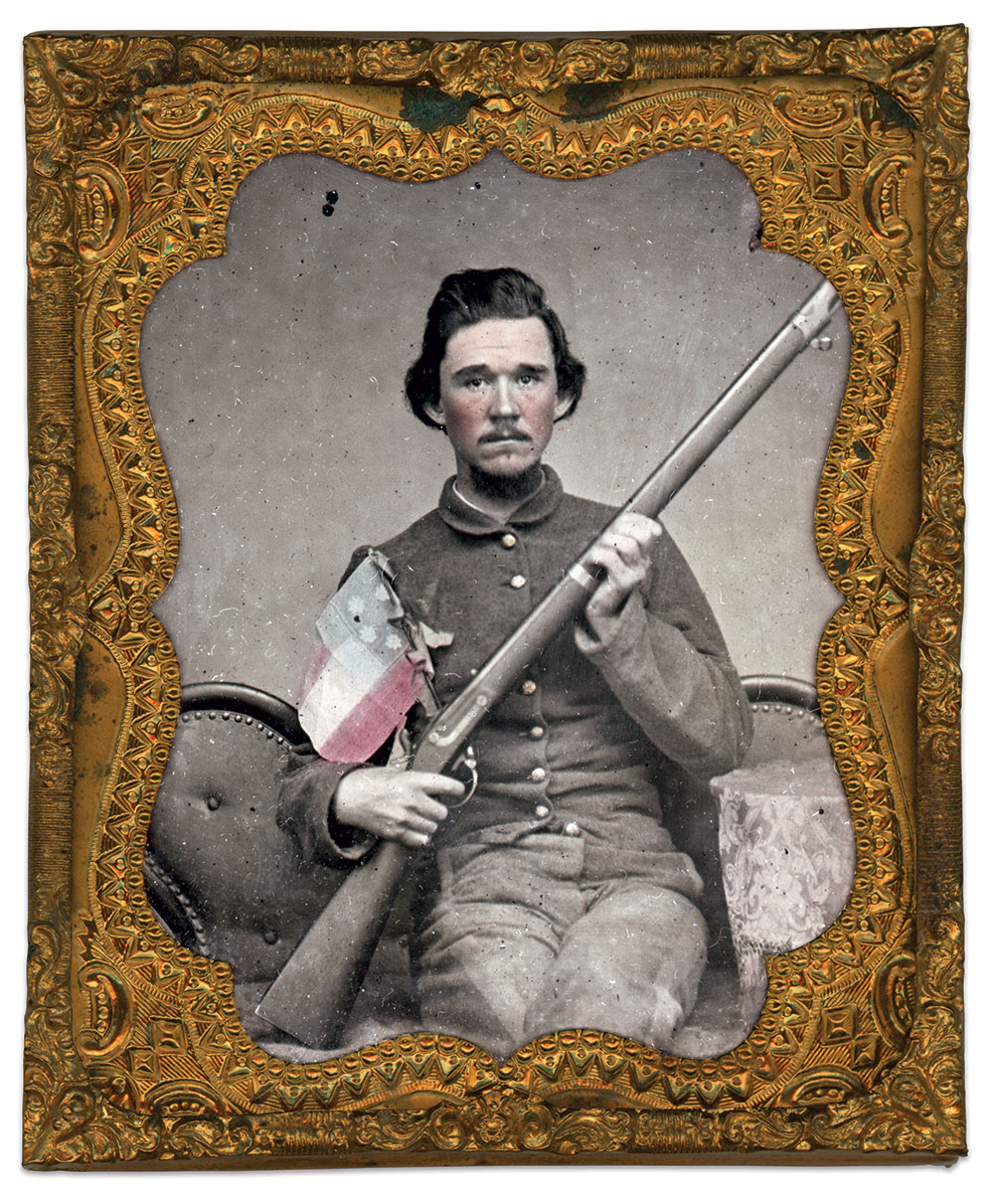
by an unidentified photographer.
For Flag and Country
With a First National flag pinned to the breast of his plain, nine-button jacket, this unidentified Confederate stares with steadfast determination at the camera. He wears an early war plain nine-button jacket with collar turned down, and holds a Model 1842 musket. Unusually, he is seated on a wide, upholstered parlor chair.
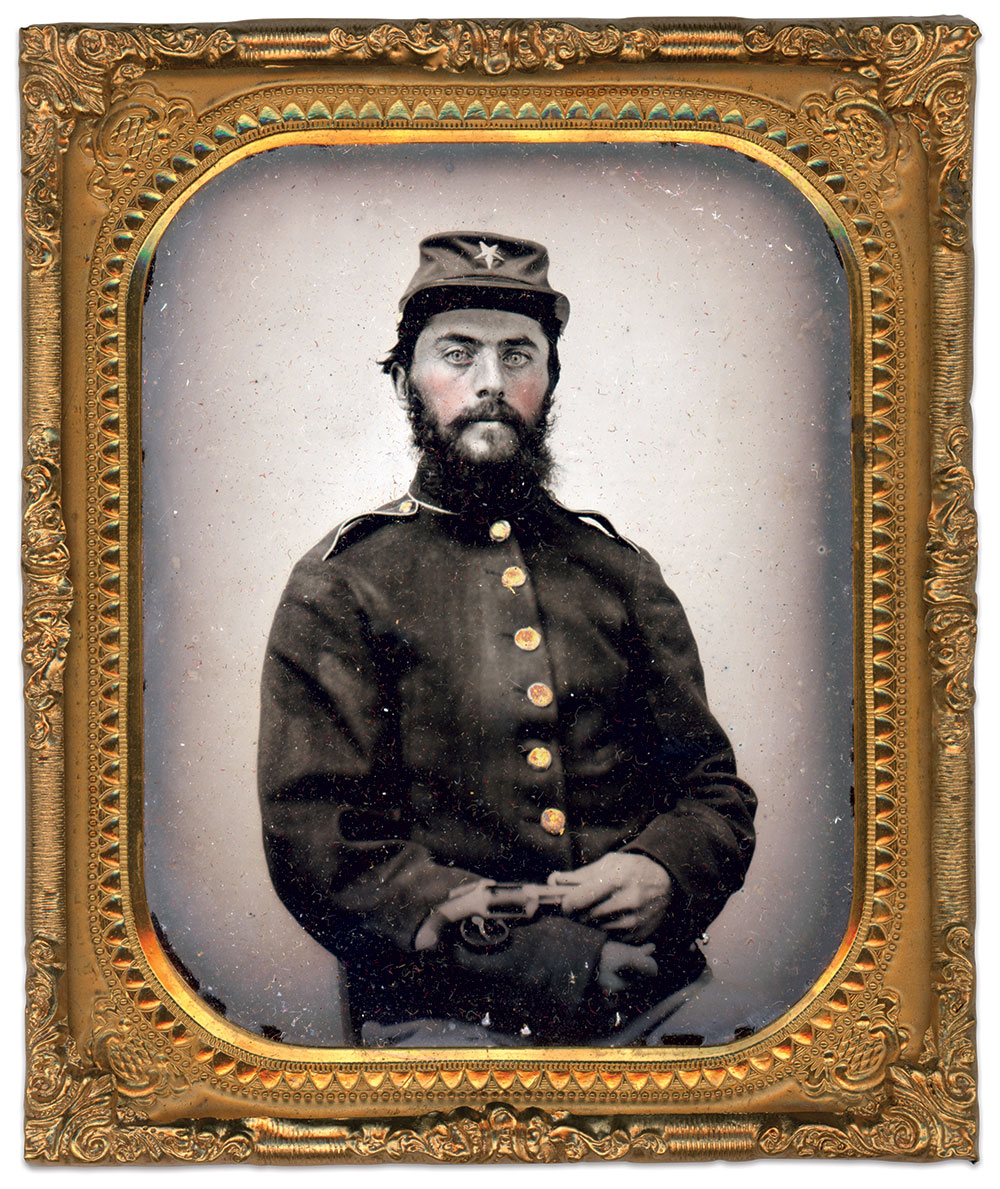
An Officer in Hood’s Brigade
Identified by a note accompanying this image, Mississippi-born John Wesley Duren (1842-1925) enlisted in Navarro County, Texas, as a private in the Navarro Rifles, Company I, 4th Texas Infantry, in July 1861. He advanced in rank to junior second lieutenant by February 1864. Duren suffered minor wounds in the right thigh and knee at The Wilderness, and received a parole following the surrender of the Army of Northern Virginia at Appomattox in April 1865. Pictured as a private prior to his first promotion, his Texas service is indicated by a five-pointed metal star attached to his cap. His jacket is trimmed around the collar and shoulder straps. He displays across his sleeve what is likely an Allen & Wheelock Bar Hammer revolver.
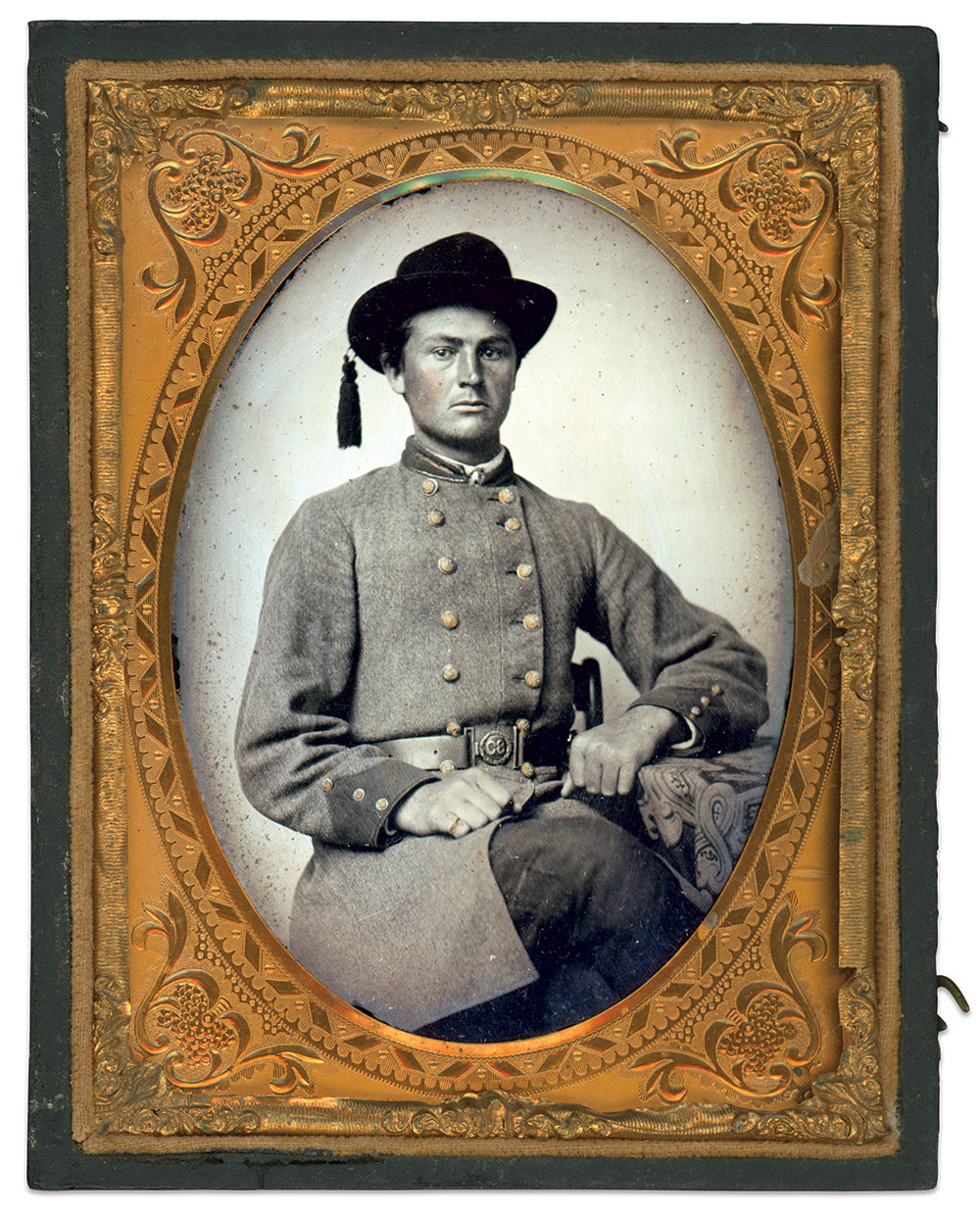
Junior Officer
This unidentified first sergeant wears a matching dark-colored uniform and forage cap. The photographer’s colorist has painted the collar and cap trim, which may indicate that they were yellow. In line with his rank, he has a red worsted waist sash and has what appears to be a Model 1850 foot officer’s sword attached to his belt.
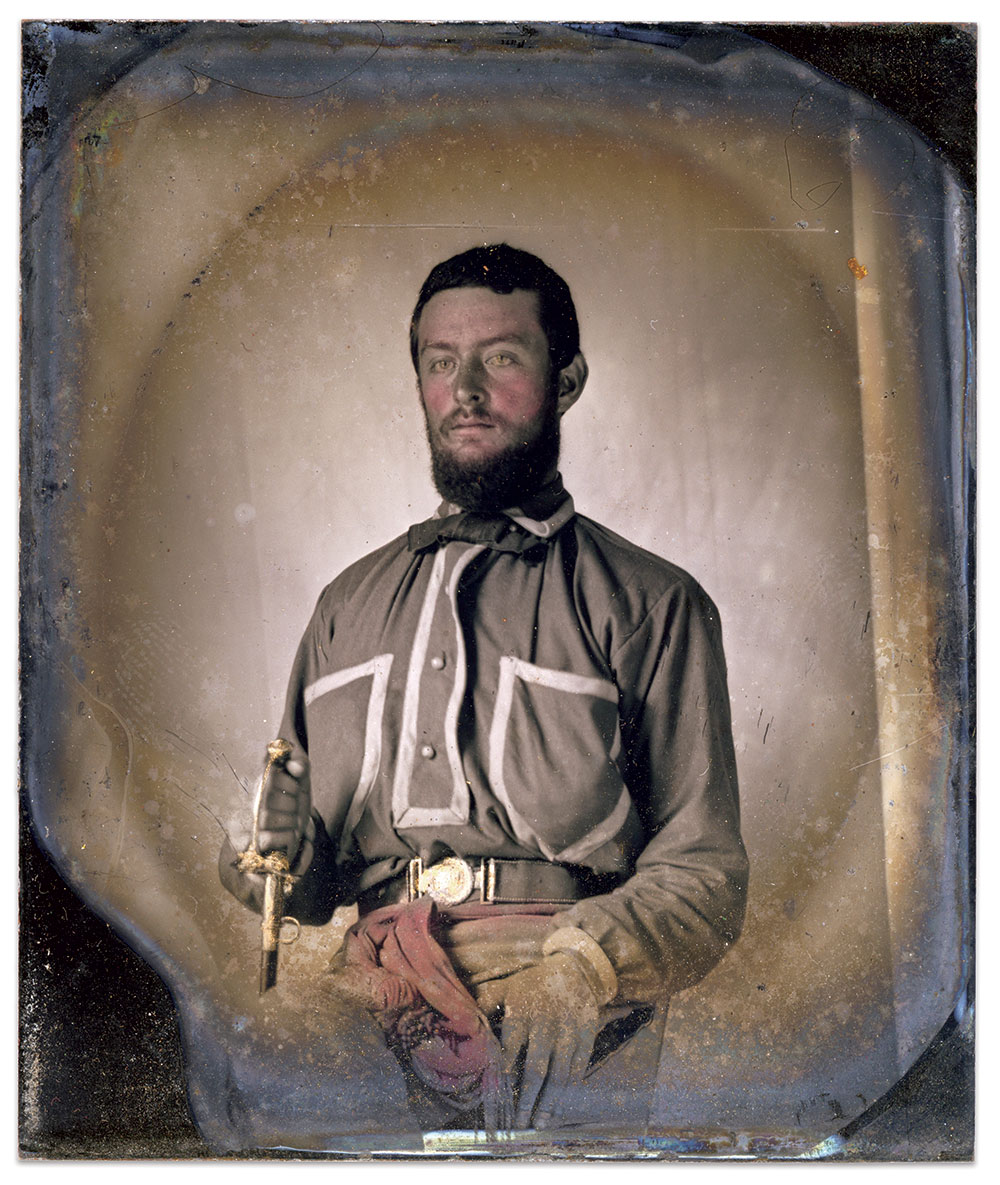
Battle Shirt
Confederate officers often wore fatigue or battle shirts, especially during the early part of the war. The heavily trimmed shirt worn by this officer has small ball buttons on its placket front. Trousers have wide seam stripes. The only indication of rank is the crimson silk net officer’s sash around his waist, and foot officer’s sword. A note accompanying this image names him as “John R. White.” As there were many soldiers with this name, his full identity has not yer been discovered.
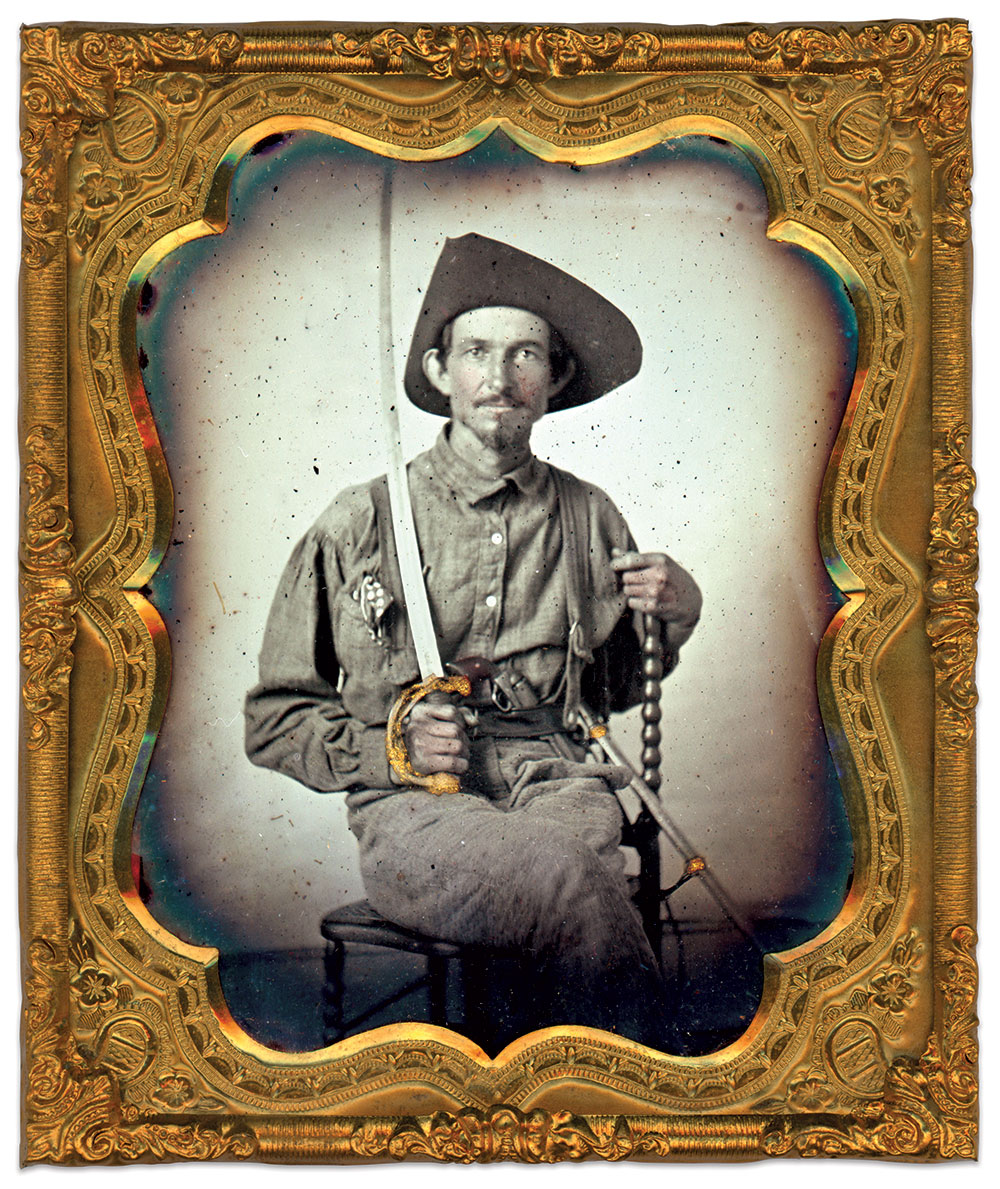
by an unidentified photographer.
Tricorn, First National
The shape of this cavalryman’s broad-brimmed hat is reminiscent of early war Mississippi volunteers. He wears suspenders over his full wool shirt; a handkerchief stuffed into his breast pocket may be patterned after a First National flag. He holds a cavalry saber, the metal scabbard for which is attached to his waist belt. A Model 1849 Pocket Colt revolver is tucked in his belt.
Bearded Patriot
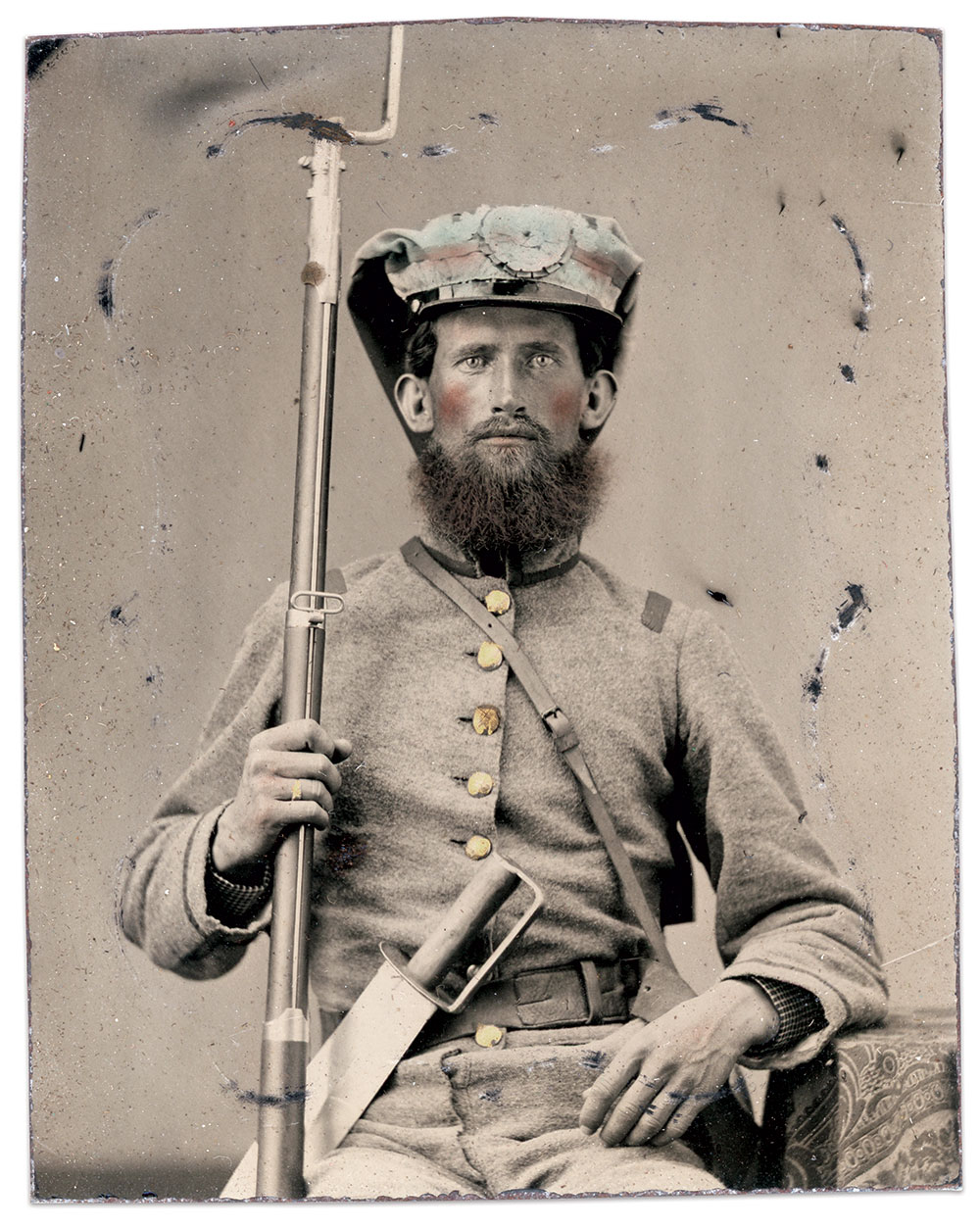
The “Sicilian”-style stocking cap was popular among Confederate volunteers, particularly in Georgia. Possibly sewn over a forage cap, that worn by this private was likely in patriotic colors which have been emphasized by the photographer’s colorist. A large secession cockade is attached to its front. His eight-button jacket with trim around collar and cuffs, and shoulder patches, was likely procured by his company from local sources, perhaps during the first winter of the war, rather than being of C.S. quartermaster issuance. He wears a finely-checked shirt of civilian origin under this. A D-Guard Bowie knife with wooden grip, typical of the hastily prepared and primitively fashioned type supplied by country blacksmiths, is attached to his belt via a hook on the back of its sheath. A bayonet is fixed to his Model 1842 musket.
by an unidentified photographer.
Mississippi Men of War
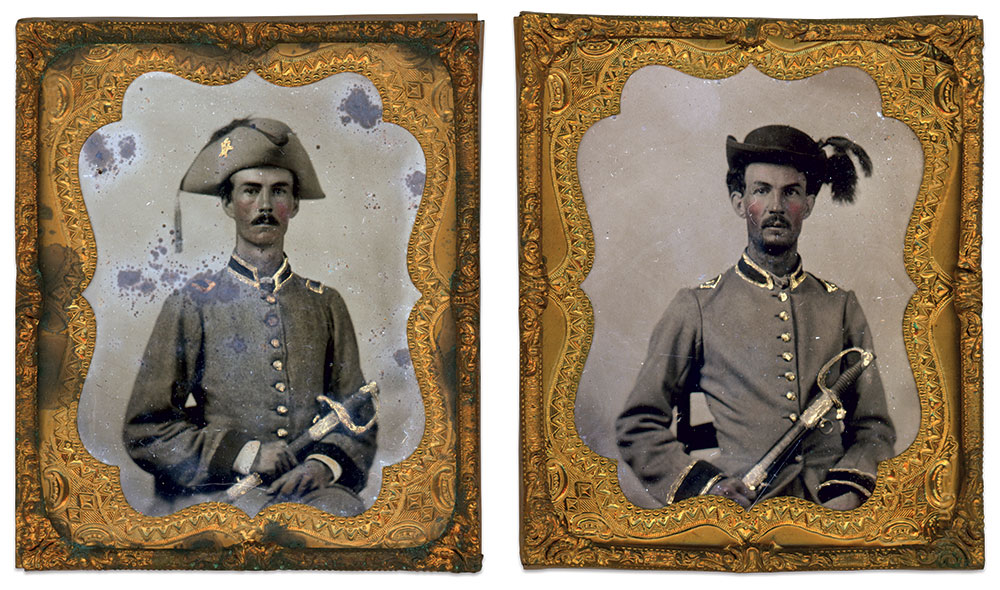
These images of unidentified officers have a Mississippi provenance. The man on the left wears the uniform prescribed by the Military Board for the Army of Mississippi in March 1861. His tricorn hat is complete with cord, tassel, and plume. An embroidered or metal five-pointed star is attached to its brim. He holds a Model 1850 foot officer’s sword. The other man wears a similar frock coat with the addition of gold trim around the cuff facings. Several feathers form a plume in his narrow-brimmed civilian hat. His shoulder straps are an unusually large, non-regulation shape.
Pillars and Arches
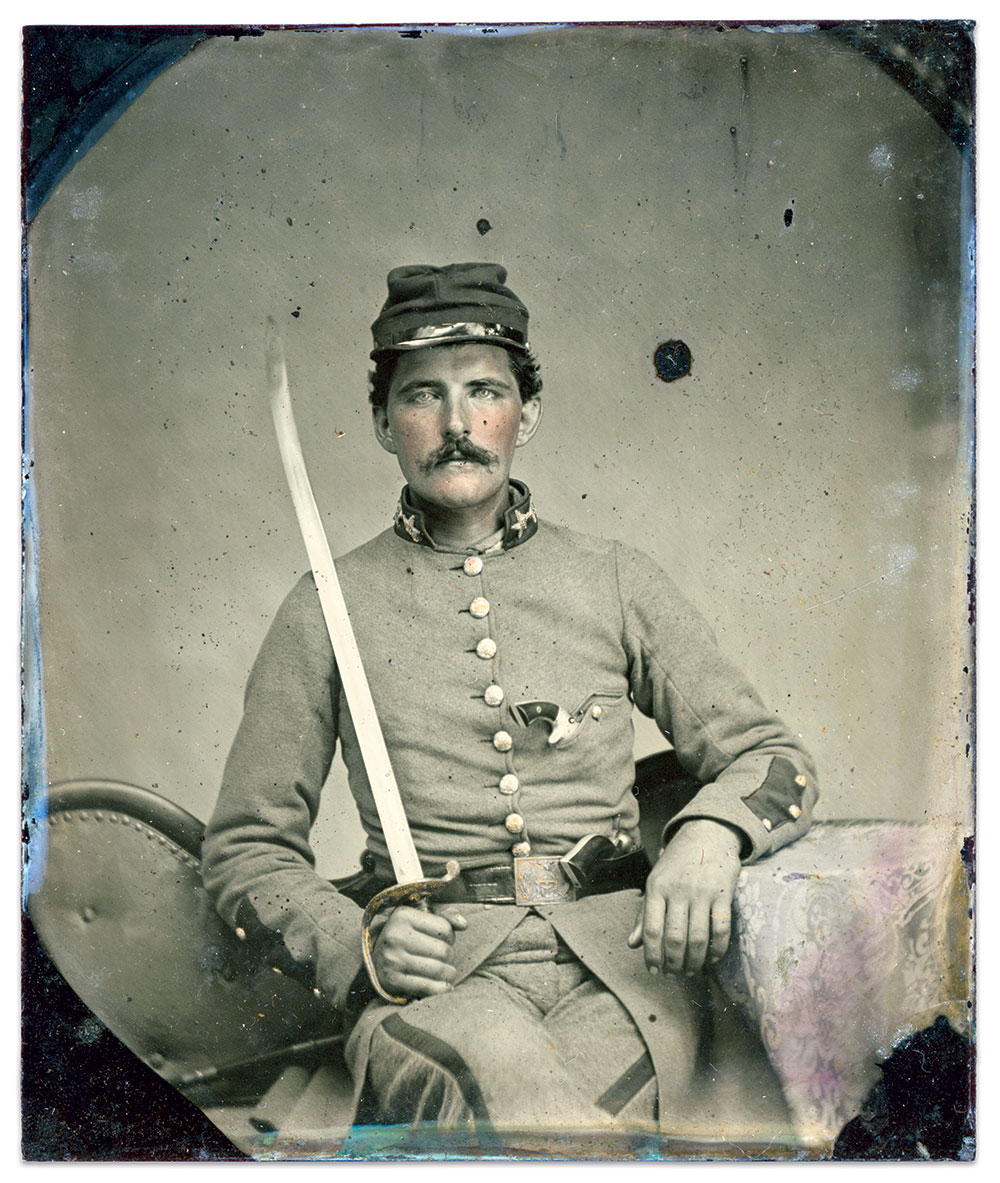
The sword belt plate worn by this lieutenant colonel is of the pattern specified for officers in the Georgia dress regulations of Feb. 15, 1861, which bore the “Pillars and Arches” state seal within a laurel wreath with an eagle on top. A limited quantity was supplied by Northern manufacturers before commerce was halted in April 1861. Apart from the stars on his collar, his early war frock coat with cuff patches is not based on either Confederate or state regulations, nor his plain chasseur-pattern cap or trousers with wide seam stripe. A Colt revolver is tucked into his belt and a Smith & Wesson Model 1 revolver in his breast pocket. He holds a Model 1850 foot officer’s sword with leather grip. This is likely a Southern sword produced during the war period.
Silver-Handled Bowie
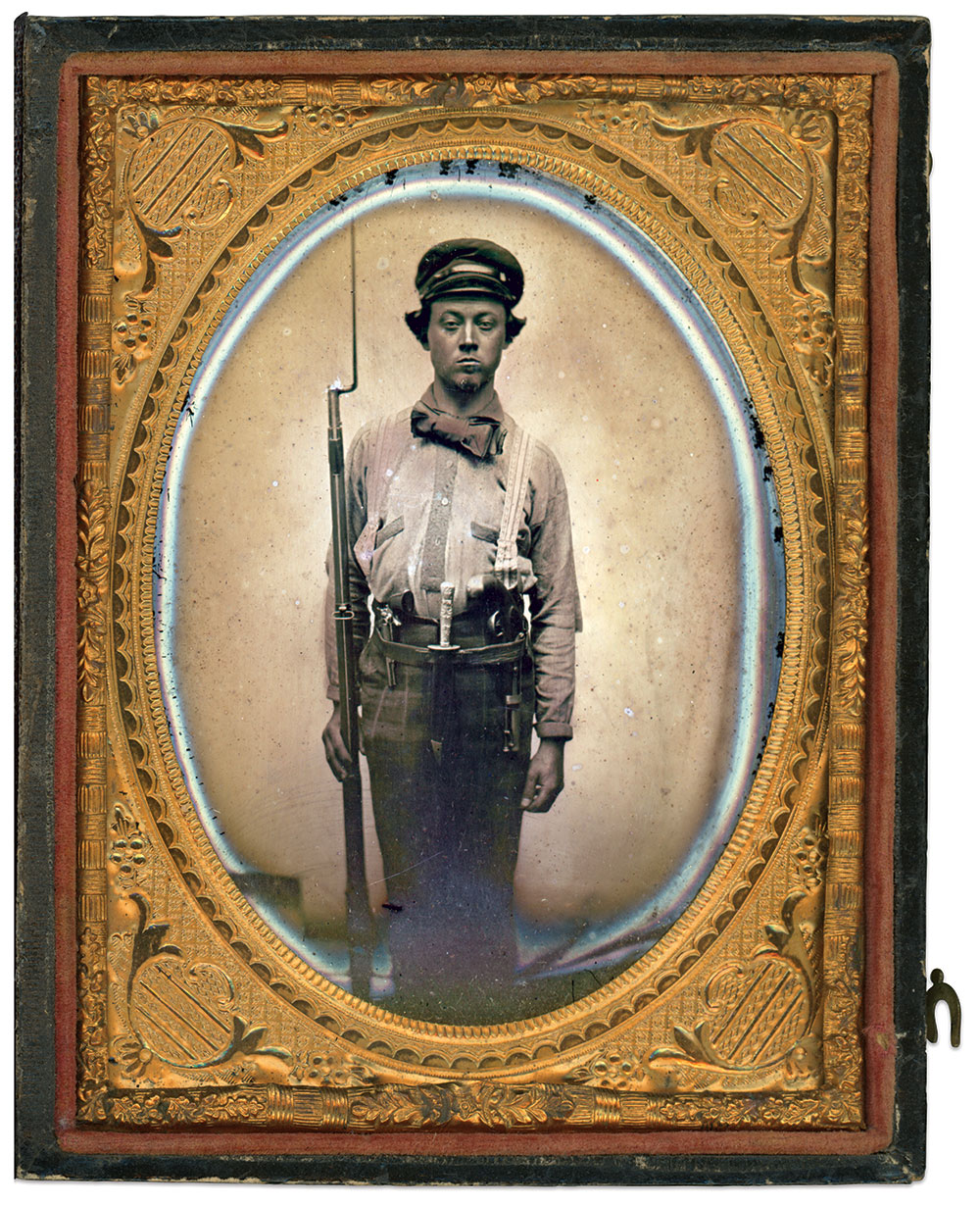
Ready to defend Southern rights, this volunteer wears suspenders over a battle shirt with contrasting collar, placket, and pockets. His 1839-pattern cap has a leather brim and chin strap. The tartan trousers were likely a personal choice or reflected Scottish heritage. His large necktie may have been added for the photo. He carries a Model 1816/1822 musket with fixed bayonet, a Bowie knife with German silver grip on his belt, and both a Colt Root revolver and Model 1842 single-shot pistol.
Militia Officer
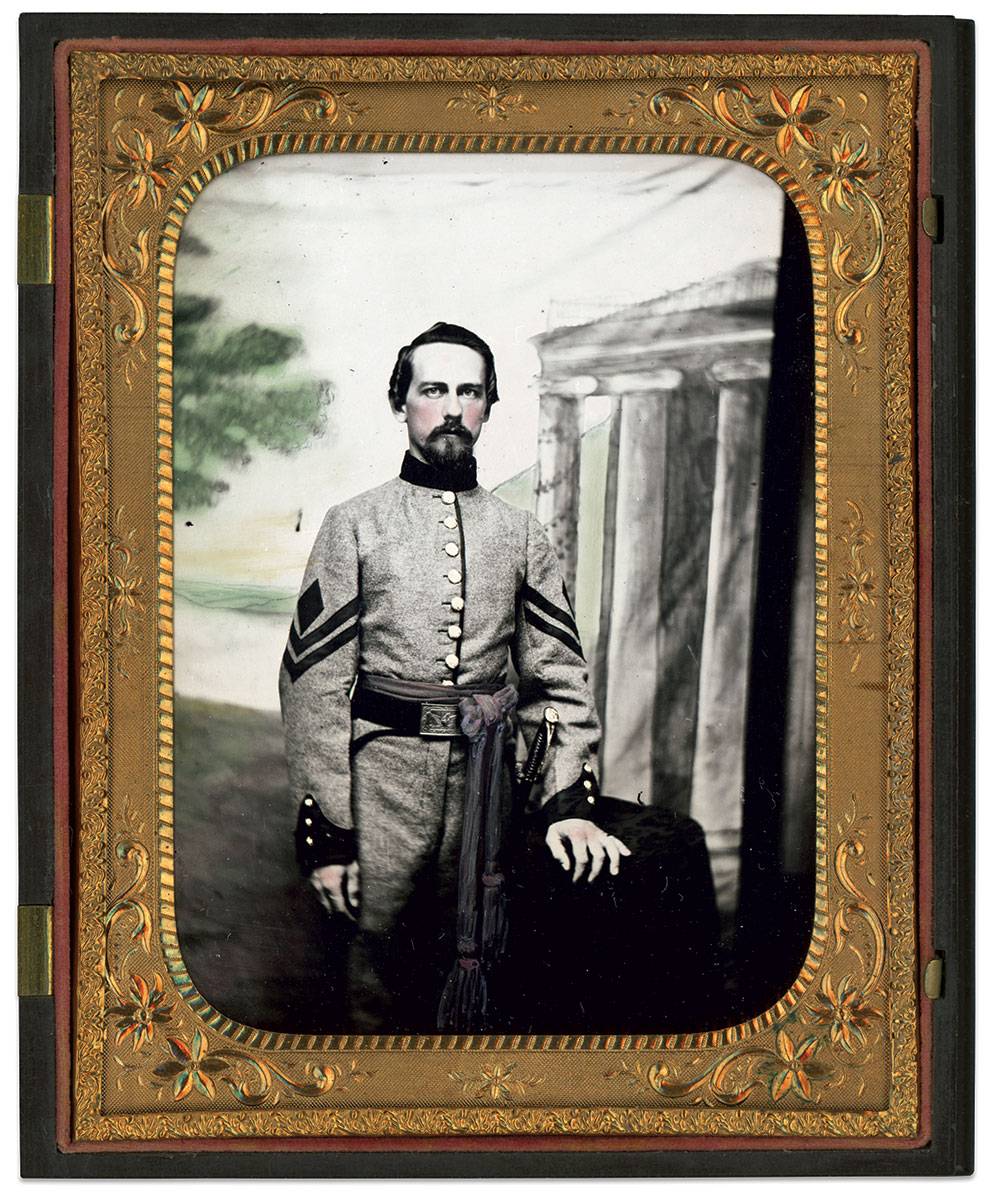
The silk waist sash and Model 1850 foot officer’s sword indicate this unidentified man is an officer. The two chevrons and lozenge are attached to his trimmed and faced gray tail coat suggest the rank of a militia officer: Pre-war Georgia militia companies such as the Clinch Rifles and Baldwin Blues, plus many northern companies, often displayed rank in this manner. His belt is fastened with a militia “Panel” plate introduced in the 1840s. First published in William A. Turner’s Even More Confederate Faces in 1983, the pillars and arches back drop is suggestive of the Georgia state seal.
Officers and Their Ladies
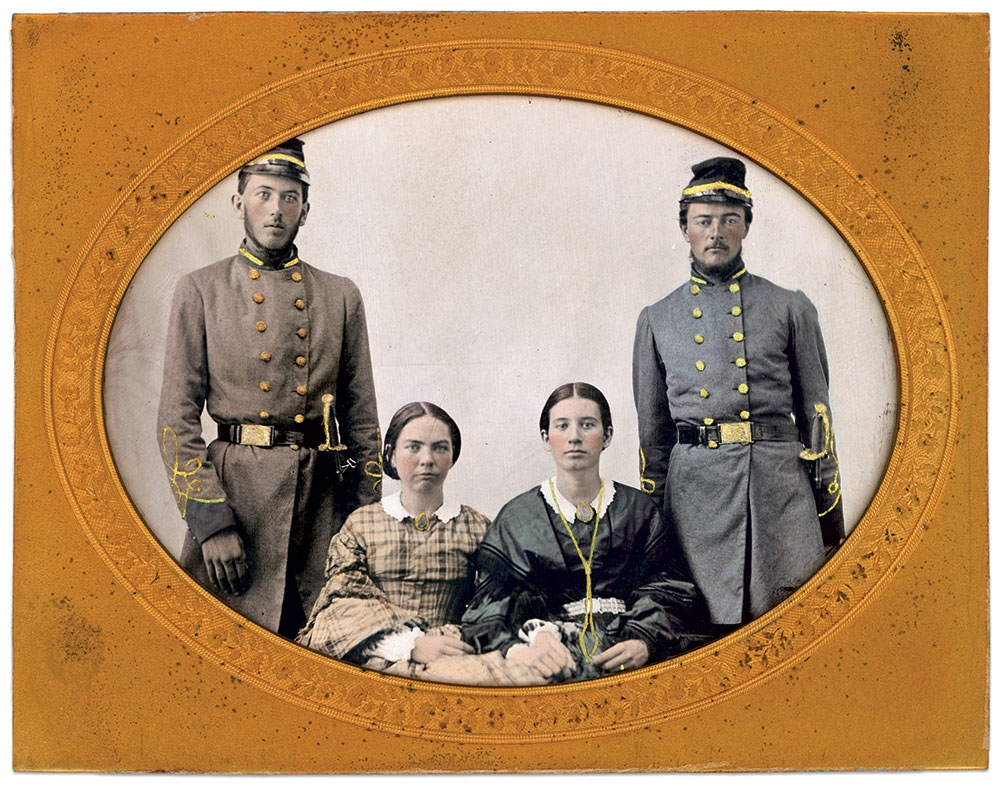
The symmetry of this image indicates a family relationship or bond of friendship between two junior company-grade officers and the seated young ladies. The officers wear Confederate regulation frock coats although their heavily tinted caps appear to be non-regulation. To combat the reverse effect of the tintype process, they both wear their foot officer’s swords on the incorrect hip.
Sardis Blues Commander
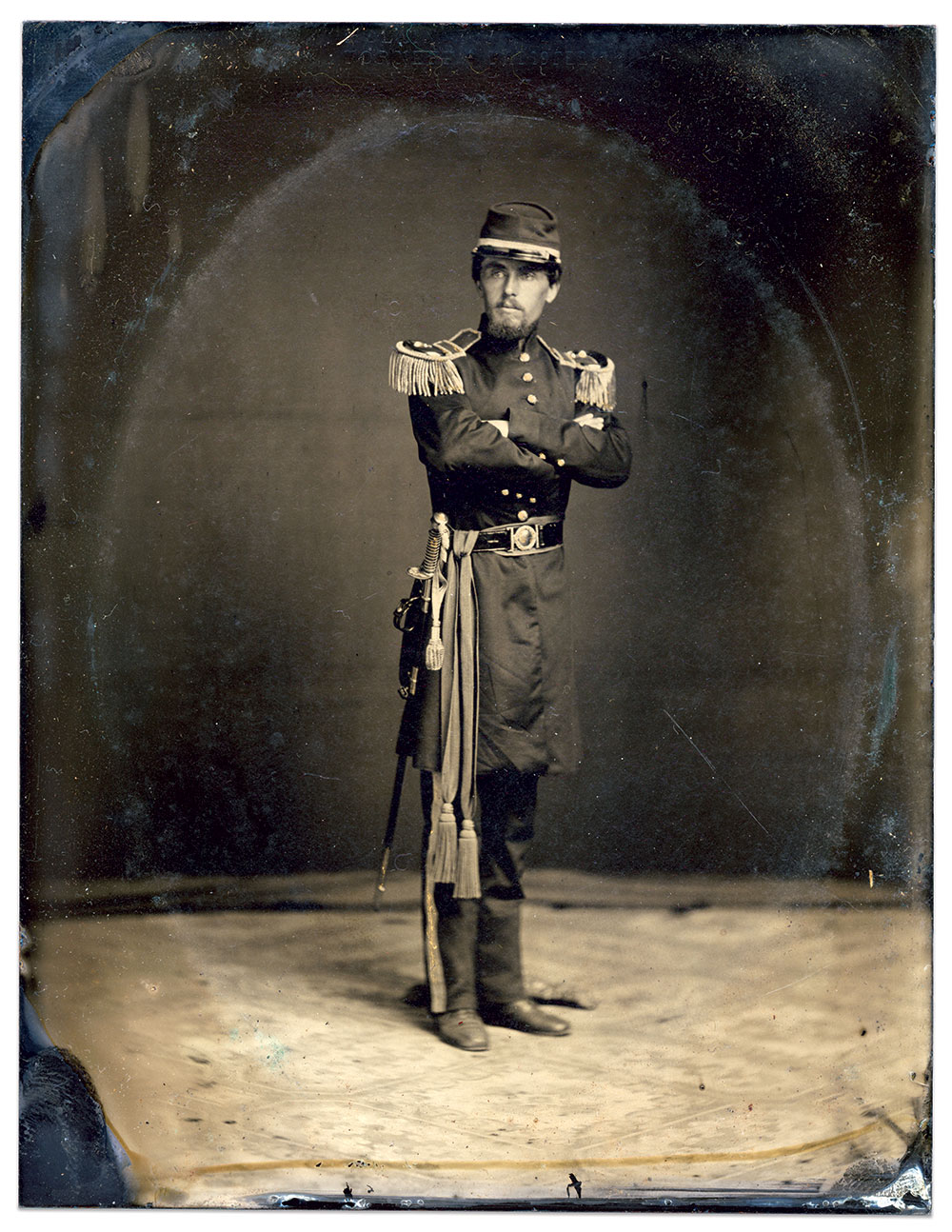
Recruited in Sardis, Panola County, Mississippi, the Sardis Blues mustered into state service on March 2, 1861, less than two months after the state seceded from the Union. They became Company E of 12th Mississippi Infantry about a week after Fort Sumter, with John William Ward (about 1837-1905) as second lieutenant. This image was originally published in William A. Albaugh III’s Confederate Faces in 1970. Promoted to captain and transferred to Company F, Ward suffered a severe head wound and paralysis of a leg at the May 1863 Battle of Chancellorsville. The injury ended his service with the regiment. He later returned to duty as a recruiting officer in Sardis. Ward wears what appear to be a blue chasseur-pattern forage cap, a blue satinet frock coat and pants, and full-dress epaulettes with light-colored trim. His two-piece belt plate, over crimson silk net waist sash, likely bears a five-pointed star in its center. A Model 1850 Foot officer’s sword is carried on his waist belt.
Crescent Regiment Sergeant
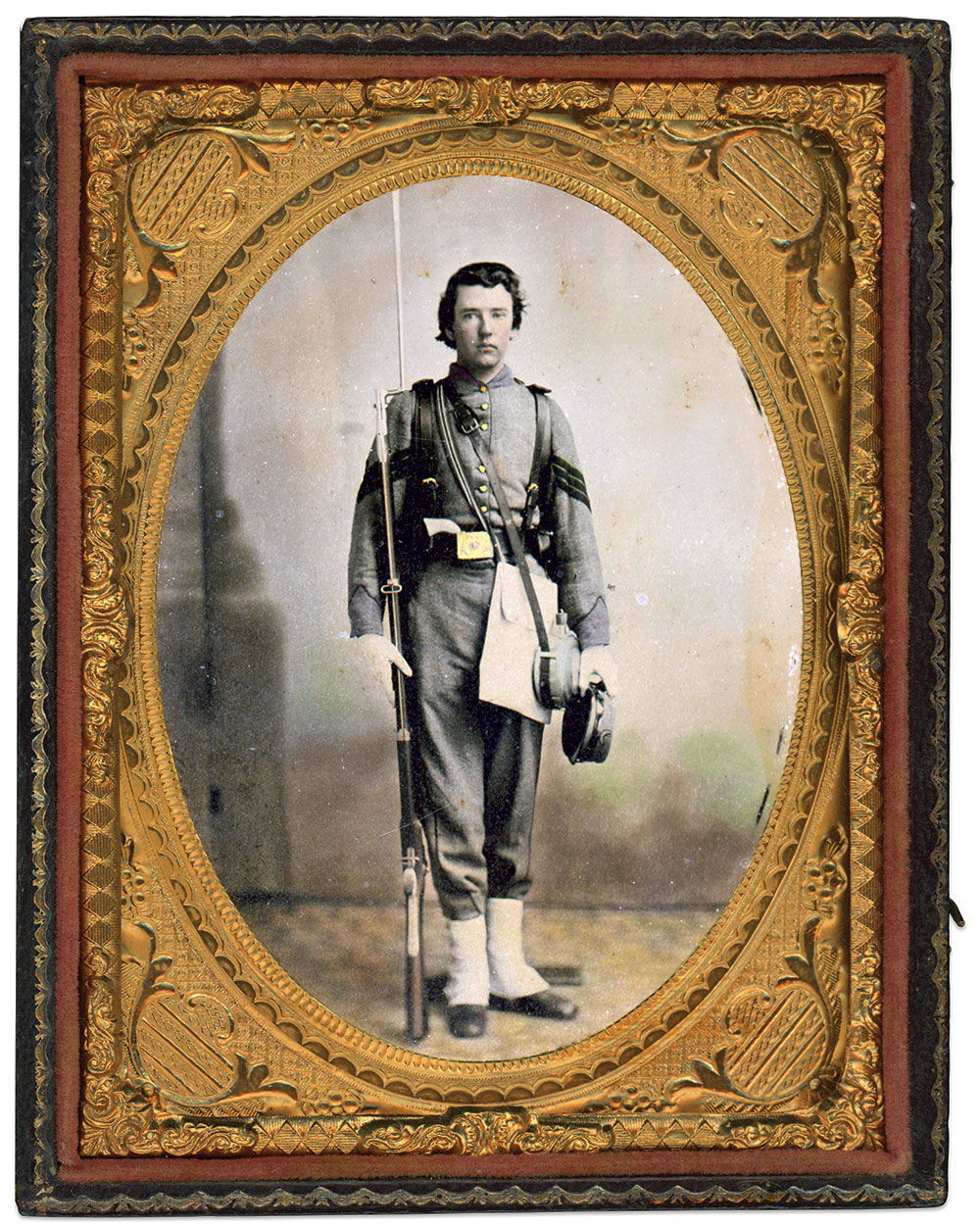
Photographed in 1861 at the studio of brothers Bernard and Gustave Moses in New Orleans, this sergeant in the Crescent Regiment, Louisiana Militia, wears a gray jacket with blue coloring on collar and trimmed cuffs. His matching trousers with narrow seam stripes are tucked into white canvas leggings. He holds a cap with a crescent-shaped patch sewn to its front. Equipment includes a tin drum canteen with cork stopper and over-sized cloth haversack with striped strap. His knapsack is supported by inverted Y-shaped carrying straps attached to his waist belt. He holds what is likely a Model 1842 musket, and has a Colt Pocket revolver tucked in his belt. Authorities transferred the regiment to Confederate service in March 1862 for a 90-day enlistment, during which time it saw action at Shiloh and Corinth.
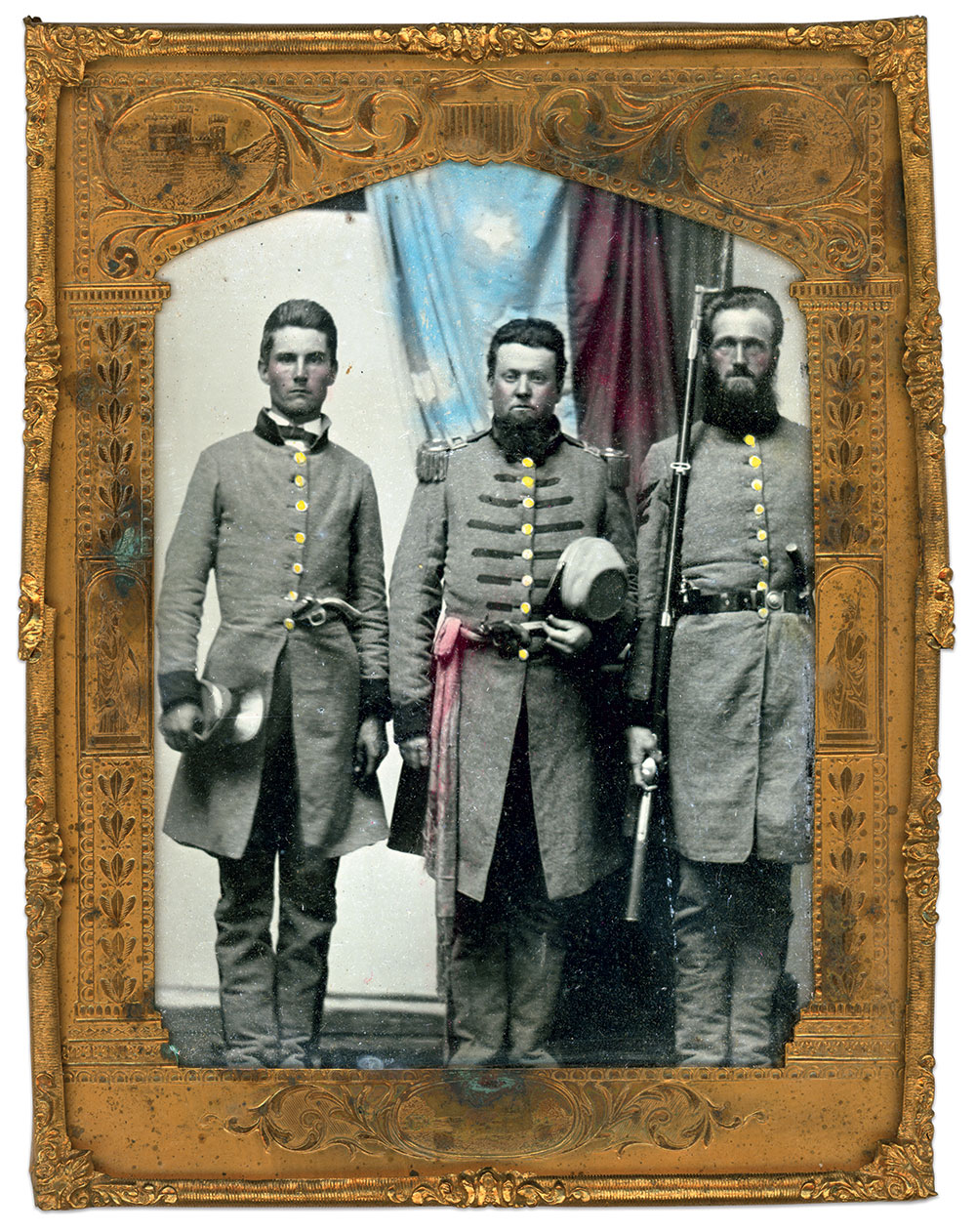
Rockbridge Artillerymen
The Rockbridge Artillery, also originally known as Captain William Nelson Pendleton’s Company, Virginia Light Artillery, fired the first cannon shot of the war in the Shenandoah Valley, and stood with the Stonewall Brigade on Henry House Hill at First Manassas on July 21, 1861. The names Samuel C. Smith, William L. Strickler, and David E. Moore, accompanying this image indicate all three served as non-commissioned officers in the unit, which would be a reason for them being photographed together. But based on the epaulettes, shoulder straps, and waist sash, the man at center is an officer and has been misidentified. The man at right does have sergeant’s chevrons high up on his sleeve, while a private stands at left. The facings and trim on their coats were likely red in line with branch service. The officer holds a chasseur pattern cap. Carrying what are likely photographer’s props rather than their own or issue weapons, they are armed from left to right with a Model 1849 Pocket Colt, a revolver of unknown make, and a Model 1816/1822 smoothbore musket. The photographer has draped a First National flag behind them.
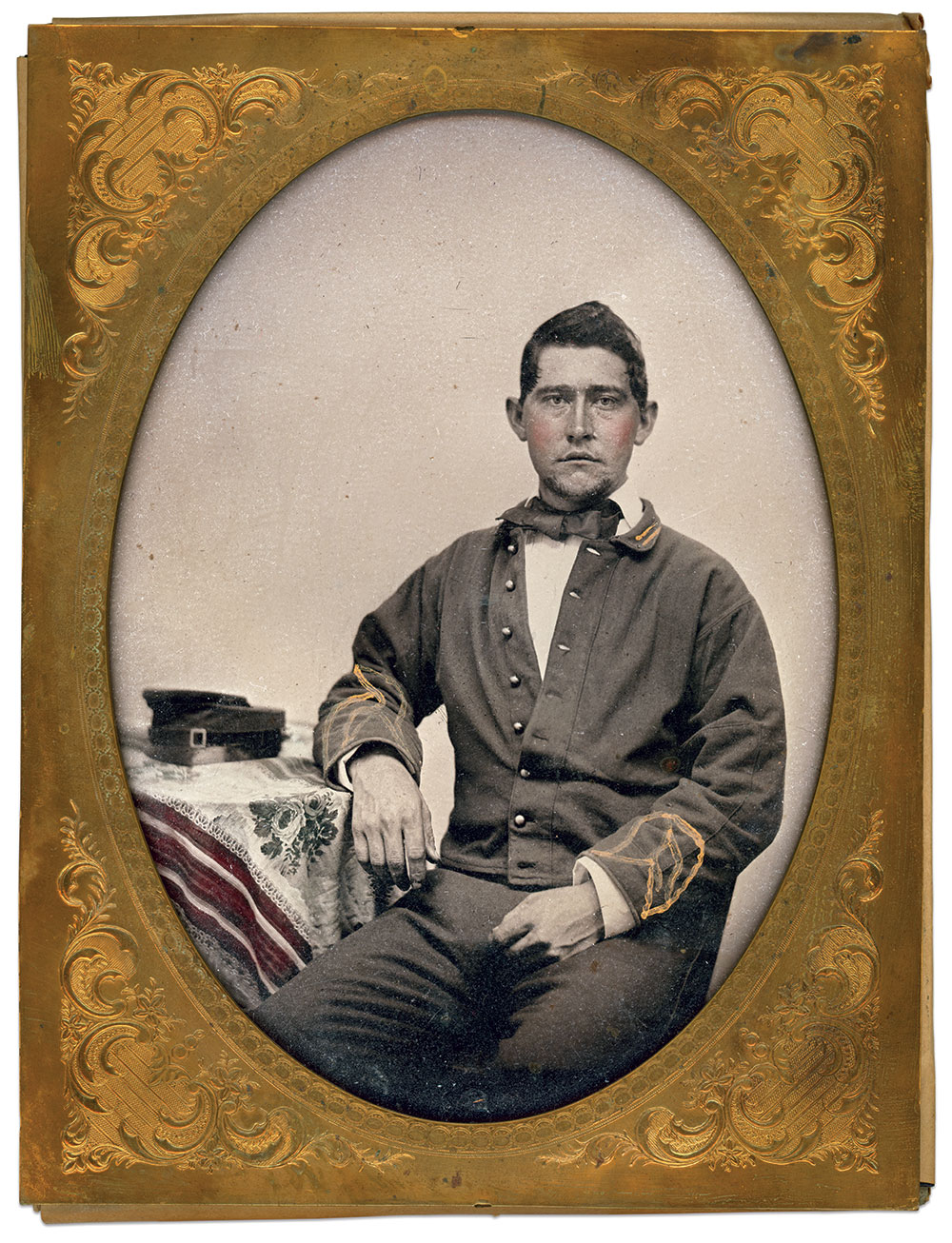
Early War First Lieutenant
Loosely based on the 1861 Uniform and Dress regulations, this company-grade officer wears a privately-purchased jacket fastened with eight small, cuff-sized buttons. The rank of first lieutenant is indicated by two over-painted horizontal bars on his fold-down collar, while the “ornament of gold braid” sewn on his cuff and lower sleeves, which in places shows either two or three strands of lace, appears to have been crudely painted on by the photographer’s colorist. His plain forage cap is placed on the table by his side.
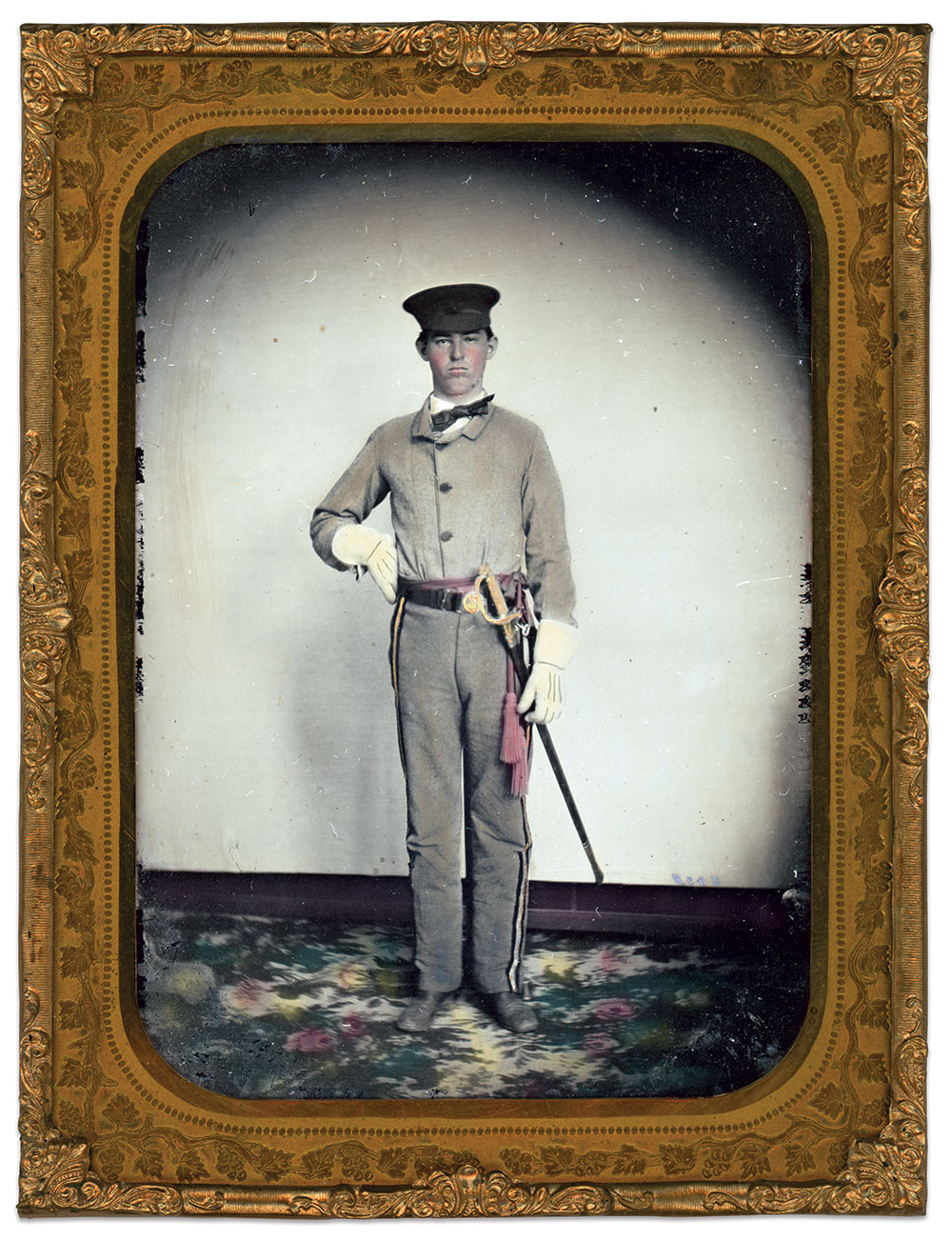
Antebellum Militiaman or Early War Volunteer
Previously published in Even More Confederate Faces, this unidentified militiaman or volunteer officer wears a Pattern 1839 forage cap. A plain four-button fatigue shirt is worn over a white civilian shirt and silk neck-tie. The stripes on the outer seams of his trousers appear to belong to a more formal full-dress uniform, and suggests the rest of his apparel is undress, which many of the wealthier antebellum and early war military companies could afford. A crimson silk net sash is worn under his waist belt with two-piece clasp, to which is attached a Model 1850 foot officer’s sword. His white leather gauntlets likely indicate mounted service.
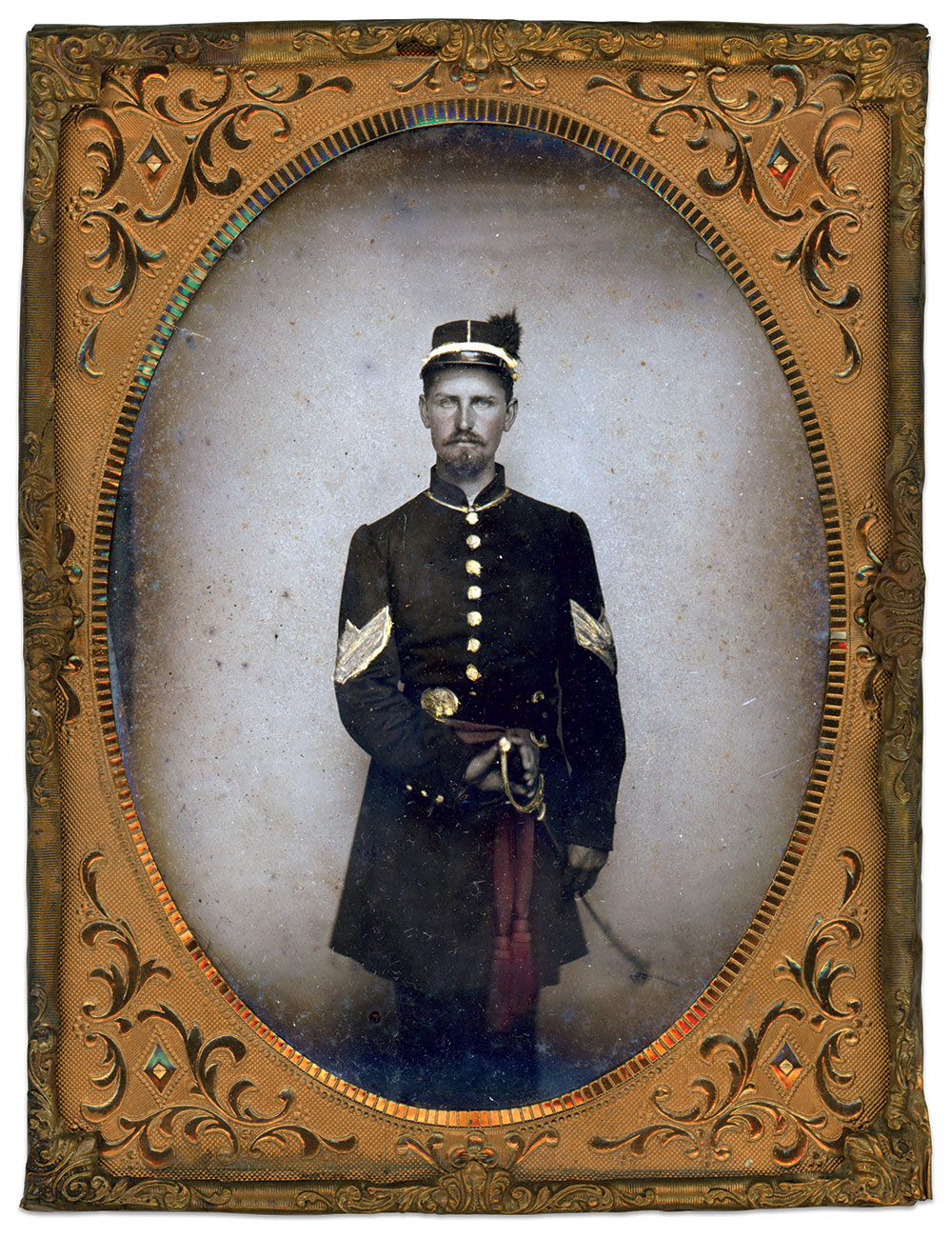
Feather-Capped First Sergeant
This unidentified first sergeant wears a matching dark-colored uniform and forage cap. The photographer’s colorist has painted the collar and cap trim, which may indicate that they were yellow. In line with his rank, he has a red worsted waist sash and has what appears to be a Model 1850 foot officer’s sword attached to his belt.
They Posed in Rees’ Richmond Gallery
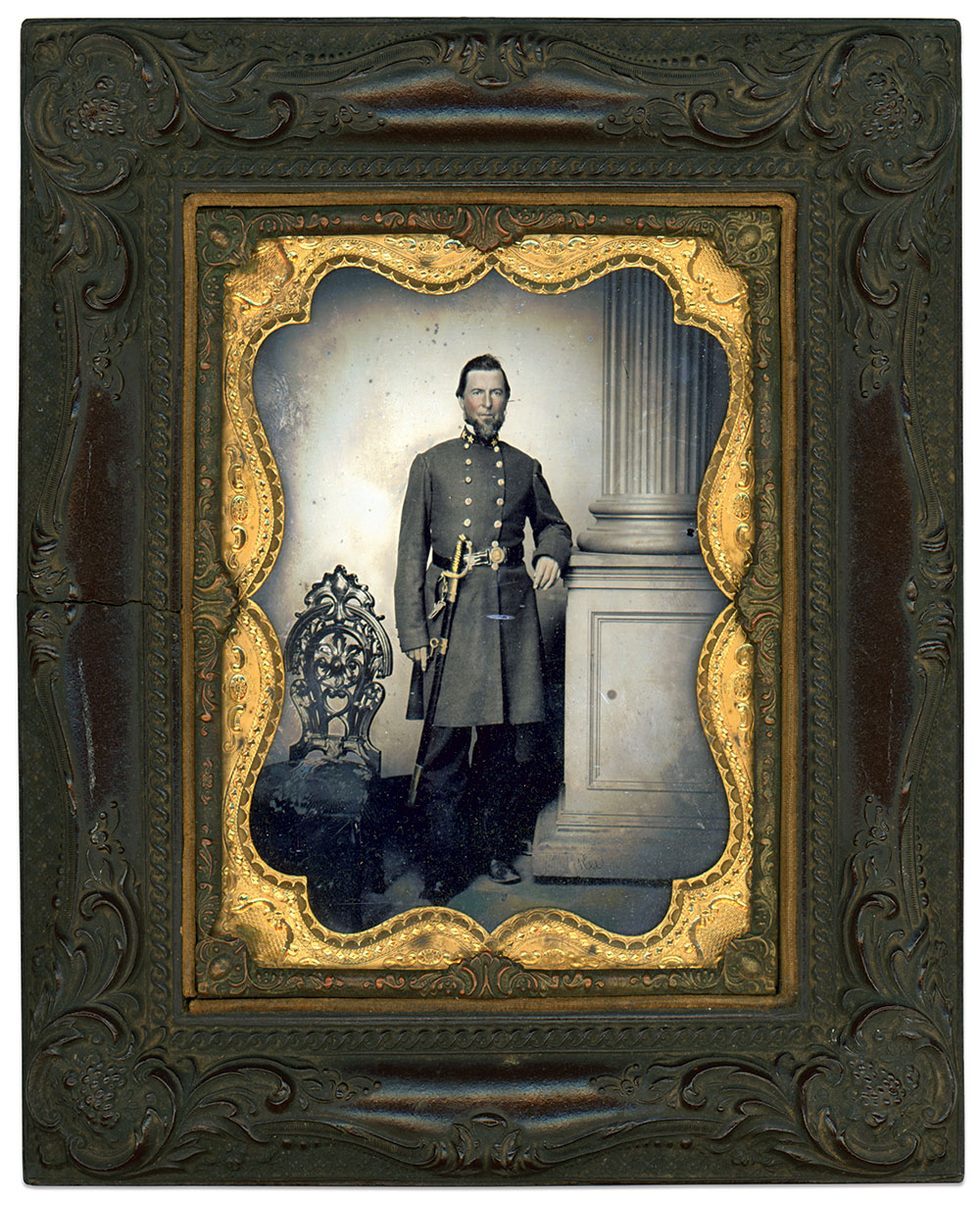
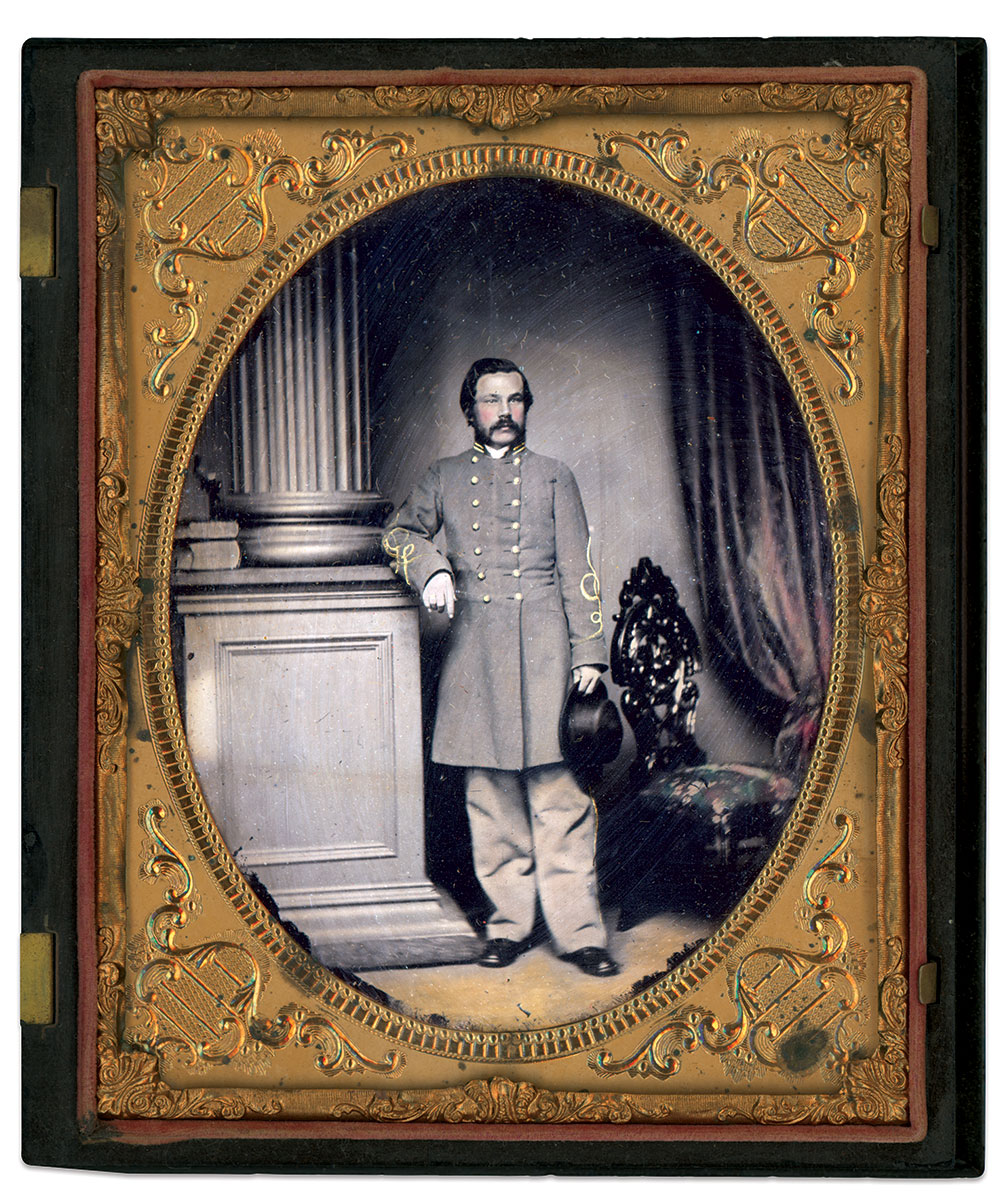
The gallery of Charles R. Rees, which occupied the top three floors above the Johnston and West bookstore at 145 Main Street in Richmond, Va., was particularly popular with officers of the Confederate army. All three of these officers availed themselves of his photographic services, which the Daily Dispatch heralded as “the most extensive and best place in the South.” Props regularly used by Rees, consisting of the ornately-carved dining chair and large wooden base and Grecian column, are notable in these examples.
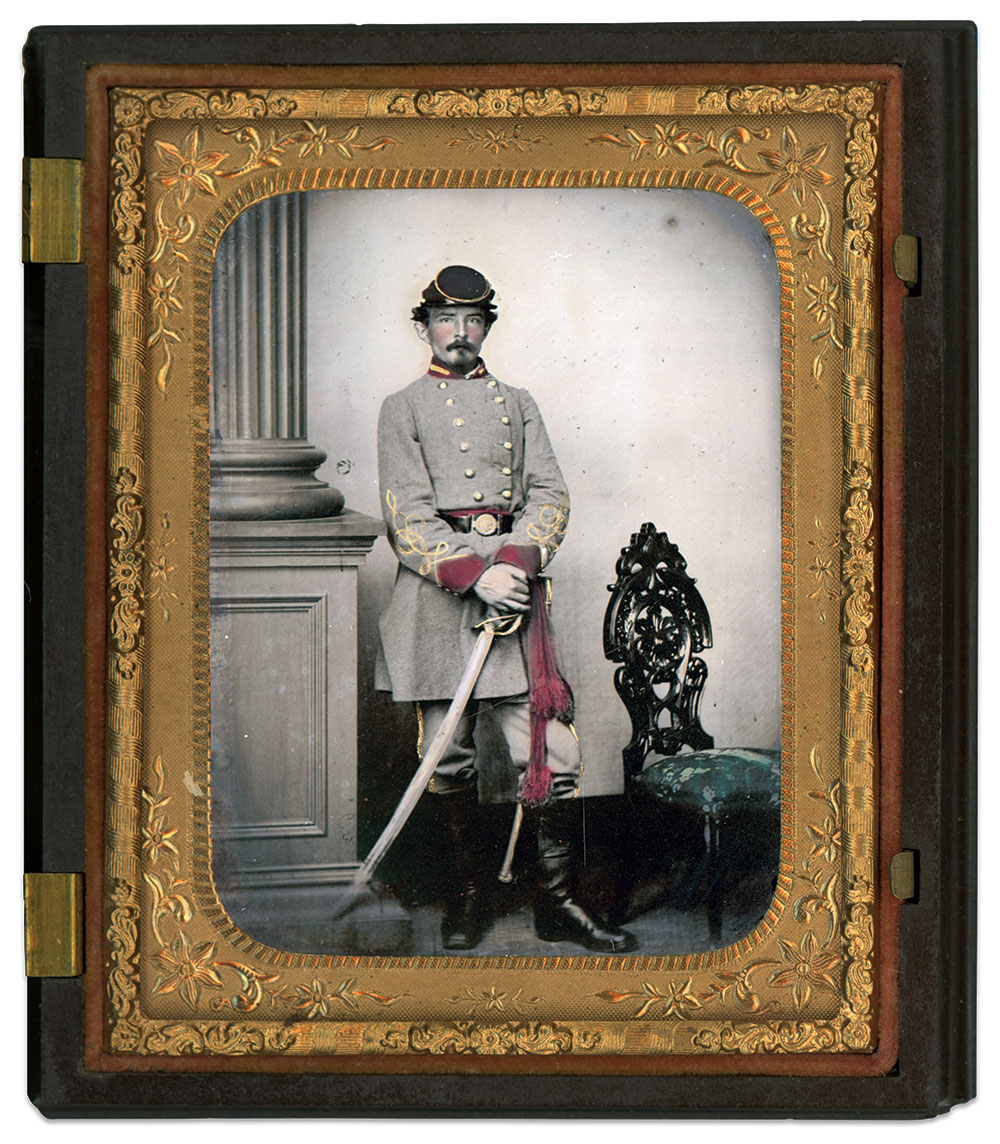
This artillery second lieutenant with red facings on collar and cuffs has regulation collar and sleeve insignia. His distinctive dark blue forage cap is trimmed around its top. A belt with two-piece clasp is fastened over a crimson silk net waist sash. He holds a non-regulation artillery officer’s sword.
This first lieutenant holds a brimmed hat with black ostrich feather plume attached.
The lieutenant colonel has two gold stars on his collar, although his regulation double-breasted coat lacks the prescribed sleeve braid. He carries a Model 1850 foot officer’s sword.
SPREAD THE WORD: We encourage you to share this story on social media and elsewhere to educate and raise awareness. If you wish to use any image on this page for another purpose, please request permission.
LEARN MORE about Military Images, America’s only magazine dedicated to showcasing, interpreting and preserving Civil War portrait photography.
VISIT OUR STORE to subscribe, renew a subscription, and more.