
By Elizabeth A. Topping
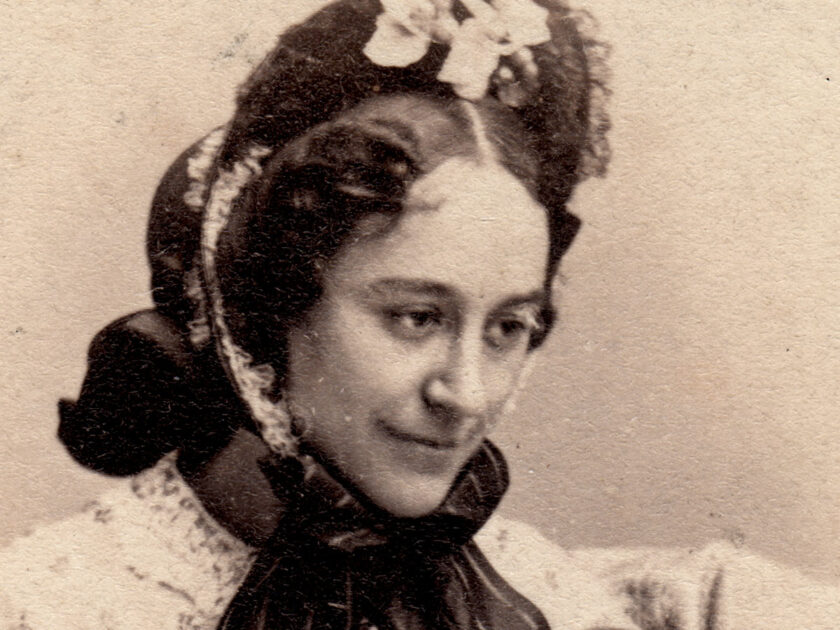
Ellen Mary Marcy McClellan remained an ardent supporter of her husband, Maj. Gen. George Brinton McClellan, throughout his military career. Though “Nelly” had rejected his marriage proposal several times over seven years, she finally acquiesced and they married in 1860. The newlyweds welcomed their first child, daughter Mary, in September 1861—only weeks after McClellan assumed command of the newly-formed Army of the Potomac.


That winter, in the nation’s capital, Nelly and “Little Mac,” as the charismatic general became popularly known, embraced the city’s elite social culture, attending lavish dinners, evening parties, and military demonstrations. Many viewed their extravagant lifestyle as disrespectful to the officers camping with their soldiers in the forts defending the capital. During the first six weeks in the city, Nelly had attended so many gatherings she ran out of dresses and had to turn down an invitation. Dismayed that his wife was unable to attend a party because she had nothing to wear, McClellan wrote to his mother-in-law asking her to get Nelly “at least one very handsome silk for an evening dress…and a wreath of rose color.”
McClellan’s letter referred to his wife as a “Flora McFlimsy.” Miss Flora appeared in a poem first published in Harper’s Weekly on February 7, 1857: Nothing To Wear. An Episode Of City Life. It satirizes the shallow life of a spoiled young lady who had a closet full of clothes but, as she claimed, had nothing to wear. Like Miss Flora, Nelly seemed to have chosen, for most of the war, to ignore the “half-starved wretches with skeleton limbs and frost-bitten feet and the curses and deep groans of dying” soldiers crying out for the aid and touch of womenfolk from home and avoiding the realities of war by indulging in the frivolities of upper-class civilians.

Nelly’s devotion to her husband gave him moral support when he felt his superiors slighted him. Sympathetic to her husband’s perceived slights, she seemed uncaring towards the Union men who loved him. During this time, military wives visited the wounded in hospitals or joined sewing circles for their benefit. But evidence indicates Nelly had little, if any, interest in these charitable endeavors. She ignored repeated requests from the U.S. Sanitary Commission in mid-1862 to help raise funds for the Union army, as evidenced by this pleading note from author and socialite Mary Elizabeth Sherwood:
My dear Mrs. McClellan,
I have written you several official notes, which I fear like many others have miscarried. The ladies are extremely anxious to have you on the Boards of Managers. The name of McClellan certainly ought to be in anything connected with the soldiers. Will you accept? We do not ask you to work only to give us as on circular says “the influence of the name, example, and position.” Please come and see us any day at 2 Great Jones St. or write to us, and believe me very truly and respectfully yours,
M.E.W. Sherwood

When McClellan moved his army out of Washington in March 1862 to embark on the Peninsula Campaign, Nelly went on holiday to visit family and friends in Connecticut and New Jersey. Her vacation continued into the Antietam Campaign. During her visit to Connecticut, she attended the funeral of Brig. Gen. Joseph King Fenno Mansfield, a resident of Middletown and commander of McClellan’s 12th Corps. Mansfield, 58, suffered a death wound in the Battle of Antietam and received a posthumous promotion to major general. The Hartford Courant reported in his funeral, noting, “One of Connecticut’s bravest heroes was consigned to the grave. Among the mourners were the governor and Mary Ellen McClellan, the wife of the commander of the Army of the Potomac.”
A portrait picturing Nelly, seated between two ladies, was taken by the Moore Brothers at the Allyn House, one of the finest hotels in Hartford, Conn., and conveniently located near the railroad station. The brothers, Nelson Augustus (1824-1902) and Roswell Allen (1832-1907), practiced their art here from 1854 to 1866. Could the lady in mourning standing to the right of Nelly be one of the late Gen. Mansfield’s daughters, Mary Louisa (who died June 22, 1863), or her younger sister Katherine? This image may have been taken before Nelly joined her husband in Maryland to view the site of his triumph, the ladies accompanying her to the station.

During their separation, George and Nelly wrote to each other daily. He wrote of his emotional experience while visiting his men in the hospital upon his return to Washington. His words must have moved her—or made her feel guilty—as Nelly made a similar visit. As far as we know, this was her only visit to hospitalized sick and wounded soldiers. Soon afterwards, President Abraham Lincoln removed McClellan from his position. This opened the door for McClellan’s own presidential bid on the Democratic ticket.

We also know Nelly participated in the Sanitary Commission’s Metropolitan Fair in New York City; her only documented involvement in these nation-wide events. The timing—April 1864, during McClellan’s presidential campaign—may have been more to promote his political future than to support soldiers fighting the war. Her name appears in the official program under the Arms and Trophies Committee. Her image also appeared on the cover of Frank Leslie’s Illustrated Newspaper, where she was depicted at her table selling tickets for one dollar each.


One of the Fair highlights, the Sword Contest, became something of a war referendum. For a one-dollar donation, an individual could cast a ballot for a general to receive a Tiffany presentation sword. McClellan and Ulysses S. Grant became the early favorites and continued to lead the voting throughout the three-week affair. When volunteers tallied the final votes, Grant had 30,291 votes to McClellan’s 14,509. A similar contest for the navy played out between David Farragut and Stephen C. Rowan, with Rowan winning the prize.
The true winners were the Union soldiers, as the contest raised more than $44,000 for their benefit.
Nelly remained at her husband’s side following his loss as president, his victory as governor of New Jersey in 1877, and his death in 1885. She lived until 1915, succumbing to pneumonia in Nice, France, during a visit to her daughter Mary (1861-1945) and son-in-law at “Villa Antietam.” Nelly was 79.
References: The New York Times, April 23, 1864; The Springfield Daily Republican, October 17, 1861; Lincoln’s General’s Wives; Butler, Nothing to Wear: An Episode of City Life; Record of the Metropolitan Fair; Dilatory Domiciles, Social Register Summer 1925.
Elizabeth A. Topping has been a reenactor and living historian for more than 25 years. Her collection and research focuses on the social and material history of the Civil War years. Her initial study centered on the subject of prostitution, which ultimately led to research on abortion, birth control and childbirth, female job opportunities and working conditions, medical treatment for poor and insane women, class and sex restrictions imposed on 19th-century females, the roles actresses played in society, and the parts women played in aiding the war efforts. Elizabeth enjoys sharing her expertise and artifacts for use in television programs, museums, magazines, conferences and roundtables.
SPREAD THE WORD: We encourage you to share this story on social media and elsewhere to educate and raise awareness. If you wish to use any image on this page for another purpose, please request permission.
LEARN MORE about Military Images, America’s only magazine dedicated to showcasing, interpreting and preserving Civil War portrait photography.
VISIT OUR STORE to subscribe, renew a subscription, and more.