By Buck Zaidel
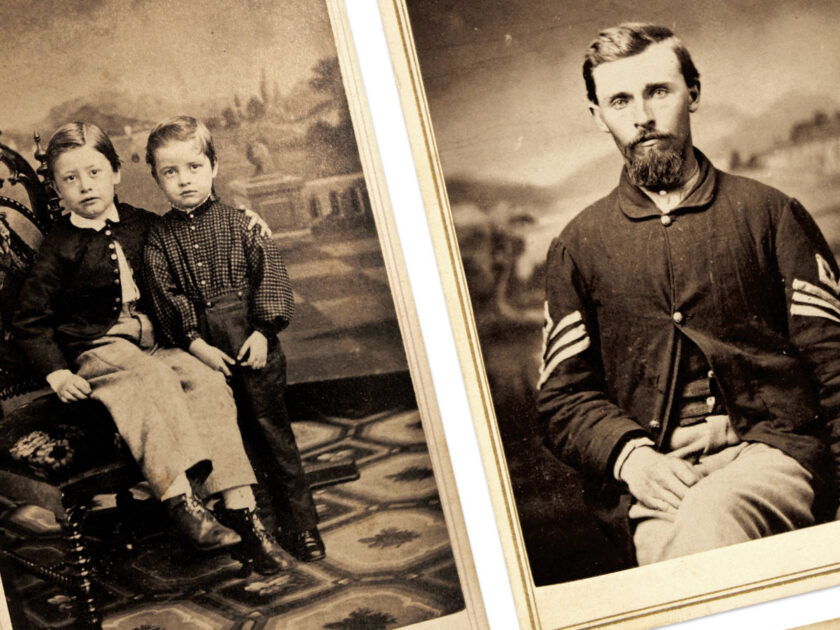
Four cartes de visite produced in Cincinnati during the Civil War years reveal how one of America’s most important 19th century photographers used painted backdrops as visual storytelling devices.
The images originate from the gallery of James Presley Ball (1825-1904), the celebrated African American photographer, entrepreneur, and abolitionist whose Cincinnati studio emerged as one of the most sophisticated photographic establishments in the country. Though much has been written about Ball’s career and activism, these portraits offer a more intimate look at how he visually distinguished civilian life from military service.
One carte, a portrait of two boys, presents a world far removed from war. One child stands with his arm draped affectionately around a smaller companion, perhaps a younger brother. They pose beside an ornately carved chair with a cushioned seat and a painted romantic scene decorating its back panel. Behind them stretches a tranquil classical landscape—a villa overlooking rolling countryside dotted with trees and distant hills. Beneath their feet lies a vibrant patterned floor covering that softens the foreground and adds warmth to the composition. Barely visible beside the standing child is the metal base of a photographer’s headrest stand, a reminder of the technical realities behind such carefully posed portraits.
The other three cartes tell a different story entirely.

These soldier portraits feature a painted military encampment backdrop that seems purposefully designed for wartime clientele in Cincinnati, then the nation’s sixth largest city. It occupied a vital position along the Ohio River as a center of manufacturing, transportation, and troop mobilization. Soldiers filled the city streets, camps spread across the region, and photographic galleries catered to citizen-soldiers traveling to and from the front lines.
About the Backdrop
This backdrop reflects this changing clientele and national mood. The painted canvas is visually divided between two worlds. On one side stand tall military tents arranged near a shoreline, accompanied by the dark barrel of a substantial cannon angled outward toward the opposite shore. On the other side unfolds a picturesque natural landscape, softer and more pastoral in tone. The juxtaposition creates a compelling duality: war and peace occupying the same visual field.
Three unidentified soldiers pose before this setting.
One private, dressed in a four-button sack coat and forage cap, stands holding a rifle with fixed bayonet. Another, wearing a broad campaign hat, grips a rifle-musket with attached bayonet. The third soldier, a seated first sergeant, appears in what may be the most artistically successful image of the group. The distant softness of the painted backdrop contrasts beautifully with the razor-sharp detail of the noncommissioned officer. Rich dark tones and careful lighting elevate the portrait beyond a simple likeness into something approaching fine art.
The identity of the backdrop painter remains unknown. However, Ball maintained a longstanding professional relationship with the noted landscape artist Robert S. Duncanson, who occasionally worked in Ball’s gallery as a colorist. Duncanson’s influence on the studio’s visual culture deserves further scholarly attention, particularly given the painterly quality of the scenic elements visible in these cartes.
The cartes themselves provide important clues about their production.
Sharp-eyed observers may notice the blind stamp on the lower recto mount of the civilian portrait, reading: “J.P. Ball, 10 W. 4th ST.” The soldier cartes bear a five-line backmark identifying “J.P. Ball’s Photographic Gallery No. 30 West 4th St., betw. Main and Walnut Sts., Cincinnati, O.” None of the four images carries a federal tax stamp, suggesting they were likely produced before August 1864, when revenue stamps became mandatory on photographs.
A Concise Biography of Ball
Born in western Virginia in 1825, Ball learned the daguerreian process from the African American artist John B. Bailey of Boston in the early 1840s. After moving to Cincinnati in 1845, Ball briefly operated a one-room photographic studio before spending years traveling through neighboring states refining his craft. Returning to Cincinnati, he opened Ball’s Gallery of the West on New Year’s Day 1851.

The establishment was magnificent by any standard. Occupying three floors, the gallery displayed nearly 200 photographs alongside landscape paintings, statuary, and even a grand piano. Ball intended his studio to be more than a commercial enterprise. It was a cultural institution and a statement of artistic and intellectual achievement.
His activism extended beyond photography. In 1855, with assistance from local African American artists, Ball created a massive moving panorama stretching some 600 yards in length depicting the history of slavery in America. Accompanied by a descriptive pamphlet, the work combined art, education, and abolitionist advocacy in a sweeping visual narrative intended to challenge public perceptions of African Americans and slavery itself.
By the Civil War years, Ball’s reputation had become firmly established. In 1857 he received a photography medal from the Ohio Mechanics Institute annual exhibition. His technical mastery attracted clients from every social class—ordinary citizens, soldiers, political figures, and prominent Black Americans seeking dignified representations of themselves in an era dominated by racist caricature and distorted imagery.
Ball understood the power of photography as few Americans did. He shared this in common with Frederick Douglass, perhaps the most photographed American of the 19th century. Douglass spoke passionately about photography’s democratizing influence in his famous 1861 lecture “Pictures and Progress.” Others similarly recognized the medium’s transformative potential. Abraham Lincoln reportedly told photographer Mathew Brady, “Brady and the Cooper Union made me president,” acknowledging the power of photographic image-making in shaping public identity. Sojourner Truth sold cartes de visite of herself bearing the phrase, “I sell the shadow to support the substance.”
Ball operated within this larger understanding of photography as both art and persuasion.
His peaceful civilian scenes projected stability, aspiration, and refinement. His military backdrops acknowledged duty, danger, and patriotic service. Together, these carefully staged environments allowed his sitters to present themselves in ways they chose to be seen—not as caricatures, but as dignified individuals occupying meaningful roles in American life.
It can be fairly stated that through photographs, paintings, pamphlets, and visual spectacle, Ball used imagery to challenge perceptions and advance social change. His portraits illuminated the humanity, intelligence, and character of people too often misrepresented or ignored in America. In this way, the painted scenery behind Ball’s subjects shaped the nation’s visual narrative.
Buck Zaidel is a MI senior editor. He is a co-author, with Dione Longley, of Heroes for All Time: Connecticut Civil War Soldiers Tell Their Stories.
SPREAD THE WORD: We encourage you to share this story on social media and elsewhere to educate and raise awareness. If you wish to use any image on this page for another purpose, please request permission.
LEARN MORE about Military Images, America’s only magazine dedicated to showcasing, interpreting and preserving Civil War portrait photography.
VISIT OUR STORE to subscribe, renew a subscription, and more.