
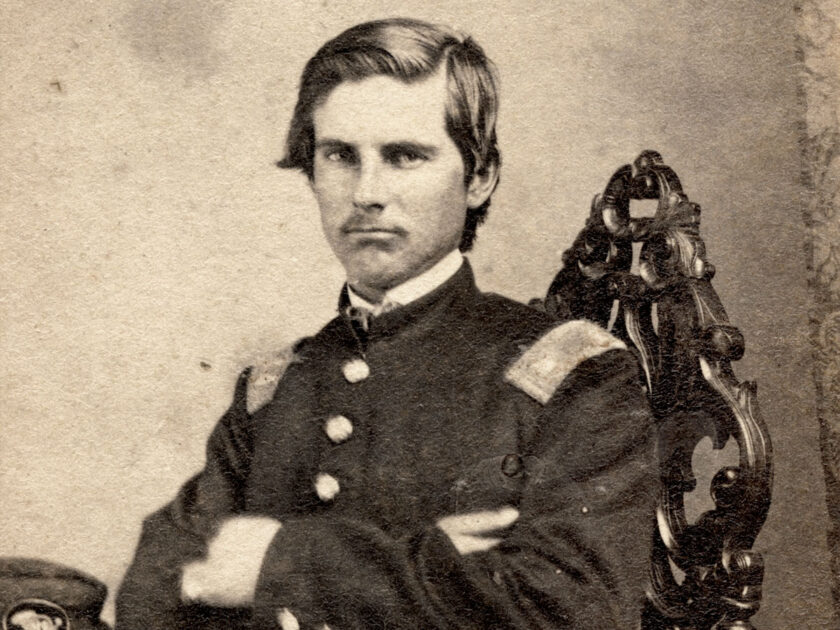
At Cold Harbor, while fighting raged across the battle-scarred landscape, Maj. Gen. Winfield Scott Hancock observed the action from a prominent knoll. As couriers and aides from the brigades and divisions in his 2nd Corps dashed to and fro, Hancock sent his staff into the maelstrom with orders to commanders scattered across the front lines.

In one instance, Hancock dispatched a staffer with orders to division commander Francis Barlow. The staff member had barely left on his errand when a bullet took out his horse, forcing him to return. Hancock sent a second man, and then a third, with the same result. Meanwhile, bullets peppered the knoll—one killed an orderly, several tore through the headquarters’ flag, and another nicked the brim of Hancock’s hat.
Hancock remained on his horse, noting dryly within earshot to his men, “Gentlemen, it is a little close here” just as the third rider returned without success. Hancock turned to the fourth staffer and said, “Now, Mr. Armes, it is your turn, and for God’s sake get this order to Barlow.”

George Augustus Armes, a 20-year-old Virginian who remained Union-loyal, took off on his horse as shells burst all around, tearing into the earth and spraying dirt through the air. He later recalled, “I headed my horse for General Barlow, who could be seen sitting on his prancing steed, in the midst of the firing. Lying at the side of my horse’s neck, I sent him forward at full speed, and in less than four minutes was at Barlow’s side.” Armes delivered the order and sped back to Hancock safely.
Moments after Armes left, Maj. Gen. George G. Meade, commanding the Army of the Potomac, rode up to Hancock and asked him the name of the young officer galloping off towards Barlow. “It is Mr. Armes,” Hancock replied, “and he would carry an order into hell if I should tell him to take one there.”
This is one of the many memorable military moments for Armes. He began his service in 1861 as an informal scout and suffered a knee wound at First Bull Run, enlisted in the 16th West Virginia Infantry, transferred to the Invalid Corps due to his unhealed wound, and returned to combat duty as an aide to Hancock. In late 1864, he accepted a captaincy in the 2nd New York Heavy Artillery, and served in this capacity until the war’s end. He continued on in the Regular Army for the better part of the next four decades.


In 1900, his memoirs, Ups and Downs of an Army Officer, trace his colorful career from his refusal to join the Confederate army to his early days in uniform and varied assignments during the Civil War, commanding Buffalo Soldiers in the West, surviving three court-martials, and official duties in Washington, D.C. He died in 1919, at age 75. His wife, Marie, survived him.
Most Hallowed Ground is part of the Arlington National Cemetery (ANC) Project. Established by Jim Quinlan of The Excelsior Brigade, its mission is to identify all Civil War veterans on the grounds. Contact Jim at 703-307-0344.
SPREAD THE WORD: We encourage you to share this story on social media and elsewhere to educate and raise awareness. If you wish to use any image on this page for another purpose, please request permission.
LEARN MORE about Military Images, America’s only magazine dedicated to showcasing, interpreting and preserving Civil War portrait photography.
VISIT OUR STORE to subscribe, renew a subscription, and more.
