
By Deena C. Bouknight
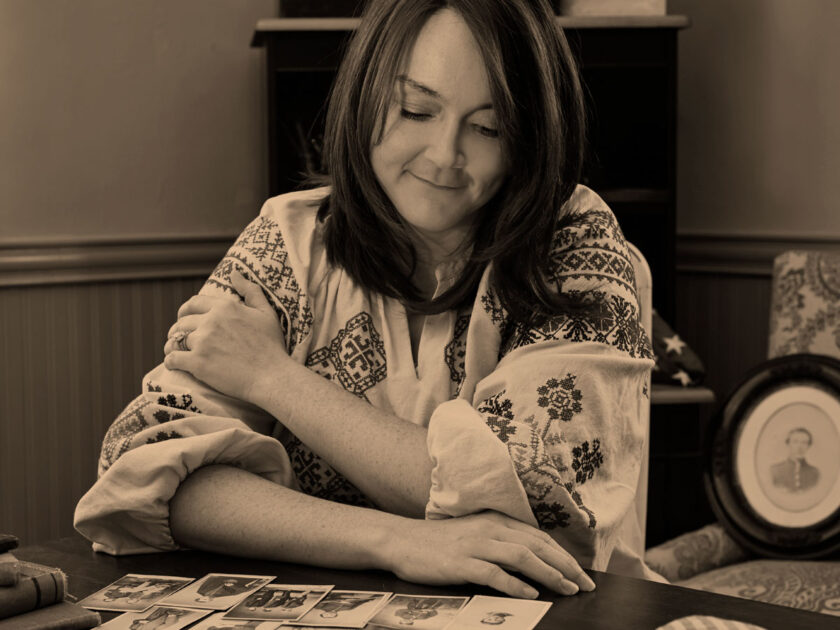
On Steinwehr Avenue in Gettysburg, Pa., near the Gettysburg National Cemetery – which is on the edge of the vast battlefield – is an iconic shop called The Horse Soldier. It is there that tourists and serious fine military antique collectors and traders alike will most days find Cara Arnold. The petite, 34-year-old is daily evaluating, researching, and valuing primarily Civil War relics and artifacts.
While many women consider military history and militaria as interests and hobbies, the preponderance of experts and collectors are male. Arnold, though, does not remember a time when she was not enthralled with all things military history-related. And, that youth-established interest developed into a full-blown career.
She talked with Military Images about what led her on a path of becoming an appraiser of images, weapons, clothing, books, utilitarian items, and so much more.
Q: Where did you grow up and when do you first remember being fascinated by history?
A: I grew up in Western Pennsylvania, north of Pittsburgh. We moved around a lot when I was young, and we finally settled down in a very small town in Armstrong County when I was 8 years old.
For as long as I can remember, I’ve had a fascination with history. It is an interest that is somehow just part of who I am. As I’ve gotten older, I’ve found that my interests have expanded and contracted though. When I began collecting in my teens, I began with WWII American stuff, and as I got into my 20s, I found myself gravitating more towards the Civil War. That interest then morphed into WWI and even into women’s vintage clothing.
Q: Did you become passionate about military history because of an image, an antique, a story, a movie? Explain.
A: My initial interest wasn’t because of a tangible item. It was because of the experiences of others that came before us. I would hear about individuals or about battles and I’d have to know more. There was something in them that resonated with me, and I felt like I could understand them and somehow simultaneously understand myself. I think that history, for many people, is just something in textbooks. For me, history is an extension of who we are. It helps me to understand myself, like invisible threads connecting us through time and space. Even looking at who we are on a scientific basis, we can see where events imprint themselves in our DNA and then are passed down through generations. So, something that an ancestor experienced may very well still be present in my experience even though I’m not conscious of it. We are the aggregate of those who have come before us.
Q: Did your interest in history have anything to do with family members?
A: I have no ancestors that served in the Civil War. Zero. I’m totally bummed about this, but my ancestors on both sides were born just a bit too late to serve. My great-grandfather on my Dad’s side served as a medic in the Meuse-Argonne with the 28th Division in WWI though. He had a hellish experience; it affected him all his life.
Q: What most fascinates you about history?
A: As I said before, history isn’t only in textbooks. We’re the sum total of all those who’ve come before us. I’m the culmination of generations upon generations love, loss, success, pain, healing, all the richness of human experience. My ancestors are alive within me. That connection is real and helps me to understand who I am and ultimately helps me to be a better person. I really feel that history is part of a deep spiritual connection for me.
Q: Were you interested in American history in high school?
A: Yes, history was my favorite subject! I had a really great history teacher who made it so fun! Although I have English ancestry (my great-great grandmother came from Madron, a town near Penzance, in Cornwall, England), I did not thrive in any of my European history courses in college. In fact, I made it through by the skin of my teeth.
Q: You said you majored in history in college; bachelor’s, correct?
A: Yes, my bachelor’s is in history.
Q: You also have your masters’s?
A: My master’s degree is in communications. I also have a certification in genealogical research as well.
Q: What were your aspirations post college?
A: I started volunteering at a local historical society. This is where my interest in public history really took off. There was someone there who taught me a lot about material culture of the Civil War – mainly images. This is where my fascination with the Civil War got so much deeper.
The shine of public history wore off when I realized that it was more about funding than the actual history. I didn’t want to be a leader of an organization. I wanted to be immersed in the stuff of history.
Q: Are you a collector yourself?
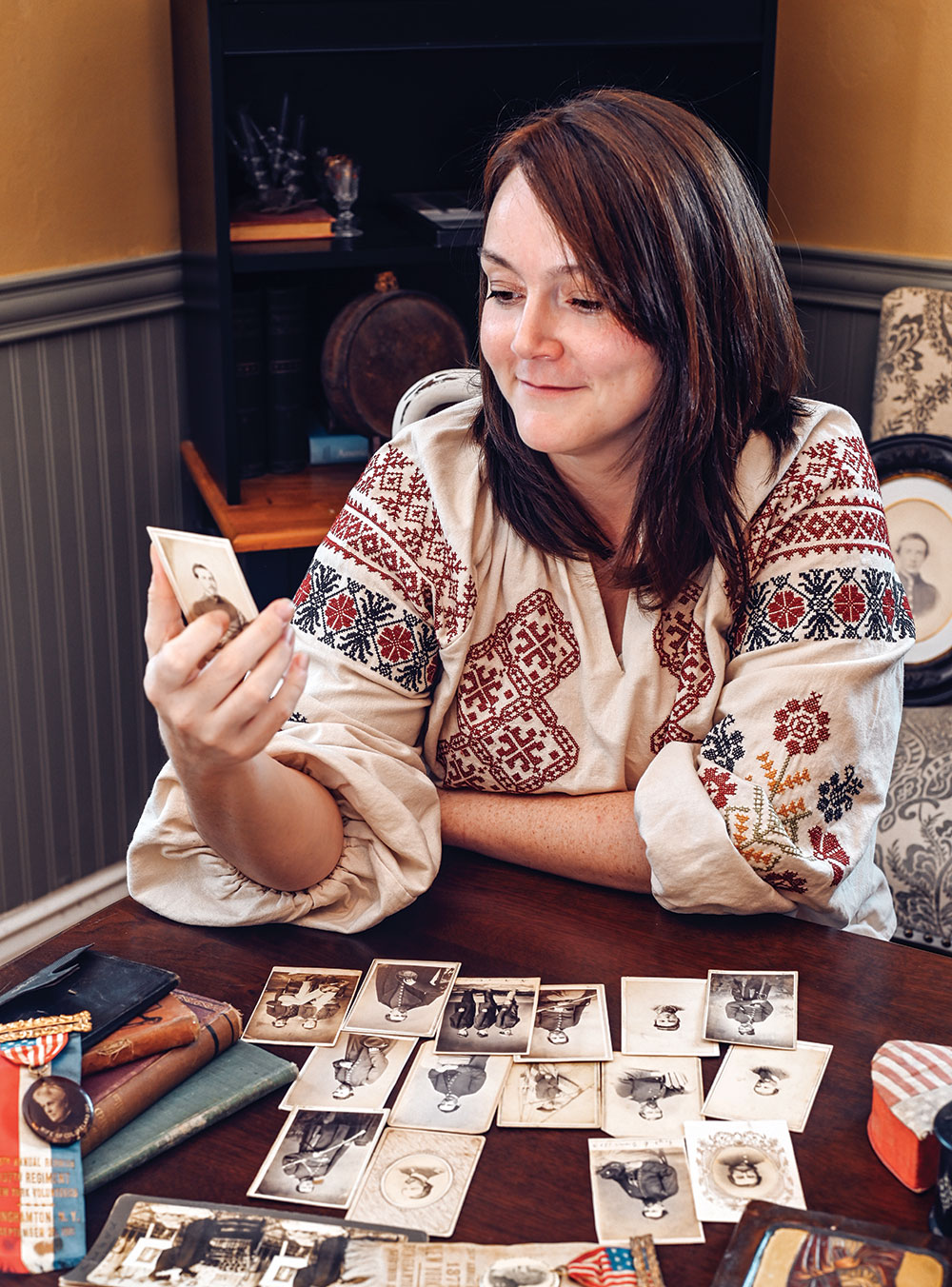
A: Yes, I’ve been collecting since high school. I started early on with WWII uniforms. Once I discovered the 137th New York and their action at Gettysburg, I was hooked on the Civil War. I’ve been collecting the regiment for almost 15 years now. I try to stick to my lane, so to speak, because I have varied interests and collecting is definitely an investment. I also feel like I can more accurately understand the men of the 137th better by focusing my collection on them. My collection is comprised of letters, documents, a diary, accoutrements, GAR badges and medals, and one revolver.
What I love to collect most of though is images. Images, for me, are a direct connection to that person. It’s like an invisible thread is formed when you look at photographs, creating a kinship that is somehow so real yet so unexplainable.
Q: Who is your Civil War hero? Why?
A: I have several! The person who literally changed the whole trajectory of my life was Capt. Joseph H. Gregg of Co. I, 137th NY. He led a bayonet charge with a small squad of men on the night of July 2nd that ultimately cost him his life. I learned about him from an old friend of mine, and we’d go out and explore Culp’s Hill. My interest in that part of the battlefield grew deeper, until eventually I had to be in Gettysburg. In my mid-20s, I quit my job and moved to Gettysburg. I’ve been here just shy of a decade already.
Q: Tell me how you arrived at your job at The Horse Soldier—and when.
A: I was working independently doing freelance research in 2018 (in addition to a part-time general antiques shop job), when I walked into The Horse Soldier on a whim to see if Jim Thomas [historian and floor manager] was holding any 137th NY items. He wasn’t, but he asked me if I was looking for work. I sent over my resume and interviewed with Sam and Wes [Small, the owners] a few days later. I started the following Monday.
Q: Did you ever consider becoming a history teacher, or did you always have your sights on becoming an appraiser?
A: I did consider education, but it wasn’t the right path for me. I never thought I’d become an appraiser. The field of history can be fickle. There are many posts online from disgruntled history majors saying that there are no jobs and no money to be made. I guess I always followed my passion instead of the cash.
I didn’t really step into the role of appraiser until I started working at The Horse Soldier and spent several years immersed in the material culture with them. I had been casually looking for ways to level-up—something beyond the typical office job, which never quite felt like the right fit for me. That’s when I came across the ASA’s appraisal courses. At first, it felt like a stretch—something exciting but maybe out of reach. But the more I looked into it, the more it felt like the right direction, and I realized it was something I could actually pursue.
Q: What has been involved in getting your appraisal license?
A: The process of accreditation with ASA (American Society of Appraisers) is rigorous. The first steps are to take a series of courses on ethics, appraisal research, development, report writing, and the legal environment. Professional appraisal organizations are centered around what’s called USPAP (said like “use-pap”), which stands for Universal Standards & Principles of Appraisal Practice. USPAP is based on several ethical principles to direct the standards of credibility for each appraisal.
There is a 15-hour USPAP course you must take and pass in order to qualify for accreditation. An update course is required every two years when a new edition of USPAP comes out. After all of the coursework is completed, it’s time for the work to begin! Seven hundred hours of appraisal work is required in order to apply for accreditation. You must select a specialty and then test and pass the exam for your specialty before you can submit your final application.
Once all that is completed, you submit your logs and two appraisal reports, which get reviewed by a committee. The committee then decides whether or not your work is up to par (complying with all USPAP standards and rules, that your methods of research are solid, that you are doing an excellent job appraising items in your specialty). ASA has three designations: AM (Associate Member), ASA (Accredited Senior Appraiser), and FASA (Fellow Accredited Senior Appraiser). Each designation has increasing years of experience, and each accreditation requires a new review of appraisal work to achieve.
Q: What has been the most challenging aspect of your job?
A: There are several challenging aspects of my job both personal and professional. I think professionally, the business is built on relationships, and as a painfully introverted person I find it difficult to put myself out there, which is also a personal challenge. There is so much to learn and it is impossible to know everything. In the grand scheme of things, I’m relatively young in this business and I still have so much to learn. I’d like to embrace the stage I’m in rather than thinking I need to be perfect in order to be accepted.
Q: What takes the most time?
A: Research! Research is never straightforward. it’s just like the trajectory of our own lives. Follow one breadcrumb here, follow another breadcrumb there – and then, “Wait! This doesn’t make any sense!” Then it’s time to regroup. Sometimes taking a break is the best policy because it can offer you a new perspective, which opens up another pathway. Although research is the most time consuming, it is also one of the most rewarding aspects of working in this field.
Q: What really charges you—causes you to sort of get lost in the process?
A: The subject! One of my absolute favorite things is finding an image that’s ID’d. Then I dig into who they are. One thing that always fascinated me was that there is such a draw to the soldier experience, but I wanted to know who they were before and after their wartime experiences as well. Companies were often raised from small towns and young men often went into service together. They knew each other before, during, and after that experience. How did war shape them and their relationships? How did it affect their families? And not only that, but how did their personalities shape their experiences and others’ experiences in relation?
Q: What are some criteria for determining the value of images?
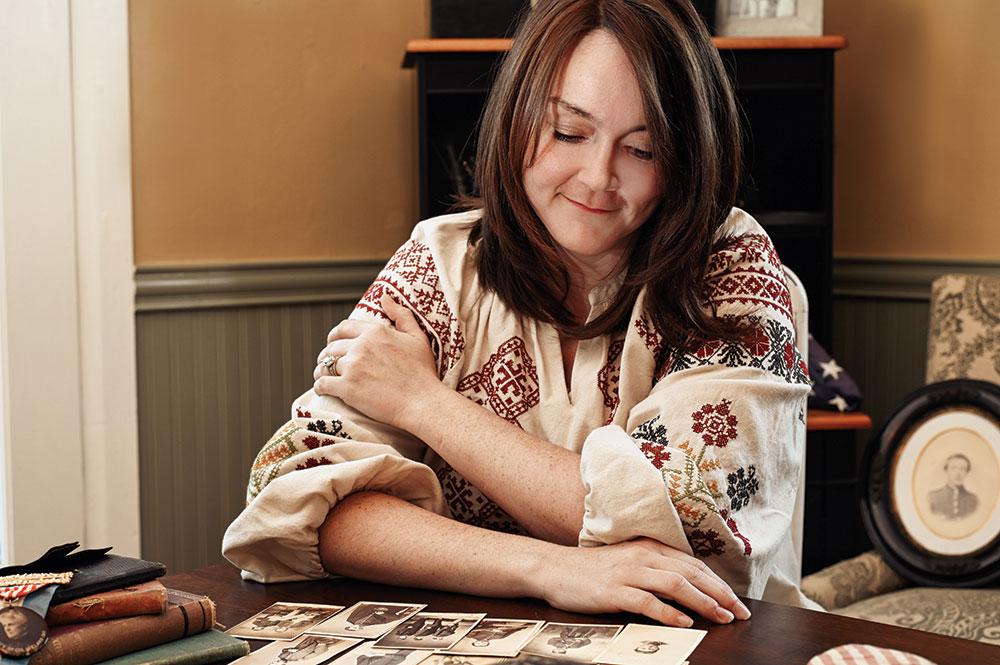
A: There are several factors that are considered characteristics of value for images. First and foremost is ID. Is the subject male or female? Military or civilian? Union or Confederate? Is the image signed in period ink or is it a verbal or secondary ID (identified from another image or source)?
Second is regimental affiliation. Has the regiment seen hard fighting during the war? What was their experience? If they fought in the Army of the Potomac and had service in places like Gettysburg, Spotsylvania, the Wilderness, or any of the smaller battles throughout Virginia, these regiments are typically more sought after.
Third is what is the soldier’s history? If he was discharged early and didn’t see hard fighting, the image isn’t as valuable. If the soldier fought with a particular unit that was at Gettysburg and that soldier was killed in action, the image is very valuable as the market for these is hot. If that soldier was Confederate, the image can be up to two or even three times as much since Confederate images are scarcer than Union images.
Something else that contributes to value is what’s called the “view.” Is it a bust view (merely head and shoulders) or is it a full standing or seated view? The uniform is crucial, too, as this helps establish ID and helps us positively pinpoint the time the photograph was taken. Are there accoutrements in the photo? Cockades and mourning badges add value as well. A soldier standing in a particular pose giving just the right “look” can add value.
Condition is also a huge factor of value. Image format is also a determinant. CDVs [carte de visite – small photographs mounted on cards] were widely produced and were able to be reproduced at a moment’s notice. Hard images like ambrotypes and tintypes had only one copy, so hard images hold more value. Provenance is important, too!
Q: What is the most surprising, fascinating, unusual, valuable image you have come across?
A: I have always loved Abraham Lincoln. I have been absolutely fascinated with the man. About two years ago, a vendor brought in an item he wanted to sell. It was purportedly one of three known ambrotypes in existence of Mr. Lincoln. It was supposedly taken in 1858 by Roderick Cole in Peoria, Illinois, but there are some confusing details around that scenario. Eventually, we sent it back to the vendor because the details were too difficult to flesh out and we couldn’t prove nor disprove the authenticity of the item. At any rate, I held onto that image at my desk for as long as we had it. It was amazing to me to think that there was a possibility that that very plate had “seen” Mr. Lincoln.
Q: About how many images does The Horse Soldier catalog?
A: In the last month [December 2024] alone, we’ve cataloged roughly 1,300 images, although not all of them are soldier-related. We have roughly 4,500 images in our inventory at the moment.
Q: What is the price range that collectors are willing to pay for an image?
A: The limit does not exist. I joke, but it’s true. Typically, we would consider images to be high-end above the $4,000 mark. However, we have seen exceedingly rare images go for $300,000.
Q: What time period/event/person, etc. regarding an image is most sought after?
A: It really depends on the collector. The market shifts as trends come and go. Right now, Confederate images are highly sought after. They always have been, but there are a couple collections that have hit the market in the last couple of years and those images go quickly. Anything Gettysburg-related (commanders, casualties) are sought after as well. Outdoor views and group scenes are popular, too.
Q: About what percentage of images at The Horse Soldier were taken in Gettysburg?
A: A very small percentage, say .01%, of images in our shop were actually taken in Gettysburg. Gettysburg only had a few photographers, so what you’ll see come directly from Gettysburg are usually post-war stereo views of the battlefield or cabinet cards of civilians. At the time of the battle, there were two photographers in Gettysburg and they were brothers working out of Tyson’s Studio [Charles and Isaac Tyson, who set up shop in 1859]. Their images are rare to find. In the time I’ve been at The Horse Soldier, I’ve seen maybe two or three of their photos and they were of Gettysburg residents.
Q: What do you have to do to make sure images are preserved? What is the process of organization, cataloging, etc.?
A: Images at the shop never stick around long enough for us to preserve. Usually, if there is a collection with a number of images, they first get entered into our inventory system where they get an item number and a price is assigned after any necessary research is done. Next, we write them up for the web. From there, we do our best to keep them together in a binder or in a case so that we can easily locate them. The next steps are up to the buyer. Typically, we recommend keeping them out of direct light and out of the reach of critters and kids.
Q: What challenges do you come up against as a woman in a field made up mostly of men?
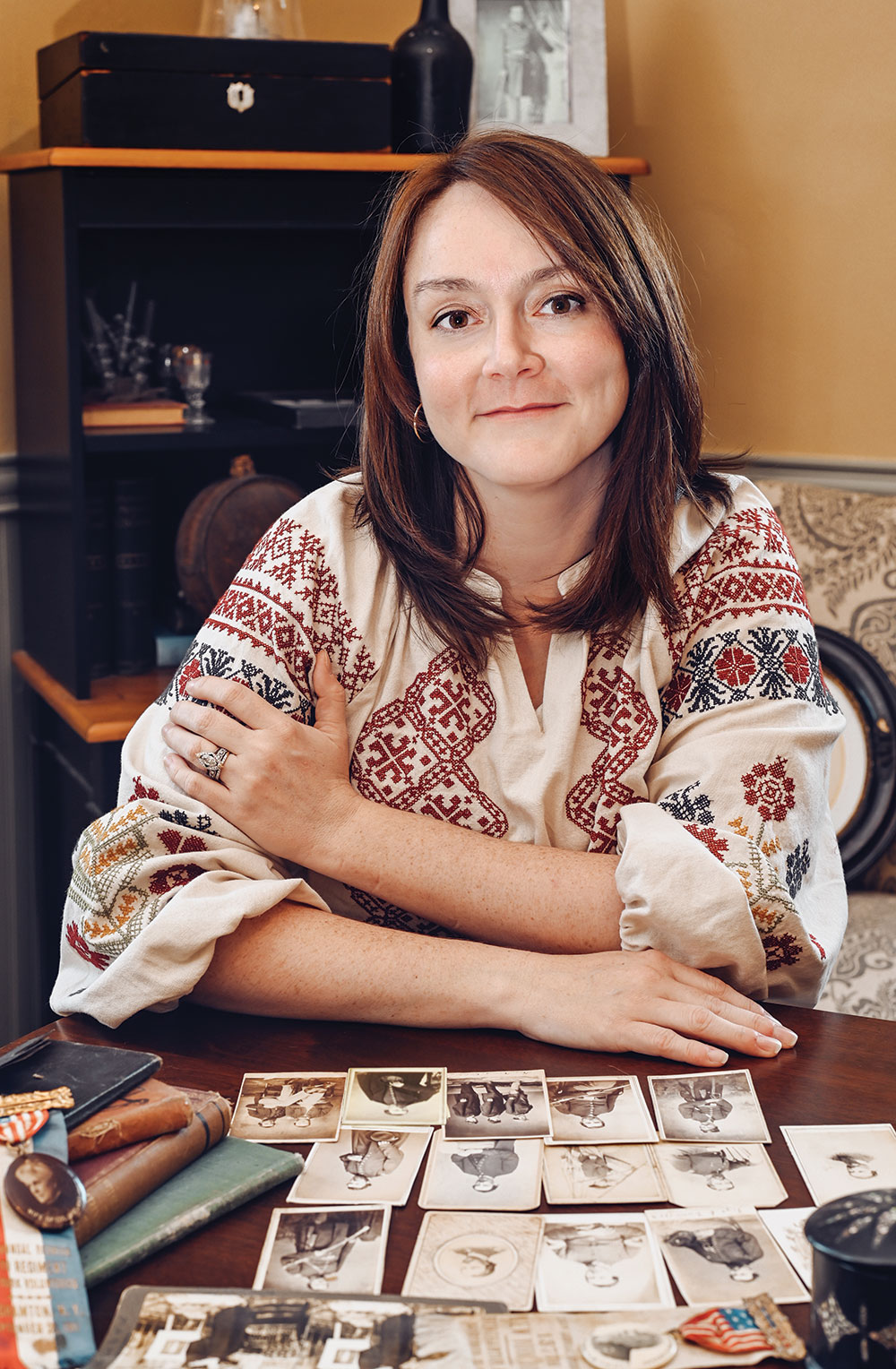
A: I feel conflicted answering this question. Women are not expected to be at the forefront in this business. It’s a man’s world. I’ve been called “sweetie,” “honey,” “kiddo,” and I’ve dealt with some pretty presumptuous people who only see their own projections of what I ought to be. My challenge is learning how to step into my own power and own my own knowledge. It’s to assert myself and to know that I deserve to be heard in a world full of people who think I only know how to ring up sales and pass messages. My goal is to be an expert. My goal is to help others understand the connection that exists through time and space.
Q: Do you know any other women doing what you do?
A: Interestingly, although the business of militaria is fronted by men, women are the support who make the engine run. I work with a whole group of women who keep the business running from sales to accounting to listing items on the web (which includes photographing and writing items up).
However, there are fewer women who know the ins and outs of the actual history. There are female battlefield guides that I really look up to. There are a couple dealers who are women, although they stick to their niche. For example, there’s an antique jewelry dealer, a women’s WWI and WWII dealer, and a woman who is an expert in textiles. Yes, women in militaria are out there—no matter how rare!
SPREAD THE WORD: We encourage you to share this story on social media and elsewhere to educate and raise awareness. If you wish to use any image on this page for another purpose, please request permission.
LEARN MORE about Military Images, America’s only magazine dedicated to showcasing, interpreting and preserving Civil War portrait photography.
VISIT OUR STORE to subscribe, renew a subscription, and more.