

Conflicting Clues, Cobalt Blue, and a Trio of Pards
Cobalt glass creates a fittingly appropriate blue hue in this ambrotype of a Union officer. The background painting appears in other portraits credited to Stephen Evans of St. Louis.
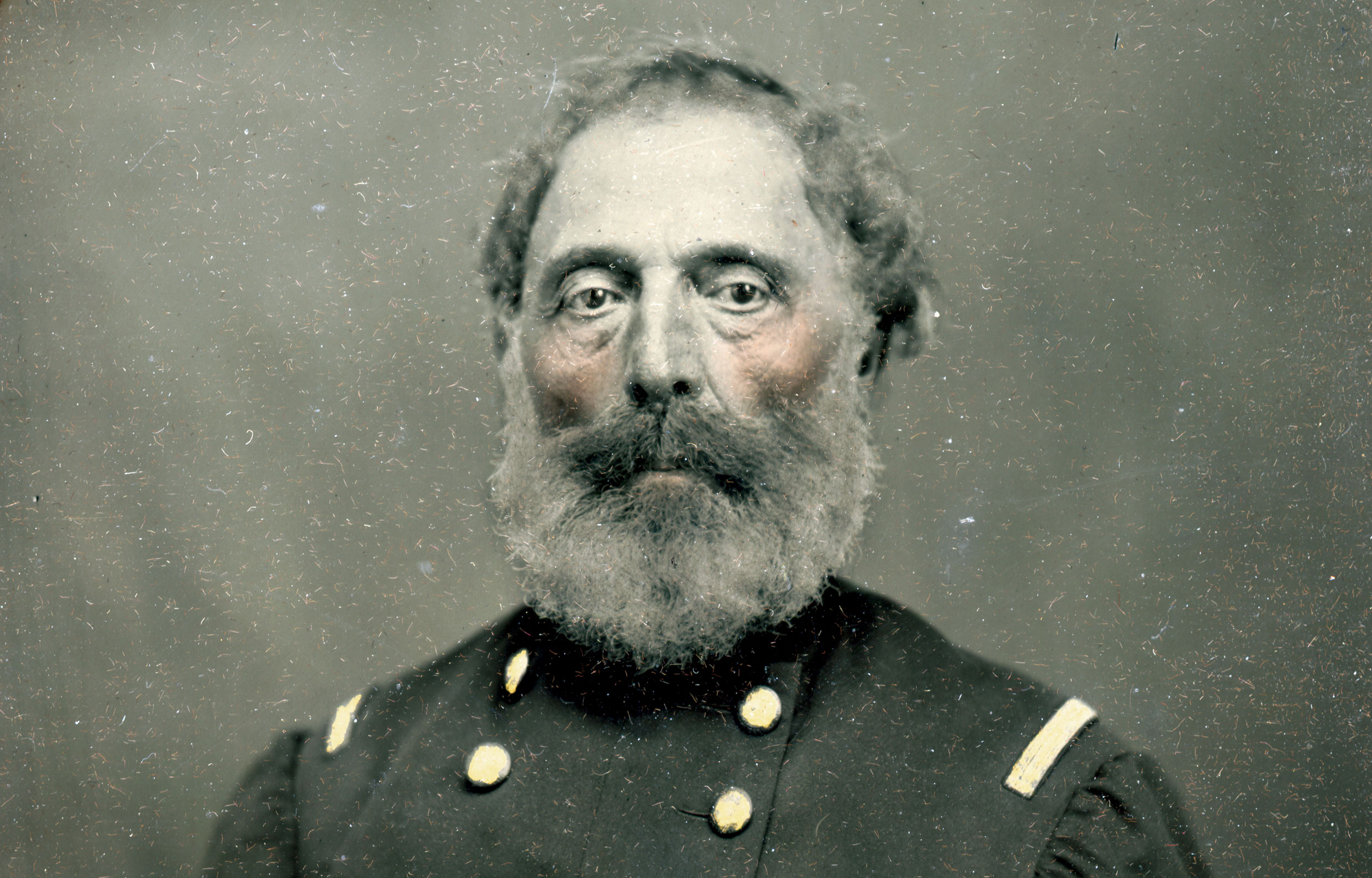
Cobalt glass creates a fittingly appropriate blue hue in this ambrotype of a Union officer. The background painting appears in other portraits credited to Stephen Evans of St. Louis.

By Michael Huston When I was 10 years old, my grandfather showed me a binder with genealogy information and a portrait photograph of a Civil War soldier. The stern look

The Autumn 2022 issue is now available, and I’m excited to share it with you. The focus is Illinois in the Civil War. As Austin Sundstrom points out in his

Sales are an indicator of the health of any collector’s market. By this measure, a review of recent sales indicates that the state of Civil War image collecting is strong.

An MI survey of 190 identified Confederate portraits published in the magazine reveals format variations in six Southern states. SPREAD THE WORD: We encourage you to share this story on social

Final Installment of Colonels In 2001, Roger D. Hunt embarked on an ambitious mission with the publication of his first volume of colonels in the U.S. army during the Civil

By Kurt Luther In previous columns, we have typically focused on identifying a single photo of a soldier or a small group. What approach can we take when researching an

By Ron Field Axe-wielding sappers were an invaluable asset to Napoleonic armies, and still prominent in many antebellum U.S. militia units. During the 1850s, sappers were the militia equivalent of

At Trevilian Station during the afternoon of June 12, 1864, Union reserves moved quickly to contain damage inflicted by Maj. Gen. Wade Hampton’s cavalry. One of the hastily formed skirmish

The 1st Maine Cavalry faced annihilation near St. Mary’s Church, Va., on June 24, 1864. About 3 p.m. that afternoon, an overwhelming force of Maj. Gen. Wade Hampton’s rebel troopers