
By Ronald S. Coddington
“Tired and happy” is how one newspaper correspondent described the excited throngs from western Massachusetts who toured Springfield’s Grand Fair over five days, from December 19-23, 1864. In the proud home of the Springfield Armory and the reliable long arm that bore its name, fairgoers explored the sprawling upper floor of City Hall—transformed into a festival of exhibits, displays, demonstrations, music, and more. Visitors ventured to the basement for refreshments. A daily newspaper, The Springfield Musket, recounted the fun and excitement.
Organizers raised funds for Soldiers’ Rest, a place where enlisted men and officers could enjoy a free meal as they passed through town. When the receipts were counted, about $18,000 had been raised (about $382,000 in today’s dollars). The amount stands as one of the highest recorded for any fair connected to the U.S. Sanitary Commission.
Photographers were well represented. George Harper Houghton of Brattleboro, Vt., donated an album of about one hundred 8-by-10-inch views of soldier life during the Peninsula Campaign, in which he documented the Vermont Brigade.
Images provided by local photographers—the Spooner brothers, John, David, and Horatio—were also featured at the fair. The eldest sibling, John Chapin Spooner (1827-1919), was celebrated as the “father of photography” in Springfield. A producer of lock screws for the Armory during the 1840s and 1850s, he began his photographic career in 1856 as an ambrotypist and brought his brothers into the business the following year.
One writer noted that during the war, “Mr. Spooner took the pictures of the soldier boys going and returning from the battlefield. He kept 20 men during the war to help him. They used to have tents near the places where the soldiers were mustered and took pictures by the hour.”
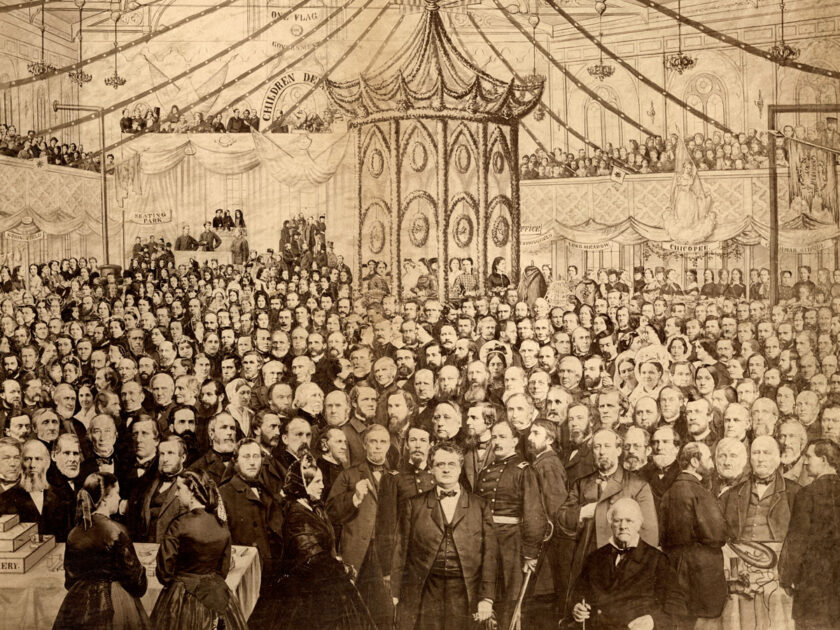
Springfield also remembered him for a single image exhibited at the fair: a mammoth albumen print mounted on a 20-by-24-inch cardstock mount—a composite of 497 people artfully arranged within an illustration of the fair’s main hall. One report described it as a “grand tableau.” Another praised Spooner for “a style of picturing in which he has no rival, and the likenesses are admirable. Smaller copies as well as duplicates of the original will be for sale.”
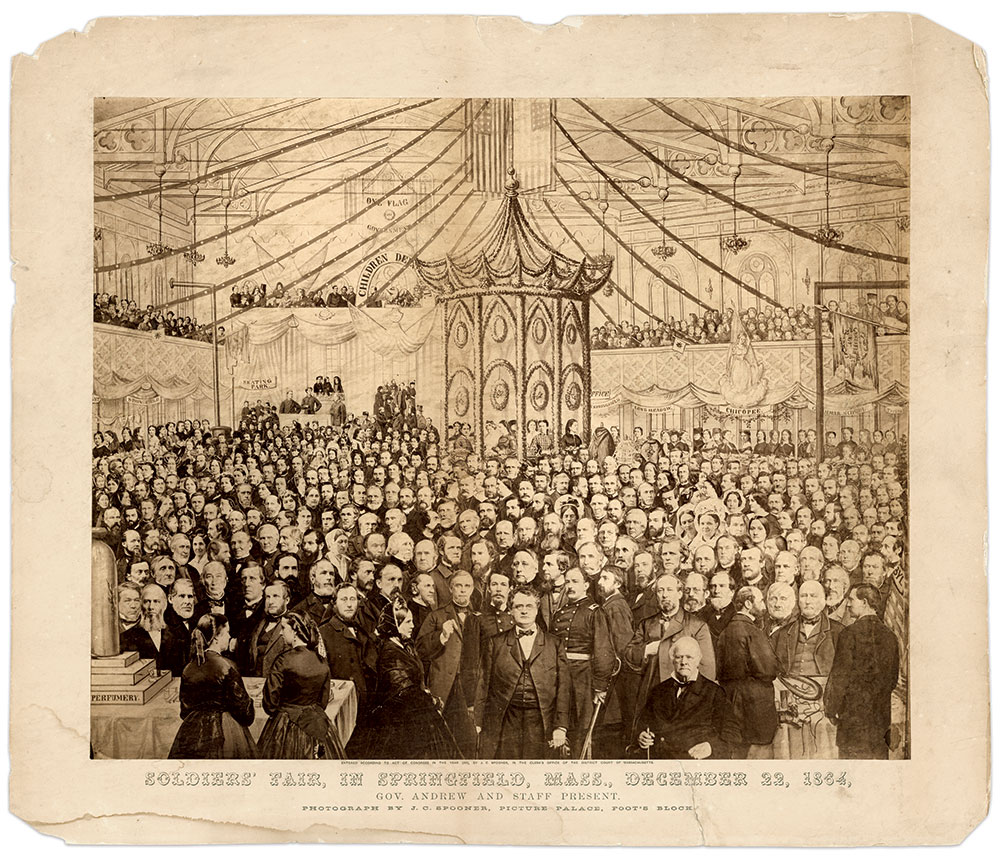
Some of these grand tableaux survive, evidence that duplicates of the original were indeed purchased. Fortunately for researchers and historians, a key identifying the faces also survives. It reveals a number of noteworthy figures in Springfield’s wartime citizenry.
Standing front and center is Republican Gov. John A. Andrew (1818-1867), an early and ardent supporter of the antislavery movement who played a key role in the formation of the 54th Massachusetts Infantry and other Black regiments.
Andrew is flanked by members of his staff, including two military aides with the rank of colonel: Henry Lee Jr. (1817-1898), a banker who actively recruited soldiers for the army, and John Quincy Adams II (1833-1894), the grandson of the sixth president and great-grandson of the second.
Another military figure is Springfield’s William Steele Shurtleff (1830-1896), who had recently served as colonel of the state’s 46th Infantry, a one-year regiment.
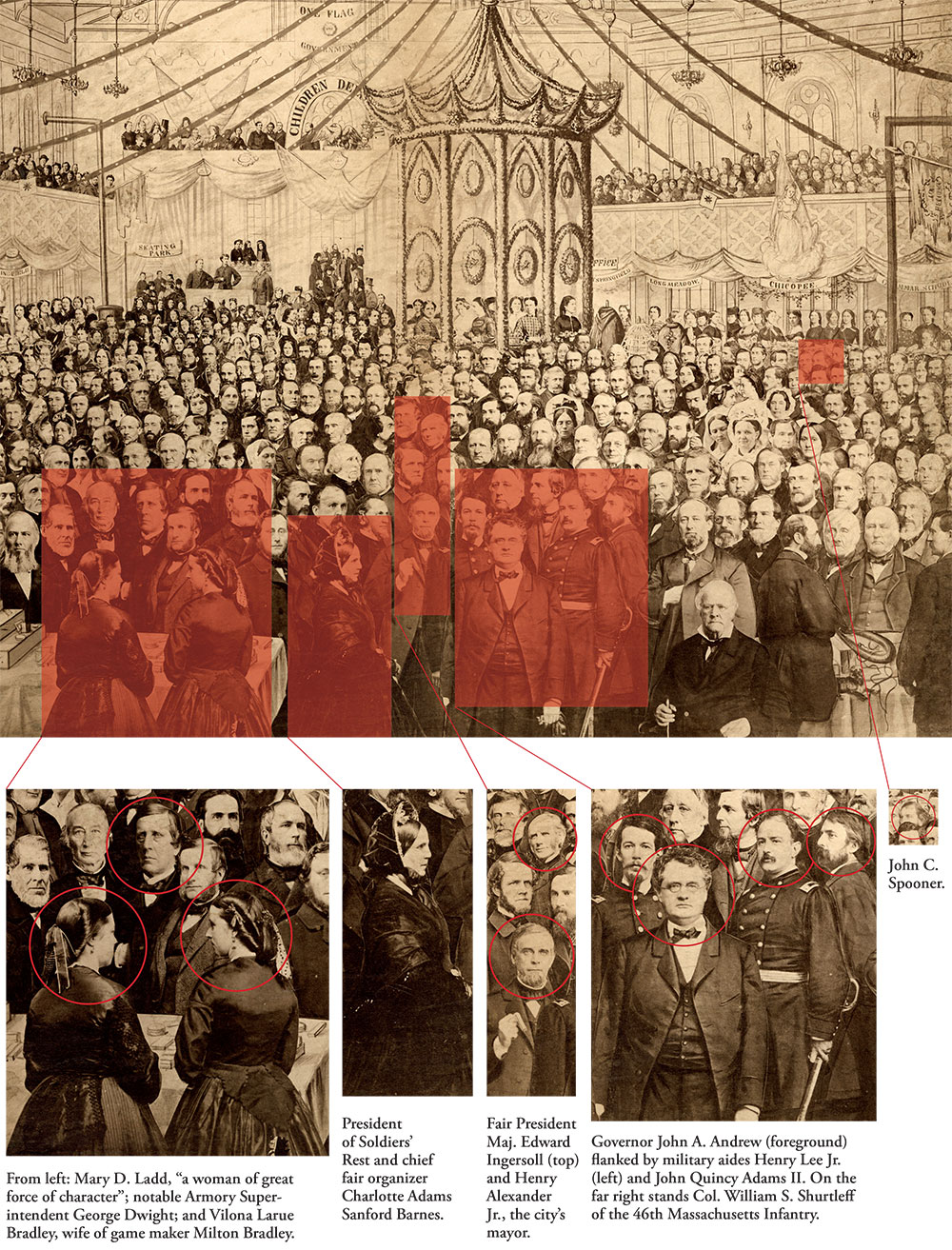 Springfield’s mayor, Henry Alexander Jr. (1818-1878), a Republican, had recently wrapped up his second one-year term in office. A banker, he went on to serve in the state legislature.
The president of the fair, Maj. Edward Ingersoll (1812-1891), had been associated with the Springfield Armory for about a quarter-century, serving in a variety of positions.
One of the Armory’s influential leaders, Springfield native George Dwight (1812-1882), served as superintendent during the war’s first six months. He oversaw the rapid expansion of production facilities and the manufacture of arms.
Standing in profile and facing the governor is the president of Soldiers’ Rest and chief organizer of the fair, Charlotte Adams Sanford Barnes (1808-1875). A native of Virginia whose brother-in-law owned Dred Scott, she was the wife of West Point-educated Brig. Gen. James Barnes, a division commander in the Army of the Potomac who suffered a wound at the Battle of Gettysburg that effectively ended his combat career.
Fair participants include Mary D. (Ladd) Bly (1844-1891), described as “a woman of great force of character, quick sympathies, and generous nature,” and Vilona Larue (Eaton) Bradley (1838-1867), wife of Milton Bradley, the game maker who made his name and fortune in 1860 with The Checkered Game of Life.
Following the time-honored artist’s tradition, Spooner included his own likeness. He occupies a spot toward the back of the assemblage—a humble location for a photographer who documented a memorable event in a city critical to the Union war effort.
Ronald S. Coddington is editor and publisher of MI.
SPREAD THE WORD: We encourage you to share this story on social media and elsewhere to educate and raise awareness. If you wish to use any image on this page for another purpose, please request permission.