
By Ron Field
My article “Ugly as the Devil,” published in the Winter 2015 issue, explored various types of Havelock hats worn by Union Army volunteers in 1861. This follow-up examines those worn by Midwestern troops, with the Seamless Clothing Manufacturing Company established by Samuel M. Perkins at the center of the story.
A resident of Springfield, Pa., Perkins patented his invention of seamless clothing on January 25, 1853. By 1856, the company had relocated to Winchendon, Mass., with L. W. Badger as manager and a sales depot at 22 Dey St. in New York City. Heralded as a “Great Invention,” its seamless garments included “Overcoats, Business Coats, Pilot Coats, Pea Jackets, Pants, Vests, Ladies’ and Gentlemen’s Leggins,” and were available through dealers as far afield as San Francisco and New Orleans.

Seamless headwear became available in 1859 and was purchased, along with seamless pea jackets, by the U.S. Navy Bureau of Provisions and Clothing in April of that year from the company, which maintained a depot at 344 Broadway in New York City.
In its earliest form, seamless headwear was not of the Havelock pattern. As it proved popular, other hatters, clothiers and dry goods dealers began producing counterfeits, even placing fake Seamless Clothing Manufacturing Company stamps or trademarks in them. This prompted Perkins to obtain an injunction in the New York Superior Court, stating that the copies were “an entirely inferior cap.” By this time, the company had moved to Matteawan, known today as Beacon, near Newburgh, N.Y., where it employed 300 workers.

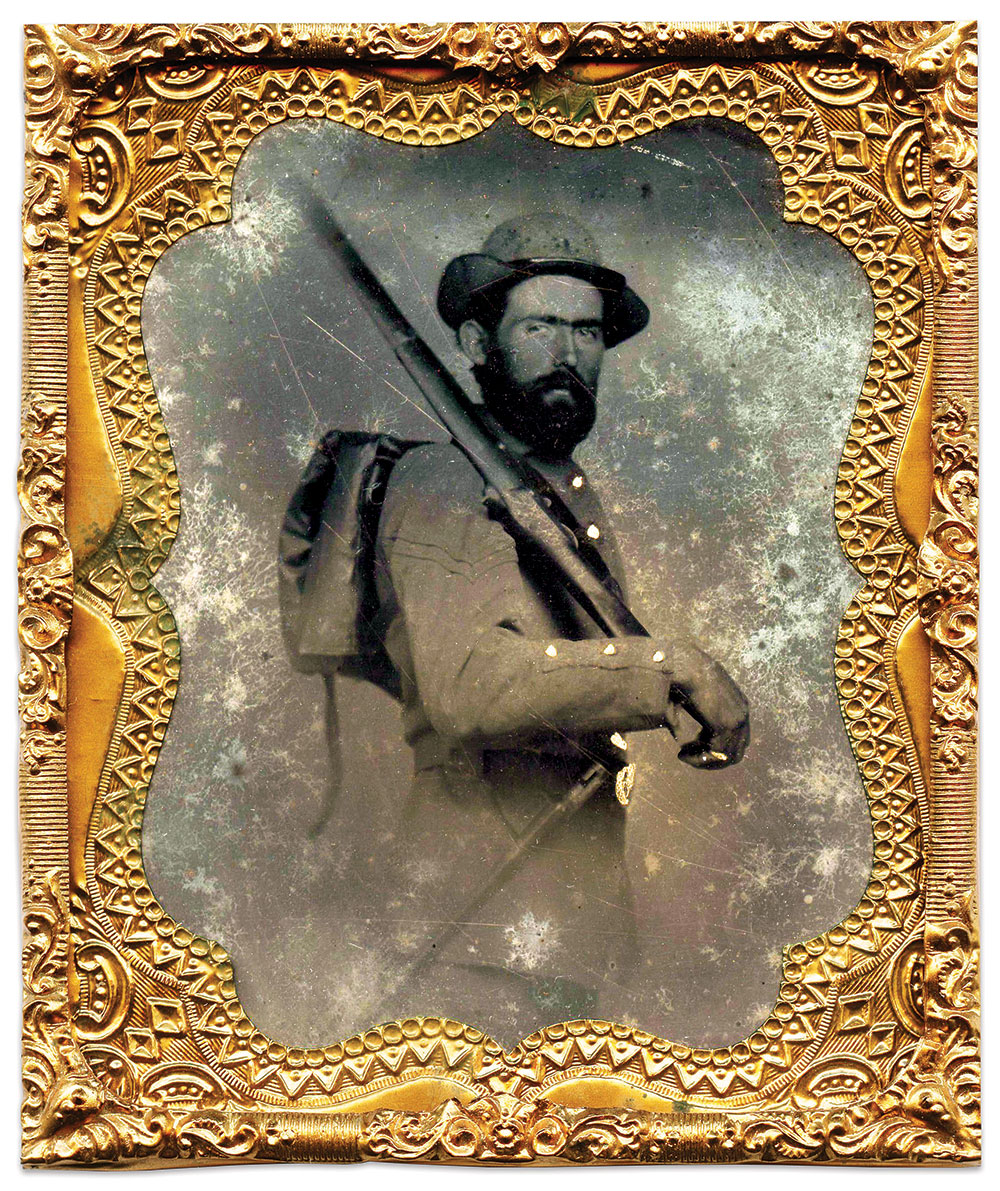
With the commencement of the Civil War, several hat makers in Chicago claimed to have invented and manufactured a Havelock hat which, based on photographic evidence, was seamless. Ignatz & Anton Herzog, at 152 Lake Street, first announced on April 19, 1861, that they were “prepared to furnish all kinds of Army, Navy and Military Caps.” On May 24, they informed the public they had produced “a new style of ‘Havelock Cap,’” boasting it was “something entirely new, and … universally admired by all military men.” Ten days later, hatter James M. Loomis, at Larmon Block on South Clark Street, was reported to have invented a “new style of forage cap” to be supplied to the Sturges Rifles, a company of Illinois sharpshooters uniformed, armed and equipped by 65-year-old Connecticut-born Solomon Sturges, a wealthy grain merchant in the city. The company served as Maj. Gen. George B. McClellan’s headquarters infantry bodyguard and was with him during most of his West Virginia and Peninsula campaigns.
This report also stated that Loomis had this headwear made in New York, indicating it was most likely supplied by the Seamless Clothing Manufacturing Company. The hats advertised by the Herzogs may also have come from the same source.
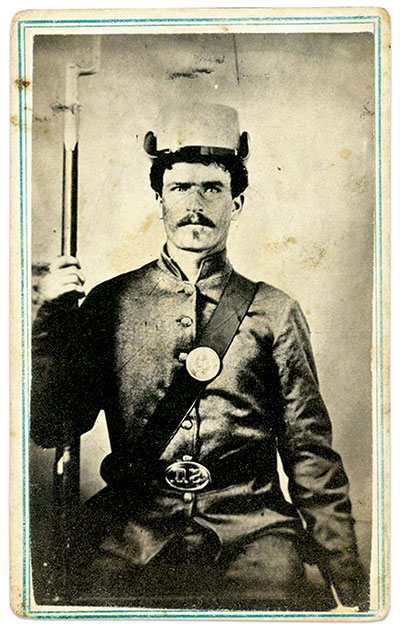
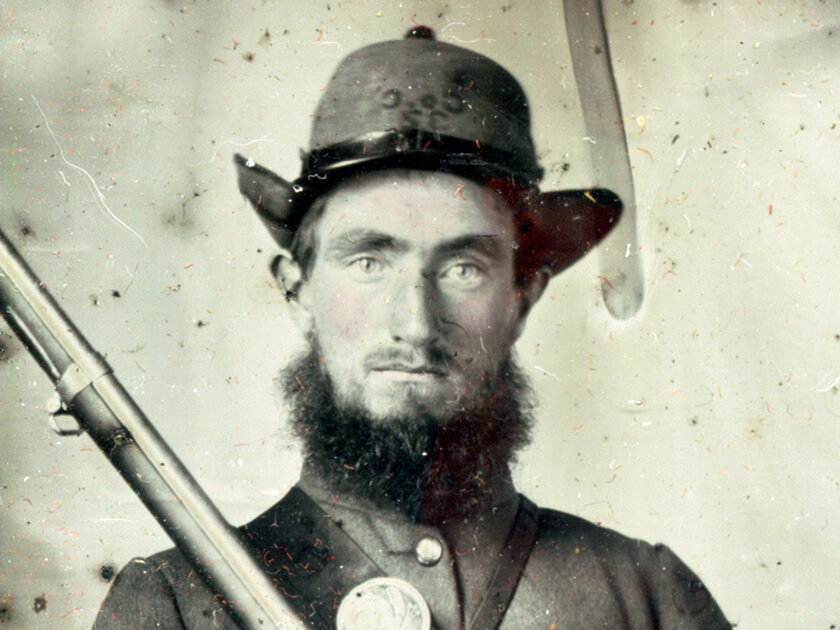
The headwear supplied by Loomis was the same style later patented by Jonathan F. Whipple on July 16, 1861, and manufactured by the Seamless Clothing Manufacturing Company. The Chicago Daily Tribune described the design on June 3, 1861, as “resembling an ordinary felt hat, the rim dishing deeply, turned downwards behind and cut away from side to side in front where a neat leather visor is substituted. Thus the neck and head are well protected, leaving the front clear and unobstructed.” The Havelock hats later issued to Union troops at Cairo, Ill.—including the 10th and 11th Illinois Infantry and the 1st Illinois Cavalry—were therefore likely supplied by Loomis or Herzog and were probably of the same pattern Whipple patented about two weeks later.
Havelock hats were also issued to troops from other Midwestern states, including Wisconsin and Iowa.
When the 3rd Wisconsin Infantry arrived at the barracks in Elmira, N.Y., on its way to Virginia on July 22, 1861, a New Yorker observed in the Broome Republican two days later that the soldiers wore “a light felt hat, with plenty of room over the head, and turned up at the sides.”
In Iowa, Havelock hats supplied to the 1st, 2nd, and 3rd infantries were issued in June and July 1861 after future governor Samuel Merrill entered into a contract with a Boston clothier for 3,000 uniforms for all three regiments. According to the Davenport Daily Gazette of July 8, 1861, the gray uniforms he acquired included “a felt hat – with Havelock.” Based on a photograph of Pvt. James Gemmill of the 3rd Iowa Infantry, this also appears to have been the same pattern of Havelock headgear produced by the ubiquitous Seamless Clothing Manufacturing Company.
Sources: Buffalo Express and Daily Democrat; New York Tribune; Shasta Courier; Washington Union; New York Times; Chicago Daily Tribune; Broome Republican; Halpin & Bailey’s Chicago City Directory for the year 1861-62.
Ron Field is a Senior Editor of MI.
SPREAD THE WORD: We encourage you to share this story on social media and elsewhere to educate and raise awareness. If you wish to use any image on this page for another purpose, please request permission.
LEARN MORE about Military Images, America’s only magazine dedicated to showcasing, interpreting and preserving Civil War portrait photography.
VISIT OUR STORE to subscribe, renew a subscription, and more.