
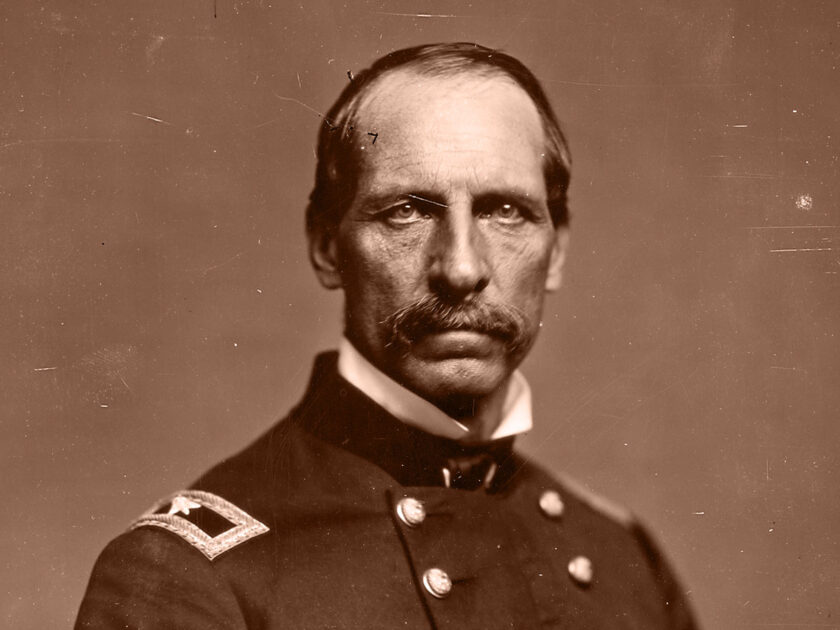
By Lance J. Herdegen
During a military review in 1863, President Abraham Lincoln said with a sly smile that Solomon Meredith of Indiana was “the only Quaker general I have in the army.” A Wisconsin boy in his brigade said 6-foot-7-inch Meredith took twice the risk on a battlefield: “Scraps of iron running out large over the heads of a regiment are apt to pick off the tall ones.”
His men simply called him “Long Sol.”
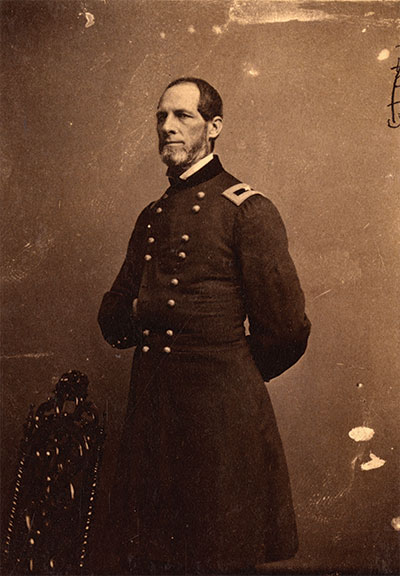
As a soldier he will always be remembered as the tall general on a big horse who led his Iron Brigade—the 2nd, 6th, 7th Wisconsin, 19th Indiana, and 24th Michigan—into the heavy fighting at Gettysburg on July 1, 1863.
Few figures in the Civil War story loom as large, literally and figuratively. One of the group of curious political officers tossed up by the war, he possessed patriotism and ambition, and lacked military skill.
Meredith entered the war as colonel of the 19th Indiana, and he quickly became a great favorite of the men. One soldier described him as a “specimen of a genuine Hoosier,” adding, “who put on no airs and frequently talks to the private soldiers and is therefore very popular with the men if not much of a military man.”
They enjoyed telling stories of his rustic manner. His height always caught attention. Meredith also had the loud and forceful voice of a stump speaker, and many noted his colorful use of the English language.
Born May 29, 1810, in Guilford County, N.C., Meredith grew up the youngest of 12 children in a Quaker family. At 19, he left North Carolina and walked to Wayne County, Ind. By the 1830s, he established himself in Cambridge City, where he purchased a farm, which he named “Oakland.”
Elected Sheriff of Wayne County in 1834, he served multiple terms in the Indiana House of Representatives as a Whig. He also held the post of U.S. Marshal for Indiana.
By the eve of the Civil War, Meredith prospered as a farmer and enjoyed the public’s respect. His ambition carried him far from his Quaker roots.
When war came in 1861, Meredith answered the call, though he had no military training. He organized the 19th Indiana Volunteers, and Gov. Oliver P. Morton appointed him as colonel. A political rival at the time quipped that Long Sol was so tall that he should be cut in half and his lower and better half be made lieutenant colonel of the regiment.
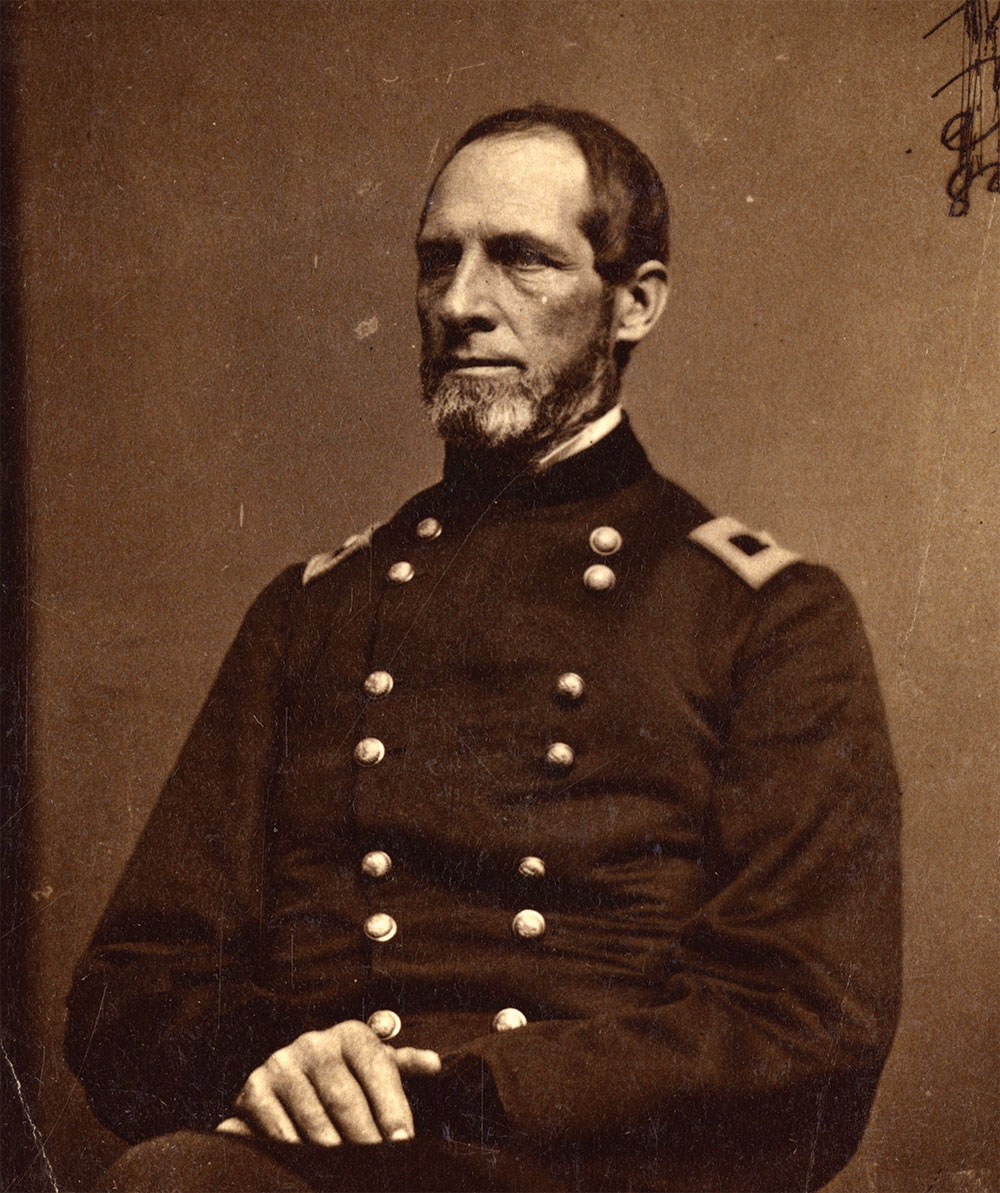
The 19th Indiana left for the war front on two trains Aug. 5, 1861. The new colonel rode on the second, smaller train and took along two favorite horses. At Harrisburg, Pa., the train halted and his soldiers were issued 10 rounds of ammunition in case of trouble at Baltimore, where a Union regiment had been fired on while passing through the city.
No violence occurred, however, as they marched through the city. Back in the cars with ammunition in their cartridge boxes, some of the Hoosiers decided to try their muskets on rebel ducks and chickens along the track. The cars were ablaze with shooting and filled with smoke. The men killed at least one horse along the way. Still much the farmer, Meredith stormed through the cars demanding to know the identities of the shooters. No one admitted to the deed.
Meredith’s regiment joined a provisional brigade made up of Wisconsin regiments under Brig. Gen. Rufus King of Milwaukee. In early May 1862, it marched overland to Fredericksburg—a position to threaten Richmond and still protect Washington. No call ever came to move on to Richmond, however, and the makeshift force of several regiments spent most of the summer of 1862 in Fredericksburg.
Meanwhile, King advanced to division command. In May 1862, Maj. John Gibbon, the Regular Army officer commanding Battery B, 4th U.S. Artillery, which was attached to the brigade, received an appointment as brigadier general and command of the brigade. No one was more upset than Meredith, who long made known his ambition to win a star. He told anyone who would listen volunteers should be commanded by volunteer officers.
A new order from Gibbon required Model 1858 black dress hats, white gloves, gaiters, extra underwear, stockings, and shoes for his soldiers. In making the requisition, Meredith, aware of the displeasure in his ranks and still upset about being passed over for brigade command, requested four extra mule teams to transport the additional luggage. Gibbon denied the request, the incident leaving him and Meredith at bitter odds.
There is a solidarity of appearance and steadiness of movement about this brigade that says distinctly, ‘get out of our way unless you wish to get hurt.’
On Aug. 28, 1862, the untested Western Brigade finally found it’s “elephant” on the Virginia farm fields of a man named John Brawner—the Second Battle of Manassas, or Bull Run. In 90 minutes of shooting against the Confederate veterans of Gen. Thomas J. “Stonewall” Jackson, the 19th Indiana suffered terribly. One soldier said the lines of battle were close enough to do effective work. Well into the fight, a ball struck Meredith’s horse in the neck and fell, pinning him to the ground. Two officers pulled the stunned Meredith free.
As a result of his injury, Meredith missed the remainder of the battle, but returned to command in time for the action at South Mountain, Md., on Sept. 14, 1862. Here, Meredith suffered another injury and left the regiment to go to Washington to recuperate—and lobby for a general’s star. While he was away, the Western Brigade marched to nearby Sharpsburg and fought in the Battle of Antietam.
A month later, in October 1862, Gibbon advanced to division command and Meredith received his coveted star and command of the men popularly known by this time as the “Black Hat Brigade,” and then the “Iron Brigade of the West.”
Meredith’s leadership style, blunt and forceful, sometimes clashed with subordinates. At the Battle of Fredericksburg where his brigade occupied the very left of the Union line, his regiments became snarled and his superiors temporarily removed him from command. At Chancellorsville, his brigade made a successful boat crossing of the Rappahannock River at Fredericksburg, but missed the heavy fighting.
Despite his weaknesses, the men in the ranks admired and were inspired by his homespun ways and courage. Others, including President Lincoln, were also impressed.
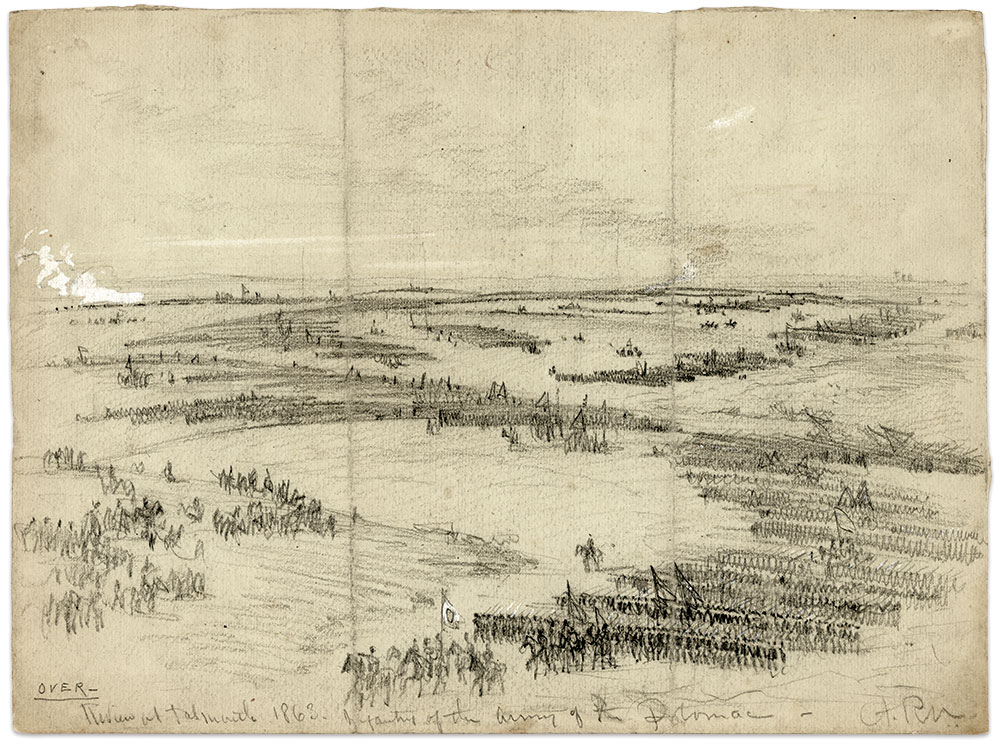
In early April 1863, the President and Mary Todd Lincoln attended a review of the 1st Corps, which included the Iron Brigade. Army of the Potomac commanding Gen. Joseph Hooker and Maj. Gen. John F. Reynolds, leader of the 1st, escorted the President. Meredith and his Iron Brigade occupied the last place in line. One correspondent using the pen name “Indiana” described the mighty Midwesterners: “There is a solidarity of appearance and steadiness of movement about this brigade that says distinctly, ‘get out of our way unless you wish to get hurt.’ As the brigade passed, a murmur of approval ran through the crowd around the President—and the waving handkerchiefs of Mrs. Lincoln and other ladies told of their admiration. More and warmer encomiums were bestowed on this than any other brigade on the review to-day.”
It was during this review that Lincoln made his Quaker quip.
The correspondent also praised Meredith: “To be able to present his brigade before the President, the Commander of the Army and Commander of the Corps in such a state of efficiency as to make experienced officers say, ‘there is a brigade that can be relied upon in the critical moment of a hard fought battle,’ is sufficient occasion of a laudable pride on the part of Gen. Meredith.”
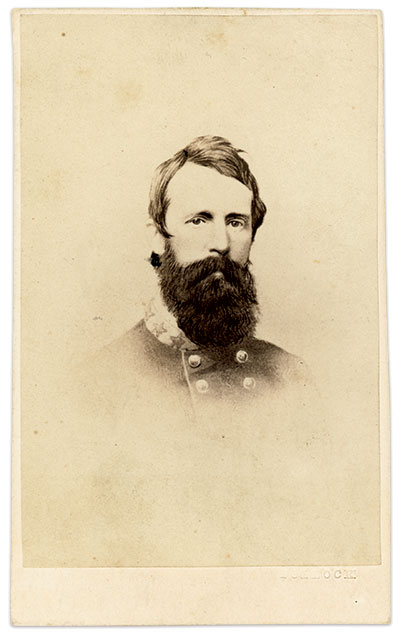
The “critical moment” for Meredith arrived three months later at Gettysburg. On the morning of July 1, 1863, the Iron Brigade, one of the first in the fight, advanced west of town. Meredith and his men scored a singular success early on when they counterattacked an aggressive Confederate brigade commanded by Brig. Gen. James J. Archer. In the chaos and confusion of combat, one of the Iron Brigade men, Pvt. Patrick Mahoney of the 2nd Wisconsin Infantry, captured Archer and delivered him to Meredith.
Facing an onslaught of Confederate brigades late in the day, the Iron Brigade retreated though the town. Meredith received multiple injuries after a shell fragment fractured his skull, and suffered broken ribs and an injured right leg after enemy lead struck and killed his horse, which fell on him.
Transported from the battlefield to Washington, D.C., Meredith wrote to Wisconsin Gov. Edward Salomon on July 23, “Although still confined to my room from injuries received in the late battle of Gettysburg, I avail myself of the first moment of sufficient convalescence to express to you my high appreciation of the heroic conduct of the troops in your noble State, who were under my command in that severely contested battle.”
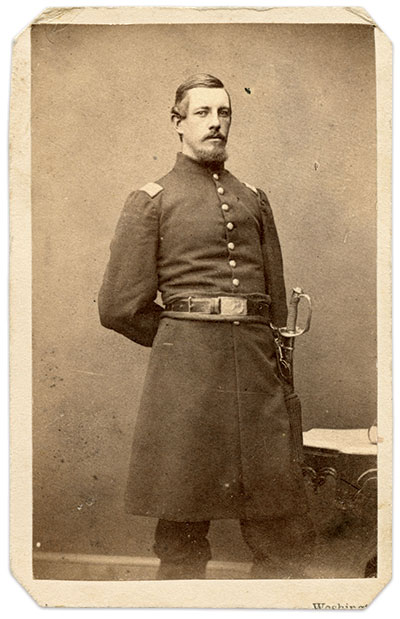
Meredith added, “‘The Old Iron Brigade’ was among the first to receive the fierce attack of a largely superior force, and the 2d, 6th and 7th Wisconsin, with the other regiments of the Brigade, beat back the foe and fought as only intelligent and patriotic freemen can fight, when defending our priceless institutions.”
Governor Salomon’s equally complimentary reply acknowledged, “Words cannot express the people’s thanks and gratitude for such deeds; but with the imperishable fame of the old Iron Brigade in the history of this war, the bravery of Wisconsin’s noble sons will be handed down from generation to generation.”
Meredith returned to Indiana to complete his recuperation—but never quite recovered. He rejoined the army in November 1863, but the rigors of active field service compromised his health. He was assigned to garrison posts in Cairo, Ill., and Paducah, Ky.
Meredith enjoyed a happy reunion with his 19th Indiana in January 1864 when the three-year veterans returned to Indianapolis for a 30-day furlough. A special reception was organized, and Long Sol attended. His old boys greeted him with cheer after cheer. These men, the tall general told the crowd, shared in all the honors won by the Army of the Potomac and the welcome received “at the hands of friends at home compensates all they have endured.”
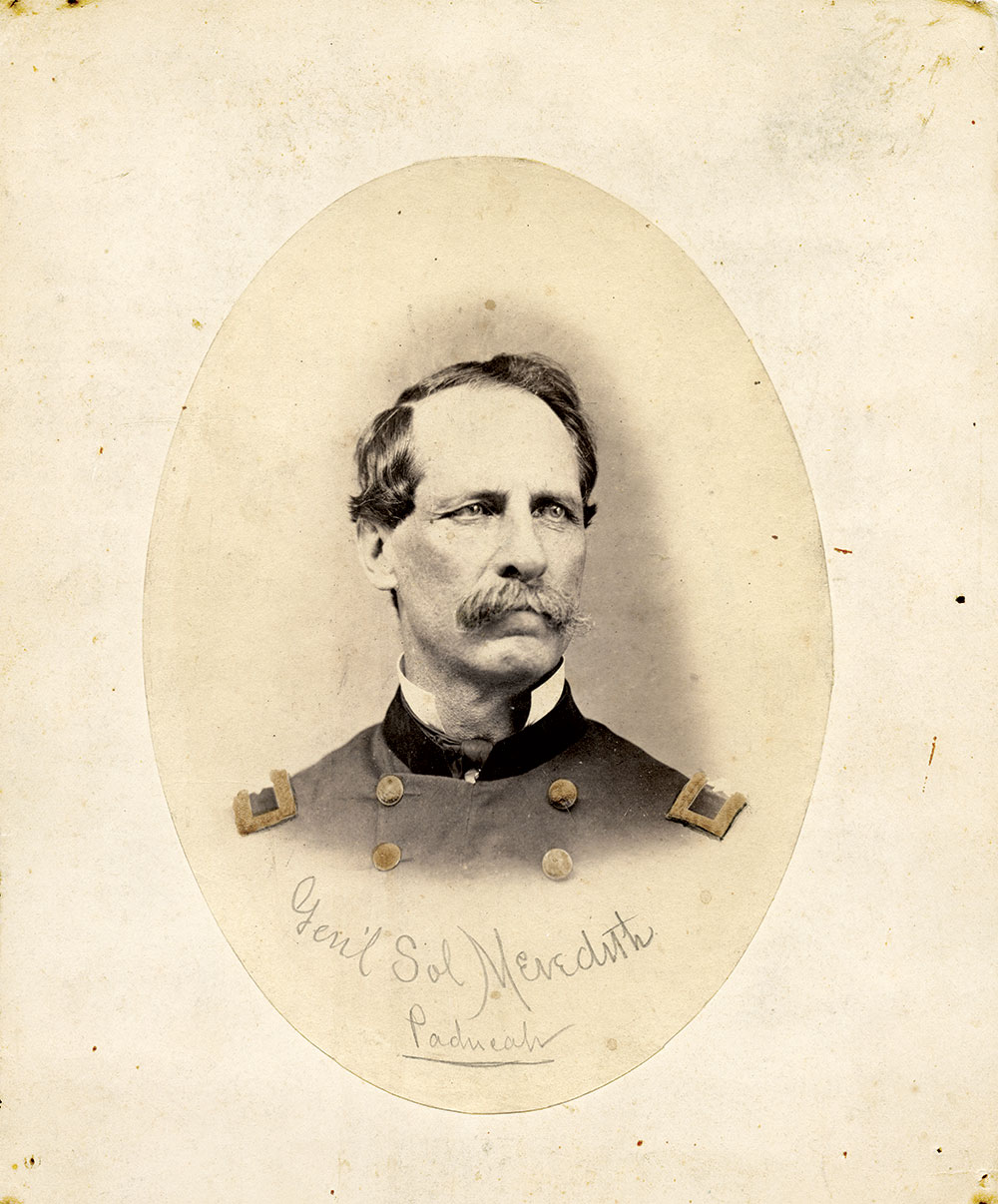
Meredith remained on garrison duty, away from the front lines, until the war’s end. In recognition of his service, the War Department brevetted him a major general of volunteers.
After the war, Meredith returned to Oakland and threw himself into agriculture, raising prize-winning cattle, sheep, and horses. His reputation as a stockman grew, and he became a fixture at agricultural fairs. Veterans of the Iron Brigade often visited, finding in Long Sol a host who relished retelling war stories.
Meredith also accepted a political appointment as Surveyor General of Montana Territory from 1867 to 1869, a position that reflected both his Republican connections and his restless spirit. Yet, Indiana remained his true home.
On Oct. 2, 1875, Solomon Meredith died at age 65 in Cambridge City. He was buried in Riverside Cemetery, where his monument still stands. The Grand Army of the Republic Post named in his honor testified to the esteem in which Indiana veterans held him.
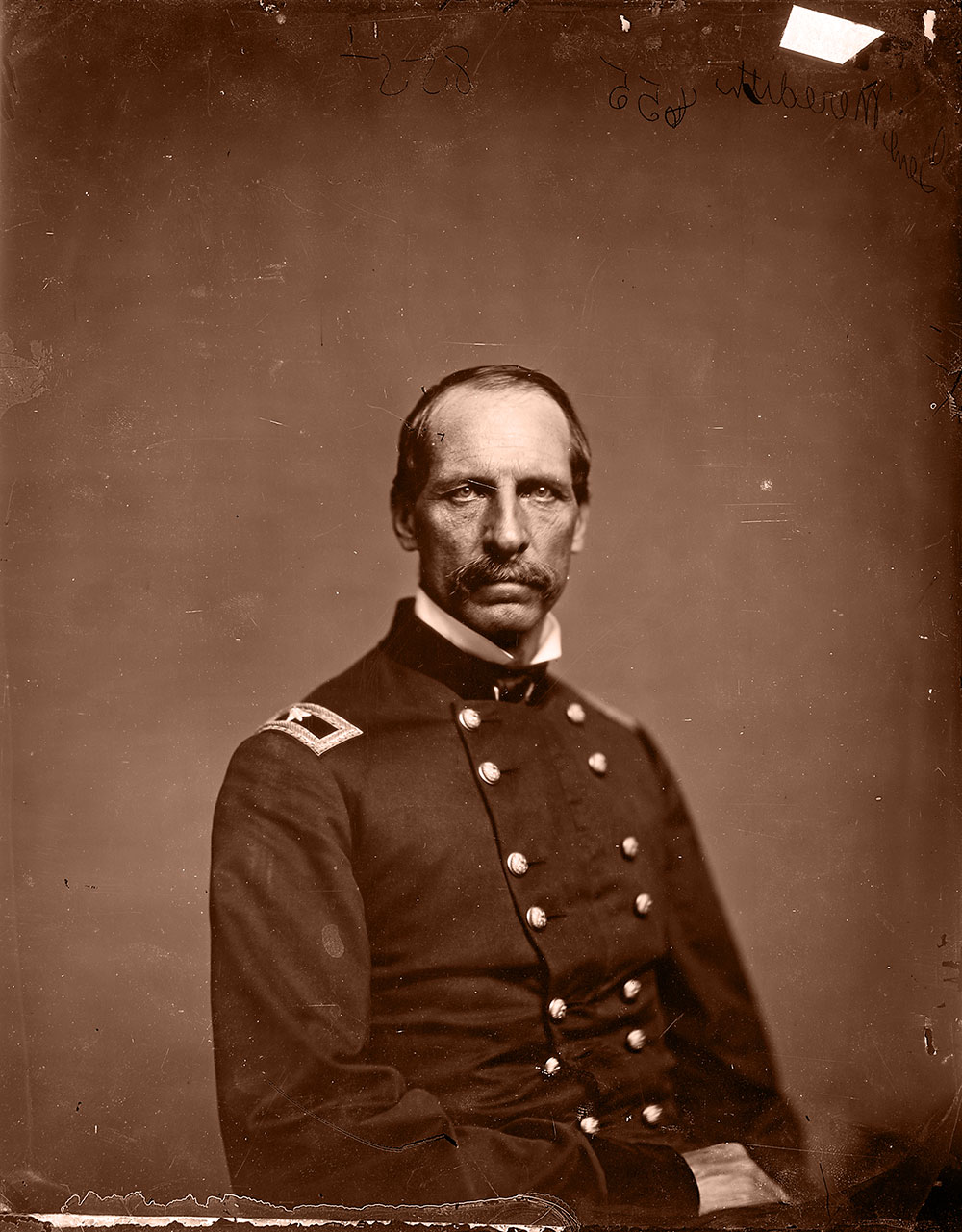
Meredith’s life embodies the contradictions of the citizen-soldier. A farmer, sheriff, legislator, and marshal before becoming a general, he had no formal military training, yet commanded one of the Union’s most storied brigades. His wounds at Gettysburg ended his battlefield career, but his name remains forever linked to the Iron Brigade’s valor.
Meredith emerges not as a flawless hero but as a man of his time—ambitious, sometimes controversial yet always committed to the Union cause. His towering figure came to symbolize the strength of ordinary men called to extraordinary duty.
Lance J. Herdegen is the author of Those Damned Black Hats: The Iron Brigade in the Gettysburg Campaign and The Iron Brigade in Civil War and Memory: The Black Hats from Bull Run to Appomattox and Thereafter. His past writings about Meredith include an article in the August 2017 issue of Civil War Times, from which this story is drawn. Lance enjoyed a long career as a journalist with the United Press International (UPI) news wire service. He lives in Spring Prairie, Wis.
SPREAD THE WORD: We encourage you to share this story on social media and elsewhere to educate and raise awareness. If you wish to use any image on this page for another purpose, please request permission.
LEARN MORE about Military Images, America’s only magazine dedicated to showcasing, interpreting and preserving Civil War portrait photography.
VISIT OUR STORE to subscribe, renew a subscription, and more.