
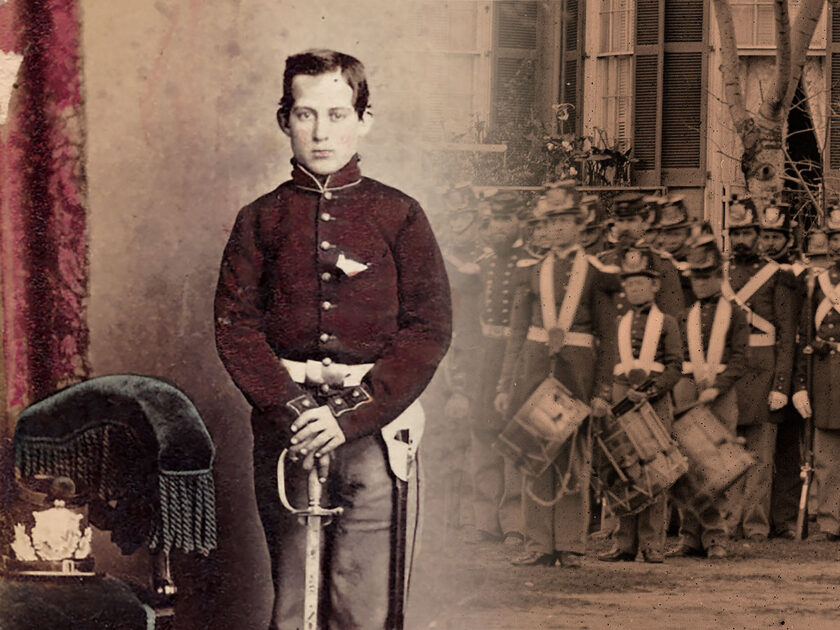
By Dr. Charles H. Cureton
In researching Marine Corps dress and equipment from the official establishment of the service in 1798 through the period of the Civil War, I have found that its uniform regulations accurately reflect what was being worn and carried. However, they do not account for changes that occurred after a regulation was issued, and they don’t mention the clothing and equipment of one group of musicians whose small size posed a challenge.
Boy musicians were apprentices attached to the Marine Corps Band located at Headquarters in Washington, D.C. They were under the supervision of the Drum Major who was to train them to play a variety of instruments enabling them to ultimately become members of the Band itself or be assigned as a drummer or fifer at a Marine barracks or as part of a ship’s guard. The program proved successful and boy musicians became a feature of the Corps throughout most of the 19th century.
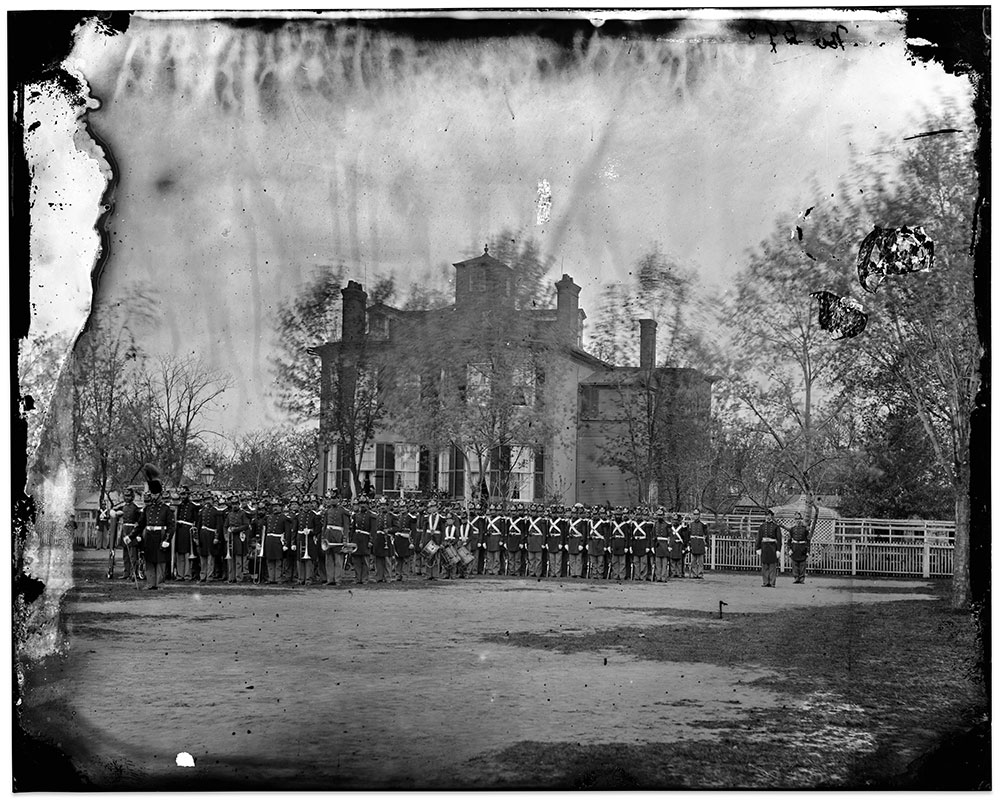
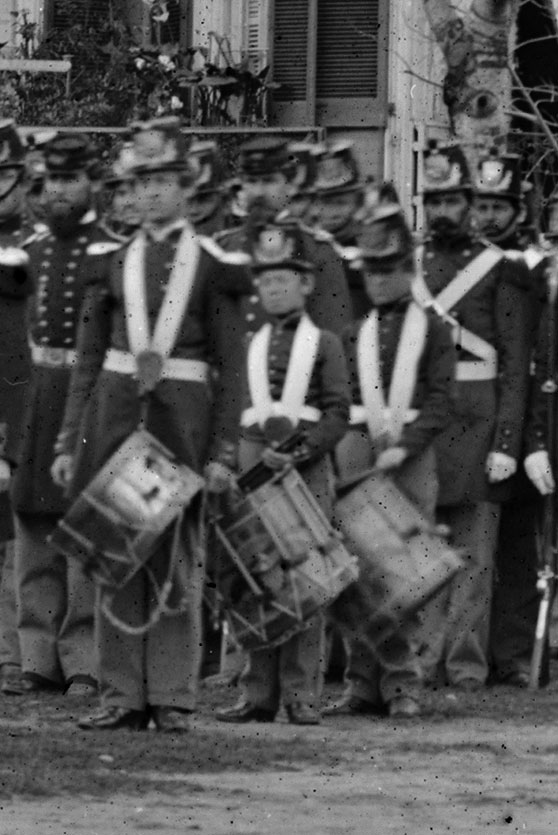
Boy musicians’ formal uniform dress consisted of a jacket, decorated with the uniform coat’s collar and cuffs. Headquarters Marine Corps discovered that it was not practical to clothe boy musicians in small-size versions of the adult uniform. In the 1820s, it decided to provide them with less expensive jackets that could be replaced more easily as they grew instead of coats. Since orders to contractors making boy musician jackets did not describe the garment beyond its basic scarlet color, its makeup and even its existence is largely unknown and unrecognized.
The jacket introduced as part of the Marine Corps’ 1859 uniform changes was not described, and its existence is just hinted at in the April 1864 photograph taken of the Marine Band in Washington. Consequently, the studio photograph of an unknown boy musician assigned to Marine Barracks Brooklyn is the clearest image of the new jacket as well as most other aspects of boy musician dress and equipment. Tinted red in the photograph, the boy’s jacket was actually a bright scarlet color made of cochineal-dyed broadcloth, the same material used in making adult musician coats. Yet, for boy musicians to take their place in parade formations where uniformity was paramount, their jackets featured the adult musicians’ uniform coat and cuff decorations: white edged scarlet collar and slashed cuff, with two loops of yellow lace with a small Marine button at the end of each loop. There were no known changes to this garment until the Marine Corps changed uniforms in 1875. Although obscured by drum belts in the 1864 photograph, the studio image shows that the jacket was made with a small chest pocket.
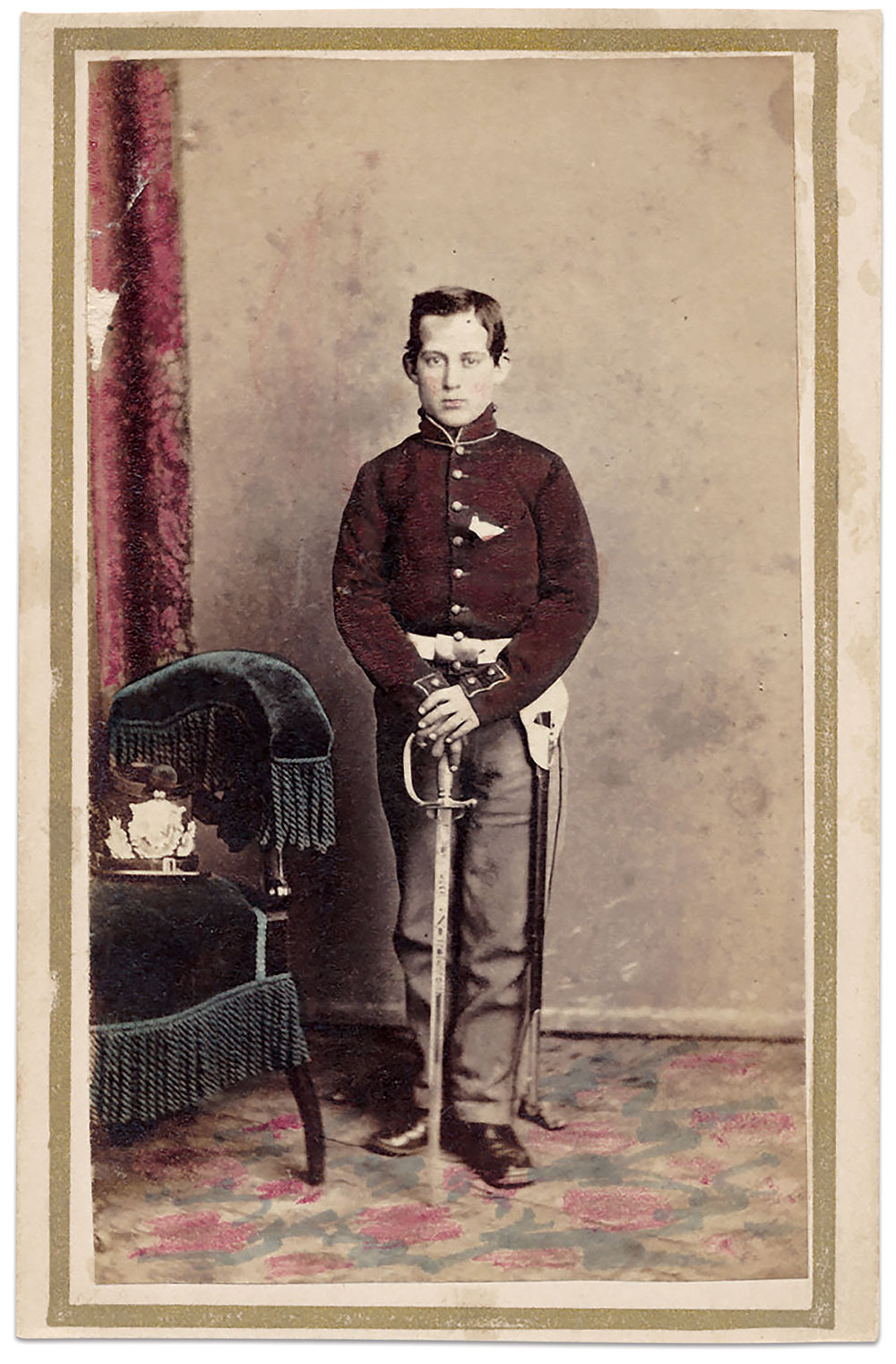
The remainder of his clothing was the same as issued to all Marines except musician’s trousers also featured a scarlet cord on the outside seam. His waist belt, belt plate, sword frog, and uniform cap were the same as worn by all Marines throughout the Civil War era; however, the photograph shows that his belt had been shortened to fit a small waist, and the large cap plate is the pattern used at the beginning of the war. Yet, just as this image provides us with answers regarding the boy musician dress, the sword he is holding is even more important for specialists in edged weapons and is the reason for the circa 1862 date of this image.
The sword in the photograph was one of 40 new pattern swords made under the Marine Corps’ first sword contract, but a design flaw led to the pattern being replaced. When the Marine Corps changed uniforms in 1859 it also changed the swords carried by noncommissioned officers and musicians to patterns that were supposed to be what the Marine regulation referred to as “Same as U.S. Infantry.” As it happened, the patterns adopted were not the same as the Army patterns, but were derived from them. It was initially not clear to the staff of the Quartermaster’s Department as to which of the two Army patterns were intended for musicians (the Army noncommissioned officers’ sword with its inner and outer horizontal counterguards or the Army musician sword with no counterguards), and it was not until October 1859 before headquarters settled on a pattern that was based on the Army noncommissioned officers’ sword and ordered 40 “musician” swords from Horstmann and Sons with the provision that some of them would have blades and scabbards “made shorter (for boys etc) when required.”
The portrait is important for two reasons: It shows the distinctive uniform of a Marine boy musician, and one of the rarest musician swords used by the Marine Corps.
But were the swords ordered and furnished made to the Army’s noncommissioned officers’ sword pattern in some way different? After all, the Army noncommissioned officers’ sword signified rank, and the Army would not have been in favor of it being repurposed as a musician sword.
This image shows what happened.
Horstmann and Sons completed the contract by mid-December, and their swords were duly received at headquarters and issued to the band and musicians assigned to Marine Barracks Washington. It is not clear from Quartermaster Department correspondence whether these swords were copies of the Army pattern or if, in selecting Horstmann as the contractor, headquarters intended them to be made with the firm’s distinctive turned-down inner counter guard. Yet, while the changed pattern is known, until this photograph it was not clear as to what exactly Horstmann furnished in 1859. Was the sword the firm’s version with a turned-down inner guard or a regulation model 1840 Army noncommissioned officers’ pattern with horizontal guards?
What is known from the records is that the 40 swords were not liked by the Band and led the Quartermaster Department to instruct Horstmann in June 1861 that the second supply would have “half of the Guard on the inside be dispensed with altogether as it only serves to protect the thumb but is very inconvenient and awkward in wearing the sword.”
What they discovered was that in switching to carrying the sword from the waist belt the inner guard rested against the hip causing the sword to turn in and get between the legs when marching. Consequently, the Quartermaster Department wanted changes made in the design of the counter guards and swords produced in 1861, and later wartime contracts were made without the inner counter guard. The sword carried by this musician could only have come from Horstmann’s 1859 contract and shows that, in addition to the firm’s trademark angled inner guard, it also has the wider blade used by the firm before and during the early years of the war.
The boy in the photograph remains unidentified; however, the image was taken by R. A. Lord at 158 Chatham Street, New York City. This location suggests the musician was assigned to Marine Barracks Brooklyn. Lord operated from this address until February 1864, when a renumbering changed his address to 164 Chatham Street. Accordingly, the back mark on the card indicates that the photograph was most likely taken before the address changed. The sword itself also suggests that the photograph is early in the war as the 1859 pattern was replaced by models without inner guards in subsequent wartime and immediate postwar contracts. When Horstmann resumed the sword contract in 1869, the company reintroduced its distinctive bent inner guard, which remained the standard for Marine Corps musicians’ swords until their discontinuation in 1920.
Further research may be able to determine the individual’s name and year in which the photograph was taken but, as it stands, the photograph has already expanded our understanding of this obscure uniform and sword.
Special thanks to Sam and Wes Small of The Horse Soldier in Gettysburg, Pa., for bringing this photograph to my attention, and to Ken Smith-Christmas, Jack Bethune, and Richard Schenk for their assistance.
References: Regulations for the Uniform and Dress of the United States Marine Corps, October 1859; Major Sutherland to Captain Abraham N. Brevoort, Marine Barracks Brooklyn, October 18, 1859, and Major Slack to Horstmann Brothers and Company, Philadelphia, June 3, 1861; National Archives.
Dr. Charles H. Cureton is the former director, Museums Division, of the U.S. Center of Military History. He is the author of The U.S. Marine Corps: The Illustrated History of the American Soldier, His Uniform and His Equipment, and co-author, with David M. Sullivan, of The Civil War Uniforms of the United States Marine Corps: The Regulations of 1859.
SPREAD THE WORD: We encourage you to share this story on social media and elsewhere to educate and raise awareness. If you wish to use any image on this page for another purpose, please request permission.
LEARN MORE about Military Images, America’s only magazine dedicated to showcasing, interpreting and preserving Civil War portrait photography.
VISIT OUR STORE to subscribe, renew a subscription, and more.