
By Phil Spaugy
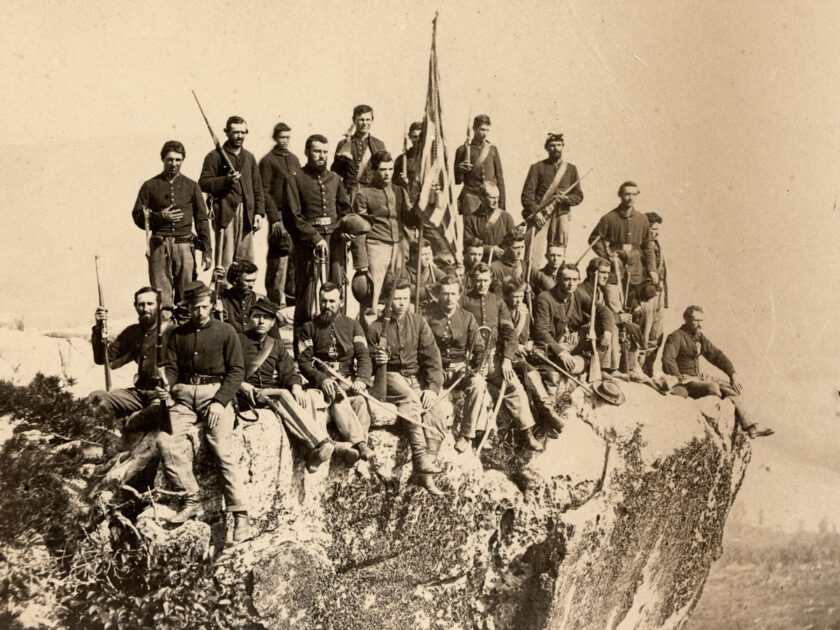
“We had our photograph taken on one plate on Point Lookout” so wrote Corp. William Thomas in his diary on August 29, 1864.
This view of 28 troopers of Company B, 9th Pennsylvania Volunteer Cavalry pictures the often-photographed rock outcropping on the heights of Lookout Mountain, Tenn. These veterans proudly brandish their recently issued Starr carbines. Though the photographer is not named, it is most certainly the work of Robert M. And James B. Linn, who operated a gallery at the picturesque and historically significant spot for decades.
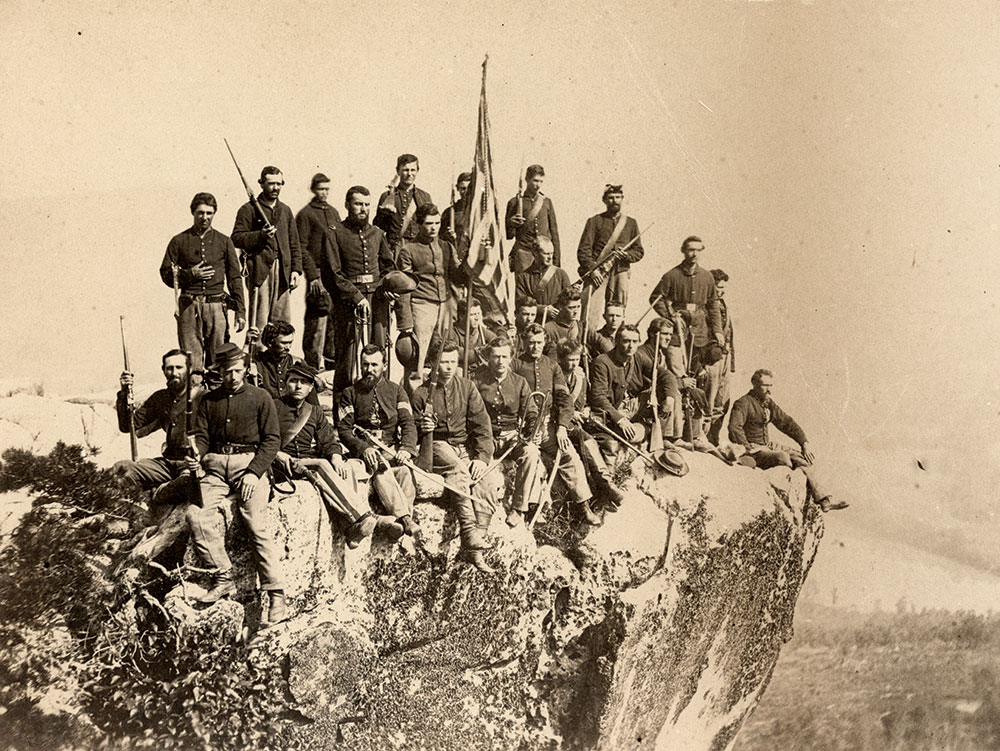
The image is in the Rick Carlile Collection, and previously owned by pioneer collector Herb Peck. It appears in The Blue and the Gray by Thomas B. Allen, published by the National Geographic Society in 1992.
The journey of these Pennsylvanians to Lookout began with the regiment’s organization in October 1861 in Harrisburg. The 9th was also known as the Lochiel Cavalry for the Harrisburg estate of Simon Cameron, the U.S. Senator and President Abraham Lincoln’s first Secretary of War who hailed from Irish ancestry. Dispatched to Louisville destined to become one of the few Pennsylvania cavalry regiments to serve in the western theater, its dozen companies were organized into three battalions—often separated for hard service in Kentucky and Tennessee to cross sabers against guerrilla forces and regular Confederate cavalry under generals Joe Wheeler and Nathan Bedford Forrest. Heavily engaged at the October 1862 Battle of Perryville, Maj. Gen. Don Carlos Buell mentioned the 9th favorably in his official report. The regiment also performed good service during Rosecrans’ summer 1863 Tullahoma campaign, including a successful charge at Shelbyville which assisted in routing the rebels.
The 9th veteranized in early 1864 and after a well-deserved 30-day furlough, returned to service in May of 1864. A few months later, Company B posed for this portrait with recently issued Starr carbines.
Two months later, now replenished and at full strength, the 9th saw more hard service —with much loss— fighting in Maj. Gen. Hugh Judson Kilpatrick’s 3rd Cavalry Division during Maj. Gen. William Tecumseh Sherman’s March to the Sea.
In April 1865, Sherman met Gen. Joseph Johnston to discuss Confederate surrender terms. The 9th attended as Sherman’s mounted escort.
At the war’s end, when the casualty lists were finalized, The 9th counted a loss of 229: six officers and 66 enlisted men killed and mortally wounded, and two officers and 155 Enlisted men by disease.
Image Details
Starr carbines: Four troopers holding Starr carbines offer different views of the firearm. Issued to the 9th on July 1, 1864, the Starr was a single shot, externally primed .54 caliber breechloading carbine firing a linen cartridge which had the ball backed by a 62-grain powder charge. 20,601 Starr carbines were produced under a federal government contract, making it the fifth most issued carbine during the war.
 During its service, the troopers of the 9th carried a variety of weapons. Their sidearms consisted of the Colt Army revolver in .44 caliber and the Model 1860 Light Cavalry saber. Long arms varied. Upon their arrival at Louisville in January 1862 they received “Belgian Rifles and bayonets, converted from flintlocks to percussion cap ignition.”—hardly an adequate arm for cavalry use! Many companies turned these weapons in preferring to be armed only with Colt revolvers and sabers. By late fall 1862, the 9th still lacked adequate carbines. Company B reported 15 Maynard No.1 carbines and the other 11 companies listed 35 Sharps carbines, making a total of 50 carbines for the entire regiment.
The situation improved after the men returned to Kentucky from their furloughs in June 1864. In Louisville, Company B received Enfield rifles, though the other companies were issued Belgian rifles. They helped counter one of Brig. Gen. John Hunt Morgan’s Bluegrass State raids. After nearly a month of chasing Morgan and other guerrilla bands, the 9th ended in Bowling Green, where the men were issued the Starr carbines pictured here. (Side note: there are no Model 1860 Colt revolvers visible in the image. The third quarter 1864 ordnance returns might explain why, as it accounted for only six Colts in Company B.)
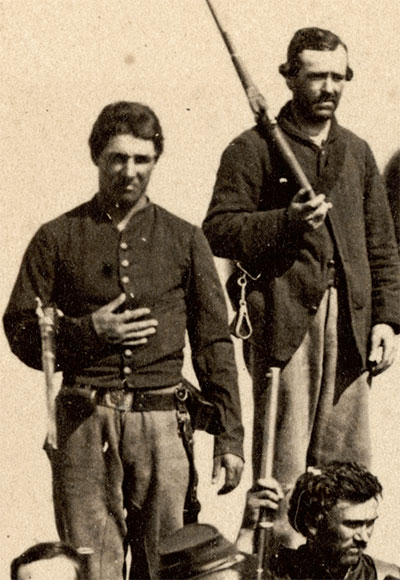 Uniform and accouterments: These two troopers exhibit jackets commonly worn by federal cavalrymen. The man on the left wears a nine-button mounted service shell jacket. If the jacket originally had the yellow trim which designated the cavalry arm it has been removed. Around his waist is the regulation issue Model 1851 cavalry belt with saber sling. His regulation cartridge box rests at a slight angle below his left hip, perhaps suggesting that the box is loaded to its capacity of twenty rounds. The cap box for his percussion caps is positioned on his right front, close to the rectangular Model 1851 belt plate.
Our subject to the right wears a regular army issue four-button blouse or sack coat with the buttons for a vest visible through the unbuttoned gap in the coat. Over his left shoulder can be seen the carbine sling and swivel hook that was attached to the ring on the trooper’s carbine. This method of carrying the carbine was primarily used when mounted, the carbine resting muzzle down in a leather thimble or socket on the side of the trooper’s saddle.
The men hold their carbines nonchalantly, much as they would when moving about camp on foot.
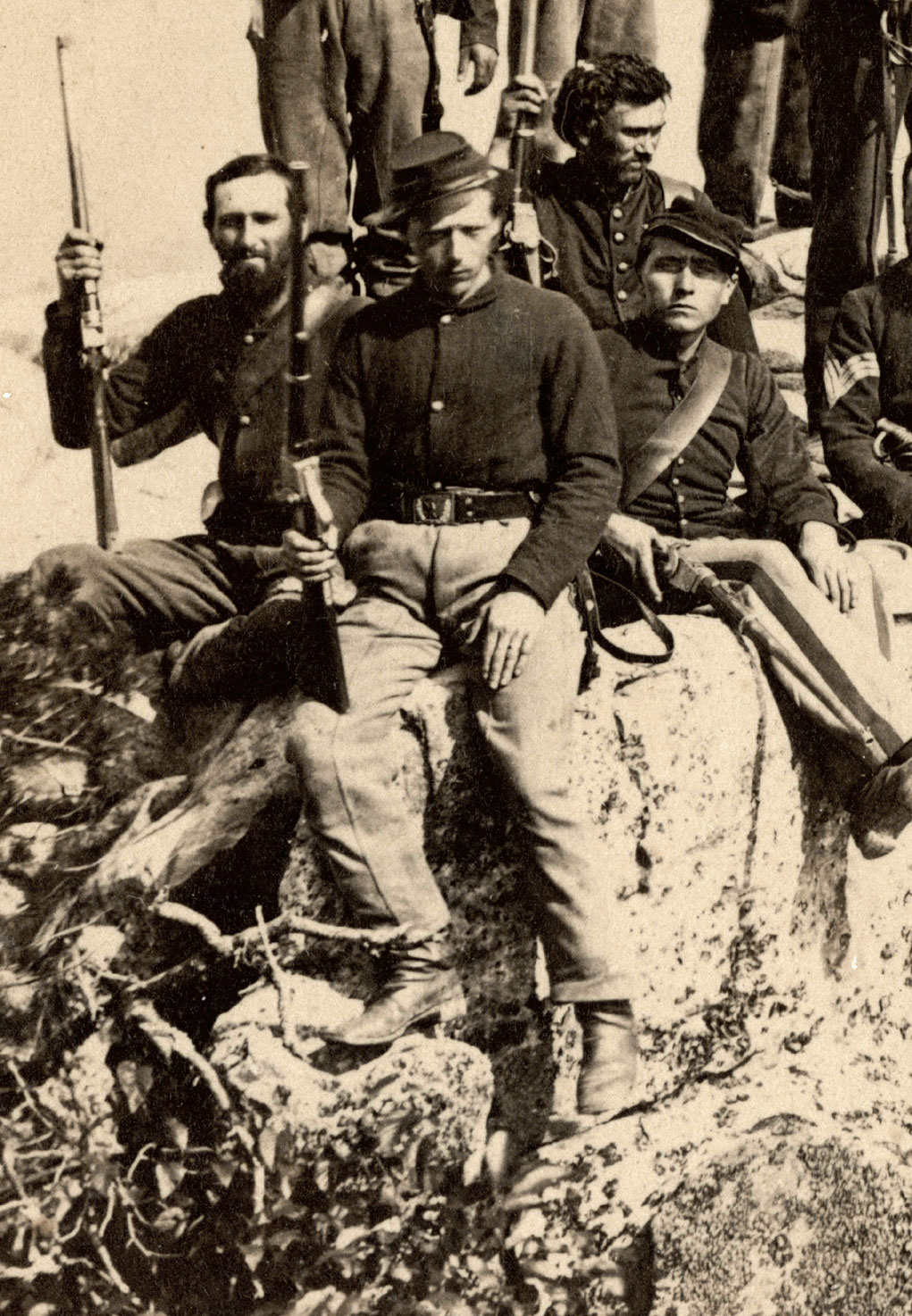
Personal style: These troopers offer a glimpse into how troopers dressed and carried their weapons and equipment, from the left:
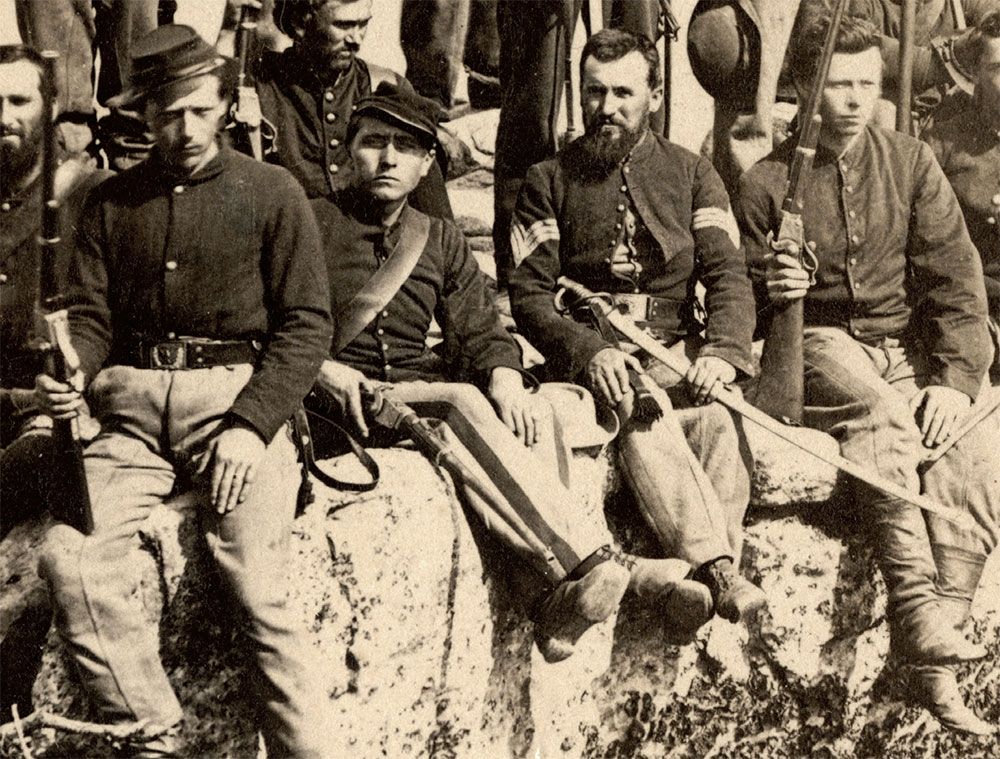
The first trooper wears a regulation forage or fatigue cap. He has his four-button blouse buttoned to his neck and tucked securely into his mounted service trousers which clearly show the extra material that reinforced the trooper’s seat and inside of the legs which would see increased wear when mounted. He wears the standard issue cavalry belt with saber sling and rests his carbine on his knee.
The second soldier’s carbine sling rests across his left shoulder. The fully-cocked Starr at his side appears to have no percussion cap on the cone or nipple. His trousers have a 1.5-inch-wide yellow stripe down the outside seam of the trouser leg. Normally, a sergeant would wear this stripe, but no chevrons are visible on the sleeve of his jacket. His brogans appear to have eyelets or fasteners of metal and of greater number than the issue brogan of the period, suggesting that they might be of private purchase. A forage or fatigue cap completes his look.
The third trooper wears sergeant’s chevrons on his mounted service shell jacket. A vest is visible through the unbuttoned front of his jacket. His Model 1860 Light Cavalry saber is fastened to the sling on his regulation belt, with this leather saber knot in view. The stripe on his right trouser leg is consistent with his rank and the lined mounted service type. His brogans and hat, perhaps a light-colored civilian slouch hat, were likely a private purchase.
The fourth man may be another sergeant, judging by the faint outline of a trouser stripe. He wears the mounted service shell jacket, but no other accouterments. His boots are cavalry issue. At his side is a carbine with the hammer at the half-cock or safety position.
A company commander: The bars on the shoulder strap of the lone officer in this image are difficult to discern, even under high magnification. He must be the captain or first lieutenant of Company B in the summer of 1864. They were Capt. Elisha Atherton Hancock (1839-1906) and 1st Lt. William H. Baugher (1839-1915), who is clad in an officer’s shell jacket with slouch hat in one hand and the other on his Model 1860 Light Cavalry saber. Standing next to him is a color bearer holding what appears to be either a company or battalion national color with the proper hat cords. It is interesting to note that several individual companies of the Ninth carried national colors in addition to company guidons. At the bottom of the frame, a trooper steadies a flag corner, perhaps to keep the colors still during the exposure.
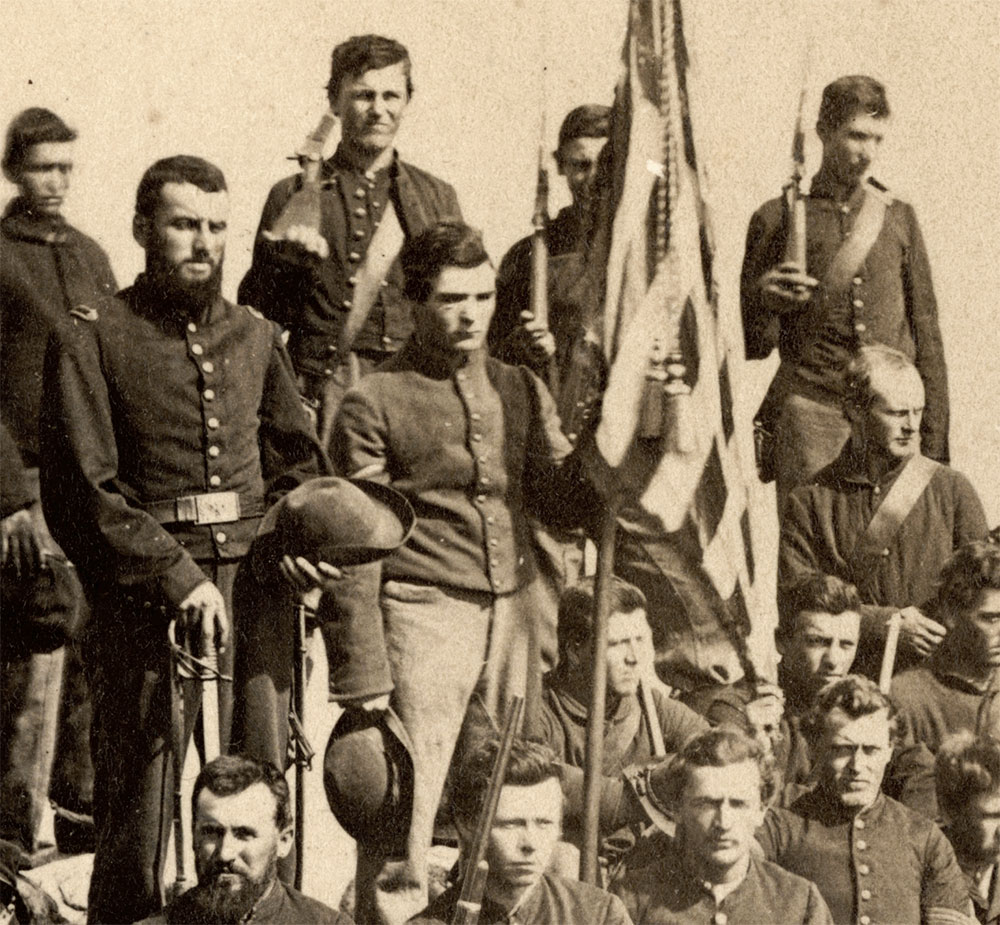
Side note: All but three of the troopers don headgear. I am certain this was at the direction of the photographer, who positioned the men at the best possible angle to catch the light on their features.
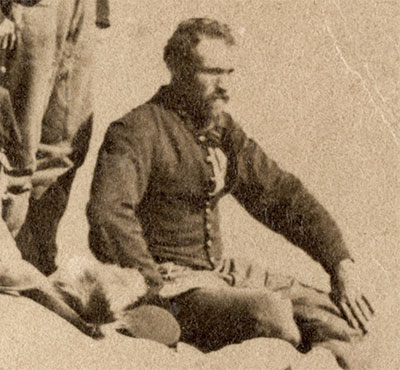 Mascots: Lying to the right of the soldier is what may be a mascot, perhaps a skunk or a raccoon. The tiny face of another mascot or pet is visible between the soldier’s right arm and hip.
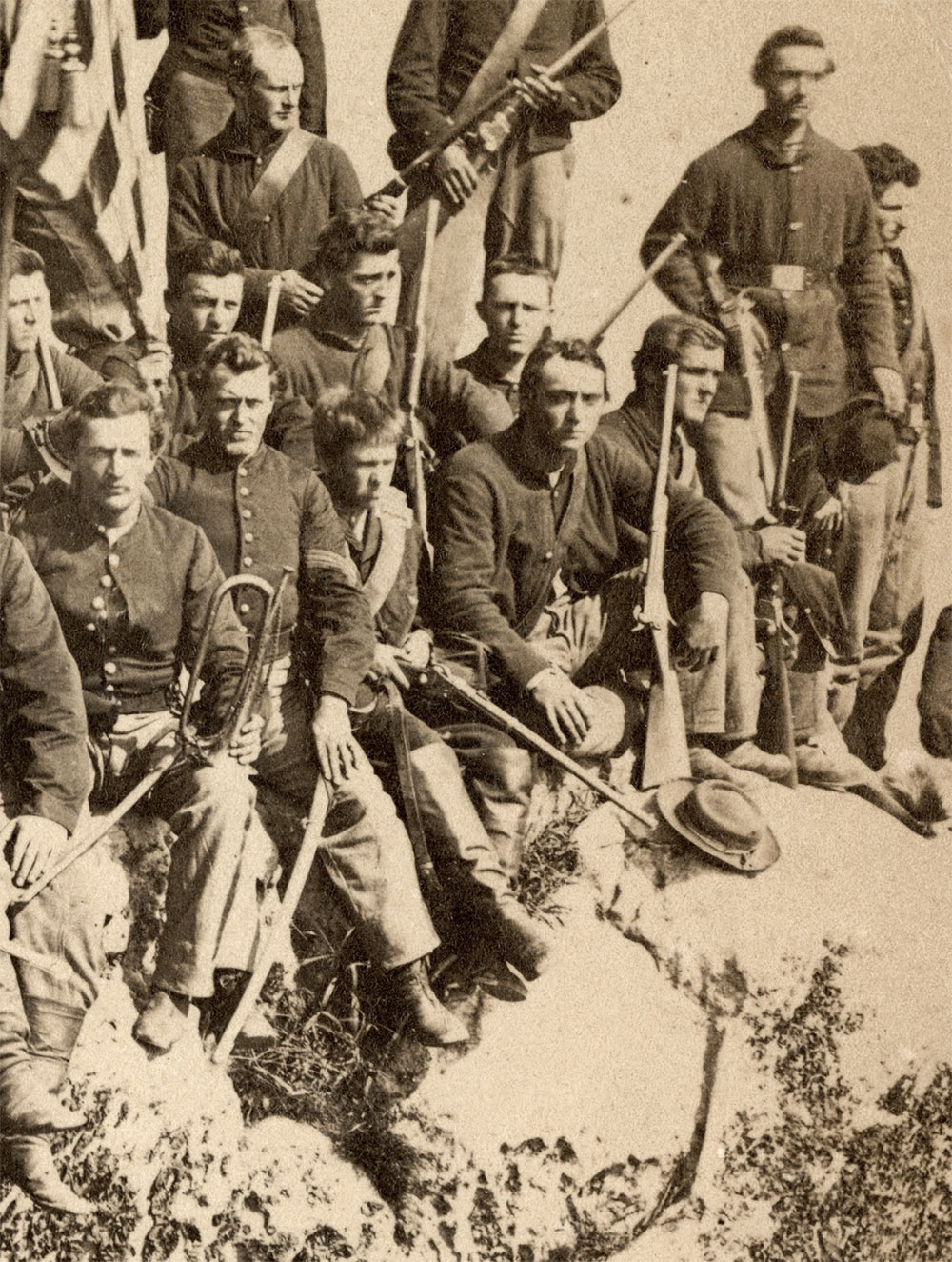 Bugle, carbines, and saber: A bugler rests his instrument on his knee as carbines are displayed around him. A sergeant grips a Model 1860 Light Cavalry saber, while forage caps and a non-regulation hat with cord lie on the rock.
References: American Civil War Database; Fold3.com; Pennsylvania Roots (pa-roots.com); Powell, Failure in the Saddle; Sauers, The National Tribune Index, Volume Three; Wittenberg and Powell, Tullahoma. The Forgotten Campaign that Changed the Civil War; Rowell, Yankee Cavalrymen; McCauley, Union City; Research Arsenal (researcharsenal.com); Todd, American Military Equipage; Sauers, Advance the Colors.
Phil Spaugy is a longtime member of the North South Skirmish Association (N-SSA). He studies arms and accouterments of federal infantry soldiers with an emphasis on his home state of Ohio, firearms of the U.S. Arsenal at Harpers Ferry, and the Iron Brigade. He is a partner with Jim Hessler, in Hessler Spaugy Action Travel. Phil is a retired aviation services company executive who lives in Vandalia, Ohio, with his wife, Amy. He is a MI Senior Editor. Contact Phil at PhilSpaugy@gmail.com.
SPREAD THE WORD: We encourage you to share this story on social media and elsewhere to educate and raise awareness. If you wish to use any image on this page for another purpose, please request permission.
LEARN MORE about Military Images, America’s only magazine dedicated to showcasing, interpreting and preserving Civil War portrait photography.
VISIT OUR STORE to subscribe, renew a subscription, and more.
1 thought on “Riders Above the Clouds”
Comments are closed.