
By Buck Zaidel, with images from the author’s collection
As a collector of Connecticut Civil War images, I am well aware of the artistic painted canvas camp scene backdrop seen in images by N.A. Moore and R.A. Moore of Hartford. The Aug. 7, 1862, Hartford Daily Courant stated: “The Moore Brothers, photographers, always first in the field, are building a large wooden house on the grounds of the 16th [16th Connecticut Volunteer Infantry Camp] for the purpose of taking soldiers’ pictures. Now the girls will have their lovers taken before going to war.”
The firm was run by Nelson Augustus and Roswell A. Moore, brothers from nearby Kensington, Conn. Nelson had been an acclaimed artist of the Hudson River School prior to opening up their photography studio. His oil paintings were noted for their detail and nuances of light while capturing the natural beauty of Connecticut and New York landscapes.
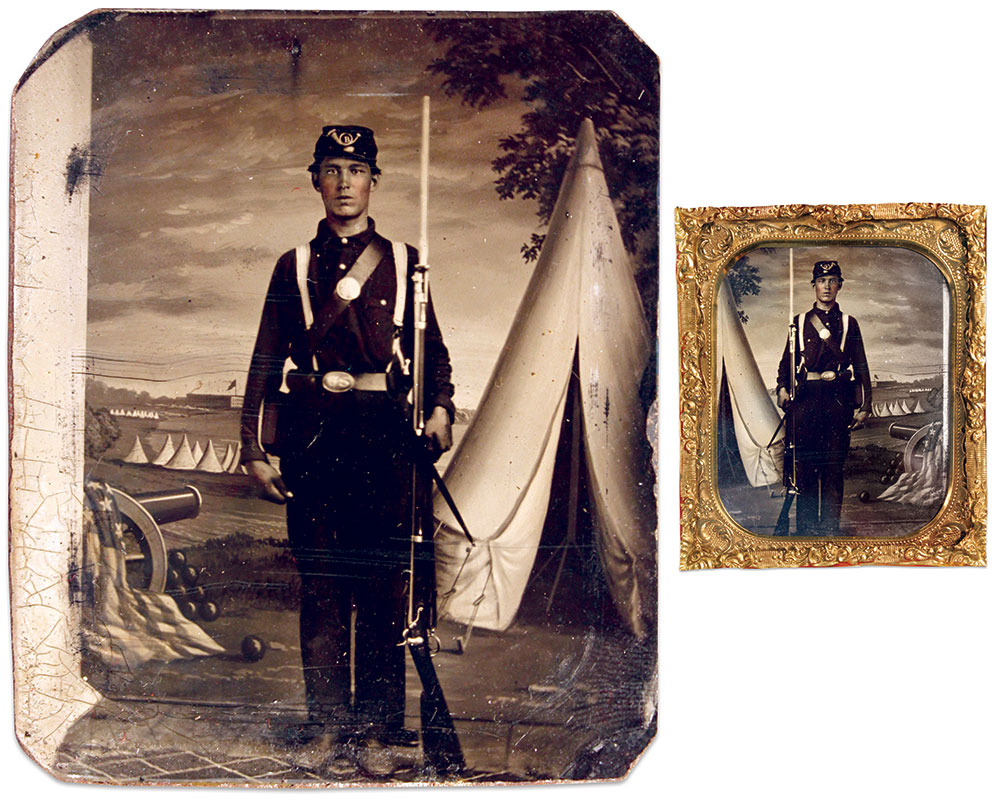
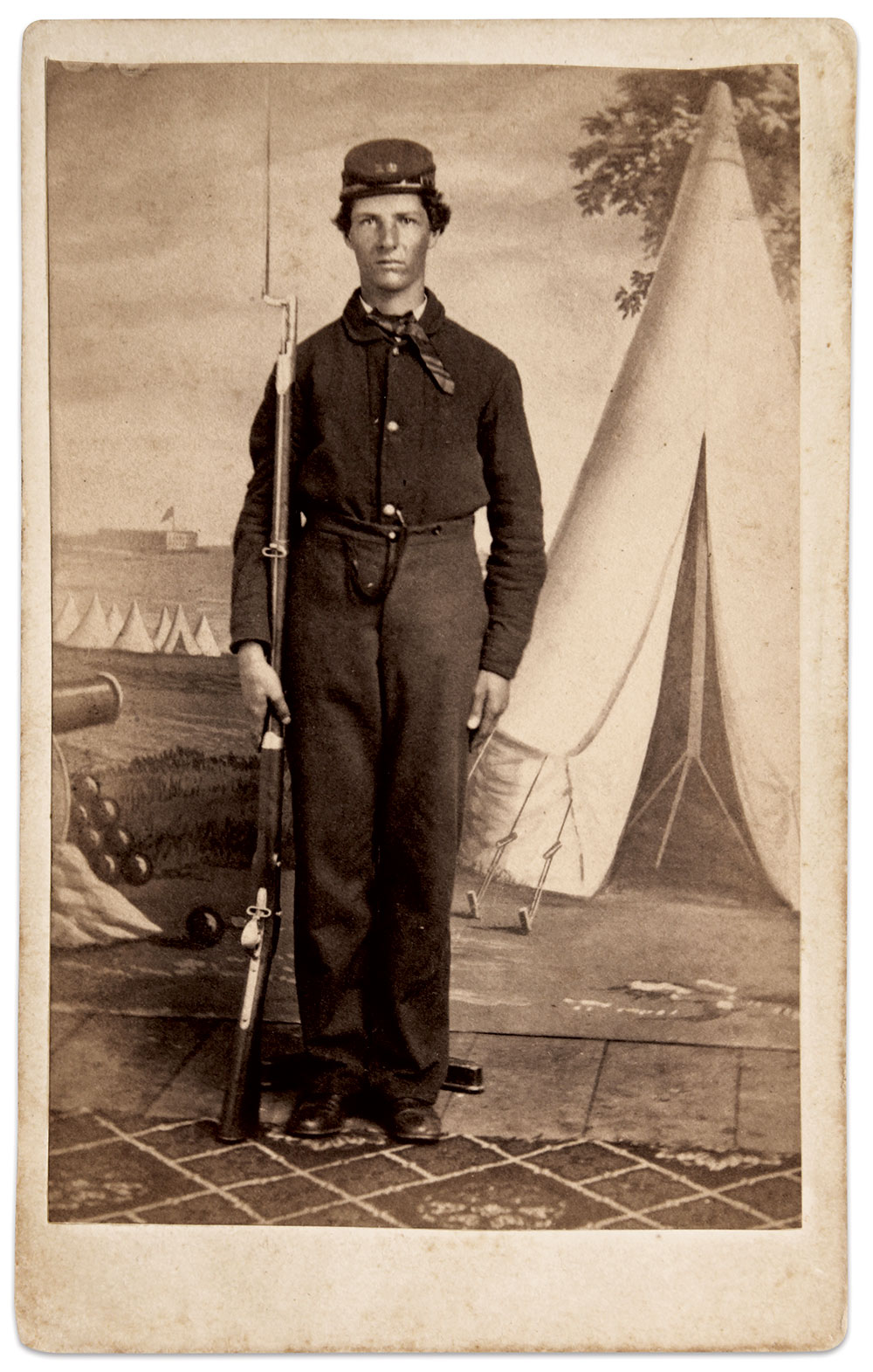
The skillfully executed camp scene backdrop in Moore Brothers images of this period exhibit a particular attention to detail: Storm clouds brewing in the sky, a leafy tree offers shade for a Sibley tent with the straight taut sides, a cannon poised nearby, a draped American flag with the red and white stripes billowing down from the barrel and over the wheel ends near a lone cannon ball set apart from a pyramid of round shot, a tented encampment in the mid-distance, and a flag waving over a distant coastal fort completes the scene.
Such a high-quality and realistic image might entice young volunteers eager to capture the start of their transition to soldier life to come in and have their likeness taken.
Who painted the backdrop? Knowing Nelson’s artistic talent, and considering the economics of painting your own versus commissioning another artist, I surmise he created it.
Another question: How to explain other similar backdrops? In exhibiting a Moore Brothers carte de visite along with another carte of 1st Lt. Thomas R. Butman of the 197th Ohio Infantry at a local Historical Society, I displayed them side-by-side with this caption: “Two images separated by a few brush strokes and 657 miles”: the distance from Hartford to the Columbus, Ohio, studio where Butman posed for photographers Reeve & Watts.
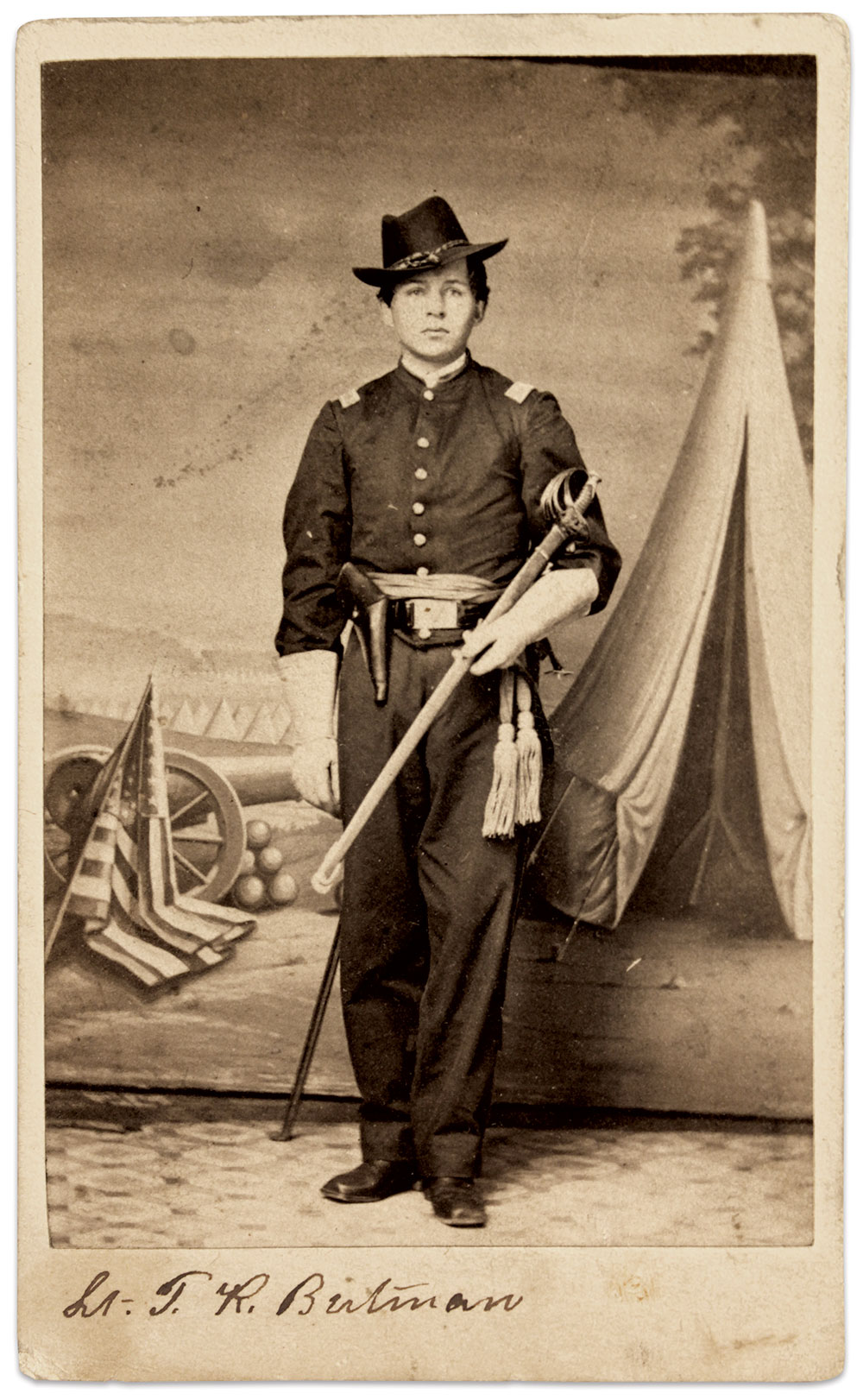
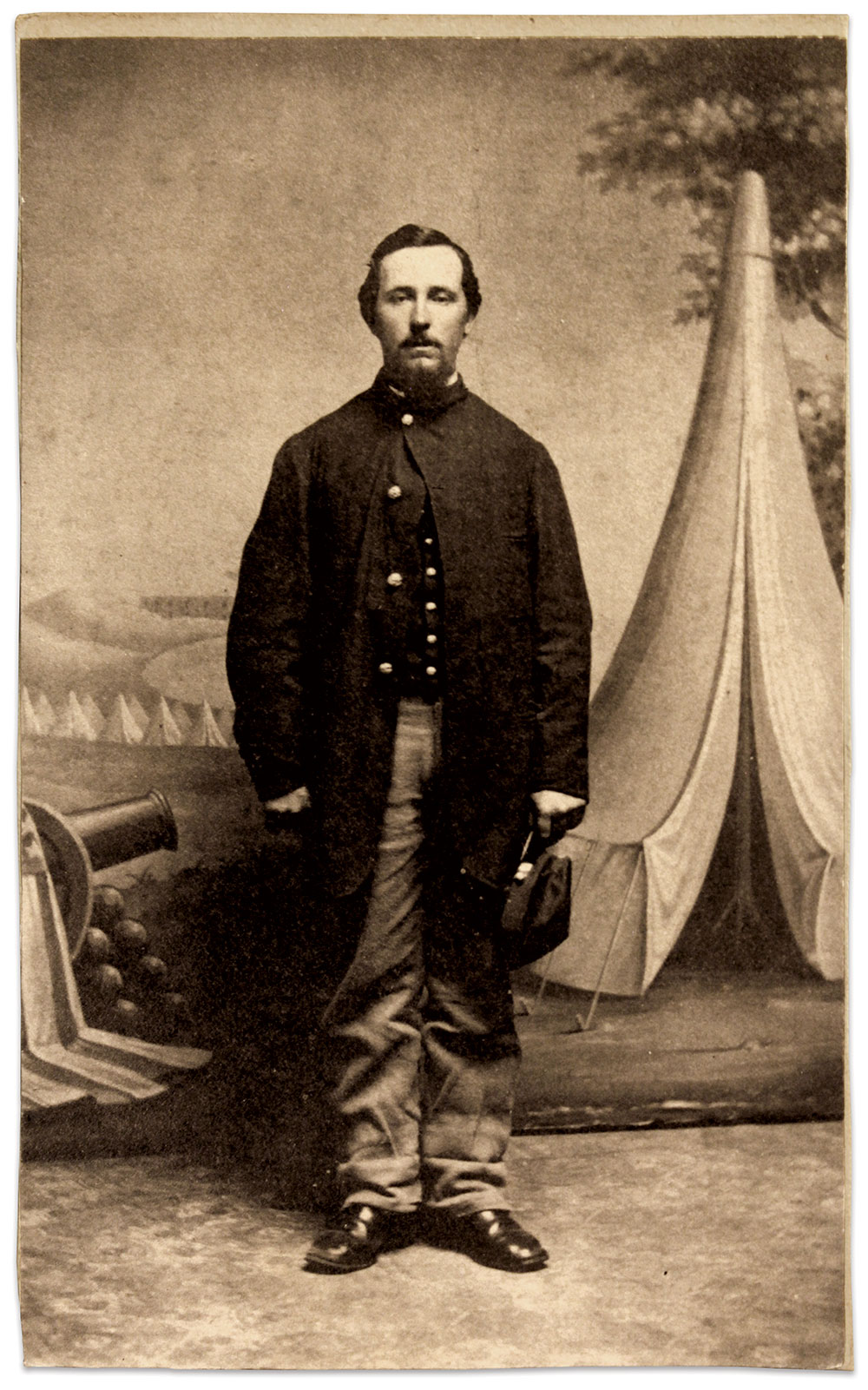
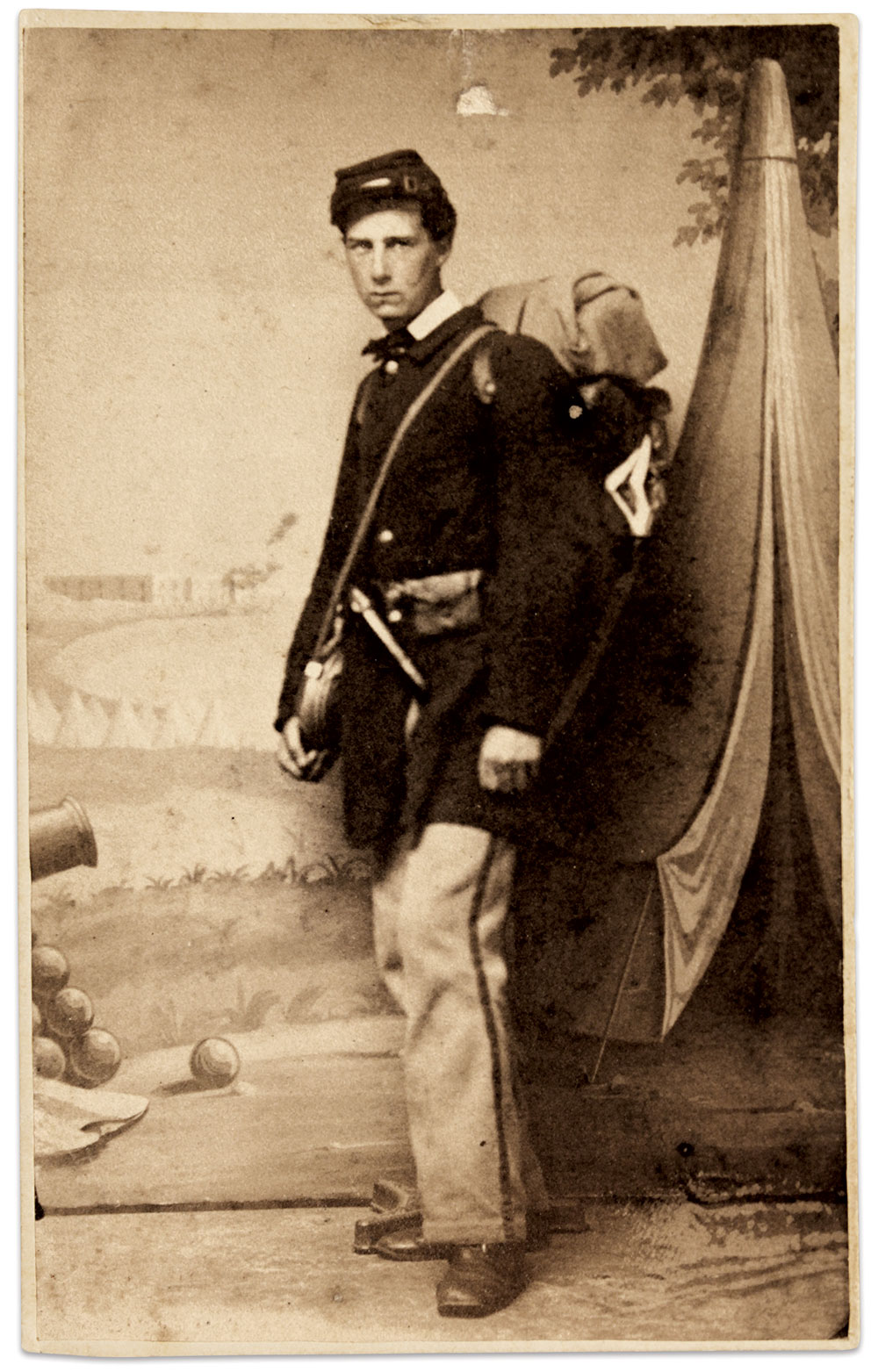
The two backdrops are remarkably similar. The main difference noted being a droop to the side walls of the tent and the folds of the flag. It seems there has to be a connection of these almost identical artworks.
Did Nelson paint additional backdrops? Or is imitation the sincerest form of flattery? Perhaps another artist found inspiration in the Moore Brothers backdrop and created their own version?
In late colonial history, the State of Connecticut set aside a large tract of land in Northeast Ohio south of Lake Erie—the Western Reserve. A fair number of Connecticut residents moved westward to take up new lives on new land in the 1800’s. Could the Moore Brothers have painted a second similar backdrop for a family member or acquaintance now living as part of this western expansion?
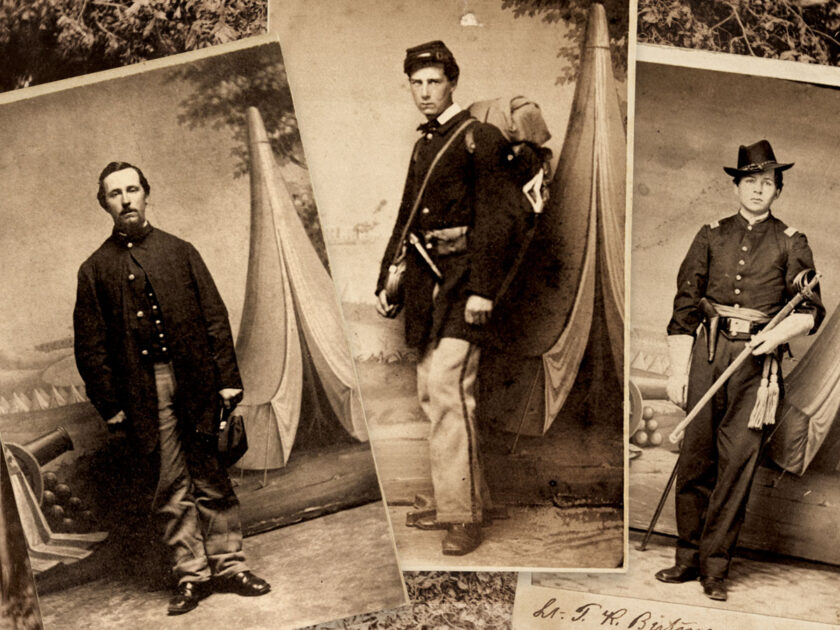
A third comparable backdrop with the same features raises more questions. Could these have been produced by a photo supply company offering their handsome backdrops to the burgeoning photography industry? The well outfitted private posed with knapsack and roll, canteen, and holstered pistol was photographed by Charles C. Evans of Philadelphia. Sharp-eyed collectors may have yet more to say about variations of the camp scene backdrops and the lens men who used them.
In the Moore Brothers capable hands, the resulting photographs produced certainly contain a higher aesthetic presence while highlighting visual reminders of soldier’s camp life.
Buck Zaidel is a MI Senior Editor.
SPREAD THE WORD: We encourage you to share this story on social media and elsewhere to educate and raise awareness. If you wish to use any image on this page for another purpose, please request permission.
LEARN MORE about Military Images, America’s only magazine dedicated to showcasing, interpreting and preserving Civil War portrait photography.
VISIT OUR STORE to subscribe, renew a subscription, and more.