
By Scott Valentine
On an inclement December eve at a Grand Army of the Republic meeting about 30 years after the war, veteran Josiah Murphey experienced a dull ache in his right cheek. The pain was all too familiar. He had felt it for years.
The source, a deep scar, marked the location of a battle wound he had received many Decembers earlier. The pain that emanated from it often caused Josiah Murphey to relive the grim details of the fight and his military service.

In the summer of 1862, Murphey—all 5-feet-3 ½ inches of him—was only 16 years old when he left his home on Nantucket Island, Mass., and joined the army. Because of his tender age, Murphey needed and received his parent’s permission to enlist. Full of patriotism and ready to take on the Rebs, he later likened his fervor to an ailment, stating that he had “caught the fever.”
Murphey enlisted in Company I of the 20th Massachusetts Infantry, nicknamed the “Harvard Regiment” because so many of its officers were educated at the college.
During the next three years, the regiment would become known as the “Bloody 20th” in recognition of its high casualties, the fifth highest of 3,000 regiments in blue.
The men of the 20th Massachusetts had a tough time from the start in 1861. They saw hard service at Ball’s Bluff, White Oak Swamp, Glendale, Malvern Hill and Antietam.
Murphey missed all these engagements. But he would be present for the regiment’s toughest test at the Battle of Fredericksburg, and would later tell his story.
During the early morning hours of Dec. 11, 1862, Murphey had just fallen to sleep along the fog-enshrouded Rappahannock River when he and the rest of his company were ordered to be ready to move in about an hour.
By this time, rumor held that the overall commander of the Union Army of the Potomac, Maj. Gen. Ambrose E. Burnside, planned to cross the Rappahannock and attack the town of Fredericksburg, defended by Gen. Robert E. Lee’s Confederate Army of Northern Virginia.
Murphey and his comrades could not have known the battle was lost before it began. Burnside’s original concept relied on swift movement and deception to catch his adversary off guard. But weeks had passed as pontoon boats were brought into position for the crossing. Lee took advantage of this and other delays to prepare for the assault.
By the time Burnside moved, Lee had fortified his position on the river’s west bank, notably along a sunken road perched above the town on Marye’s Heights.
Burnside’s engineers began to lay the pontoons under the cover of the early morning fog on December 11. But the fog lifted by mid-morning, revealing that only one of five bridges was partially constructed. Confederate sharpshooters, Mississippians and Floridians under Gen. William Barksdale, made life difficult for the unarmed engineers, who hightailed it back to the safety of the east bank of the Rappahannock.

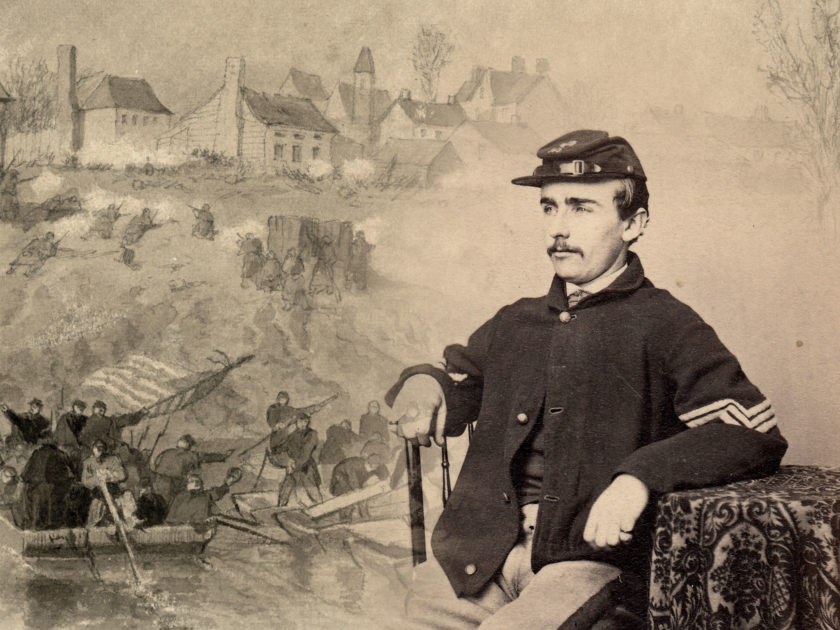
After Union artillery perched on Stafford Heights failed to drive Barksdale’s sharpshooters from the shoreline, Burnside asked for volunteers to cross the river in pontoon boats and drive away Barksdale’s sharpshooters. One brigade commander, Col. Norman J. Hall, offered his five infantry regiments, which included his own 7th Michigan. The others were the 19th Massachusetts, the 59th New York, the 137th Pennsylvania—and the 20th Massachusetts.
Word of the assignment circulated swiftly through the ranks. Murphey later recalled: “Well we knew what was in store for us, we knew that we were to make an attempt across the river and gain the city and the heights beyond, and knowing how strongly fortified the rebs were, we knew what a reception we should get, and that many of us would never see the light of another day.”
The men of the 7th Michigan ferried over first, and, after a brief firefight, secured the riverbank and sent Barksdale’s sharpshooters scampering up into the streets of Fredericksburg. A half-hour later, the 19th Massachusetts followed, and both regiments fanned out along the street above the river. By the time Murphey and the 20th Massachusetts readied to cross, the wounded of the 19th Massachusetts and 7th Michigan were being ferried back from the shoreline opposite. The pontoons pulled up and unloaded the injured.
Now, the time arrived for Murphey and the rest of the 20th Massachusetts boys to cross. Murphey later recalled that, “When we crossed the Rappahannock river in boats at the assault on Fredericksburg, it was necessary to push the boats a little way from the shore to prevent their grounding when we got into them. The shore was fringed with ice and we with shoes on, of course, we were wet above our ancles and with no chance to dry them.
After getting into the boat two men sat down at the oars. One was Thomas Russell of this town [Nantucket], the other man I do not remember, but he pulled Russell right around and headed the boat upstream. Lieut. Leander F. Alley said to me, ‘Murphey, take that oar,’ which I did and we soon had the boat across on the other side where she grounded a few feet from the shore. We jumped out and waded to the land.”
They soon joined their comrades in the 19th Massachusetts and the 7th Michigan, and awaited further orders.Meanwhile, engineers completed construction of the pontoon bridge, and the free flow of Union forces began in earnest.
“We lay under the bank of the city and as soon as the troops began to cross we were ordered forward,” Murphey remembered. “Our company formed in two platoons of about thirty men each at the lowest end of a street called Farquier street and began our advance up the street.”
“As soon as we came in sight of the rebels who were concealed in every house and behind every fence, they opened a terrible fire on us at short range”