
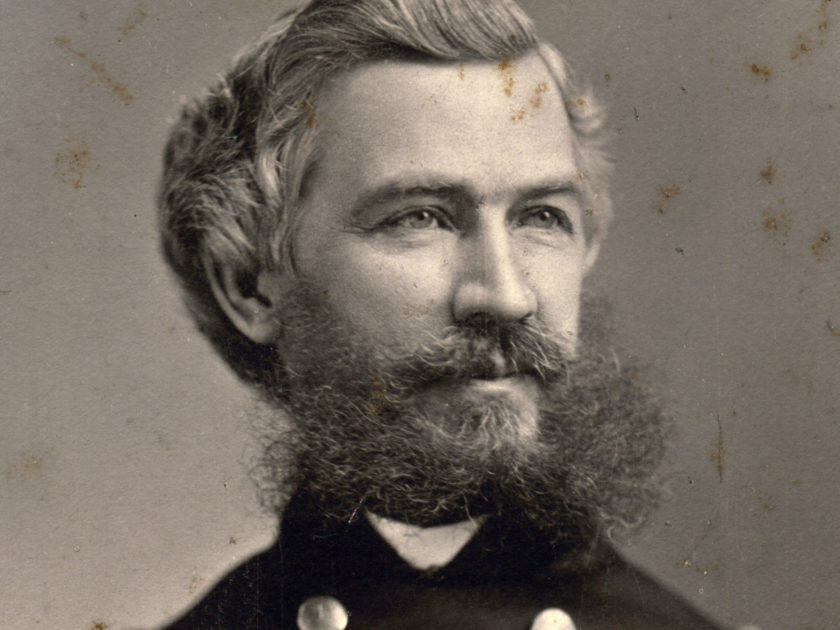
By Ronald S. Coddington
Veterans have always told war stories. Those who survived the Civil War were no exception, and they number among the earliest to recall their service through photography.
The preservation of these images by the veterans began soon after the war ended. Massachusetts officers Arnold A. Rand of the 4th Cavalry and Albert Ordway of the 24th Infantry assembled the best-known collection. It is fair to characterize Rand and Ordway as among the first military image collectors. The portraits and original negatives they obtained formed the collection of the Military Order of the Loyal Legion of the United States (MOLLUS) Massachusetts Commandery.
Far less is known about another veteran, however, who amassed thousands of Civil War images, behind the scenes with no fanfare.
Left for dead, his adjutant, a Harvard classmate, discovered Lawrence, and managed to get him into an ambulance.
Samuel Crocker Lawrence, a quiet man of generous spirit, had been enamored with soldiering since his boyhood in the Boston suburb of Medford. After graduating from Harvard in 1855, he became involved with the local militia, the Lawrence Light Guard. The company was named for his father, a prosperous rum distiller and scion of the community. As the nation drifted towards war, young Lawrence prepared accordingly. In late 1860, he tapped into his family wealth and social position to rent a hall above a Boston railroad station to drill his troops. By this time, he ranked as colonel of the state’s 5th Militia.
The men of the 5th, with Lawrence in command, departed for Washington when the war came. The 5th arrived in the U.S. capital a few days after its brother regiment, the 6th, had endured rough treatment from pro-secession mobs as it marched through Baltimore.
In Washington, Lawrence’s regiment became known as the “Steady Fifth” for its gentlemanly conduct and soldierly bearing—the officers and enlisted men taking cues from their colonel. The regiment lived up to the reputation on the slopes of Henry House Hill during the First Battle of Bull Run on July 21, 1861. The 5th went into action, even though its enlistment had expired.
An eyewitness account quoted in the regimental history recalled the performance of the 5th that day.
“I saw the Mass. Fifth in their dark uniform and their steady advance under the enemy’s fire of shot and shell; I noticed them some distance off; they came into the field by a flank movement, and then into column, with as much coolness as if they had been on an ordinary muster-field. They had to pass over an open field exposed to the full force of the rebel batteries, but they did not waver in the least. On the brow of the hill I first saw their Colonel [Lawrence] at their head. He is a tall and slim man, with dark hair. He is quite young, not more than twenty-five. They took their places and fought bravely.”
In fact, Lawrence was 28 years old when he led his men into the fight. The 5th was eventually driven from its position. About this time, an artillery shell crashed into a tree and sent splinters tearing into Lawrence’s side. Left for dead, his adjutant, a Harvard classmate, discovered Lawrence, and managed to get him into an ambulance. Caught in the skedaddle to Washington, Lawrence eventually made it to the capital, though the ambulance was abandoned along the way.
The injuries ended Lawrence’s active duty, and he left the military service in 1864 as a brigadier general in the Massachusetts Militia.

His life after the war was marked by business success and a reluctance to enter politics, despite the urging of friends. Finally, in 1892, he consented to become a candidate for the first mayoral race in his hometown of Medford and won handily on the Republican ticket. But he had no taste for the job, and served only a single term. He preferred to move in philanthropic circles, where his generosity funded numerous initiatives that supported the local community. His death at age 78 in 1911 was widely mourned.
Lawrence left a fortune estimated in the millions, and a will that designated bequests to various organizations, which he was associated during his lifetime.
Among his personal effects was a collection of 3,680 Civil War photographs that included albums of cartes de visite and unmounted prints of camp scenes and battlefields by the studios of Mathew Brady and Alexander Gardner. How Lawrence came into possession of so many photographs is unclear. We do know that he was a collector by nature. He had a passion for books, especially local and military histories and volumes related to his Masonic brethren.
He also collected artwork. According to a biographical sketch published a year before his death, he decorated the Lawrence Light Guard Armory with examples from his collection. “In the various rooms of the Armory he has hung many pictures, representing a great variety of subjects, paintings, engravings and prints, many of which are very rare.” The prints to which the writer referred might have been Civil War photographs.