

By Scott Valentine
Labeled by the men under his command as “a sort of despot” and “petty tyrant,” one of his greatest detractors also described Lt. Col. Hiram Duryea of the 5th New York Infantry “as brave a man as ever stood in shoe leather.”

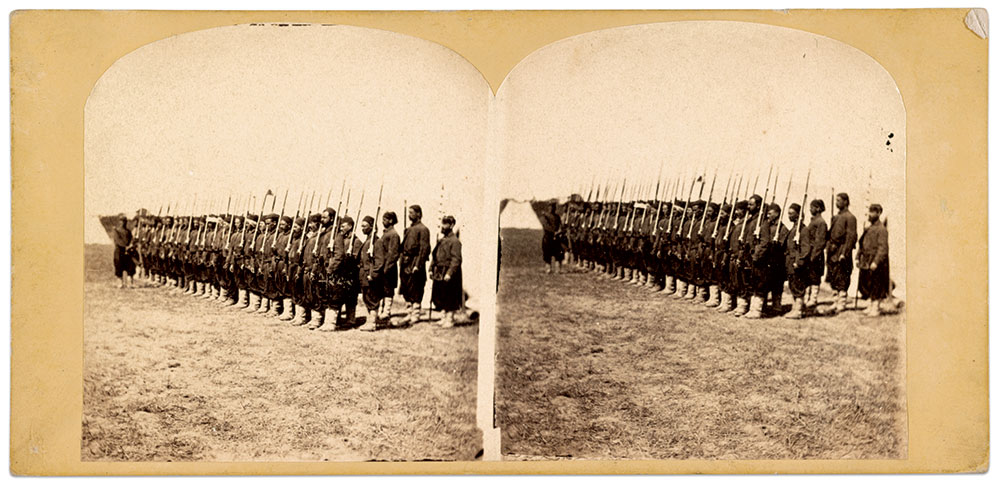
Duryea started his service as the captain of a company in the regiment, popularly known as Duryée’s Zouaves for its commander, Col. Abram Duryée. The two men were not related.
Duryea proved himself a talented leader, rising to lieutenant colonel within months of the regiment’s formation in April 1861.
An example of his courage occurred during the Peninsula Campaign at the Battle of Gaines’ Mill. Duryea sat on his horse in the midst of severe cannon fire while most of his officers had already dismounted. When an unexploded Confederate shell landed in front of his horse’s hooves, Duryea shouted to his men, “Boys, the horse stands it well.” One of his men responded, “Yes, and by God so does the rider.”
The fact that Duryea suffered from malaria at the time made his performance in the saddle even more impressive.
In describing Duryea in a report to Washington, the first lieutenant colonel of the 5th, Maj. Gen. Gouverneur K. Warren, wrote that nothing “but iron will, undaunted courage, unsurpassed ability and sense of honor that culminated in him ever made the regiment what it was.” Duryea received credit for being largely responsible for turning the 5th into a formidable fighting regiment.
But malaria continued to slow him down. By August 1862, he left the regiment on sick leave. He briefly returned to duty as the newly promoted colonel, but his health again failed, and he resigned in November 1862. He later received a brevet of brigadier general of volunteers for distinguished conduct at Gaines’ Mill.
With his military career cut short, Duryea threw himself into the family business as the head of the National Starch Company, which manufactured food and laundry products. He accumulated great wealth before he retired in 1890. He entertained former members of the 5th in his sumptuous home in Bay Ridge, Brooklyn, N.Y. Duryea also held membership in the Veteran Association, Society of the Fifth Army Corps, The Military Order of the Loyal Legion, and the Holland Society.
On the night of May 5, 1914, Duryea’s son Chester shot him while he slept on the porch of his home. Chester fired seven bullets and one other from a rifle, which jammed after the first shot. When the police arrived, Chester surrendered. “It was evident there had been a struggle, as the chairs and a table in the room were overturned and books and papers were scattered about the floor,” the Standard Union reported. When questioned by detectives as to why he shot his father, he said, “I received a message from Washington, telling me to do it.” When asked if he and his father quarreled, he said, “Oh no, we were on the best of terms.” He then became incoherent.
Indicted for homicide, Chester was confined to a hospital for the insane. In March 1940, a judge ruled him sufficiently sane to stand trial, but the indictment was dismissed because of lack of evidence.
Scott Valentine is a MI contributing editor.
SPREAD THE WORD: We encourage you to share this story on social media and elsewhere to educate and raise awareness. If you wish to use any image on this page for another purpose, please request permission.
LEARN MORE about Military Images, America’s only magazine dedicated to showcasing, interpreting and preserving Civil War portrait photography.
VISIT OUR STORE to subscribe, renew a subscription, and more.