
By Evan Phifer
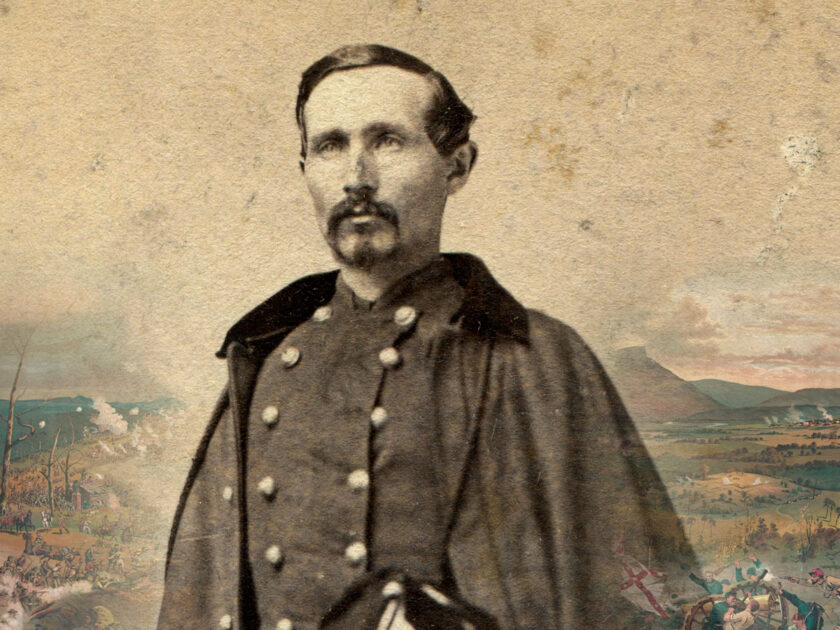
At Missionary Ridge on November 25, 1863, Maj. Ruel M. Johnson assumed command of the 100th Indiana Infantry after its commander, Lt. Col. Albert Heath, received a severe wound. Leading the regiment’s assault on the northwestern end of the ridge, Johnson exposed himself to enemy fire, encouraging his men to remain steadfast in spite of Rebel infantry and artillery fire.
Across open fields under Confederate artillery and small arms fire, the Hoosiers and the rest of their brigade advanced. The movement cost the 100th dearly with over 130 casualties, 43 percent of the regiment’s strength. After several near misses, with his clothing pierced by enemy bullets, Johnson received a wound in the right cheek. Nevertheless, he continued to lead his men.
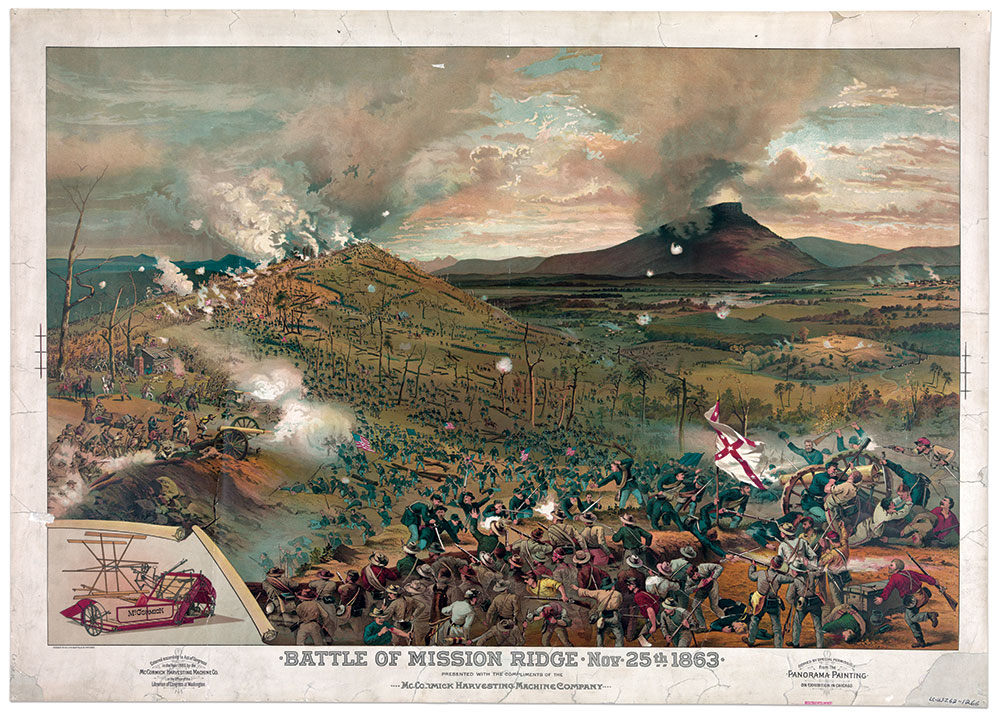
Colonel John M. Loomis, the 100th’s brigade commander, recalled, “I had so much confidence” in him “that I did not doubt his regiment, which would stay with him if he lived. I only watched them to see if he did still live in the storm of lead and iron, often concealed in the smoke and bursting of shell. The quiet temper of his men told me that he did still live.”
Of its conduct during the battle, Capt. Eli Sherlock, the historian of the 100th, wrote, “The regiment established a reputation on that day which commanded the respect and admiration of the whole army, and of which every man who belonged to it ought to be proud.”
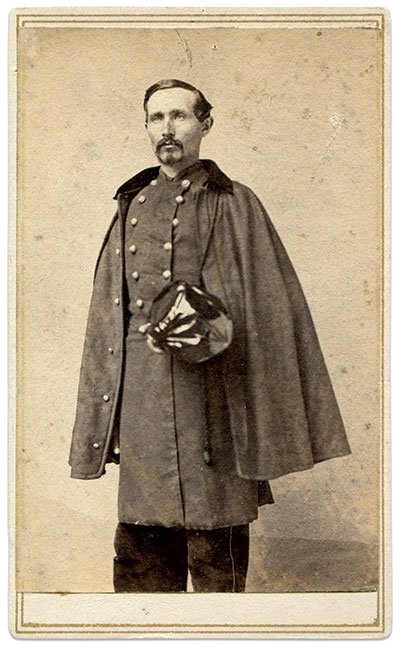
Johnson’s leadership abilities surfaced when the 100th came into existence. Back in August 1862, while practicing law in Goshen, Ind., Johnson, an 1858 graduate of the University of Michigan, heeded his country’s call to arms. According to one source, within just five days, he had recruited a company’s worth of soldiers. While studying in Ann Arbor, he had worked his way through graduation, sweeping floors, sawing wood, and embracing a spartan diet of “pudding and salt.” No doubt these habits would prove beneficial for the new soldier. Taking his new recruits to Fort Wayne, Ind., then to Camp Morton in Indianapolis, they joined the ranks of the 100th, with Johnson commissioned as captain. Ordered to Memphis, the regiment took part in the Vicksburg and Jackson campaigns.
In recognition of his leadership, in September 1863, Johnson advanced to major upon the death of Robert Parrott who died after being hit by a fallen tree during a storm.
Four months later, Johnson’s gallantry at Missionary Ridge contributed to the Union victory.
Following the battle, during the winter of 1863-64, Johnson trained the 100th hard, which paid off in the coming campaigns. At Resaca, Johnson distinguished himself while in charge of a skirmish line, driving the Confederates into their works and rifle pits. Captured while commanding his division’s skirmish line during the July 22 fight for Atlanta, Johnson attempted to escape his captors, but soon found himself back in Confederate custody. After his exchange in September, he returned to his regiment, leading them during the March to the Sea and the Carolinas Campaign, and ending the war as the colonel of the 100th. Fellow comrades wrote in their memoirs of Johnson’s fair and judicious leadership.
Johnson returned to Goshen after the war, establishing a legal practice and, in 1886, accepted an appointment as a clerk for the New Mexico Supreme Court and later served as clerk for the U.S. District Court for the New Mexico Territory. By 1889, he had opened a law practice in Las Vegas.
Johnson also took part in veteran activities as a member of the Grand Army of the Republic and the Loyal Legion. In 1890, Johnson moved back to Goshen, and the next year married. In 1896, Johnson received the Medal of Honor for his actions at Missionary Ridge.
Johnson passed away on November 12, 1901, and is buried at Oakridge Cemetery in Goshen.
Evan Phifer has worked at numerous cultural institutions including the Foundation for the National Archives, White House Historical Association, and the American Revolution Institute of the Society of the Cincinnati. He holds a BA in History from Bucknell University and is a graduate of American University’s Public History program.
SPREAD THE WORD: We encourage you to share this story on social media and elsewhere to educate and raise awareness. If you wish to use any image on this page for another purpose, please request permission.
LEARN MORE about Military Images, America’s only magazine dedicated to showcasing, interpreting and preserving Civil War portrait photography.
VISIT OUR STORE to subscribe, renew a subscription, and more.