It is easy to imagine soldiers of the advancing Union armies in the Western Theater, cooking rations around campfires after a long day’s march. Wartime photographs of these men, posed alone or with their mess mates, document these oft-repeated scenes.
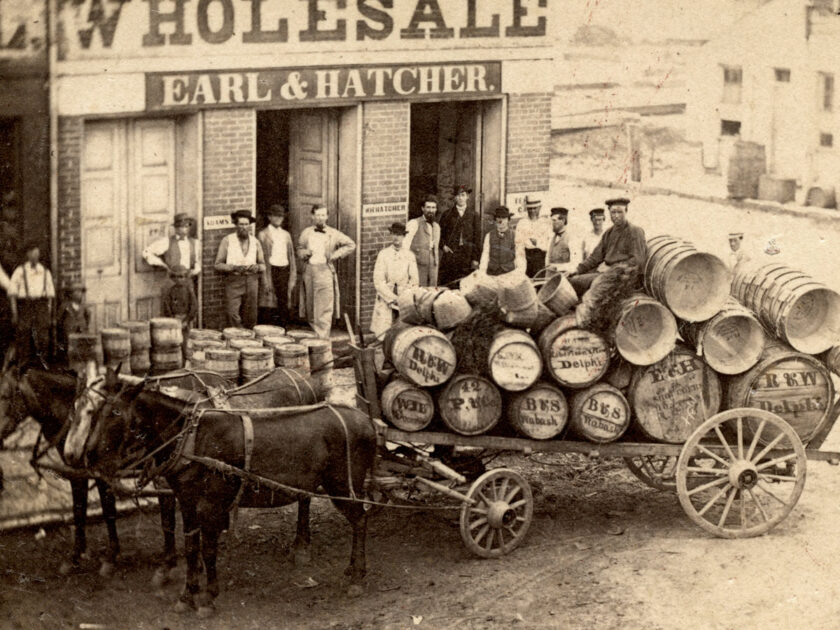
Largely overlooked are the workers and businesses who fulfilled government contracts to provide troops with food and supplies. This image documents their existence and labors. The wagon parked in front of wholesale grocers Earl & Hatcher of Lafayette, Ind., loaded with barrels from Delphi, Wabash, and elsewhere in the state, may have been destined for the boys in blue on the Western front.

The men grouped between the storefront and wagon likely included the proprietors, Adams Earl (1819-1898) and William Henry Hatcher (1828-1869). Earl, a tall man and big thinker who started out as a farmer, launched a flatboat and water transportation business in 1840, floating goods along the Wabash and Mississippi rivers to New Orleans. Earl jumped into the grocery trade in 1853, and partnered with various entrepreneurs to grow the business.
In 1860, Earl bought them out and formed a new partnership with Hatcher at the corner of Columbia and Second streets in the heart of Lafayette, conveniently located near the Wabash.
During the first year of the Civil War, Earl & Hatcher contracted with the War Department for pork (salted and bacon), flour, beans, rice, hominy, coffee, sugar, vinegar, soap, candies, salt, potatoes, and molasses—all the ingredients for a successful mess. Earl increased his holdings as the war progressed, partnering with cattlemen, Chicago meatpackers, boot and shoe makers, and wholesale dry goods merchants.
The story of Earl & Hatcher is representative of the business boom that fueled the expanding Northern wartime economy. It is also a tribute to the Midwestern states that kept the Union armies moving on camp and campaign in the South. The business also supported local efforts, including the funding of a flag for the Purdue Rifles, a militia company formed in 1863 as a home guard.

This carte de visite, picturing the store in early 1864, was taken by Daniel Russell Clark, who had just opened a new gallery in the city. By the war’s end in 1865, Earl & Hatcher had far outgrown the location and built a handsome new facility—an Italianate edifice faced with stone that survives today—recognized as Earl & Hatcher Block.
Though the Earl & Hatcher name ended with the untimely passing of Hatcher in 1869, Earl continued to flourish in the postwar economy. Everything he touched seemed to turn to gold. Upon his death in 1898, he left behind a large family, the palatial estate “Earlhurst,” and a legacy as one of Lafayette’s greatest businessmen.
SPREAD THE WORD: We encourage you to share this story on social media and elsewhere to educate and raise awareness. If you wish to use any image on this page for another purpose, please request permission.
LEARN MORE about Military Images, America’s only magazine dedicated to showcasing, interpreting and preserving Civil War portrait photography.
VISIT OUR STORE to subscribe, renew a subscription, and more.

1 thought on “Feeding the Western Troops”
Comments are closed.