
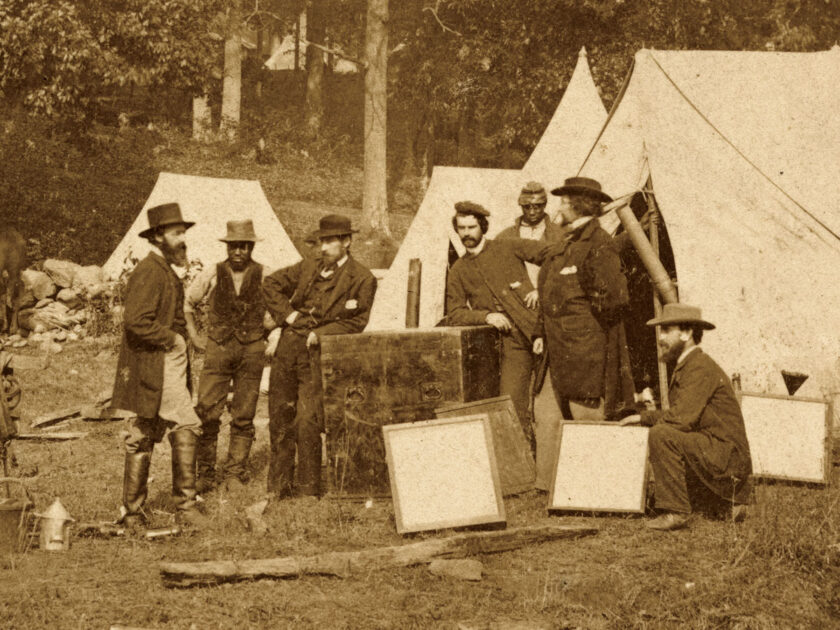
Every collector follows a different path. Some pursue Civil War soldiers, others seek the work of pioneering photographers, anonymous faces, or other unexpected treasures. Beneath these varied interests lies a common bond: a passion for early photography and the stories behind the images. In the essays that follow, four accomplished collectors reflect on the discoveries, surprises, and enduring fascination that have shaped their journeys—and remind us why this shared pursuit continues to inspire.
Photographs as Historical Documents
By Larry West
Looking back over the past 50 years, I realize I never set out to build collections. I set out to tell stories.
Along the way, I found extraordinary teachers. Friends in The Daguerreian Society and Lincoln groups I belong to opened windows onto America’s past. Collectors and scholars such as Grant Romer, Greg French, Ross Kelbaugh, Bob Drapkin, and many others challenged the way I looked at photographs—not simply as portraits, but as historical documents capable of preserving forgotten lives.
Whenever I came to a fork in the road, I took it.
One path led me into African-American history. Beginning in the mid-1970s, I became fascinated by the work of early Black photographers whose accomplishments had been largely overlooked. Long before there was widespread interest in the field, I quietly searched for surviving daguerreotypes and ambrotypes produced by three remarkable pioneers: James Presley Ball, Glenalvin Goodridge, and Augustus Washington.
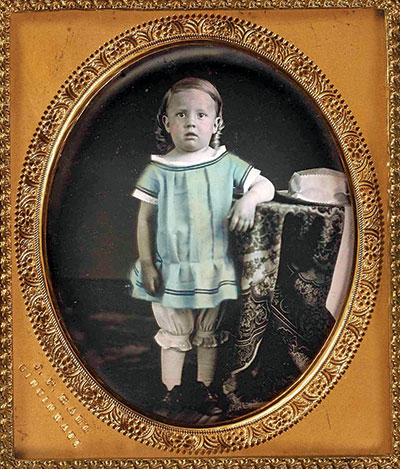
The search lasted decades. It resulted in the largest collection of cased images by these photographers ever assembled, later acquired by a museum along with hundreds of related photographs and photo-objects that will help tell this important chapter of American history.
That work also introduced me to another remarkable figure, Robert S. Duncanson. Before achieving international recognition as one of America’s finest landscape painters, Duncanson tinted daguerreotypes in Ball’s Cincinnati gallery. His unmistakable eye for color reminds us that early photography and painting were never separate worlds. They influenced one another in fascinating ways, and following those connections became another rewarding road in my collecting life.
Like many collectors of 19th-century photography, I was drawn early to Mathew Brady—not only for the photographs that bear his name, but for his ambition. Brady understood that photography could preserve history as it unfolded. He assembled talented teams, embraced new technologies, and pursued grand ideas, often at great personal financial cost. His vision transformed the way Americans remember the Civil War.
Over the years, I assembled a collection of Brady portraits, images of members of his photographic team, and photographs of many of his contemporaries. In 2007, I donated that collection to the Smithsonian’s National Portrait Gallery. More recently, I helped create the Mathew Brady Memorial at Washington’s Congressional Cemetery, beside Brady’s gravesite. The memorial celebrates not only Brady, but the photographers and subjects whose images continue to shape our understanding of 19th-century America.

Brady’s work reinforced something I had already begun to discover: photographs are never just pictures. They are doorways into larger stories.
One of those stories arrived in the most unexpected way.
Around 2012, I purchased a 19th century sewing box that incorporated photographs into its design. Hidden inside was a handwritten note identifying its maker as William Henry Baker. As I followed that single clue through diaries, military records, and the battlefield where Baker lost his life with the 13th Massachusetts Infantry, the box became something far greater than a collectible. It became a reminder that every photograph—and every object associated with one—has the potential to recover a life that history nearly forgot.
That is why I collect.
Whether the subject is early African-American photographers, Mathew Brady and his circle, or a young Union soldier whose story survived inside a handmade sewing box, the goal has never changed. The photographs draw us in. The stories keep us there.
Little Pictures, Big Stories
By Ross J. Kelbaugh
Fresh from my college graduation in the summer of 1971, I had the epiphany that there was an opportunity to build a world-class collection of 19th-century photographs that few other collectors and institutions then recognized. I had already acquired some examples of soldiers as part of my fledgling Civil War collection in a field that was already highly competitive due to the Civil War Centennial, but images that were not military related were largely ignored. When I asked dealers on the antiquing trail if I could look at closed miniature cases, they often immediately replied that “there are no soldiers!” So began my adventure to build a collection that documented 19th-century American life from the cradle to the grave.
I always had hopes of a book documenting my collection and maybe the possibility of a museum exhibit. I even approached a local museum then with that idea and got thoroughly humiliated by a curator for even suggesting such a thing since “these images were never meant for public display.” (This same museum has recently borrowed my images for an exhibit.) As a school teacher, I knew that the only way I could compete with the nascent but growing number of collectors, some of whom had deeper pockets, was through search and research as a “Road Scholar” in the pre-internet, cell phone era. So off I went on my great American treasure hunt for my sublime obsessions.
I sought images whose aesthetic quality touched my soul. I also focused on little pictures with big stories that I could research. This crayon tinted albumen photograph of Cpl. William Demby, a Black Civil War soldier now in my collection at the National Gallery of Art, sent me on a research quest that continues today.

I acquired this photograph along with the soldier’s promotion document in the early 2000s from Arthur G. “Gil” Barret, the noted collector of photographs of Union soldiers from Maryland. Through a visit to the National Archives to examine his service and pension files, I found that Demby was born free on Maryland’s Eastern Shore to an enslaved father and free mother, which determined his legal status. He joined the 4th U.S. Colored Troops when they were formed in Baltimore in the summer of 1863. In the Battle of Sugar Loaf, N.C., in March 1865, he suffered a severe wound to his left leg, which was amputated. He died on a hospital ship while it returned to Baltimore. His mother applied for his service pension after the war since he was her sole means of support because his father had died years earlier. A lawyer took up her case, but it was initially dropped. Years later, another lawyer reopened the case, and, this time, she was granted his pension retroactive to her son’s death in 1865. But where was he buried? I assumed it was back on the Eastern Shore, but I had no evidence.
During the pandemic I was researching Demby one day online. Eureka! A document came up that was the order for his tombstone in a national cemetery just a few minutes from where I live. So, off my wife and I went to find his grave without success. Driving away we passed by another part of the cemetery where we saw what looked to be an administration building. We stopped and I showed the document to a gentleman that came to the door, who said he would look him up. Finally, the man reappeared and he told me he had trouble finding Demby because he was buried under the wrong name! Instead of “Demby,” the name on his tombstone was Demly. The adventure continues today as I try to get this error corrected for a man who willingly gave “his last full measure” for our country.

One of my favorite images offers no clues for further research. I saw an ad in the local newspaper for an estate auction that included some military items so off I went to the preview. While looking around, I spotted an uncased ambrotype with its mat and preserver lying on a table. I picked it up and laid it against the dark sleeve of my jacket. The image immediately came to life! The dark backing revealed a tinted portrait of a young boy wearing a zouave uniform and accouterments and holding an American flag. Here was a fabulous image that could only be revealed by someone who knew how to unlock its secrets.
The auction was on a Thursday which meant I had to take off from school to attend. So, I arranged for a substitute and off I went playing hooky. The image came up that afternoon and I was the successful bidder as no one else recognized this treasure. Once I got it cased, the image came alive and remains one of my sublime obsessions.
These are just a couple of the adventures I have had in my journey of acquiring thousands of photographs over the last 50 years leading up to our nation’s 250th anniversary.
Finding Valuable Images in Humble Settings
By Dr. Robert Drapkin
I started collecting photographs while living in New York City in the 1970s. I was a Fellow at Memorial Sloan Kettering, and my pay would barely cover my food and rent.
Collecting photographs then was different than it is today. Many antique collectors were unsure that 19th and early 20th-century photography was a good investment. One of my good friends from Boston was a photo dealer, and he would visit New York City monthly to buy, sell, and trade images.
He would also invite all the area dealers to my apartment on the Upper East Side to buy, sell and trade. Initially, I felt that collecting anything was a waste of my time. But in time I noticed the rapid increase in the value of these photographs. Eventually I joined the group of dealers and learned about 19th-century photography.
My friend noticed that my apartment walls had empty spaces. He suggested visiting Swann Galleries and attending a photo auction to find art to cover them. My first purchase came from Swann—a group of large-format Edward S. Curtis photogravures. Framing them cost more than purchasing the photos.

Back then, it was possible to find important photographs in secondhand shops, antique galleries, and big auction houses.
I became fascinated by the concept of finding valuable images in humble settings. I purchased any image that appealed to me, and I would then learn about the photographer and his role in photography.
This is exactly how I found these tinted salt prints of Rear Adm. David G. Farragut and his wife, Susan Caroline Marchant. I found them in a secondhand shop on the Upper West Side of New York City and paid $5.00 for the pair.
Far Afield
By Greg French
Rat-a-tat-tat, rat-a-tat-tat, pum pum pum,
Rat-a-tat-tat, rat-a-tat-tat, pum pum pum.
“Each drummer was required to play variations of the 26 rudiments. The rudiment that meant attack was a long roll. The rudiment for assembly was a series of flams while the rudiments for drummers call were a mixture of flams and rolls,” notes Michael Aubrecht in his “A History of Civil War Drummer Boys” for the Emerging Civil War blog. He continues, “Additional requirements included the double stroke roll, paradiddles, flamadiddles, flam accents, flamacues, ruffs, single and double drags, ratamacues, and sextuplets.”
There were well over 40 different rhythmic patterns that were used for communication.
Drummer boys, so-called because of their relatively young age, were part of a formation called the Field Musicians. Their cadences spelled out the orders and activities of the day. They also served as aides, carrying stretchers and assisting with other medical tasks. Usually, during actual combat, these units were moved to the rear for safety reasons. Nevertheless, hundreds of drummers were casualties of the war.
Rat-a-tat-tat, rat-a-tat-tat, pum pum pum,
Rat-a-tat-tat, rat-a-tat-tat, pum pum pum.
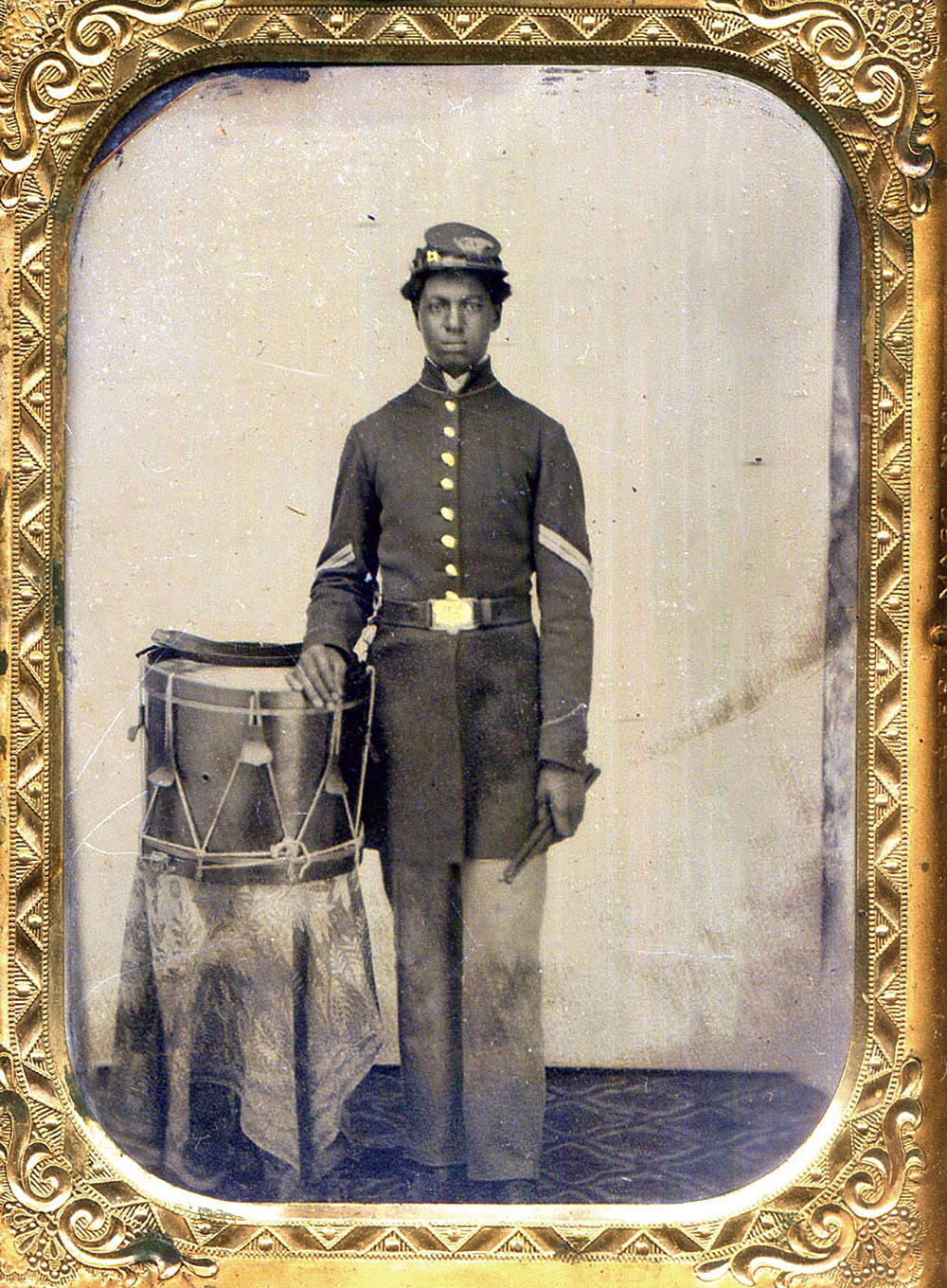
Then we look at this cased tintype of an African-American drummer with a rope tension drum. What was his name? Where was he from? Did he survive the war? Did he return home after the war? Perhaps facial recognition applications will answer some of those questions, but that’s predicated on there being another photo of him, and one that’s identified.
Regardless, he’s still iconic in his anonymity.
Rat-a-tat-tat, rat-a-tat-tat, pum pum pum,
Rat-a-tat-tat, rat-a-tat-tat, pum pum pum.
We have visceral responses to images. This tintype of a drummer reminds me of my late brother, John Shepard, who was a printer, and a rock-n-roll drummer. They don’t even look alike but they both carry sticks and a similar demeanor.
Some of us are collectors of cartes de visite, some of us collect swords, and some collect diaries. Some of us don’t collect any objects. However, we’re all collectors of stories and knowledge.
This second image is a collector’s story.

In the 1980s and early 1990s I bought antique photographs from C.E. Guarino’s catalog out of Denmark, Maine. One of them was this daguerreotype identified as “Sarah Gammon Negress Slave.” According to the original description in the catalog, Sarah was born into slavery, separated from her parents when they were sold, and later traveled west with a Judge Murphy. She arrived in Virginia City, Montana Territory, around 1870, worked in a mining camp, and was twice married, first to a white man named Brown and later to the successful businessman Stephen Bickford. After Bickford’s death, she assumed control of his enterprises and is credited with establishing Virginia City’s first water system.
The description also stated the daguerreotype had been in one family for 83 years and mentioned a book, Pioneer Trails: The History of Madison County, Montana. I purchased the daguerreotype, based on a 1 ½-by-1 1/8 inches reproduction in the catalog.
I called the Montana dealer who consigned it, and the Montana family that owned it for 83 years, speaking to various members on a couple of occasions. I wanted to know more about it. I called their local library, and purchased Pioneer Trails (this was pre-internet).
The woman depicted was clearly not Sarah Gammon Bickford.
I lent the image to Matthew Isenburg for “An African American Portfolio,” published in The Daguerreian Annual 1994.
The following year, it was again reproduced in the Annual, this time in an article, “A Re-Identification of an African-American Portrait in the 1994 Annual” by Bruce T. Erickson. (A nod to Ken Nelson and Jackie Erickson.) He claimed it was Victoria Kamamalu.
And indeed, it is Victoria Kamamalu, a Hawaiian Princess, attributed to Hugo Stangenwald, a pioneer daguerreian working in Honolulu. How her likeness ended up in Montana is a mystery.
But, as we know, history takes us on some unexpected journeys.
SPREAD THE WORD: We encourage you to share this story on social media and elsewhere to educate and raise awareness. If you wish to use any image on this page for another purpose, please request permission.
LEARN MORE about Military Images, America’s only magazine dedicated to showcasing, interpreting and preserving Civil War portrait photography.
VISIT OUR STORE to subscribe, renew a subscription, and more.