
By Evan Phifer
Within popular memory of the Maryland Campaign, the Confederate operation against Harpers Ferry is often overlooked by the savage fighting at South Mountain and Antietam. Less remembered still is the attempted defense of Union forces along Bolivar Heights before the garrison’s capitulation, the largest federal surrender of the war.

Frederick Wilhelm Fout, an unfortunate member of that garrison, later received the nation’s highest honor for gallantry during the final morning of the siege. Born in 1839 in Meissen, Germany, he emigrated to the U.S. circa 1855-58 and settled in Palestine, Ind., where he worked as a carpenter.
When war broke out, Fout enlisted in the 7th Indiana Infantry, a three-month regiment. In its ranks he participated in early operations in western Virginia. After mustering out, Fout returned to Indiana and worked with his brother. During this brief respite from military life, he and several acquaintances concluded that artillery service might better suit them than the infantry.
In January 1862, Fout traveled to Indianapolis and joined an artillery organization. Two months later, it became the 15th Independent Battery, Indiana Light Artillery. The battery mustered into federal service in July and soon departed for Baltimore. Fout, serving as orderly sergeant, assisted with the battery’s administration and logistics.

Ordered to Harpers Ferry
Equipped with six three-inch rifled cannon and commanded by German-born Capt. John von Sehlen, the battery moved to Harpers Ferry in August. Fout later recalled the locale as “one of the glory spots of this round earth.” In addition to drill, he and his comrades found time to visit the infamous John Brown’s Fort, already a local attraction.
Soon after the battery’s arrival at Harpers Ferry, Gen. Robert E. Lee and his Army of Northern Virginia crossed the Potomac into Maryland and gathered in and around Frederick. Union forces in his rear at Martinsburg and Harpers Ferry limited further movements and threatened his line of supply, communication, and retreat if needed. Lee assigned Maj. Gen. Thomas J. “Stonewall” Jackson to eliminate the threat.
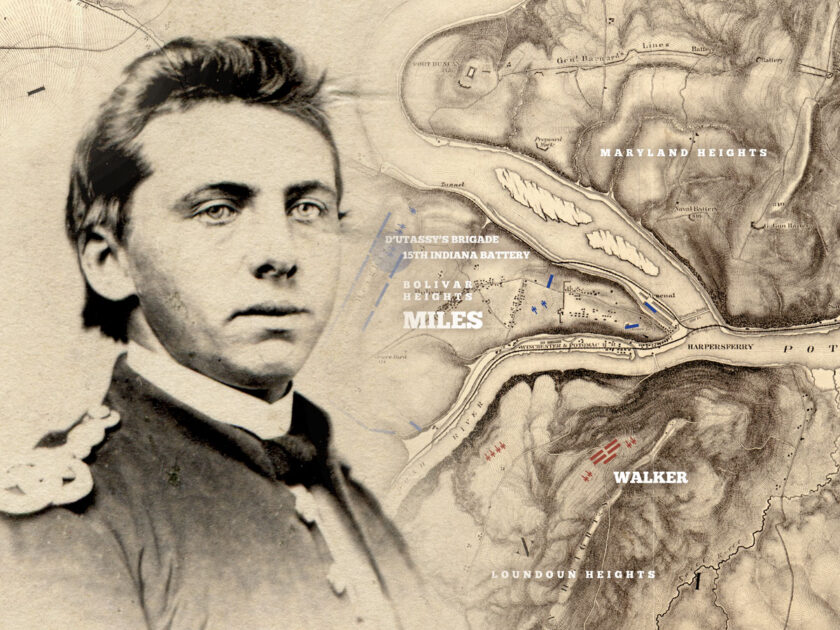
The geography of Harpers Ferry favored Jackson. The town lay surrounded by elevations on three sides: Maryland, Loudoun, and Bolivar Heights. The confluence of the Shenandoah and Potomac Rivers limited the ability of the Union positions to support one another.


Garrison commander Col. Dixon S. Miles deployed some troops and artillery on Maryland Heights and concentrated the bulk of his force on Bolivar Heights, including Fout and the 15th, part of the 1st Brigade, commanded by Col. Frederick George D’Utassy.
Confederates under Brig. Gen. John G. Walker occupied Loudoun Heights, while Maj. Gen. Lafayette McLaws forced Union troops to evacuate Maryland Heights on September 13. Jackson, with three divisions that had driven the Federals from Martinsburg, arrived west of Harpers Ferry. Surrounded on three sides by some 23,000 Confederates, the 14,000 men under Miles found themselves in a precarious position.
The next day, Jackson’s batteries opened fire from three directions. Fout’s battery, positioned near the center-right of the Union line on Bolivar Heights, engaged the well-placed Confederate guns with only a slight earthwork for protection. With ammunition already at a premium, the 15th lost about 100 rounds when an enemy shell struck one of its caissons. A correspondent for the Boston Evening Transcript observed that the Union gunners “served with rapidity and precision [and] answered defiantly the challenge of the rebel guns.”
During the afternoon engagement, Fout attempted to obtain more ammunition for the battery, but without success. While on this mission, he encountered a sergeant from another battery ramming a second round into a 20-pound Parrott gun. After firing the double charge toward Maryland Heights, the sergeant asked Fout, “What do you think of that, orderly? Didn’t I send them rebels a good one?” Though unable to see any damage inflicted on the Confederates, Fout noticed the recoil had shattered the gun’s trail.
As the day faded, Fout hitched his horse outside a nearby home while he grabbed a quick meal. When he emerged, the horse was gone. Unable to locate the animal, he returned to camp and procured another mount.
At about this time, Capt. von Sehlen suggested to headquarters that artillery be placed farther north on Bolivar Heights to better protect the right flank along the Potomac. Receiving permission, he shifted four of his six guns into the new spot, leaving the remaining two-gun section in place. During the night, Fout assisted von Sehlen in positioning the gun caissons.
Shot and Shell at Bolivar Heights
Overnight, infantry and artillery under Maj. Gen. A.P. Hill maneuvered around the left, or southern, flank of the Bolivar Heights line. Jackson placed additional artillery across the Shenandoah River, further enfilading the heights.
Jackson’s guns roared into action in the morning. Fout, on his new horse, faced heavy fire as he rode from the 15th’s four-gun position to the detached two-gun section. He recalled, “I rode off through shot and shell that now swept the open plateau on the East of Bolivar Heights. Every gun of the enemy appeared in action, and every part of our position was unsafe.”
“Mein Gott in Himmel! Run boys! Come, get away from here!”
Fout survived the barrage and discovered the guns abandoned, the men sheltering in a ravine. When he asked why they had deserted their post, they explained that the lieutenant commanding the section had cried, “Mein Gott in Himmel! Run boys! Come, get away from here!”
During a lull in the firing, Fout rallied several gunners back to one of the pieces and opened fire on the Confederates with the little ammunition remaining.

Confederate artillery fire soon intensified. Colonel William Trimble, commanding the garrison’s Second Brigade, later observed, “there was not a place where you could lay the palm of your hand and say it was safe.”
At last, Miles called his subordinate officers into council and decided to open surrender negotiations. As Miles approached Fout’s freshly loaded gun with orders to cease firing, one of the cannoneers protested, “General, don’t let us surrender to these rebels. Let us fight them.” When Miles replied that further resistance would be useless, the gunner defiantly yanked the lanyard, firing what may have been the last Union shot of the siege.
Only minutes after the ceasefire, a Confederate shell mortally wounded Miles.
Fout and the men of the 15th remained defiant, refusing to raise their own white flag until a cook from the nearby 111th New York Infantry finally did so.
Aftermath
In his memoirs, Fout recalled Jackson and his Confederates entering the surrendered Federal lines. One of the Southerners rode Fout’s missing horse, its baggage still intact.
Only three members of the 15th suffered wounds during the siege—two injured in a caisson explosion and another struck by a shell fragment.
Despite the surrender, Fout emerged with his reputation enhanced. According to 2nd Lt. Henry M. Binney, an aide to Miles, the colonel recommended Fout for promotion. Brig. Gen. Julius White, who formally surrendered the garrison after Miles’s mortal wounding, commended the artillerymen, writing they “acquitted themselves in the most honorable manner.”
Despite the surrender, Fout emerged with his reputation enhanced.
In his memoirs, Fout repaid Miles for this deathbed commendation, writing, “Although high officials, in order to shield themselves, have denounced his surrender as disgraceful, yet those with him who knew the facts will remember Colonel Miles as a patriot and a hero, who gave his life for his country and the cause he defended, and can testify that not a traitorous hair grew on his beard. The responsibility for his surrender lies entirely upon the shoulders of others.”
Fout and most of the surrendered garrison reported on parole to Camp Douglas in Chicago and were exchanged several months later. Returning to duty, he served throughout the Western Theater during Morgan’s Raid, in East Tennessee, and through the Atlanta, Nashville, and Carolinas campaigns. During the Battle of Nashville, a splinter from an exploding shell struck his left temple and permanently impaired his hearing. He ended his service as a first lieutenant.
Afterward, Fout worked for the Missouri Glass Company before entering the pension claims and residential development business in St. Louis. In 1902, he published his Civil War memoirs covering the campaigns of 1864-65 in German for the city’s large immigrant community. Two years later, he issued an English-language volume of his earlier service titled The Dark Days of the Civil War, 1861-1865.
Fout received the Medal of Honor for his conduct at Harpers Ferry on November 2, 1896.
In 1905, Fout passed away in St. Louis. His life was not without controversy: In 1899, the U.S. Interior Department disbarred Fout for “improper and unprofessional conduct” in his business, including accusations of withholding pension money and issuing worthless notes in return. Nonetheless, Fout’s obituary in the St. Louis Globe-Democrat remembered him for his gallantry at Harpers Ferry and as “one of the best known among the old-time lawyers.”
Evan Phifer has worked at numerous cultural institutions including the Foundation for the National Archives, White House Historical Association, and the American Revolution Institute of the Society of the Cincinnati. He holds a BA in History from Bucknell University and is a graduate of American University’s Public History program.
SPREAD THE WORD: We encourage you to share this story on social media and elsewhere to educate and raise awareness. If you wish to use any image on this page for another purpose, please request permission.
LEARN MORE about Military Images, America’s only magazine dedicated to showcasing, interpreting and preserving Civil War portrait photography.
VISIT OUR STORE to subscribe, renew a subscription, and more.