
By Michael F. Fitzpatrick
In the autumn of 1907, a man in crisp military uniform climbed into a horse-drawn cab and, with a curt command that comes easily to one who has spent the better part of a half century at sea, ordered the cabbie to “shove off.” The man was Rear Adm. Robley Dunglison Evans, who enjoyed a reputation for being “ready at the drop of a hat for a feast, a frolic or a fight.”

Known affectionately as “Fighting Bob” and “Old Gimpy,” Evans commanded President Theodore Roosevelt’s Great White Fleet as it prepared to set out on an around the world cruise. A contemporary praised Evans as “the most popular officer of the United States navy, and the best-equipped man for the position.” But before rising to flag rank, or getting saddled with the nickname “Fighting Bob,” a young Robley Evans had to overcome major obstacles just to get accepted into the Navy and then stay there—and, neither Indian arrows nor Rebel bullets were going to keep this obscure son of a Virginia slave owner from his dream of a U.S. Navy career.
To Annapolis—by Way of Utah Territory
Evans was born in 1846 in the Blue Ridge Mountains of southern Virginia’s Floyd County, where “the nearest neighbors in that region could not hear each other’s dogs bark.” His father, Samuel, a country physician who served the poor hard-working community, supported his family with his small farm and ten slaves.
Doctor Evans died when Robley was 10. His widow, Sarah, and her three children moved to Fairfax City in Northern Virginia. Times were tough. Keeping her older daughter and youngest son with her, she sent Robley, her middle child, across the Potomac River in 1857 to live with an uncle, a lawyer in Washington. D.C.

Ships from all corners of the globe sailed up the Potomac’s fresh waters from the salty seas beyond. “I had never seen salt water; and I don’t think I knew a single naval officer,” Evans later wrote, “but somehow it came to me that I should like a sea life, and from this time on the idea was never out of my mind.”
In the spring of 1859, fate intervened in the form of one of his uncle’s acquaintances, William H. Hooper, a Mormon and Congressional delegate from Utah Territory who had the power to make United States Naval Academy appointments. As none of his constituents had an interest, Hooper offered Evans the appointment. To be eligible, Evans, now 12, had to establish residency in Utah.
Though the Naval Academy at Annapolis lies less than 30 miles from the national capital, Evans would have to travel more than four thousand miles round trip via Salt Lake City to get there. If Evans ever noted the irony, he never mentioned it.

Four days after accepting the offer Evans set out for the first leg of the journey by rail to St. Joseph, Mo. Saying goodbye to his mother and uncle, he boarded a train carrying “all my worldly goods in a large, old fashioned grip sack,” while “on my person in a money belt I carried two hundred and fifty dollars in gold.” A few miles up the line the enormity of the adventure confronted him. “The job that I had cut out for myself came to me then with full force,” he declared, “and I felt that the chance of my ever coming back was very small. But youth and health are great things, and I was soon comfortably asleep on one of the seats, happily oblivious to my surroundings.”
In St. Joseph, contacts connected him with a five-man party heading west on the California Trail. Evans procured a Mexican saddle mule, “which, as it afterwards turned out, could smell an Indian farther, and under the influence of his scent, run faster than any animal in the outfit.”
Under the leadership of a guide named Bromely, they set out for the South Platte River in Nebraska. Just west of Fort Laramie in what is now Wyoming, their wagon bogged down while fording a stream. Early next morning, a raiding band of Pawnees descended on their camp, captured supplies, and burned the wagon. The men saved their weapons, ammunition and animals, but were harassed by the Pawnees for 10 to 12 hours before fending off the attacks and returning to Fort Laramie to refit.
This incident marked the first of many Native American encounters.
In one occurrence, a hunting party of supposedly peaceful Blackfeet attacked with bows and arrows. Combat ensued. Bromely the guide took an arrow through the skin over his stomach, giving the appearance he had been shot clear through from side to side—it turned out to be a flesh wound. Another arrow struck Evans in his left ankle, continued through the stirrup leather and embedded itself in the ribs of his mule—pinning him to the animal. “My mule had only three arrows in him,” Evans recalled, “but some of the animals resembled the ‘fretful porcupine,’ being struck pretty thickly all over.”
Once clear of the Blackfeet, Evans had a hard time dismounting, as “any approach toward him was enough to make him dance on his hind feet in true circus fashion.” A lasso around the mule’s forelegs enabled the arrow to be cut between Evans’ foot and the animal’s side. The injuries to boy and mule proved to be minor, although Evans “rode mostly with one foot for a week afterwards.”

Another occurrence ended with a far different outcome. At Robinson’s Ferry in Wyoming Territory, a party of Bannocks stole all their animals. Two days later, several hundred friendly Snakes and their Chief Washakie stopped at the ferry. Upon learning of the raid, they promptly took off after the Bannocks and returned with a drove of horses and mules, including those belonging to Evans’ party. Chief Washakie took a shine to Evans, whom he called “Little Breeches,” and after a failed drunken kidnapping, invited Evans to enjoy their hospitality for 10 days. At first Evans was disinclined to accept the invitation, but the ferry keeper advised him that Washakie had promised to bring him back in 10 days, but if he refused to go, Washakie would probably forcibly take him anyway and then there was no guarantee when, if ever, he would be returned. Besides, a chief who voluntarily returned stolen horses could be trusted to return a mere human being. With some trepidation, Evans set off for a stint with the friendly Snakes.
Evans stayed with the tribe of about a thousand people, living in the teepee with the chief. He hunted and fished, and learned to use the bow and arrow. Evans later admitted, “had it not been for my fear of treachery I should have enjoyed my ten days among them very much” though “Indian life had less charm for me the more I saw of it.” Chief Washakie returned Evans to his friends as promised.
The trek continued. Evans got his first glimpse of Salt Lake City and the vast inland lake that gave it its name—his first ever view of salt water, hundreds of miles from the nearest ocean.
Evans fulfilled his Utah residency requirement in the household of his benefactor, although Hooper remained in Washington. Because he was to represent Utah in the Navy, Evans felt obligated to call upon Brigham Young, leader of the Mormon Church and territorial governor. Evans found him to be “a rugged, hard-looking man, but withal kindly in his manner and good enough to wish me success in the profession I had selected.”

Evans returned to the East in the summer of 1860 by stage coach—a quicker and less hazardous journey than the prior year. The stage, light and fast, was less a target than heavily laden west-bound settlers. Weather proved the most serious safety threat. In northeastern Kansas, a windstorm lifted a frame house the travelers were resting in off its foundations. They “concluded to follow the example of some of the natives and go out on the open prairie, lie down flat on our faces, head to the wind, and hold on to the grass as best we could.”
In Missouri, Evans boarded a train bound for Washington, and arrived in late August, just after his 14th birthday.
Midshipman Evans
Evans passed the Naval Academy entrance exam in September 1860 and reported as an acting midshipman on board the frigate Constitution at Annapolis—the first to represent Utah within the halls of the United States Naval Academy.
Midshipman Evans acclimated to his studies, which included drills in practical seamanship and gunnery, the two most important subjects in the curriculum. Two brothers serving on the staff of the Academy influenced him: Christopher Raymond Perry Rodgers, commandant of midshipmen, and George Washington Rodgers II, commander of the Constitution. “To them I owe everything in my professional life,” Evans declared.

Evans’ tenure at the Academy might have been unremarkable had it not been for an event two months after his arrival. The election of Abraham Lincoln to the presidency in November 1860 sparked the secession crisis. The effect on the Academy was palpable. Even as a plebe, Evans was astute enough to observe, “During the winter of 1860-’61 the anxious faces of our officers foretold the storm of war that broke so suddenly in April of the latter year.”
As each Southern state left the Union, midshipmen from the departing state would submit their resignations.
In the wake of the firing on Fort Sumter in April 1861 the Academy relocated to Newport, R.I., for the war’s duration.
Meanwhile, more state secessions resulted in midshipmen resignations despite an impassioned exhortation by Commandant Rodgers to “stand by the old flag.”
After Virginia seceded, Evans informed his mother that he would remain loyal to the Union. Mother Sarah “was much grieved and shamed by my determination,” Evans recalled. She took matters into her own hands, writing his resignation and sending it to the Navy Department. The dismissal, dated June 14, 1861, stunned and shocked Evans. The dream that he had worked so hard to achieve had been shattered. No one had gone to such extraordinary lengths to secure an appointment to the Academy: he had traveled unchaperoned halfway across the continent as a 12-year-old; been attacked and wounded by hostile Indians and kidnapped by friendly ones; lived a year among strangers; and was nearly blown off the face of the Earth by a Kansas tornado. As his biographer later wrote, he “had burst the bonds of provincialism” and should not be expected to “restrict his patriotic devotion to one particular star on the flag.”
A tearful Evans appealed to his mentor, Lt. George Rodgers, who explained matters in a telegraph to his superior in Washington, and was restored to duty.
Evans later claimed that he was out of the service for about 24 “very unhappy” hours, but, in reality, his reinstatement did not come until July 1, just over two weeks after his dismissal. It seems likely that there had been a delay in notifying Evans of his dismissal. It’s also possible that Rodgers, confident of a positive outcome, had simply told Evans not to worry about it and return to his regular routine.
That regular routine culminated with his assignment to the fleet as an acting ensign in October 1863, almost a year earlier than usual due to wartime acceleration. “We…were rejoiced to find that the Navy Department had decided to send us into service immediately,” he recalled. “Our educations were not complete, but we knew enough to look out for a ship and stop bullets, which were the important things.”
“I Preferred to Die With My Legs On”
Evans reported on board the United States steamer Powhatan at Philadelphia, where, “I was at once given a watch and division of guns.”
By December 1864, the Powhatan had joined the Union fleet in the campaign against Fort Fisher, protecting Wilmington, N.C., the last Confederate seaport open to blockade runners. When an initial attack in December failed, a second attack was formulated for January 1865. After the navy’s warships pounded the fort with artillery fire, the plan called for the army to land some 8,000 soldiers for an attack against the landward side of the Confederate defensive works while the navy made a diversionary land attack on the seaward face.

The bombardment began on January 12. The troop landing involved several waves of surf boats—more than 200 total—crewed by sailors manning the oars. Evans commanded the commodore’s barge, “a very handsome, large, able boat, fit to carry thirty-five or forty men.” On the run to shore, enemy shells splashed and bullets spluttered along on the surface of the water.

The naval forces kept up the artillery fire for two days, forcing the defenders to keep their heads down. On January 15, a second force of about 1,600 sailors and 400 Marines landed a mile-and-a-half northeast of the fort. The Marines were to man rifle pits in the sand and provide cover fire for a Forlorn Hope composed of sailors that would storm the sea face of the fort.
The attack force was composed of volunteers, and it included Evans, who, a fellow officer once described as having “a natural instinct for a scrap, and, like Farragut in his early days, was about ten pounds uniform and the rest plain ‘fight’,” made sure his name was at the top of the list from his ship. The young ensign was given command of a landing party of 62 sailors, each armed with a cutlass and revolver. While forming up on the beach, Evans noted, “The rebels were firing at us slowly, but doing no damage to speak of. Curious little puffs of sand showed where the Enfield rifle balls were striking, but they only hit a man now and then by accident.”

At 3 p.m., the navy ground force advanced in three columns abreast and charged the fort. When about 500 yards away the head of the column collapsed. Officers rallied their men and started forward again. Unfamiliar with infantry tactics and the orders necessary for implementing them, Evans simply ordered his small force of sailors to “board the fort on the run in a seamanlike way.” A fellow officer later remarked that the order “was more easily said than done.”
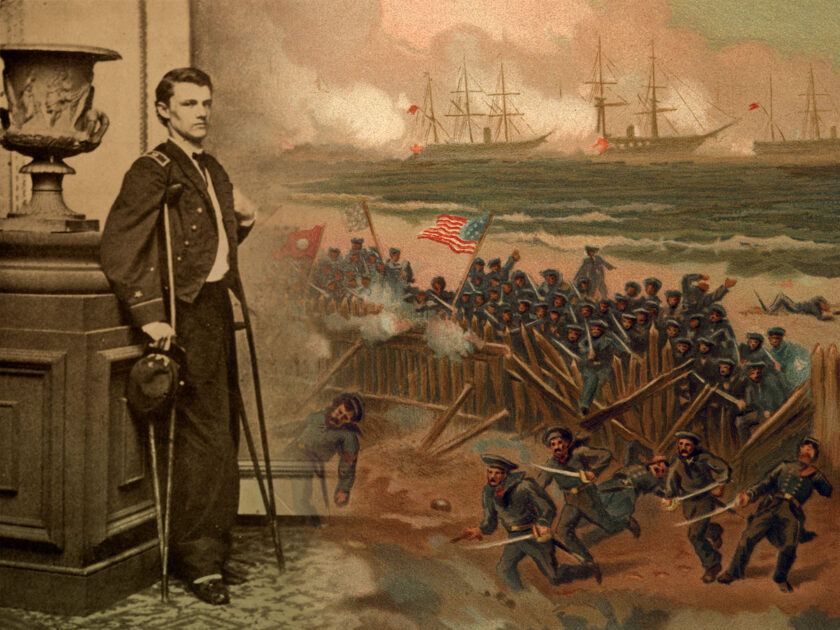
Evans did not hold back. He raced across the sand with raised sword, leading his sailors towards the rebel stronghold. Men fell with rapidity in a hail of enemy lead. One bullet struck Evans a glancing blow across his chest, ripping through his coat and spinning him completely around, but as he was still on his feet he continued on at the head of his company. About 100 yards out a .58 caliber Minnie ball hit him in the shin just two inches below the knee, knocking his left leg out from under him. Evans landed heavily on his face in the sand, yet miraculously the missile had passed between the tibia and fibula without shattering either bone. After bandaging the wound with a silk handkerchief, Evans hobbled forward once more, remembering, “My left leg seemed asleep, but I was able to use it.”

Evans continued on, urging his men through a break in the wooden stockade and up the fort’s sandy parapet. He and seven sailors advanced into the breach before all were shot down. Out of a naval landing force of nearly 2,000 sailors and Marines, Evans was the only naval officer to penetrate the stockade and reach the earthen wall. A bullet ripped into his right knee—his third wound of the day—and this time he could not rise again. The Navy’s desperate rush for the fort was over.
Evans’ biographer later wrote, “Its fifteen-minute toll was staggering. Every officer of the Powhatan in the volunteer corps was hit by a bullet. Of the sixty-two men in Evans’ company, fifty-four were killed or wounded. The repulse from the bastion had turned into a massacre.”
Yet the Navy’s Forlorn Hope had not been in vain. Their sacrifice succeeded in diverting the Confederate defenders and helped clear the way for the Union army’s assault on the fort’s rear.
Bleeding profusely, Evans lay at the foot of the earthen fort as Union forces retreated up the beach. A Confederate marksman appeared over the crest of the earthworks 35 yards away, taking pot shots at Evans as he fumbled with tying a bandage on his knee. “At the fifth shot, I think it was, he hit me again,” Evans recalled, “taking off the end of one of my toes, tearing off the sole of my shoe, and wrenching my ankle dreadfully.” This, his fourth wound of the day, infuriated him more than the others. Evans rolled over to face his antagonist and aimed his pistol just as someone handed the Confederate a freshly loaded musket. Evans’ fatal shot struck the rebel in the neck, and he fell over and rolled down the embankment, coming to rest near Evans.
Soon a brave Marine raced in, and before any rebel sharpshooters could hit him, had scooped Evans up under one arm and carried him to the safety of a shell crater on the beach where he lapsed into unconsciousness.
Evans awoke to a rising tide flooding his refuge. Facing the possibility of drowning, he drew his revolver and persuaded a less heroic Marine to risk enemy fire and drag him to higher, though more exposed ground. At this point a sailor with a coal shovel showed up offering to drag Evans to safety. But a Confederate bullet through the sailor’s arms ended this effort. Finally, after dark, two men arrived with orders to retrieve the wounded officer. Taking turns, one would carry Evans on his back while the other helped steady him. When one tired, the other would take over, and in this way they carried him a mile and a half down the beach to a field aid station. There, he said, he was laid by a fire, “which was very grateful in the chill of the January evening. My clothing was saturated with blood and salt water, and thoroughly filled with sand. My wounds were in the same condition.”
After an examination, medical personnel evacuated Evans to the Norfolk Naval Hospital. There, he overheard two physicians discussing his wounds. The chief surgeon told the other that in the morning he would have to amputate both legs. After thinking “very seriously of the matter,” Evans told the surgeon “that I preferred to die with my legs on; that I was only eighteen years old, and the thought of living my life without my legs was more than I cared to face; that as the legs belonged to me, I thought I had a right to say what was to become of them; and that I asked the doctors to do what they could for me with my legs on, and if I died it was no matter.”

The surgeon insisted that orders had to be obeyed and that his legs must come off. But the spirited young officer was not about to give in so easily. “I pulled the gun from under my pillow,” Evans recalled later. “I told him that there were six loads in it, and that if he or anyone else entered my door with anything that looked like a case of instruments I meant to begin shooting, and that he might rest perfectly sure that I would kill six before they cut my legs off.”
The legs remained intact.
In his after-action report, Comm. James Parker, senior naval officer on shore during the attack on Fort Fisher, mentioned Evans: “From all I can learn, his bravery and determination to enter the fort were equaled by few and excelled by none.” Indeed, had it not been for the kind attentions of the surgeon’s wife and daughter who kept him fed and changed his bandages, his fate no doubt would have been as fatal as the surgeon had predicted.
Recovery, Return, and Honors
Evans’ recovery was long and painful. The war ended before he was back on his feet. It took months of stretching the tendon before he could get the heel of his left foot to touch the ground. His right knee, bent and fused, left him dependent on crutches—and unfit for sea duty. However, he would not be deterred from his life’s ambition. “The idea came to me that my right knee could be broken again, and my leg set at such an angle that I could walk on it,” he reasoned. The operation straightened his leg and enabled him to walk without crutches, but his knee was forever locked, resulting in a permanent limp.
Much to his dismay, the Navy’s Medical Board placed him on the retired list. For the second time, Evans found himself involuntarily dismissed from the Navy through no fault of his own.
“There was nothing for it but to go to Congress for relief,” he stated. “Being the only officer in the navy retired for wounds received in battle, I was put back on the active list, and shortly afterward advanced some thirty numbers, in company with three other classmates.” Thus, he received his lieutenant’s bars in the summer of 1866, shortly before his 20th birthday.
With the Navy aggressively downsizing after the war, Evans’ meteoric rise and promotion irked some of his contemporaries. However, he would have to prove himself capable of duty. Evans was determined not to fail, “as above all other things he dreaded the report of a superior that his injuries hampered him in the performance of his watch and division functions,” his biographer noted. “For many years, he continued to feel obliged stoically to seek the most exacting tasks and the most fatiguing details to prove to his shipmates and to himself that he was earning his seat in the wardroom. Never did he ask or accept the slightest consideration because of his ailments. His one determination was to ignore them and thus compel every one else to do the same.”
The class that entered in the Fall of 1860 was a notable one. Its members became veterans before they became adults.
In spite of all the obstacles, Evans had at last succeeded in securing his dream of a navy career. In March 1868, the navy rewarded him with promotion. “Twenty-one and a half years old,” his biographer later wrote, “the age at which a midshipman nowadays graduates from the Academy if he is among the younger members of the class, and Robley D. Evans was a lieutenant commander whose service record was already noteworthy and experience varied.”


Evans went on to spend 40 more event-filled years on active duty. More adventures awaited him, but that, after all, is reserved for another story. When he retired as a rear admiral in 1908, the public was reminded that, “Men like Robley D. Evans do not cease their usefulness when they go over the ship’s side for the last time and their flag is lowered.”
Robley’s death in 1912 was widely mourned. Perhaps the most fitting tribute to him was penned by biographer Edwin Falk. “The class that entered in the Fall of 1860 was a notable one. Its members became veterans before they became adults.”
References: Barnes, James, “Robley D. Evans — Rear Admiral,” Outlook (Vol. 87, No. 12, Nov. 23, 1907); Evans, A Sailor’s Log: Recollections of Forty Years of Naval Life; Falk, Fighting Bob Evans; Robley Evans pension file, National Archives; United States Naval Academy Museum.
Mike Fitzpatrick has been an avid photo collector for more than 30 years. He has authored several magazine articles and written a Civil War novel, The Letters from Fiddler’s Green. He is currently writing a history of Annapolis, Md., during the Civil War. He is a MI Contributing Editor.
SPREAD THE WORD: We encourage you to share this story on social media and elsewhere to educate and raise awareness. If you wish to use any image on this page for another purpose, please request permission.
LEARN MORE about Military Images, America’s only magazine dedicated to showcasing, interpreting and preserving Civil War portrait photography.
VISIT OUR STORE to subscribe, renew a subscription, and more.
