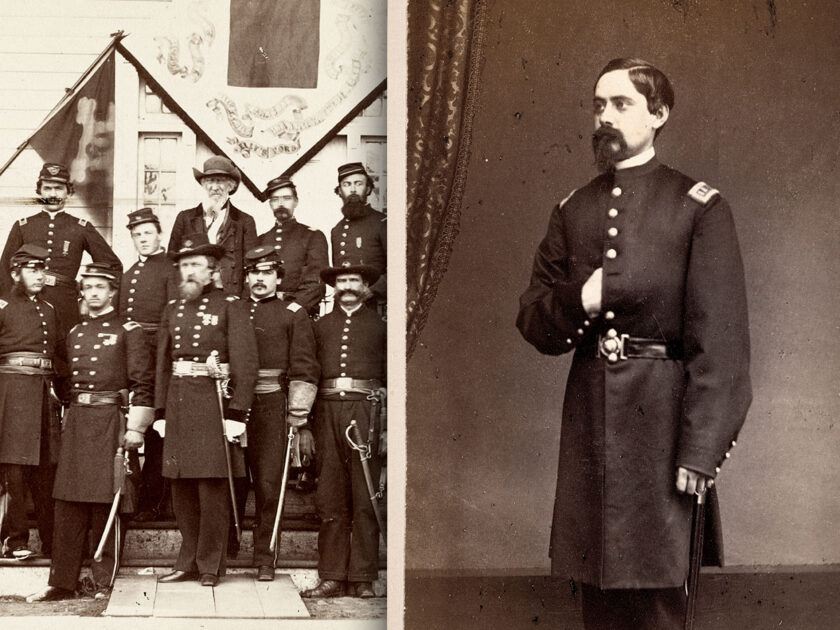
By Evan Phifer
When the Civil War broke out, John Barclay Fassett volunteered as a private in the First Troop Philadelphia City Cavalry for three months in 1861. Soon afterwards, he joined the 23rd Pennsylvania Infantry as second lieutenant of Company H and went on to become first lieutenant of Company C.

Fassett later served as a staff officer to Maj. Gen. David B. Birney of the Third Corps, the regiment’s original lieutenant colonel. This position ultimately led to his role at Gettysburg in which he earned the nation’s highest military honor.
During the chaotic evening of July 2, Fassett had just assisted in reforming Brig. Gen. Andrew A. Humphrey’s battered division as part of the defense of Cemetery Ridge. As Fassett left to report back to Birney, he encountered 2nd Lt. Samuel Peeples of Battery I, 5th U.S. Artillery (Watson’s Battery). The 21st Mississippi Infantry had captured three of the battery’s guns east of the Trostle Farm, and Peeples sought reinforcements to recover them.
Fassett went in search of help and found Maj. Hugo Hildebrandt of the 39th New York Infantry, popularly known as the “Garibaldi Guard.” The regiment had been captured last fall as part of the surrender of Harpers Ferry. After this humiliating experience at the hands of the late Stonewall Jackson, the New Yorkers, only four companies strong, were hell-bent on revenge.
The 39th belonged to Maj. Gen. Winfield Scott Hancock’s Second Corps, technically outside of the organizational purview of a Third Corps staff officer. With no time to waste though, Fassett ordered the 39th to retake the guns. Hildebrandt responded, “By whose orders?” When Fassett responded, “By orders of General Birney,” Hildebrandt retorted that he was in Hancock’s corps. Disregarding this technicality, Fassett told the major, “Then I order you to take those guns by order of General Hancock.”
Fassett and Peeples, who armed himself with a spare rifle, joined with the 39th in their assault upon the captured Union artillery. During the attack, a Confederate soldier took the bridle of Fassett’s horse. Another aimed his rifle directly at Fassett. Luckily, he raised his saber in time to deflect the shot, which passed though the visor of his cap. At the same time, a soldier of the 39th ran his bayonet through the offending Confederate and Fassett shot the man taking hold of his horse’s bridle.
Though not as well-known as the famous charge of the First Minnesota, the bravery and determination of Fassett, the New Yorkers of the 39th, and Peeples provide another example of the desperate yet effective ad-hoc nature of quick-thinking officers who put circumstances at hand over strict obedience to the chain of command, ultimately securing Union control over Cemetery Ridge that evening.

Fassett came away unscathed and continued on Birney’s staff until September 1864, the same time Birney fell sick, eventually succumbing to disease on October 18. Fassett joined other friends and associates of the general who created a fund for his widow and children.
Fassett received the Medal of Honor on Dec. 29, 1894, for his actions at Gettysburg. He passed away in 1905 at age 68 in Pasadena, Calif. His remains rest in Woodlawn Cemetery in Bronx, N.Y.
Note: Fassett’s surname is also spelled Fassitt.
Evan Phifer has worked at numerous cultural institutions including the Foundation for the National Archives, White House Historical Association, and the American Revolution Institute of the Society of the Cincinnati. He holds a BA in History from Bucknell University and is a graduate of American University’s Public History program.
SPREAD THE WORD: We encourage you to share this story on social media and elsewhere to educate and raise awareness. If you wish to use any image on this page for another purpose, please request permission.
LEARN MORE about Military Images, America’s only magazine dedicated to showcasing, interpreting and preserving Civil War portrait photography.
VISIT OUR STORE to subscribe, renew a subscription, and more.

1 thought on ““By Whose Orders?””
Comments are closed.