Site Overlay

Experimental Accouterment: Colonel Mann’s Forgotten Innovation

By Frederick C. Gaede and Paul D. Johnson 

Soldier-inventor William d’Alton Mann, colonel of the 7th Michigan Cavalry. Glass plate negative by Mathew B. Brady of Washington, D.C. National Portrait Gallery.

During the Civil War, thousands of soldiers suffered from debilitating injuries not caused by enemy fire, but by their own equipment. The heavy cartridge boxes, typically worn on tight waist belts, caused hernias, varicose veins, and other medical conditions that led to countless discharges. In response to this serious problem, Col. William d’Alton Mann (1839-1920) of the 7th Michigan Volunteer Cavalry proposed an innovative solution: a new system of accouterments that shifted the burden from the waist to the shoulders. Mann’s designs promised greater comfort, improved performance, and increased ammunition capacity. Though initially well received, these experimental accouterments ultimately faded into obscurity, leaving behind intriguing questions and only a handful of surviving examples.

A Solution to a Dangerous Burden

Colonel Mann patented a system in 1863 that aimed to address these concerns. His accouterments distributed the weight of cartridge boxes, pistols, sabers, and knapsacks across the shoulders rather than concentrating it on the waist. Mann designed different boxes for various arms: one combined carbine and pistol cartridges for cavalry; another held large quantities of Spencer rifle ammunition; and his infantry model featured simplified flaps and fittings to reduce bulk. His design also allowed soldiers to carry significantly more ammunition without additional strain. Mann’s inventive spirit combined engineering skill with a salesman’s flair, as he promoted his accouterments through persuasive letters and secured endorsements from military leaders.

8th-plate tintype by an unidentified photographer.Paul D. Johnson Collection.
8th-plate tintype by an unidentified photographer. Paul D. Johnson Collection.

Mixed Results in the Field

Mann’s accouterments were distributed for testing to select infantry and cavalry units, including the 15th New Jersey and 4th Maine infantries, and Mann’s own 7th Michigan Cavalry. The 15th New Jersey reported highly favorable results. Colonel William Penrose praised the comfort, balance, and ease of movement provided by the equipment, noting that soldiers could march longer and breathe more freely. The design prevented chafing, relieved pressure on the stomach, and allowed for quick, efficient handling of weapons. Penrose even observed that soldiers eagerly scavenged Mann’s gear from fallen comrades on the battlefield.

However, not all feedback was positive. The 4th Maine Infantry, under Colonel Elijah Walker, found Mann’s accouterments cumbersome. Walker reported that the chest-mounted cartridge box caused discomfort, particularly during prone firing, a common practice in combat. His men preferred the traditional pattern and resisted the new design, finding the box awkward on long marches and inconvenient in battle. Walker did, however, commend the improved tin magazine inside the cartridge box, which better protected ammunition.

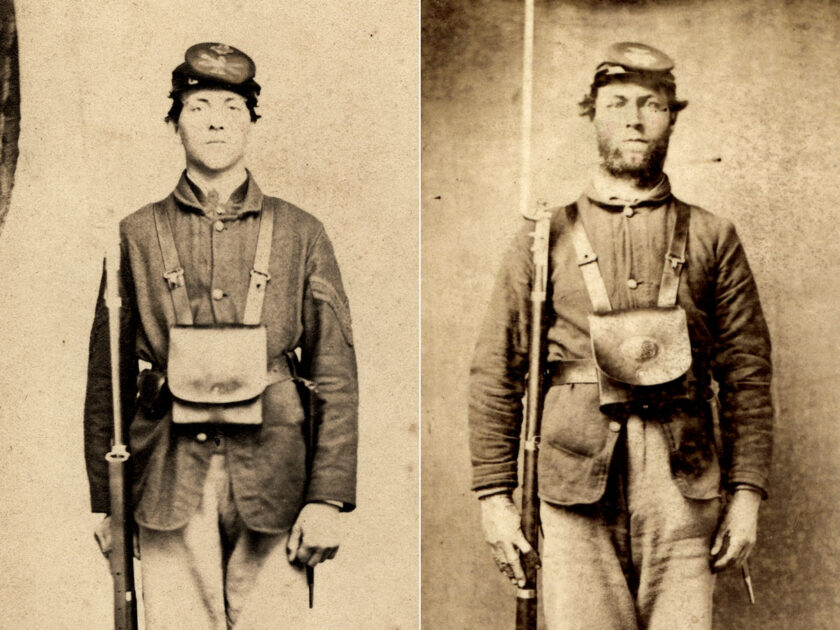
Left: Carte de visite by an unidentified photographer. Ronald S. Coddington Collection. Right: Carte de visite by Samuel Clarke of Reading, Pa. Paul D. Johnson Collection.

Cavalry units, such as the 7th Michigan, provided enthusiastic endorsements, highlighting the increased ammunition capacity and reduced fatigue. Still, it is unclear how some of Mann’s claims about ammunition volume fit with the physical dimensions of the known boxes today. Despite glowing endorsements from officers like Major H. W. Granger and praise from prominent generals including Ulysses S. Grant and George A. Custer, doubts about the practicality of Mann’s invention persisted.

An Idea That Faded from Use

Following the war, Mann’s accouterments continued to undergo evaluation, but enthusiasm waned. A critical report from the District of Kansas in 1866 summed up the main issues: the equipment was found to be uncomfortable, poorly balanced, and offered no real advantages over existing designs. The knapsack, intended to rest on the shoulders and balance the cartridge box, instead sagged, pulling the cartridge box uncomfortably against the stomach. Complaints from both officers and enlisted men sealed the fate of Mann’s ambitious design.

Mann’s infantry waist belt. Sixth plate tintype by an unidentified photographer. Paul D. Johnson Collection.

Although the U.S. government purchased tens of thousands of Mann’s sets—more than 37,000 infantry and 12,000 cavalry—the equipment was never adopted as standard issue. Mann’s invention was largely abandoned by the Regular Army, and by the 1870s, most of his cartridge boxes and related gear had disappeared. Today, surviving examples are rare. Collectors and historians puzzle over their scarcity, and images of Civil War soldiers wearing Mann’s equipment are limited.

Despite their ultimate failure, Mann’s patent accouterments represent an important chapter in the history of Civil War military innovation. His efforts to improve soldiers’ health and combat performance reflected the continual search for better ways to equip and protect those who bore the burdens of war. The mystery of where Mann’s thousands of boxes ended up continues to intrigue researchers, ensuring that his story endures as more than just a footnote in the annals of military history.

Frederick C. Gaede is an occasional contributor to MI. He has written articles for the journal Military Collector & Historian and other publications.

Paul D. Johnson is the author of the book Civil War Cartridge Boxes of the Union Infantryman and many articles on bayonets and accouterments. His most recent article is “Whitney Rifles for Georgia—Another Theory,” which may be downloaded from the American Society of Arms Collectors website.


SPREAD THE WORD: We encourage you to share this story on social media and elsewhere to educate and raise awareness. If you wish to use any image on this page for another purpose, please request permission.

LEARN MORE about Military Images, America’s only magazine dedicated to showcasing, interpreting and preserving Civil War portrait photography.

VISIT OUR STORE to subscribe, renew a subscription, and more.

Scroll Up