

By Ronald S. Coddington
Confederate forces had their backs against the gates of their capital city on Saturday, May 31, 1862. With the federal Army of the Potomac advancing, the defenders of Richmond understood what was at stake. Their general, Joe Johnston, planned to take the offensive and catch the bluecoats off guard. Heavy fighting lay on the near horizon.
An air of inevitability hung over the ranks of the 11th Virginia Infantry’s Company F. Its captain, Eusebius Fowlkes, reportedly gave his men the watchword of the day: “Victory or Death.”
Fowlkes had packed a lot of life into his 25 years. Born southwest of Richmond in Nottoway County, he moved with his family to Montgomery County, tucked between the Blue Ridge and Alleghany mountains, in search of a healthier climate for his ailing father. As a child, he displayed traits that matured with him—unassuming, disciplined, and dutiful. These qualities served him well at Christiansburg Academy, Virginia Military Institute, and the University of Virginia. Armed with a medical degree, he established a practice in his home county. After a while, he grew restless and headed west to see the world—and what it might offer a young doctor.


Word of the outbreak of war reached him in the wilds of western Arkansas, and he hurried home. A strong supporter of secession and state sovereignty, and the son of a father who owned about 37 enslaved people, Fowlkes understood that his family’s way of life hung in the balance. By the time he arrived, four or five military companies had already been organized in Montgomery County. Undeterred, he raised his own, the Preston Guards. The rank and file elected Fowlkes their captain, and the Guards became Company F of the 11th. The regiment soon joined the division commanded by Maj. Gen. James Longstreet.
An admiring biographer commented on Fowlkes’ unique position: “Many of his company being from the immediate neighborhood, and he being a physician, he combined the duties of captain, guardian, and physician to a much greater extent than was common.”
Fowlkes served in this capacity at First Manassas, Dranesville, and the Peninsula Campaign’s Battle of Williamsburg, where the regiment suffered 134 casualties, including its colonel, Samuel Garland, Jr. He recovered, returned as a brigadier and brigade commander, and lost his life months later at South Mountain.
On the front lines near Richmond on May 31, Fowlkes passed the watchword to his men. He also shared with them “a premonition that he would fall, amounting to a certainty, but his proud heroic spirit scorned to shun death when his country’s liberties were at stake,” noted his biographer, who added, “of the thousands of choice spirits of the South who so nobly offered their lives upon the altar of their country, there were none brighter, purer, or more truly ingenuous than was that of Captain Fowlkes.”
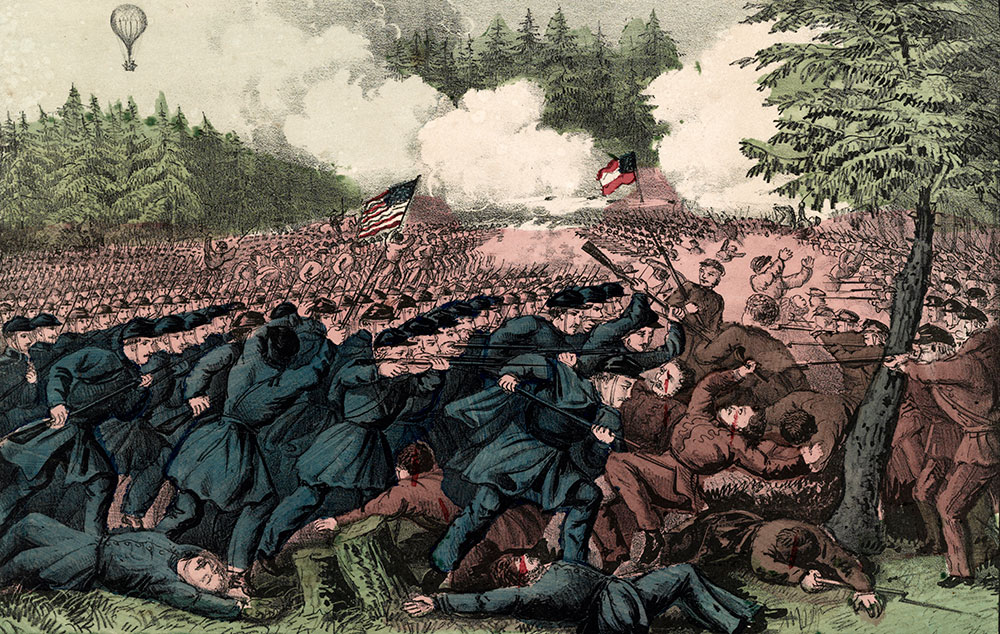
The premonition came true. In the battle that day, which went down in history as Seven Pines, the 11th and its brigade led an assault against the federal center and endured the brunt of enemy fire. Somewhere in the thick of the action, Fowlkes fell at the head of his company.
He fulfilled the spirit of his watchword.
Buried on the battlefield, his remains were never recovered. An announcement of his death in the Daily Richmond Whig included a line that could serve as Fowlkes’ epitaph: “He devoted all of his talents and energies, with the assiduity of a martyr, to the service of his country.”
In June 2001, 139 years after his death, the unveiling of a cenotaph in the Confederate section of Hollywood Cemetery, near the burials from Seven Pines, honored Fowlkes’ life and service.
Ronald S. Coddington is editor and publisher of MI.
SPREAD THE WORD: We encourage you to share this story on social media and elsewhere to educate and raise awareness. If you wish to use any image on this page for another purpose, please request permission.