

By Ronald S. Coddington, featuring images from the collections of Mark Savolis and Dan Smith
New Bern looms large in the history of the 25th Massachusetts Infantry. During the regiment’s long military service, the North Carolina riverfront community emerged as a frequent destination for its officers and men. They fought to capture and occupy the town, performed provost duty there, defended it against the enemy, and encamped in its vicinity.
Here they formed eternal bonds built on discipline, trust, and sharing in a common cause. It may be fairly stated that these Bay State citizens, volunteers all, became soldiers at New Bern and during the larger operations of Maj. Gen. Ambrose E. Burnside’s successful 1862 North Carolina Expedition.
About six months into its service, in May 1862, the quartermaster issued Sibley tents to the regiment. These large conical shelters were capable of housing a dozen or more troops and their gear, the occupants arranged as spokes in a wheel with heads at the wall and feet to the center.
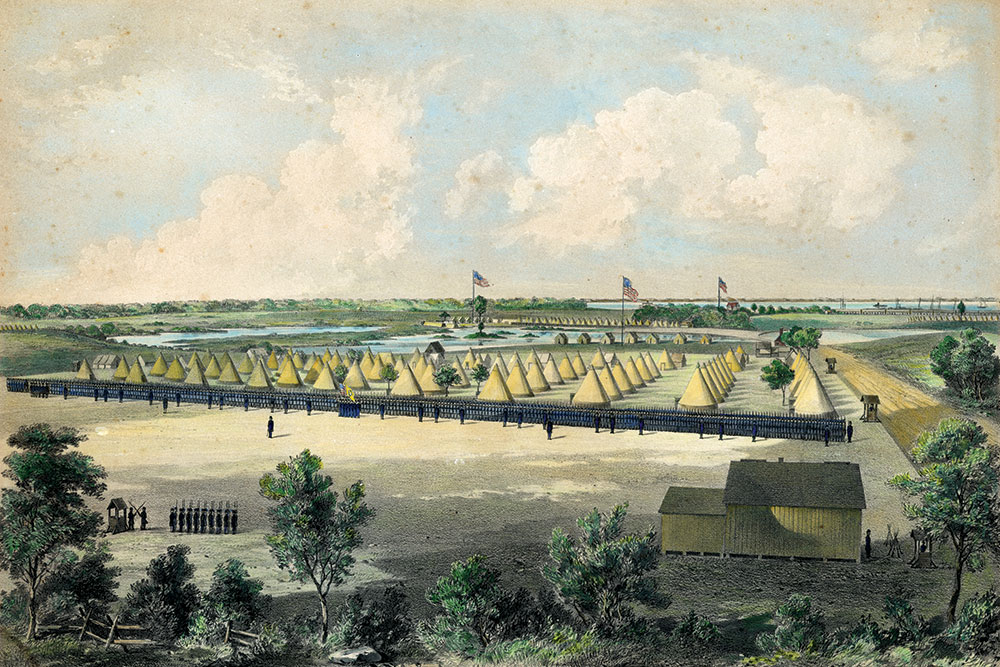
For a group of soldiers in Company A, Tent No. 6 became their home. A collection of photographic portraits housed in a handcrafted wood case with identifying information written in pencil on the frame survives as a unique memento. It documents this band of brothers in a strange land, far away from home.
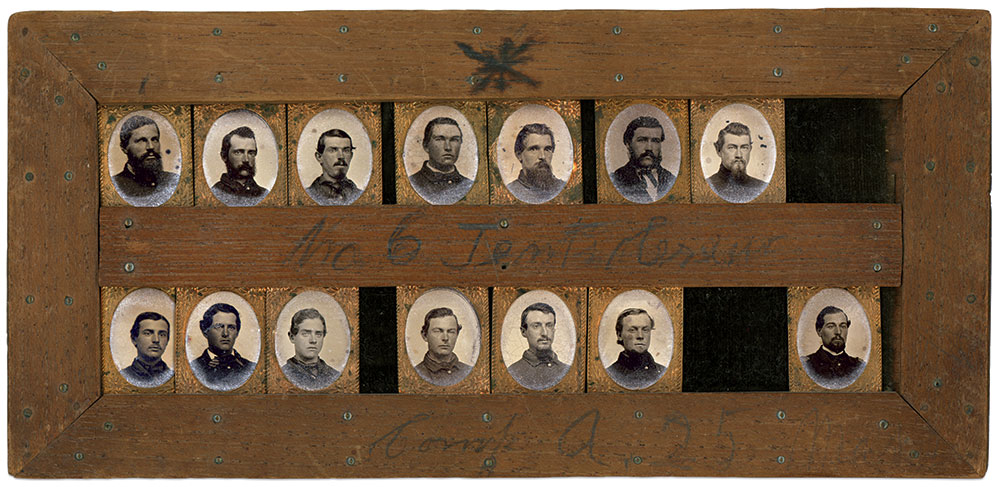
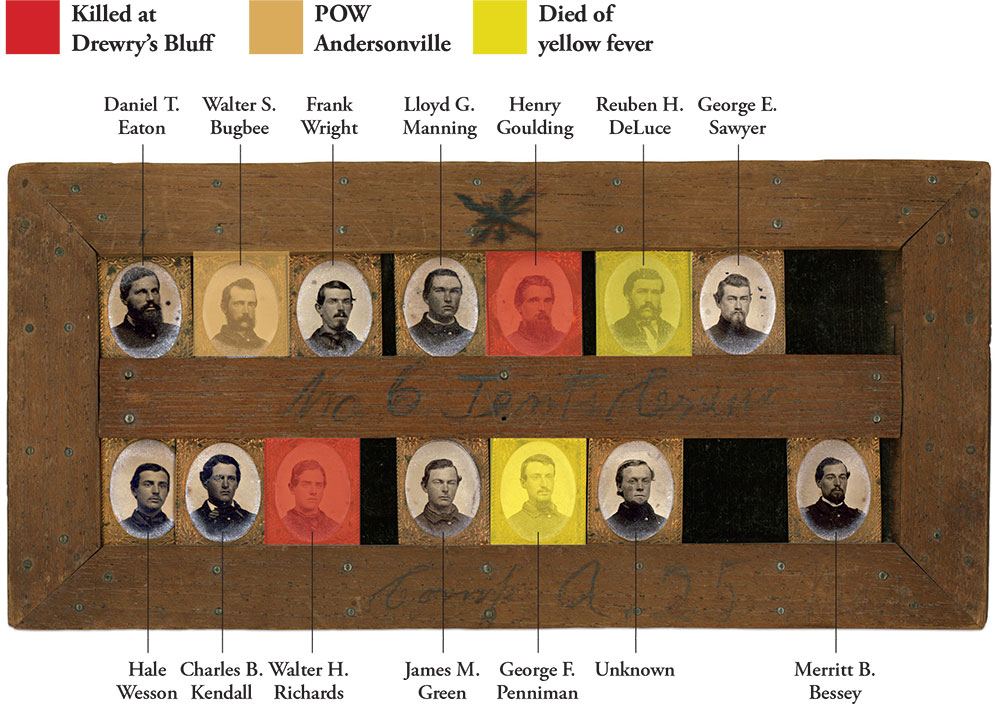 The case holds 14 gem-sized tintypes picturing enlisted men and a single officer. The wood frame, crudely crafted with exposed nailheads, is cleverly designed to hold the images with a slat-and-groove construction.

On the back of the case is a name written in pencil: Penniman. This is George F. Penniman, a peacetime express clerk in Worcester.
None of the portraits are identified by name. However, the 25th happened to be very well documented visually. The regimental history, Wearing the Blue, is copiously illustrated with upwards of 200 faces. Also, a significant number of images, mostly cartes de visite and gem-sized tintypes, have been collected by Mark Savolis, who studies Worcester in the Civil War. Thanks to this source material, all but one portrait can be identified.
The arrival of Sibley tents in May 1862, as documented in Wearing the Blue, establishes the earliest time Penniman crafted this memento. In support of this date is the portrait of the officer. Vermont native Merritt B. Bessey is pictured as a first lieutenant, a promotion he received March 20, 1862—six days after the victory at the Battle of New Bern.
A portrait of an enlisted man establishes the latest date for the memento’s creation. Hale Wesson, a Grafton farmer with an impeccably clean military service record, transferred from Company A to the U.S. Signal Corps in November 1863—one of several men in the regiment who made this move.
The 25th spent the bulk of this 16-month period, May 1862 to November 1863, in New Bern.
The photographer who created these tintypes is a mystery.
One possibility is Jesse L. Cowling, a Virginian who relocated from Norfolk to New Bern in early 1856 and set up shop in a gallery recently vacated by daguerreotypist George A. Jeffers. By the time the 25th arrived in town, Cowling had purchased a frame building on Pollock Street. He established his gallery on the second floor, above a drugstore.
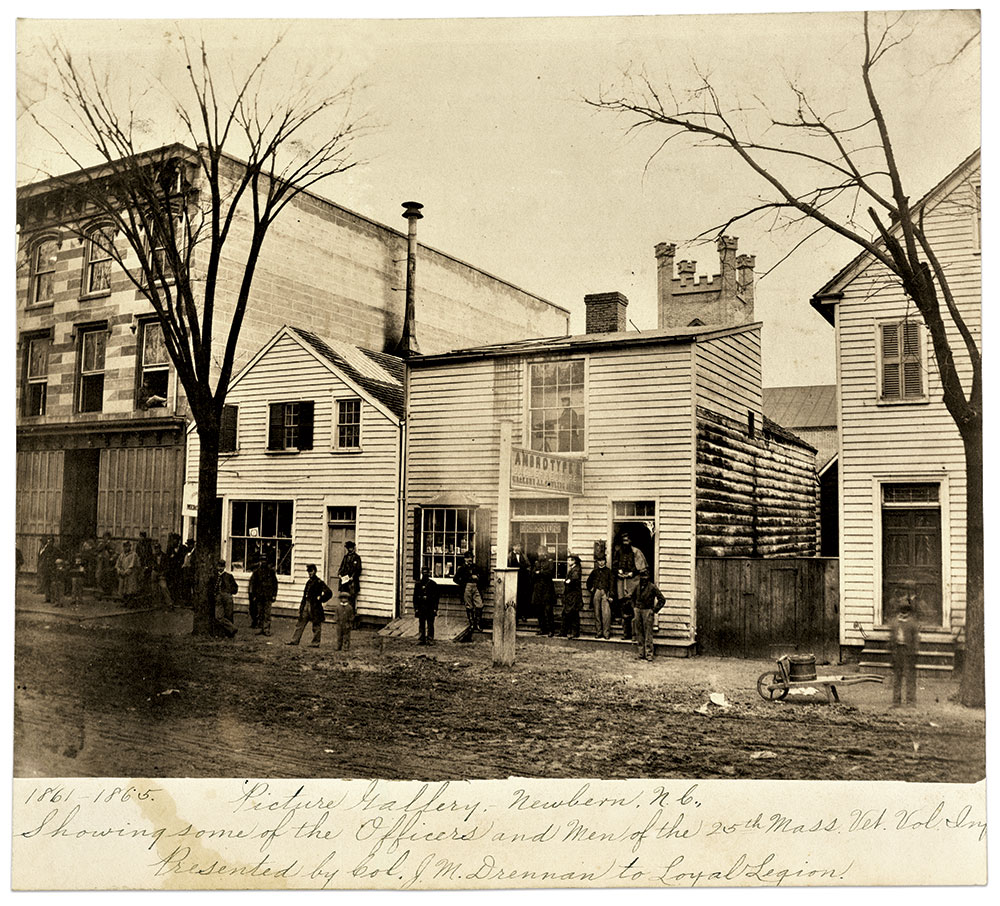
A surviving albumen print pictures a person visible in a second-floor window. The natural light from the window and the skylight on the roof above him reveals the dim outlines of a man with facial hair sporting a cap. He rests one arm on a camera.
Is this Cowling?
If it is, one wonders who took this photograph. One possibility is his younger brother, George S. Cowling, who also worked as a photographer in New Bern. However, when the war began, he enlisted in the Elm City Rifles, which became Company K of the 2nd North Carolina Infantry in June 1861. Ordered to Virginia soon afterward, the regiment returned to North Carolina in March 1862 for a three-month stint on duty in the military department of Cape Fear, north of New Bern. Might George have visited his hometown during this time and, if so, concealed his Confederate connection from Union troops while photographing the scene in front of Jesse’s gallery? Or, perhaps George stood in the window while Jesse produced the image.
In June 1862, the 2nd received new orders to return to Virginia, where it fought in the Seven Days Battles, the culminating series of engagements that ended the Peninsula Campaign. In the final battle, at Malvern Hill on July 1, 1862, George suffered a wound that resulted in his death two weeks later.
If the man in the window is not one of the Cowling brothers, who is he? An inscription below the print places men and officers of the 25th in front of Cowling’s studio. It indicates the image was presented by James Marcus Drennan to the Military Order of the Loyal Legion of the United States (MOLLUS). Drennan, a Worcester woodworker, began his service in the 25th as the second lieutenant of Company K and ended as captain of Company E. Following the war, he continued his service in the 10th Massachusetts Volunteer Militia and became its colonel in 1875. He signed his name with this postwar rank. Drennan also described the 25th as veteran volunteers, suggesting that this photograph had been taken after the men reenlisted in January 1864. However, these men do not wear the service stripes on their cuffs consistent with this status.
Cowling’s gallery ended abruptly in September 1864 when he, his wife, and a son fell victim to a yellow fever epidemic.
How Cowling, a Virginian with a brother in the Confederate army, felt about photographing Union troops occupying New Bern is unknown. His political views and loyalties are lost to history. Wherever his sympathies lay, there is no evidence that they influenced his willingness to photograph them and be paid for his efforts. As a practical matter, the federal military presence represented a source of income at a time of economic uncertainty brought on by the war.
Four additional candidates for the mystery photographer with connections to Worcester operated galleries in New Bern—a unique Southern migration.
 The most intriguing possibility is the only known photographer who advertised himself as a melainotype artist specializing in gem-sized tintypes: Edwin J. Leland (about 1828-1892). According to his obituary, Leland studied with noted Boston photographer John Whipple in the late 1850s and established a gallery in New Bern “at the beginning of the war.” It is probable that Leland arrived in New Bern after it fell to Union forces. An advertisement in the April 20, 1864, issue of New Bern’s North Carolina Times states that he was “the first to introduce the small ones known as the GEM, which have become so popular.” The advertising copy does not reveal the date Leland introduced the gems. Leland’s stay in New Bern appears to have ended soon after the war, as federal census records note the birth of a daughter in New England in late 1865. Leland continued in the business in partnership with other local photographers in Worcester. He left photography in 1878 to work in the nascent telephone service and expanded into burglar alarms and the rapidly growing electric industry by 1880.
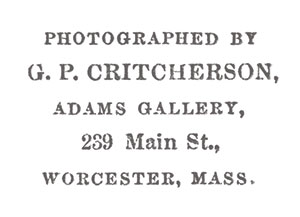 Leland had a partner in Worcester, George Pittman Critcherson (1833-1902), who is another intriguing candidate. A pair of undated cartes de visite of buildings in New Bern occupied by the 25th are imprinted with Critcherson’s name as an employee of Adams Gallery, located at 239 Main Street in Worcester. George Adams, a daguerreian pioneer, operated at this location from 1863 to 1866. The lack of a tax stamp dates the images to 1863-1864. The squarish dimensions of the images in the albumen prints suggest they were created as stereographs.
No evidence beyond the surviving cartes has yet surfaced to place Critcherson in New Bern. Following the war, Critcherson continued his career, notably accompanying marine painter William Bradford on an Arctic expedition in 1869. Bradford used Critcherson’s photographs as references for his oil paintings. Critcherson’s 1902 obituary notes he “was a great traveller and had journeyed to many distant parts of the world with his camera.”
The mystery photographer could also be Moses Sanford Chapin (1810-1886). A native of Worcester and pioneer daguerreotypist, he set up shop in New Bern after federal forces occupied the town. How long he remained in North Carolina is not known.
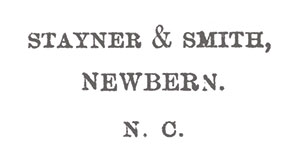 The fourth possibility is the partnership of Lucien Matthew Stayner (1835-1910) and O.J. Smith (life dates unknown). Numerous cartes de visite of Union soldiers featuring the Stayner & Smith imprint survive.
Born in New Hampshire, Stayner lived for a time in Worcester, where he is buried. Federal census and genealogical records reveal he listed his occupation as a milkman, farmer, and constable, and that he lived in New Bern at some point after the war began until at least 1870. He likely served as Smith’s business partner in the Union Photograph Gallery located in New Bern on Pollock Street—not far from Cowling’s gallery.
Little has been found about the life and times of Stayner’s partner, O.J. Smith. However, a number of surviving images of wartime New Bern are attributed to him, and he is listed in the town’s 1866-1867 business directory as a photographic artist. In October 1866, he sold his gallery to another local photographer, John D. Heywood.
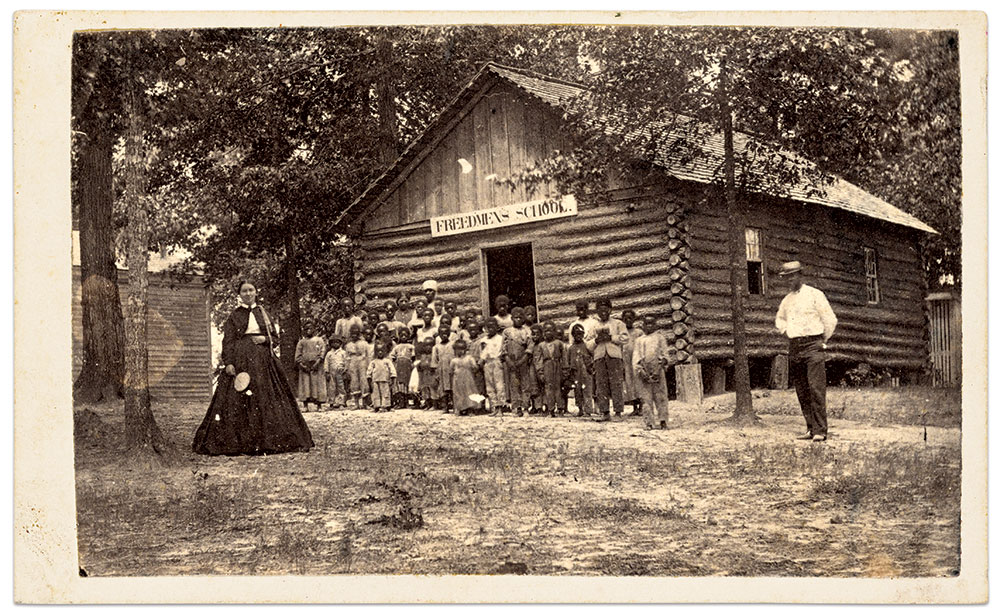
A review of concurrent service timelines of these Company A men reveals several common connections. Eight of them resided in Worcester, and most worked in urban jobs. Four joined the military in the weeks following Fort Sumter—one entered the navy and three enlisted in the 3rd Massachusetts Rifles for a three-month term.
Five of these men became casualties in 1864—four did not survive the war. The Battle of Drewry’s Bluff in May claimed the lives of two Worcester men, machinist Henry Goulding and clerk Walter H. Richards. That same month, Confederates captured Walter H. Bugbee, a veteran of the 3rd Rifles, at Cold Harbor and sent him to Andersonville. He survived imprisonment and gained his release in February 1865. Penniman, owner of this memento, and Reuben H. DeLuce, a Boston expressman, perished three days apart in September during the same yellow fever epidemic that claimed the lives of the Cowling family and others.
Notably, a second memento survives. It is in the collection of Dan Smith. The frame is made of wood, just like the one that houses Savolis’ tintypes. Yet this one is more refined: its gold-ruled mat, velvet-lined lid, and hinges must have been inspired by standard photographic cases of the period. Designed to hold 14 gem-sized tintypes, only 13 are present.
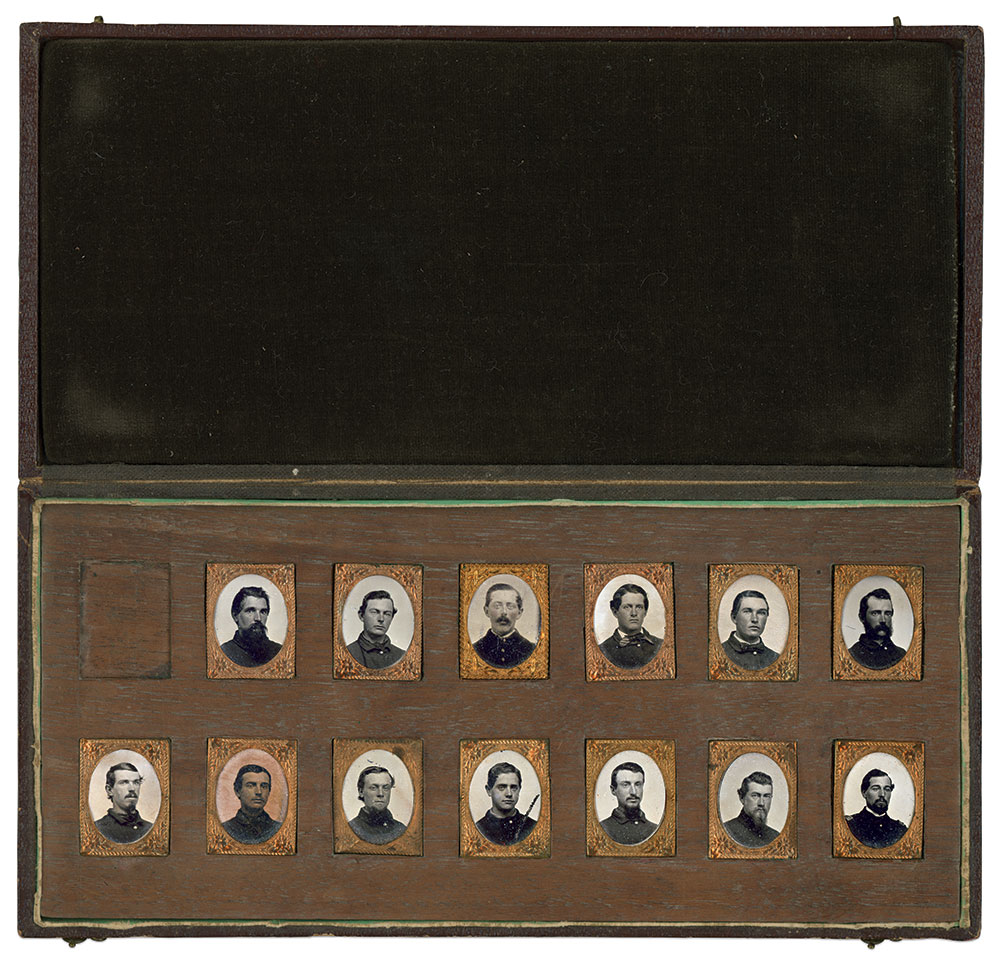
Did the empty fourteenth slot originally contain a portrait? A slip of paper accompanying this memento lists 13 names. Why the empty slot exists is unknown. Perhaps the original owner intended to fill it with the tintype of an absent comrade who died or received an early discharge. Or, the owner left it blank to represent God or another presence watching over them.
Though the original owner is not known, a postwar paper attached to the memento points to Putnam Simonds as a man who may have owned it. A Fitchburg shoemaker in Company F, he declined to reenlist when his three-year enlistment ended in October 1864. A review of his military service records and other sources shows no direct connection to Company A, which is problematic. No portraits of him have surfaced.
A comparison of the tintypes to those in the Savolis memento reveals several differences.
The names of Eaton and DeLuce are listed on the paper, but their likenesses do not appear.
One image is unidentified. He might be Simonds. He could also be Frederick A. White, a name that appears on the list and is not represented in the Savolis memento. A Worcester clerk in Company A with previous service in the 3rd Massachusetts Rifles, White left the 25th in May or June 1863 on detached duty with the Signal Corps and transferred permanently in August 1863.
 The portraits of Wright and Richards are different poses, notably in the way the coats are buttoned, the neckties, and subtle differences in facial features. They appear to have been made at different times rather than as variations of a single sitting.
The majority of the poses are the same. Knowing that two mementos survive, it is probable that others were produced—though no other examples have yet been discovered. It is easy to imagine that each tent mate received one collection of tintypes, leaving them to craft their own frame or leave them unframed.
To make multiple sets of portraits for the soldiers, a photographer would have copied the gem-sized tintypes. By this time in the history of photography, the mass production of tintypes had been perfected, as evidenced by photographic badges and buttons created in bulk for political campaigns and other uses beginning in the late 1850s. The best-known example of wearable tintypes in the United States was produced by Abbott & Company in 1861. These Abbottypes pictured military and political leaders. Though the photographer who produced the gem tintypes worked at a much smaller scale than Abbott, he may have used a similar process to make small batches of tintypes for members of Company A. Supporting this possibility is an album of gem tintypes of Company F in the Savolis collection.
Much about these unique mementos remains uncertain: who assembled the second case, who the unidentified men are, and whether other sets survive. Together, however, they offer a glimpse of life inside the 25th Massachusetts Infantry, when war and fate brought New England citizen soldiers to coastal North Carolina. Through the faces of Tent No. 6, we can better understand their service and sacrifice during an uncertain time in the nation’s history.
Ronald S. Coddington is editor and publisher of MI.
SPREAD THE WORD: We encourage you to share this story on social media and elsewhere to educate and raise awareness. If you wish to use any image on this page for another purpose, please request permission.