
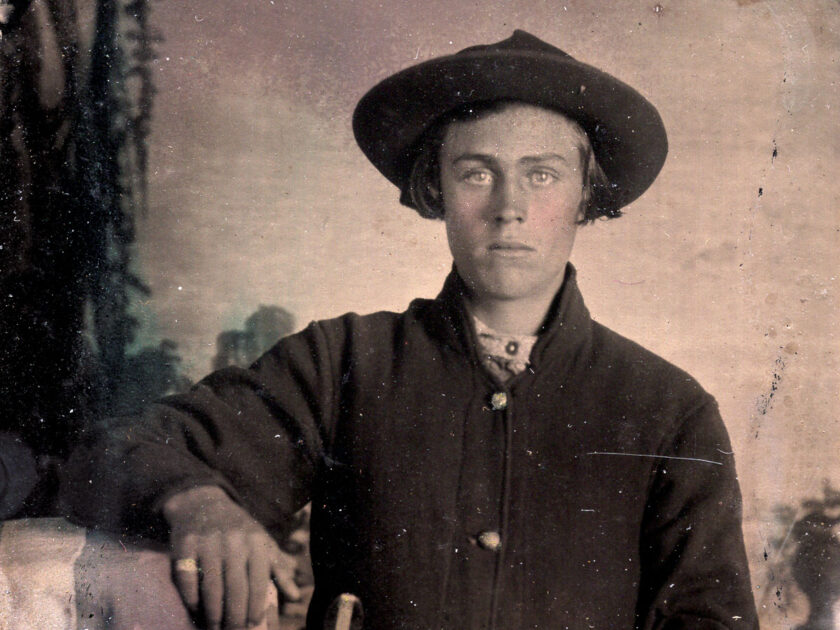
By M. Jane Johansson
On August 22, 1889, Union veteran Enos Franklin Hilton arrived in Alamosa, Colo. He brought with him his wife, Sarah Jane, along with their three daughters and two sons. Sarah opened a dress shop on State Street, and Frank opened a photographic studio nearby after installing a darkroom and remodeling the building.
Warmly welcomed to the town by Ernest A. Newton, the editor of the San Luis Valley Courier, Hilton repaid the welcome by advertising in the newspaper. He opened his studio with a flourish assuring readers that he had “a grip on the finest photo work in the valley,” and that he produced large and small photos “both for the album and wall.”
Besides taking portraits, Hilton also shot outdoor images, particularly of artesian wells in the area that the city editor regarded as wonderful advertisements for prospective residents in the south-central part of the state. Hilton’s business took off as he worked “night and day” during the 1889 Christmas season.

The jaunty, upbeat ads and newspaper reports, though, obscured the fact that Hilton’s Civil War service had wrecked his health.
Frank was born on Christmas Eve 1844 in Barry County, Mo., located in the southwest part of the state. Less than a month after the Civil War started, the teen-aged Frank left the family farm and enlisted in an independent home guard company in neighboring Stone County. Service in the company ended six months later with Hilton having seen no combat.
Hilton rejoined the army in March 1862 when he furnished his own horse and enlisted in the 14th Missouri State Militia (MSM) Cavalry. A creation of the Missouri State Convention, the MSM was designed to operate against Confederate recruiters and guerrillas. Unusually, the federal government, rather than the state, funded these units. Hilton participated in skirmishes and scouts in southwest Missouri and in the Prairie Grove Campaign in Arkansas during the autumn and winter of 1862. It was perhaps within this time period that Hilton entered a photographic gallery and sat for a tintype.


At his enlistment, friend and fellow trooper Simon P. Neill described Hilton as a “stout healthy young man.” But he soon developed chronic diarrhea, perhaps caused by poor camp sanitation. He then contracted measles in January 1863 while stationed in Ozark, 12 miles south of Springfield, Mo. His condition worsened after he “was taken from his bed” to avoid capture from Brig. Gen. John S. Marmaduke’s raiders. Taken to Springfield, Hilton caught “a severe cold causing the measles to settle on his lungs” according to Neill. Hospitalized in Springfield, Hilton may have been there when Marmaduke’s men unsuccessfully attacked the town on January 8.
Authorities disbanded the 14th MSM Cavalry in March 1863, and Hilton transferred to Company M of the 8th MSM Cavalry. This regiment, serving in separate components, experienced skirmishes in southwest Missouri, which was wracked by guerrilla violence through much of the conflict.
Despite his health problems, Hilton was present for most roll periods during the conflict, even though his friend, Neill, said “he never saw any man suffer so severely from said diseases and not die.”
The Path to Photography
After the war’s conclusion, life moved forward for Hilton. He married Sarah Jane Hobbs in Stone County in November 1865, and the couple’s first child was born the following year.
Over the next 15 years, Hilton and Sarah Jane grew the family to five children, and moved from Missouri to Arkansas to farm in Carroll County, and, later outside Fort Smith in Dayton.
By this time, Hilton’s health had worsened. An 1879 pension application revealed struggles with chronic diarrhea and a lung condition. One doctor stated Hilton could no longer perform manual labor, which likely explained why Hilton took up photography. The Bureau awarded him eight dollars per month.
The 1880 census, taken while the family lived in Dayton, marked the first time that Hilton was listed as a photographer. No records document how he acquired the equipment or learned the craft. Another move, to Chautauqua County, Kan., in the mid-1880s, connected him with fellow veterans at the local Grand Army of the Republic (G.A.R.) post. Presumably he continued his work as a photographer, although no surviving images have been located from here or his previous location.
Hilton’s health declined further, and he sought an increase in his pension. In a February 1889 letter to the Commissioner of Pensions, Frank wrote in a partly phonetic style, “I am now down in bed and wholey unable to be up and have been so for the greater part of this winter… I am constaly suffering…” The following month, the family’s destitution was further documented as “my 2 girles has been forest to leav home to work for bread and close.” Importantly, Hilton also stated, “my phisician has advised me to go west for my helth.” The Bureau raised his monthly payment to $10.00.
His Career Blossoms, Briefly
Hilton followed his doctor’s advice and moved to Colorado and settled in Alamosa.
Thus began the most documented part of his photographic career, and perhaps its most creative.

In 1892, Hilton moved about 70 miles northwest to Creede, which had become a boomtown due to silver mining. It must have seemed like an attractive place to further build a business. Hilton continued interacting with Union veterans in the G.A.R. and welcomed customers to the Castle Rock Gallery “perched upon a big boulder.” As he had done at Alamosa, Hilton ventured outside of his gallery to document scenes around him. Groups of picnickers and prospectors, street scenes in Creede and nearby Jimtown (today’s Jamestown), a burro train, and many other sights caught his eye.
Hilton opened a second gallery in nearby Bachelor in 1893, but it burned, along with the Last Chance Saloon, on February 27.
Disease continued to haunt Hilton, and he fell seriously ill in the spring of 1894. Forced to close his Creede gallery, he relocated again, this time to Las Animas County, 100 miles southwest of Alamosa and nearly in New Mexico. The 1900 census listed him as living alone and working as a farmer. His marriage had collapsed, and a divorce was finalized in 1909.
About this time, Hilton entered a veterans’ home in Topeka, Kan., and, in March 1910, transferred to the Mountain Branch of the National Home for Disabled Volunteer Soldiers in east Tennessee. Exactly why he moved so far away is unknown. Paralyzed on the left side and suffering heart problems, he passed away on May 22, 1910. His remains rest in Mountain Home National Cemetery.
Hilton likely became a photographer due to his poor health. His story is one of persistence and survival. How many other Civil War veterans became photographers due to wartime injuries or poor health? Perhaps more than previously realized. Today, some of Hilton’s surviving work resides in at least five repositories, and provides documentation of late 19th century Colorado communities. No doubt there are more to be discovered here and in the other towns he worked.
Examples of Hilton’s Photography, Circa 1892-1894, Capturing Colorado’s Mining Boom


Waiting for Mail at Creede, Colorado, ca. 1894. Albumen silver print by E. F. Hilton, 4 7/16 x 7 15/16 in., Amon Carter Museum of American Art, Fort Worth, Texas, P1976.11.117

References: 1850, 1860, 1870, 1880, 1900, 1910 U.S. Censuses; The Creede Candle, Colo.; Colorado State Archives, Divorce case for E. F. Hilton and Sarah Hilton, filed Dec. 8, 1909; Military service and pension records, National Archives; Piston and Rutherford, “We Gave Them Thunder”: Marmaduke’s Raid and the Civil War in Missouri and Arkansas; San Luis Valley Courier, Colo.; Veterans Administration Payment Cards, National Archives; Correspondence with Polly Cox, a great-granddaughter of E. F. and Sarah Hilton.
M. Jane Johansson retired as a history professor emerita from Rogers State University in 2023 and lives in Neosho, Mo., with her husband, Richmond. She has authored and edited several books about the trans-Mississippi Civil War with the most recent being New Fields of Adventure: The Writings of Lyman G. Bennett, Civil War Soldier and Topographical Engineer, 1861-1865. Contact her at jjohansson@rsu.edu.
SPREAD THE WORD: We encourage you to share this story on social media and elsewhere to educate and raise awareness. If you wish to use any image on this page for another purpose, please request permission.
LEARN MORE about Military Images, America’s only magazine dedicated to showcasing, interpreting and preserving Civil War portrait photography.
VISIT OUR STORE to subscribe, renew a subscription, and more.