
Site Overlay

Rocket Man: Acting Signal Officer George H. Felt and his innovative pyrotechnics

By Dale R. Niesen and Ronald S. Coddington

Ulysses S. Grant spent the first day at Shiloh in the saddle, directing his division commanders as the contours of the battlefield ebbed and flowed under relentless enemy assaults. Moving along the lines with his staff, he issued orders and gathered intelligence amid heavy firing and hard fighting. The little group moved with the urgency of a beehive inside a vast hornet’s nest.

“It was a case of Southern dash against Northern pluck and endurance,” Grant later recalled.

The Battle of Shiloh. Library of Congress.

At some point between the dash and the pluck of that hectic day, a small party of soldiers approached him. Three officers and six enlisted men in blue reported for duty. They were wearing unusual crossed-flags insignia.

They were Grant’s new Signal Corps detachment.

Timing is everything, the old adage goes—and this was not a good time. Preoccupied by the crisis and pulled in every direction, Grant could not give them proper attention.

The signalmen struck off on their own. They established a station with the aim of opening communication with another Signal Corps detachment serving Maj. Gen. Don Carlos Buell and his Army of the Ohio. Better coordination between the two senior commanders would have been useful, especially in light of rising tensions between them. The Signal Corps might have bridged a divide. Their efforts, however, proved in vain—they were unable to make contact.

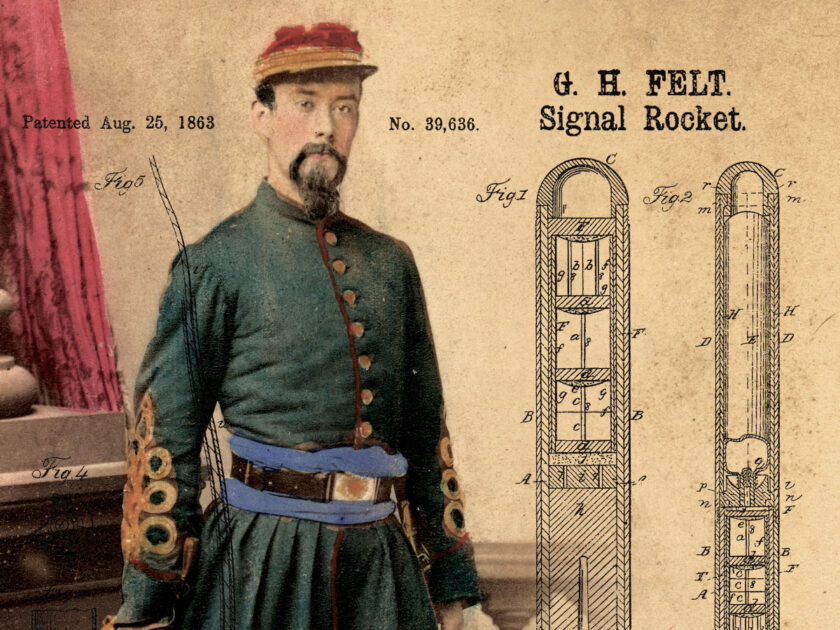
Felt, pictured as a first lieutenant in the 55th New York Infantry, also known as the Gardes de Lafayette. Formed by French immigrants before the Civil War, its members dressed in a Zouave uniform inspired by their home country. Carte de visite by an unidentified photographer. Dale R. Niesen Collection.

One of the Signal Corps officers who made the failed attempt was 1st Lt. George Henry Felt. A well-educated peacetime mechanical engineer in his early 30s, and son of a prosperous printer in New York City, he began his military duty days after the Union loss at First Bull Run. In Staten Island on the last day of July 1861, he joined the Gardes de Lafayette, attired in natty Zouave uniforms reflecting the French heritage of its antebellum militia organization. The men mustered into the army as the 55th New York Infantry.

Just a few months later, orders arrived in camp that changed the course of his service. The Signal Corps, created in 1860 and in its infancy, needed men, and Felt was detached from regular duty and sent to a camp of instruction in Georgetown on the outskirts of the capital city. Felt’s education and engineering background suited him for the role as an Acting Signal Officer.

Carte de visite by D. Appleton & Co. of New York City. Tom Glass Collection.
Major Gen. Henry W. Halleck. Carte de visite by D. Appleton & Co. of New York City. Tom Glass Collection.

In mid-March 1862, Maj. Gen. George B. McClellan dispatched Felt and his brother Signalmen to Department of the Cumberland headquarters in St. Louis. They reported to Maj. Gen. Henry W. Halleck, the department commander. The bulk of Halleck’s forces, led by Grant, happened to occupy Pittsburg Landing along the Tennessee River. Halleck ordered the Signal party to join Grant, which they did during the first day of Shiloh.

So new were the Signal Corps that their crossed-flags insignia caused one artillery captain to suspect them of espionage. Late that night, the captain observed the Signalmen swinging torches in the air. Were they alerting Confederates to their position? The captain learned that in fact the mystery men wagging and waving flags and torches were friends, not foes.

Before the end of the battle, Felt and the others joined another Signal Corps detachment detailed to Brig. Gen. William “Bull” Nelson, commanding Buell’s 4th Division. They established a signal station on the banks of the Tennessee River.

Roman Candles, Colored Stars, and Sophisticated Code

At Shiloh, Acting Signal Officer George H. Felt observed that torches were not useful in situations with limited visibility.

The inability to contact Buell’s signalmen during the first day’s fight at Shiloh haunted Felt. He determined to understand why it happened and how to prevent future failures.

His reflections and analytical thinking led him to a realization that traced back to the origins of the Signal Corps in the mid-1850s. Its founder, Albert James Myer, had been inspired by Comanches signaling with lances across the wide-open spaces on the Western frontier. Myer invented a method of aerial telegraphy using flags and torches to send coded signals at great distances, and sold the U.S. Army on the idea.

Felt concluded the method failed in Shiloh’s heavily wooded areas and limited visibility. At some point after Shiloh and before he returned back East in the summer, he hit on the solution: a system of high-flying colored rockets and a unique code.

The system Felt perfected featured a rocket carrying a Roman candle inside its body. The internal candle ejected a sequence of “stars,” or colored burning balls, one after another. Each star contained a small explosive charge in a concave cavity that propelled it outward and ignited it, creating timed bursts of light in different colors. This enabled operators to encode more complex signals than traditional rockets.

Once the rocket reached its intended height, an internal charge ejected the Roman candle upward from the rocket casing. The candle then continued firing stars sequentially in midair. In some versions, a balloon filled with compressed gas deployed at this moment, lifting or slowing the descent of the candle so the signal remained visible longer.

The rocket also included a stabilization system in the form of angled spiral vents at the base. These vents expelled gases that spun the rocket, keeping it steady in flight without the need for a traditional guiding stick. A specialized fuse provided a safe delay before ignition, then rapidly ignited the main charge.

The rocket’s three colors, in three-part sequences, yielded 27 distinct signals, which Felt combined within a grid-based code to produce as many as 729 unique message elements. By organizing these signals into intersecting columns and layers and mounting them on movable, reconfigurable leaves, he created a signal system more sophisticated than standard flags or flares. The number of message combinations made it more adaptable and secure.

Felt created a signal system more sophisticated than standard flags or flares. The number of message combinations made it more adaptable and secure.

Felt’s pyrotechnical solution proved innovative, but not a first in America. The U.S. Navy adopted a nighttime signaling system based on a pair of patents issued in 1859. This method used Roman candles and colored lights, similar to Felt’s rockets. The champion of this system, Martha J. Coston, had developed the ideas of her late husband, a naval officer who had died in the late 1840s. Further inspiration came from fireworks makers behind a New York City celebration for the Transatlantic cable in 1858.

New York City’s 1858 transatlantic cable celebration inspired Coston. Military Images.
Martha Jane Coston (1826 - 1904). Internet Archive.
Martha Jane Coston (1826 – 1904). Internet Archive.

The start of the Civil War greatly increased the demand for Coston’s Signal Rockets. Naval officers recounted the effectiveness of her system. One of them, Rear Adm. David Dixon Porter, noted, “The signals by night are very much more useful than the signals by day made with flags, for at night the signals can be so plainly read that mistakes are impossible, and a commander-in-chief can keep up a conversation with one of his vessels distant several miles, and say what is required almost as well as if he were talking to the captain in his cabin. This was the case in the Mississippi and also in the North Atlantic Squadron during the war, where we read hundreds of these signals (nay, thousands), which were frequently kept going all night long.”

The rockets were used to save Union sailors from the Monitor when the ironclad sunk off Cape Hatteras on the last day of 1862.

A Useful Experiment

One day in New York City during the summer of 1862, Felt conducted an experiment with his newfangled rockets. And he had a guest: Capt. Samuel T. Cushing, West Point 1860.

Felt, recovering from sickness he had suffered in the West after the rigors of Shiloh and setting up a camp of instruction at Paducah, Ky., used his recuperation to tinker with his idea. Cushing, assigned to duty with the 2nd U.S. Infantry, had been detached, like Felt, to the Signal Corps. Cushing had commanded the Georgetown camp on instruction when Felt had his training, and now had charge of the Signal Office in Washington, D.C.

Cushing’s meeting with Felt went well. A letter of recommendation by Cushing to Signal Corps Chief Myer praised Felt’s code: “The principle upon which it is based is very simple and ingenious and readily admits of such changes as will perfectly prevent it from being rendered useless, should treachery place the key in the hands of the enemy.” Cushing added, “The rockets which he proposes to use with the code are also constructed upon a new principle, and the experiments I witnessed with them, were of the most satisfactory character.”

With Cushing’s endorsement, the future of Felt’s rockets and code shone bright.

Escalating Tensions and Questions of Character

Felt returned to the Signal Corps camp in Georgetown by January 1863 with sample rockets and ambitions to advance his project. To his dismay, he found camp life limiting. He requested and received permission to seek quarters outside of camp that allowed him to focus on improvements to the mechanical drawings and code for his signal flare invention.

Setting up shop in neighboring Washington, Felt moved freely back and forth between his quarters, camp, and elsewhere with a pass. He financed his efforts on his own dime, along with his military pay plus a monetary allowance for quarters and fuel.

Meanwhile, Signal Corps Chief Myer monitored Felt’s activities, possibly through subordinates, to learn more about Felt’s plans. As Felt progressed, evidence suggests he became more guarded about his invention and suspicious of the motivations of others.

Felt questioned the character and motivations of Signal Corps Chief Albert J. Myer in a court of inquiry. Glass plate negative by Mathew B. Brady of Washington, D.C. Library of Congress.

An anecdote shared by Felt accused Myer of appropriating his intellectual property. In April 1863, Felt began, Myer’s signal code “had become worthless because the rebels knew it as well as we did. The signal officers were ordered not to shake their flags in the presence of the enemy, because it was only furnishing them important information.”

Felt continued, “Myer ordered me to get up a code, which I did. He made a slight alteration in it, and on the 14th of April, 1863, issued it as his own, and had the signal officers instructed in it as Myer’s code.”

Felt added that the improved code debuted at the Battle of Chancellorsville, where, following the Union loss, it contributed to the safe withdrawal of troops and valuable equipment across the Rappahannock River during the night of May 5-6.

Escalating tensions between Felt and Myer came to a head at a Signal Corps Examining Board. Claims and correspondence by Myer, raising questions about his subordinate’s motivations and vague suspicions of financial impropriety, sunk Felt’s nomination as a full Signal Corps officer.

In short, acts unbecoming an officer and a gentleman.

Felt called for a Board of Inquiry to clear his name. He later claimed, “Myer offered me any position in the corps that I wanted if I would stop this court of inquiry, which I refused.”

On May 19, 1863, the court assembled in Washington for the trial to inquire into and review Felt’s case. Felt represented himself across four days of testimony from officers, including Myer.

Testimony for the prosecution suggested that Felt improperly continued receiving commutation after being ordered to camp, potentially violating regulations. Myer implied misconduct in Felt’s decision to profit from his work while on government duty, arguing it contradicted an understanding that such innovations should benefit the United States.

Fellow officers and superiors testified in Felt’s defense. They described him as a gentleman, efficient officer, and man of good moral character. Evidence revealed that Felt had been assigned duties requiring work outside camp, had permission to reside off-site, and may not have knowingly violated regulations regarding fuel or quarters. Testimony also supported the legitimacy and effectiveness of his rocket innovations.

The court exonerated Felt. He had his father print the full proceedings, which were distributed to every member of Congress.

Felt argued, on his own behalf, that misunderstandings, inconsistent orders, and administrative confusion contributed to the accusations. He denied any improper intent and challenged Myer’s claims, suggesting bias and misrepresentation.

The court exonerated Felt. He had his father print the full proceedings, which were distributed to every member of Congress.

Felt left the Signal Corps with his pride intact. The internecine warfare reduced his chances of having his code and rockets formally vetted and reviewed by the Army, and tarnished his reputation inside the Corps.

Rocket Man on the Potomac

Felt’s belief in ultimate success led him to pursue another course—the U.S. Navy.

Felt’s August 1863 patent combined a rocket with a Roman candle, balloon suspension, and spiral exhaust, enabling sequential colored signals, longer visibility, and greater stabilization. Before the end of the year, he received a second patent for a signal rocket code. Google Patents.

On May 30, 1863, just a week after his victory over Myer in the Board of Inquiry, the Navy shared its findings on the system in a report issued by the Permanent Board. This commission had been established by the Navy to evaluate a myriad of applications for inventions, and included Professor Alexander Dallas Bache, superintendent of the U.S. Coast Survey, Rear Adm. Charles Henry Davis, Chief of the Navy’s Bureau of Navigation, and Brig. Gen. John G. Barnard, Chief Engineer of the Department of Washington.

The Permanent Board found issues, notably not enough differentiation between green and red lights. But they left open the door to adoption if Felt addressed the issues. He did, and, in January 1864, following a second test, the Board declared the issues resolved.

While the Navy deliberated throughout late 1863, the U.S. Patent Office approved two patents recognizing Felt’s inventions—the rocket in August and code in December.

By this time, Coston’s rockets were in widespread use in the Navy.

Felt documented one case where his rockets made a difference in the waning months of the war. He reported that Cdre. Foxhall A. Parker Jr. of the 42-strong Potomac Flotilla used the rockets on his flagship, the Don, with signals read at a distance of 180 miles, contributing to the seizure of prizes valued at $200,000.

In a quirky twist of fate, Parker’s staff included fleet clerk Henry H. Coston, one of Martha’s sons. Any reaction he had to Felt’s rockets has yet to be found. Coston went on to become an officer in the Marines and follow his mother’s passion for invention and aerial signaling.

The war ended before Felt’s rockets were distributed for wider use along rivers and seacoasts.

Epilogue

In the autumn of 1863, Signal Corps Chief Myer moved aggressively to unite his group with the Military Telegraph Service to form a single entity. The head of the telegraphers, Col. Anson Stager, held an opposing view. Secretary of War Edwin M. Stanton resolved the matter in November 1863 when he removed Myer and left the two branches separated.

The February 4, 1865, issue of Harper’s Weekly captured Rear Adm. David D. Porter's fleet celebrating the victory at Fort Fisher by firing off its supply of Coston’s Rockets. Military Images.
The February 4, 1865, issue of Harper’s Weekly captured Rear Adm. David D. Porter’s fleet celebrating the victory at Fort Fisher by firing off its supply of Coston’s Rockets. Military Images.
Rear Adm. David D. Porter preferred communicating at night with his subordinates, thanks to Coston’s rockets. Carte de visite by Mathew B. Brady of Washington, D.C. Tom Glass Collection.

Stanton reassigned Myer to the West, following a familiar pattern for sidelining senior officers who had fallen out of favor with the administration in Washington. He spent the remainder of the war in the Military Division of West Mississippi and the Department of the Gulf, honing his methods and developing new innovations. He wrote and privately published A Manual of Signals for the Use of Signal Officers in the Field. It embraces the use of rockets and a related code, not mentioning Felt.

Restored to Signal Corps Chief in 1866 and returned to duty the following year, Myer continued to serve in this capacity until his death in 1880. He is celebrated as the father of the Signal Corps, and for his postwar efforts in meteorology and forecasting weather, which earned him the nickname “Old Probs,” a play on probabilities.

Two years before his death, one of Myer’s lieutenants, J. Willard Brown, started work in earnest on a history of the organization. In 1896, its veteran’s association published The Signal Corps, U.S.A, in the War of the Rebellion, adding further laurels to Myer’s reputation.

The book includes a section on “Composition Fires,” or pyrotechnics, which acknowledges Coston’s signals, but does not recognize Martha by name or credit her contributions. There are several other references to the use of her system. Felt’s rockets and code are not mentioned. In fact, he is mentioned only twice; as a member of the party assigned to Halleck and detached to Grant, and a mention in the biographical directory that notes the assignment to Halleck and ends with an undated, abrupt reference to his presence at the Georgetown camp.

“Felt is barely mentioned in the history of the Signal Corps, and his rockets and code are not referenced at all.”

In 1878, quotes from a letter by Felt revealed his deep animosity towards Myer. Felt repeated the assertion that Myer’s usurpation of his code before Chancellorsville, and claimed this to be the main cause of Myer’s removal from office by Secretary Stanton.

After the war, Felt continued to invent, studied the field of Egyptology, and, in 1875, co-founded the Theosophical Society for the study of religion, philosophy, and science. The founding of the society took its inspiration from a lecture Felt presented on a proposed book titled, Kabbalah of the Egyptians and the Canon of Proportions of the Greeks. The book was never published. Felt also claimed knowledge of ancient Egyptian magic. Years later, the society removed him as its vice president because he could not substantiate the claim.

In 1892, he established the Felt Electrical Light and Power Company to manufacture and sell electrical accumulators and batteries.

Felt died in 1906 at age 75. His wife, Mary, and eight children survived him. His remains rest in Milford Cemetery in Milford, Pa.

References: Perkins and Santucci, Forgotten Magi: George Henry Felt; Brown, The Signal Corps, U.S.A. in the War of the Rebellion; U.S. Veteran Signal Corps Association, Roster of Signal Corps, U.S.A. 1861–1865; Proceedings of a Court of Inquiry, Convened by Special Order No. 85, Headquarters Department of Washington, at the Request of First Lieut. George H. Felt, Fifty-Fifth N.Y.S.M. and Acting Signal Officer, U.S.A.; Google Patents; American Civil War Research Database (Historical Data Systems); Ancestry.com; Find a Grave; C. Jinarājadāsa, “The Founding of The Theosophical Society,” The Theosophist (November and December 1932); The Boston Globe, Dec. 5, 1906; “George H. Felt,” Theosophy Wiki; The Sun, New York City, July 16, 1878; Coston, A Signal Success: The Work and Travels of Mrs. Martha J. Coston; The Philadelphia Inquirer, Feb. 4, 1861; Bigelow, The Campaign of Chancellorsville: A Strategic answer Tactical Study; Reingold, The Papers of Joseph Henry: January 1858-December 1865; Brown, Lamb’s Biographical Dictionary of the United States, Volume II; Grant, Personal Memoirs; Myer, A Manual of Signals for the Use of Signal Officers in the Field; Bruce, Lincoln and the Tools of War; Olcott, Old Diary Leaves: The True Story of the Theosophical Society; Martin, ed., Le Défi Magique: Esoterisme, Occultisme, Spiritisme (see Santucci’s “Forgotten Magi: George Henry Felt and Ezekiel Perkins”); Demarest, “The Felt Working Group Progress Report, Revision 6, The E.H. Britton Archive (March 11, 2011).

Dale R. Niesen is the founder of The Image Collector on Facebook. A collector of Civil War images who is focused on Michigan portraits, Dale is also a photographer documenting natural phenomena in the Midwest. He is an MI Senior Editor.

Ronald S. Coddington is editor and publisher of MI.


SPREAD THE WORD: We encourage you to share this story on social media and elsewhere to educate and raise awareness. If you wish to use any image on this page for another purpose, please request permission.

LEARN MORE about Military Images, America’s only magazine dedicated to showcasing, interpreting and preserving Civil War portrait photography.

VISIT OUR STORE to subscribe, renew a subscription, and more.

Scroll Up