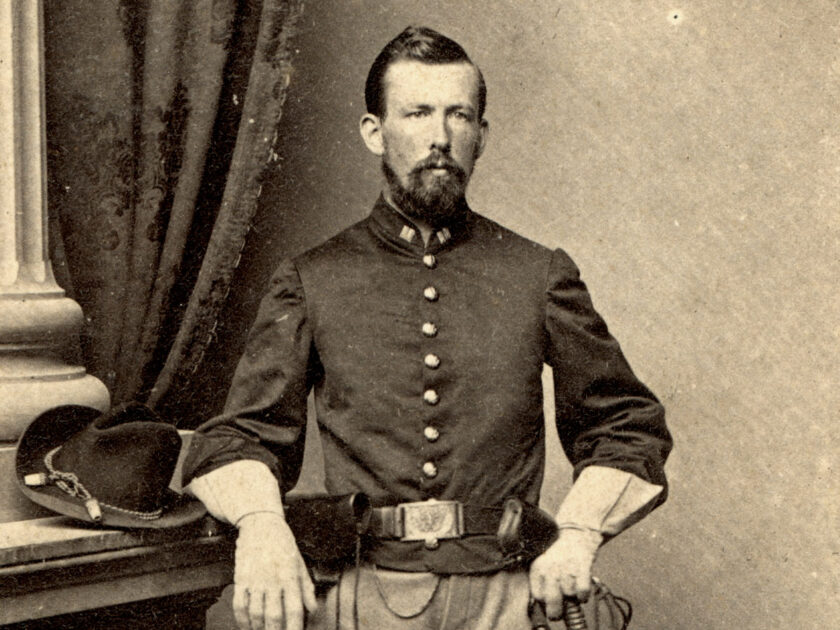
Troopers of the 10th New York Cavalry spent October 13, 1863, in the saddle, moving through hostile Virginia. Repeated calls to form for battle proved false alarms. Near 9 p.m. that night, the exhausted men halted to rest, expecting a fight the next day.
One officer would not share in the respite. Captain George “Van” Vanderbilt, 24, received orders to establish a reserve and post a picket. A steady and trusted leader who had risen from quartermaster sergeant after helping organize Company H in Elmira, he was often called upon to command in the absence of senior officers.

That night, after a day of strain and uncertainty, Van rode into the darkness on his horse, Black Dan, leading Companies H and L. Moving down a ravine and past the supply train, he located a suitable position for the reserve. Leaving the bulk of the men there, he took a small detachment forward along the Warrenton Road and established a picket post behind a makeshift barricade.
Sleep eluded him. Restless, he waited for daylight.
At dawn, the gray light revealed Confederate infantry in fields beyond the road and mounted troopers advancing in his direction. Acting quickly, Van placed eight dismounted men in the woods at an angle to the road, giving each a clear field of fire. When the approaching horsemen failed to answer his challenge, he gave the order: “Fire!” Eight carbines cracked through the morning stillness.
The volley checked the Confederates, who soon regrouped and charged. From behind their barricade, Van and his men held firm, delivering a steady fire that forced the attackers to withdraw.

Moments later, a courier arrived from the regiment’s major with orders to hold the position for ten minutes—time needed for the main body to form for battle. As the enemy prepared another advance, Van called for volunteers. Twelve men mounted and, at his command, charged down the road “yelling like demons.” The Confederates broke, pursued through woods until the federals struck an opposing barricade. There, nine of the 12 horses were killed, though remarkably no trooper was hit. Black Dan came through unscathed.
By the time Van and his party returned, the regiment had come up in support. The brief clash along the Warrenton Road marked the opening moments of the Battle of Bristoe Station, part of the Bristoe Campaign. Though a minor engagement, the action helped delay Confederate movements and contributed to a Union success.
The 10th New York Cavalry went on to fight in many of the war’s notable actions. Van was twice wounded and frequently entrusted with command. When his enlistment expired in 1864, he returned to New York, later receiving a brevet to major. Comrades remembered him as a reliable officer who enjoyed the full confidence of his men.
After the war, Van worked as a contractor, married, and raised a family, while remaining active in veterans’ circles. In 1907, while visiting a comrade in Virginia, he suffered a fatal heart attack. He was 68.
Survivors of the regiment honored him with an obelisk at his grave in Arlington National Cemetery, a fitting tribute to an officer whose steadiness under pressure left its mark on a hard-fought campaign.
Most Hallowed Ground is part of the Arlington National Cemetery (ANC) Project. Established by Jim Quinlan of The Excelsior Brigade, its mission is to identify all Civil War veterans on the grounds. Contact Jim at 434-992-7041.
SPREAD THE WORD: We encourage you to share this story on social media and elsewhere to educate and raise awareness. If you wish to use any image on this page for another purpose, please request permission.
LEARN MORE about Military Images, America’s only magazine dedicated to showcasing, interpreting and preserving Civil War portrait photography.
VISIT OUR STORE to subscribe, renew a subscription, and more.