
By Ronald S. Coddington
New York dentist and inventor Edward Maynard could not have known that his breechloading carbine would become closely associated with the Confederate Army.
As Senior Editor Phil Spaugy reported in his Autumn 2024 Of Arms and Men column, the Model One Maynard rifle and carbine performed impressively during U.S. Ordnance Department field tests in 1856 and 1857. Equipped with Maynard’s innovative tape-primer system, the breechloader proved simple to operate and maintain while delivering acceptable accuracy. In December 1857, the Ordnance Department ordered 400 carbines, and favorable press coverage soon followed.
In the six months between Abraham Lincoln’s election and the outbreak of war, the Maynard Rifle Company sold 3,201 rifles and carbines, more than 90 percent of them to Southern states and militia units, chiefly in Georgia, Florida, and Mississippi.
The Model One Maynard might have seen broader adoption had the Massachusetts Arms Company factory not burned on Jan. 28, 1861.
In late December 1860, Mississippi senators Jefferson Davis and Jacob Thompson contracted with the company for 800 Maynard carbines and rifles.
The Model One Maynard might have seen broader adoption had the Massachusetts Arms Company factory not burned on Jan. 28, 1861. Rebuilt in 1863, the company later received a contract for 20,000 Model Two Maynard carbines, which saw limited service during the latter part of the conflict.
A significant number of surviving portraits of Confederate soldiers posed with Maynards illustrate the extent to which these weapons were distributed in the South. Contemporary writings also confirm their use. One report from the summer of 1862 described a squadron of troopers from the 1st Mississippi Cavalry as “well-mounted and very well armed, carrying revolvers and Maynard carbines.”
But what about the other 10 percent that remained in the North?
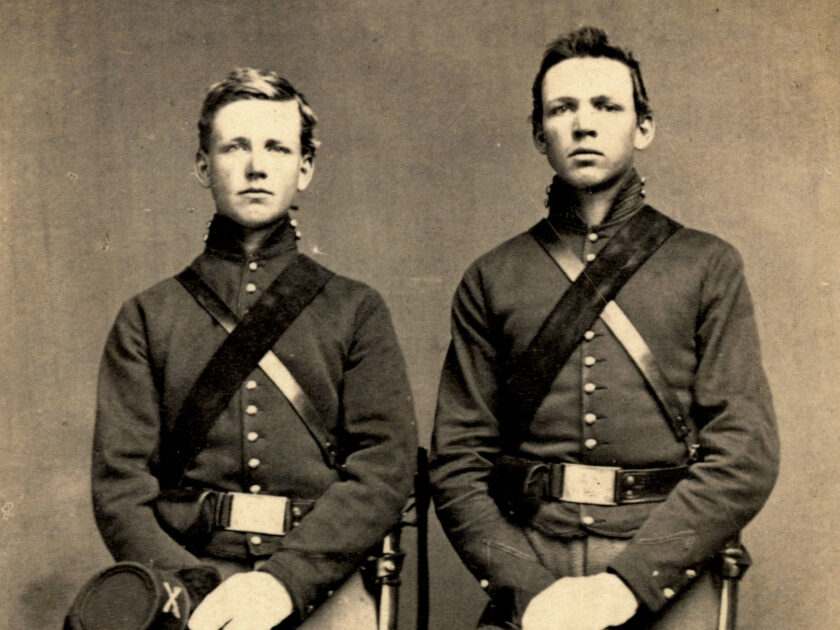
This portrait of Union troopers from the Scott Hilts Collection, armed with Maynards and sabers, represents the comparatively small number of Federal cavalrymen who carried them during the war. Their names are currently lost to history. The absence of a photographer’s imprint or inscription on the carte de visite mount offers no clues to their regimental affiliation. A revenue stamp hand-cancelled with an X dates the image between August 1864 and August 1866.

According to surviving records, two Northern volunteer cavalry regiments—the 1st Wisconsin and 9th Pennsylvania—received Maynards. The War Department also issued them to the 4th U.S. Cavalry. Spaugy notes that author John Rowell, in his book Yankee Cavalrymen, cited the regimental order book of the 9th Pennsylvania, which recorded 13 Maynards and 41 Sharps carbines on Oct. 27, 1862.
Spaugy further observed that Maynards appeared sporadically in other commands. The 3rd U.S. Cavalry, for example, listed a grand total of one Maynard in its summary statement for the fourth quarter of 1862—no doubt carried by an enthusiast. Another reference to the dependable carbine appears in a November 1864 letter from a correspondent serving with the 6th Indiana Cavalry, published in the Terre Haute Star. He reported that “a number of the line officers availed themselves of the opportunity to go home to vote, and are now, doubtless, using Cupid’s darts instead of Maynard’s Carbine” while courting their sweethearts.
Ronald S. Coddington is Editor and Publisher of MI.
SPREAD THE WORD: We encourage you to share this story on social media and elsewhere to educate and raise awareness. If you wish to use any image on this page for another purpose, please request permission.
LEARN MORE about Military Images, America’s only magazine dedicated to showcasing, interpreting and preserving Civil War portrait photography.
VISIT OUR STORE to subscribe, renew a subscription, and more.