
By Melissa A. Winn
In a recent string of Facebook Messenger exchanges—filled with shared images, notes, links, and plenty of appreciative “oohs” and “ahhs” (the kind of conversation many readers of this magazine undoubtedly know well)—Military Images Senior Editor Dale Niesen and I found ourselves immersed in a newly acquired carte de visite album from his collection. Each photograph is a gem.
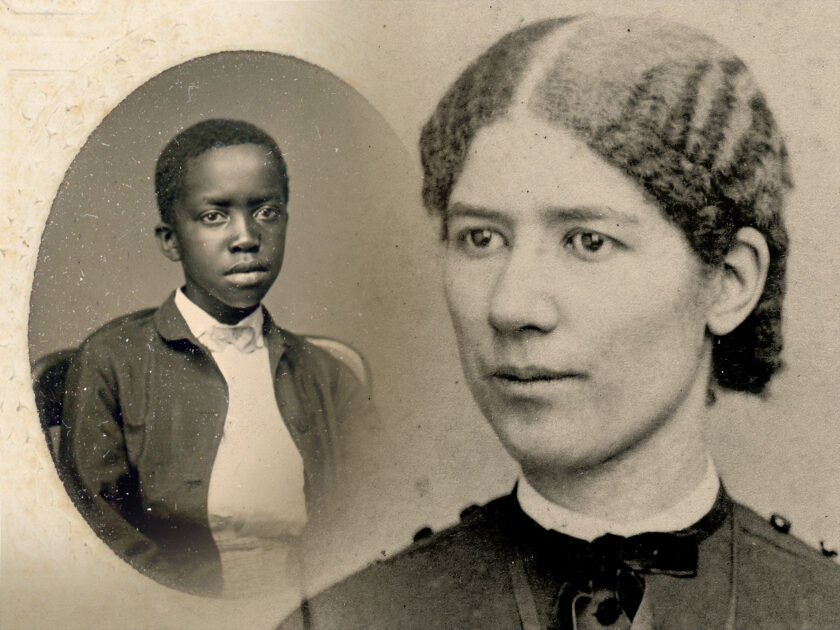
Many depict young children, carefully labeled “pupils,” “scholars,” or, more starkly, “slave child.” Several appear to belong to a well-known series of 1863 images produced in support of the Freedmen’s Relief Association, intended to raise funds for the education of formerly enslaved children. One striking photograph shows a young Black boy, identified simply as “One of my colored scholars, Washington, D.C., 1866.”
Just above him, on the same album page, is the portrait of a young Black woman. A caption beneath it, written in a different hand, identifies her as Emma Brown Montgomery.
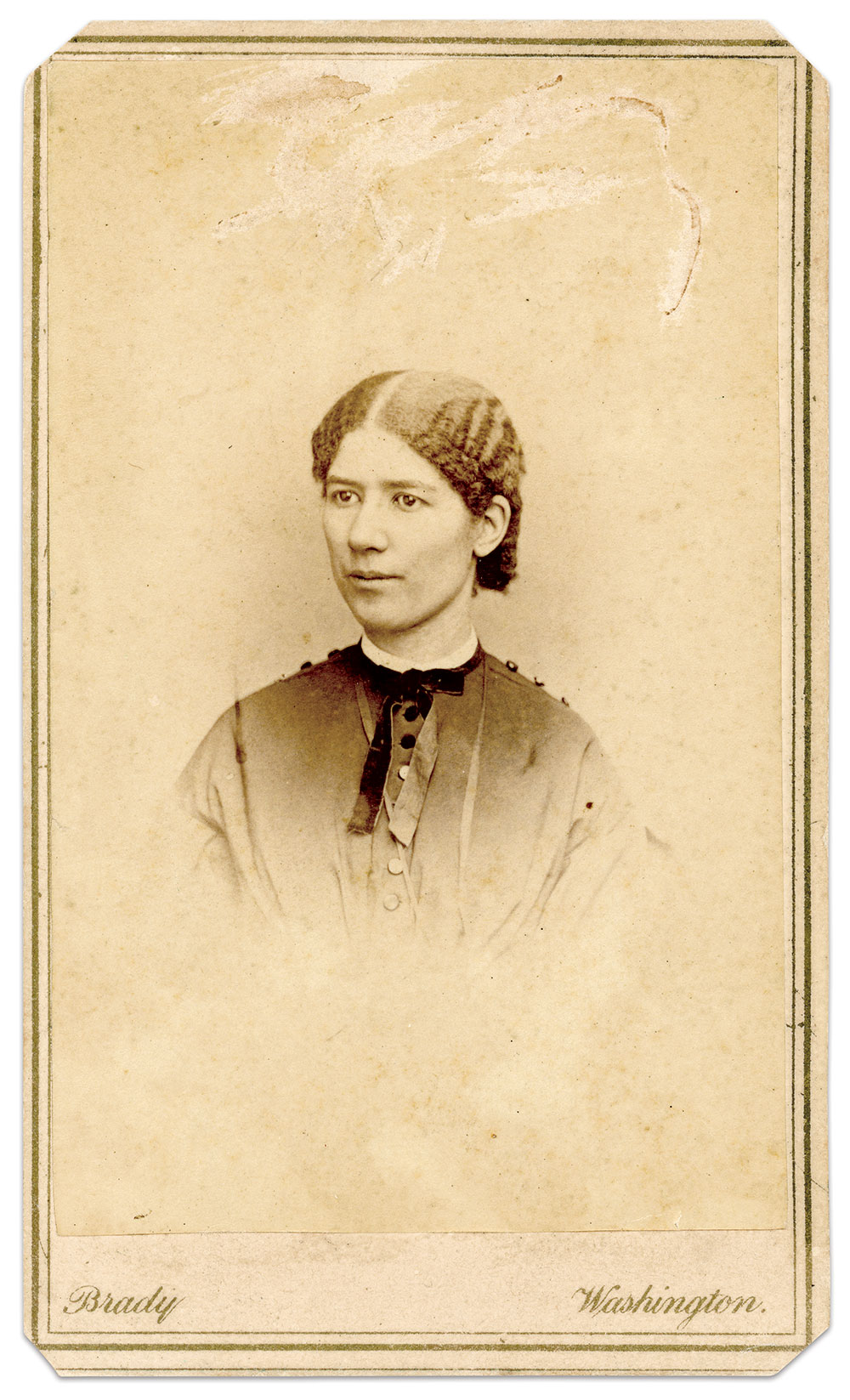
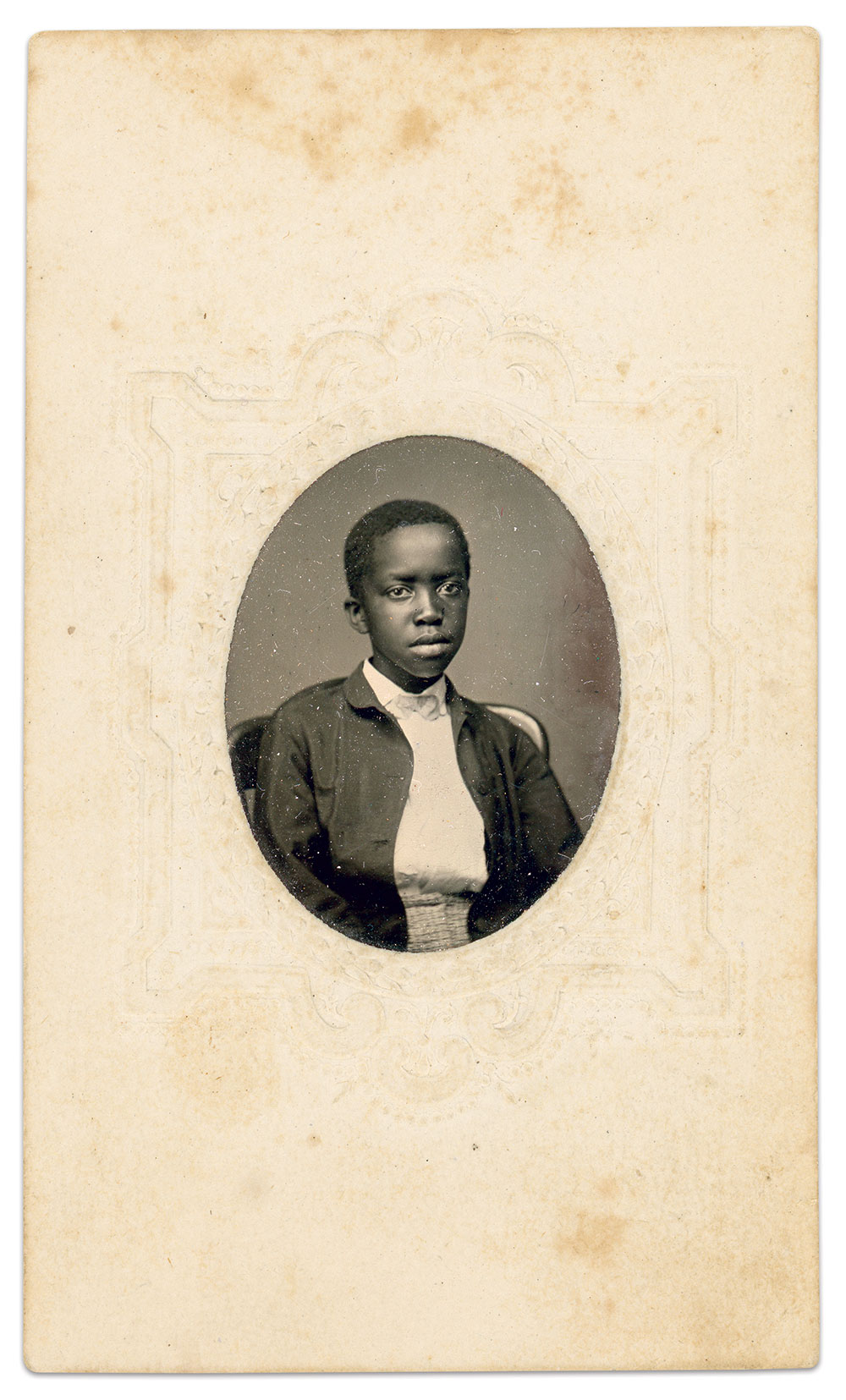
The varied handwriting, and research, suggests the album has had multiple owners, with Emma likely its original owner. If so, the collection becomes something more than an album. It’s a reflection of her life’s work, capturing the faces of the scholars she was determined to teach.
Born in 1843, Emma learned early that women sometimes have to care and provide for themselves. Her mother, Emmeline V. Brown, a widow, supported herself and her children as a dressmaker in Georgetown, D.C. As a young woman, Emma studied under the abolitionist educator Myrtilla Miner, whose Normal School for Colored Girls concentrated on educating future educators. At Miner’s urging, 16-year-old Emma enrolled in Oberlin College, one of the few institutions open to Black students. Here, she immersed herself in antislavery activism, even challenging prominent figures like the college’s president Charles Grandison Finney, when she felt his gradualist approach to abolition fell short. The outbreak of the Civil War disrupted her studies, and by June 1861 she returned home to a transformed Washington, where emancipation had begun to reshape life for the formerly enslaved.

In 1864, the Board of Trustees of public schools of the District of Columbia opened the first free school for Black children in Little Ebenezer Church on Capitol Hill, with Emma as its lead teacher. She earned $400 a year and was assisted by a White woman named Francis W. Perkins.
Its initial enrollment of 40 quickly tripled in size under Emma’s direction.
She often aspired to educate in the manner of one of her early mentors at Miner’s school, Emily Howland. Emma enjoyed a lifelong friendship with Howland and wrote her frequently for decades. Many of these letters still exist today in several institutions’ archives and prove invaluable to documenting Emma’s life experiences and most charmingly, her acerbic wit and humor.
In July 1864, Emma wrote Howland: “Doctor Breed offered me the Corporation school and I felt that I should like to help establish the first district i.e. colored school. We have had an average attendance of 130 pupils. There is only one room for this multitude. Miss Perkins prefers to have the primary department. She teaches from the charts you gave. Her scholars recite in concert and I must have my classes at the same time period. We have a regular Bedlam.”
“This is hard work,” she admitted, exhausting, and she confessed that at times she had even grown to “hate teaching.” Yet even in her darkest moments, she pressed on, driven by her dedication to the children and education.
During Reconstruction, Emma faced racial prejudices as the country sought to educate and assimilate Black and formerly enslaved children. She could be cynical and frustrated by the system. In one particularly candid letter to Howland in 1867 she described a contentious teacher’s meeting in which General Oliver Otis Howard, Commissioner of the Freedmen’s Bureau addressed the group:
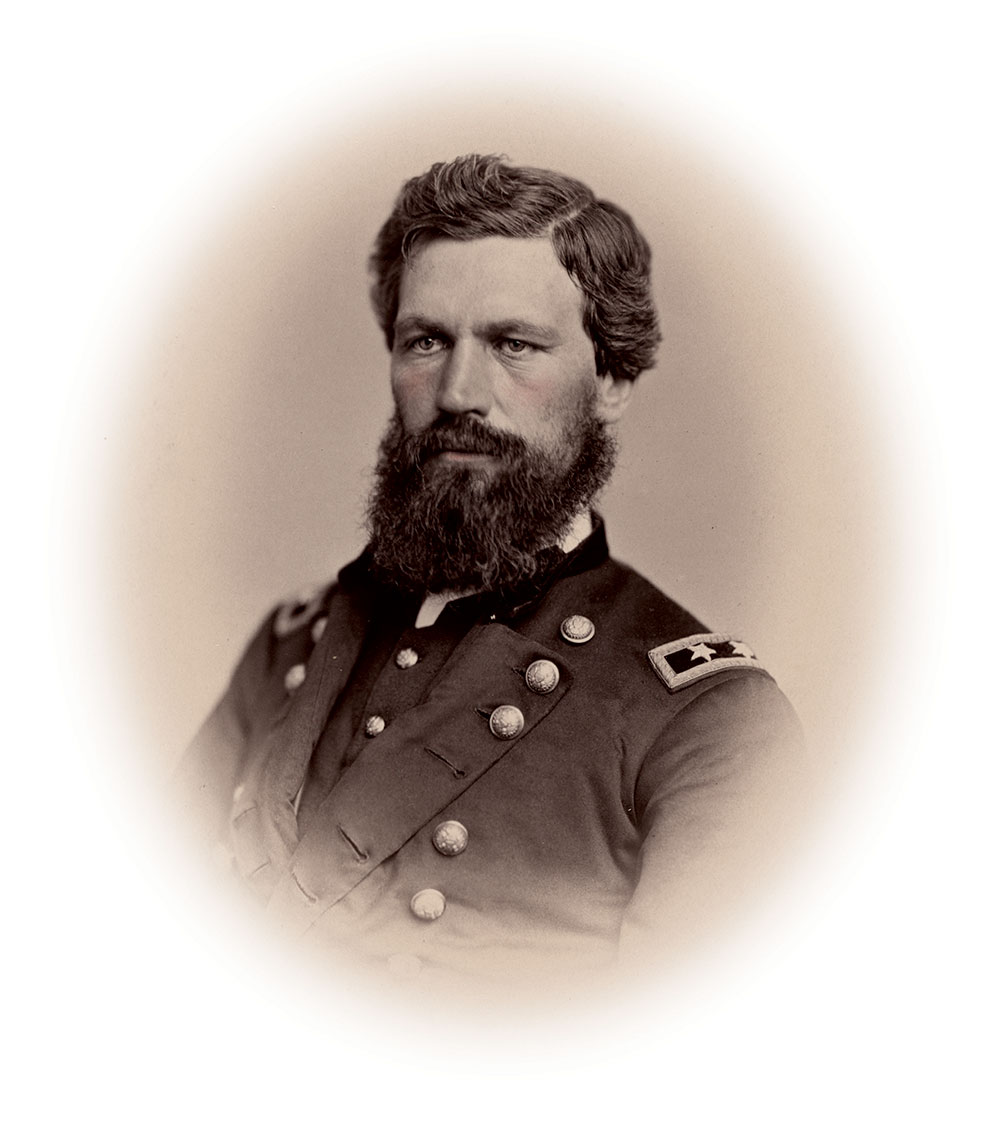
“His address was as tame as he looks. He said several original things such as these, ‘Teachers you are doing a noble work—You are glorious laborers in the cause—You will have high places assigned you in heaven.’ Just as he said this, I looked at Miss Smith and mentally resolved to ask the Lord please to let me have a low seat as I did not care to sit with [these teachers.]”
She continued, sharply criticizing the meeting and White teachers in attendance who questioned the intelligence and honesty of Black students.
She could be alternately self-effacing and critical of herself, as well.
“Why do you say that I toil on heroically?” she opined in the same letter to Howland. “You cannot know how often I falter—how near I am to being shipwrecked. The battle rages fiercely within me. There’s no more peace nor quiet within than there was months ago. I cannot accept my destiny—I cannot be resigned. I scarcely care for anything—yet it is necessary that I should work—that I should keep up. I am impatient, cross and hateful.”
Despite these obstacles, Emma continued to flourish as an educator. Where she saw fault in herself and sometimes her surroundings, others saw her careful organization and dedication. She spent time in schools in South Carolina and Mississippi and in 1870 was named the principal of the John F. Cook School in Washington, D.C.

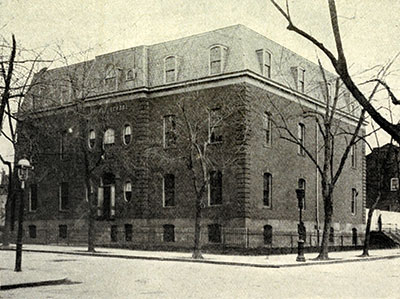
Two years later she was named principal of Washington, D.C.’s prestigious Sumner School, one of the “finest educational institutions in the city” according to contemporary reports. The building itself was impressive, with 10 classrooms, playrooms, offices, and an auditorium all heated by steam and equipped with improved desks, chairs, clocks, and electric bells. Emma was proud of it and her work, writing to Howland:
“You will pardon my egotism if I inform you that this school is a success. I glory in it. It is just the field I like—wide enough for my ambition. It is your school for you incited or rather inspired me with the zeal. With no talent—with nothing but energy I feel I have accomplished a little.”
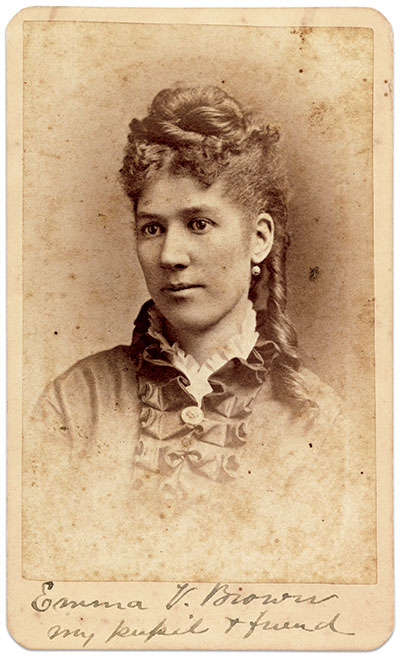
In 1879, Emma married Henry P. Montgomery, a formerly enslaved man who became an educator himself. She continued to advocate for Black education, serving organizations like the Manassas Industrial School and maintaining ties to the broader reform community. Her husband served as the principal of the John F. Cook school and supervising principal of a group of schools, including Sumner School, from 1882 until his death in 1899.
When Emma Brown Montgomery died in 1902, she left more than a legacy—she left a foundation. She helped build a system of education where none had existed. All the more poignant, then, to peruse her album and see the faces of those she knew—the “pupils” she taught, the “scholars” whose lives she touched, while opening doors for all the generations of those she would never meet.
Melissa A. Winn has been enchanted with photography since childhood. Her career as a photographer and writer includes numerous publications, among them Civil War Times, America’s Civil War, and American History magazines. She is currently Director of Marketing and Communications for the National Museum of Civil War Medicine. Melissa collects Civil War photos and ephemera, with an emphasis on Dead Letter Office images and Gen. John A. Rawlins, chief of staff to Gen. Ulysses S. Grant. Melissa is a MI Senior Editor. Contact her at melissaannwinn@gmail.com.
SPREAD THE WORD: We encourage you to share this story on social media and elsewhere to educate and raise awareness. If you wish to use any image on this page for another purpose, please request permission.
LEARN MORE about Military Images, America’s only magazine dedicated to showcasing, interpreting and preserving Civil War portrait photography.
VISIT OUR STORE to subscribe, renew a subscription, and more.
1 thought on “A Will to Teach”
Comments are closed.