
By Robert May
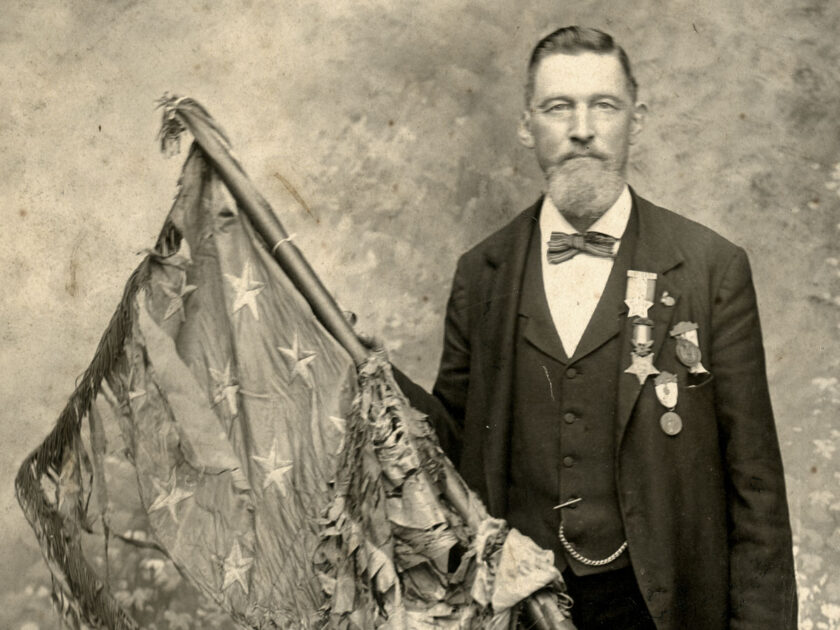
Behind this portrait of a citizen-soldier wearing his Medal of Honor and holding the tattered remnants of the Stars and Stripes—attached to a flagstaff with a makeshift repair—is a story of courage and gallantry in two significant Civil War battles.
John Arthur Kiggins, a peacetime metal molder in Syracuse, N.Y., could not have known what fate had in store when he enlisted in the Empire State’s 149th Infantry in late 1862. He and his regiment proved their fighting mettle throughout the war. Along the way, Kiggins rose from private to color sergeant and is remembered for two acts of gallantry: one in the Eastern Theater and another in the West.

Atop Culp’s Hill during the Battle of Gettysburg, enemy gunfire shattered the flagstaff. Kiggins and William C. Lilly, then the color sergeant, paused to repair the pole and keep the flag flying. Kiggins held the broken pieces together as Lilly used slats from a wooden ammunition box and leather straps from his knapsack to stabilize the staff.
A few months later, on October 28, Lilly suffered a mortal wound at the Battle of Wauhatchie in Tennessee. Kiggins stepped into his place.
At Lookout Mountain on November 24, the 149th advanced toward entrenched Confederate forces. The regiment joined a charge through thickening fog above the Craven House, owned by iron-master and slaveholder Robert Cravens, who had fled with his family during the Siege of Chattanooga. With visibility reduced by fog and gunsmoke, a Union battery mistakenly opened fire on the 149th. As his comrades fell around him, Kiggins rushed between the lines, climbed onto a tree stump, and frantically waved the flag. His action caught the attention of the battery and halted the deadly friendly fire.
But Kiggins’s bravery made him a target. Confederate soldiers fired at him, striking his thigh and grazing his head before he reached Union lines. Once there, he discovered nine bullet holes in his clothing.
Kiggins recovered and served through the end of the war, mustering out in June 1865. He received the Medal of Honor in 1892 for his actions at Lookout Mountain. He died in 1914 at age 77 and is buried in Bath National Cemetery in Bath, N.Y.
Robert May of Syracuse N.Y., started collecting Civil War memorabilia at the age 15, inspired by his first trip to Gettysburg. Now 20, he can confidently say this will be a lifelong passion, and he’s looking forward to continuing to share soldiers’ stories with everyone.
SPREAD THE WORD: We encourage you to share this story on social media and elsewhere to educate and raise awareness. If you wish to use any image on this page for another purpose, please request permission.
LEARN MORE about Military Images, America’s only magazine dedicated to showcasing, interpreting and preserving Civil War portrait photography.
VISIT OUR STORE to subscribe, renew a subscription, and more.