
By Edith Cuerrier

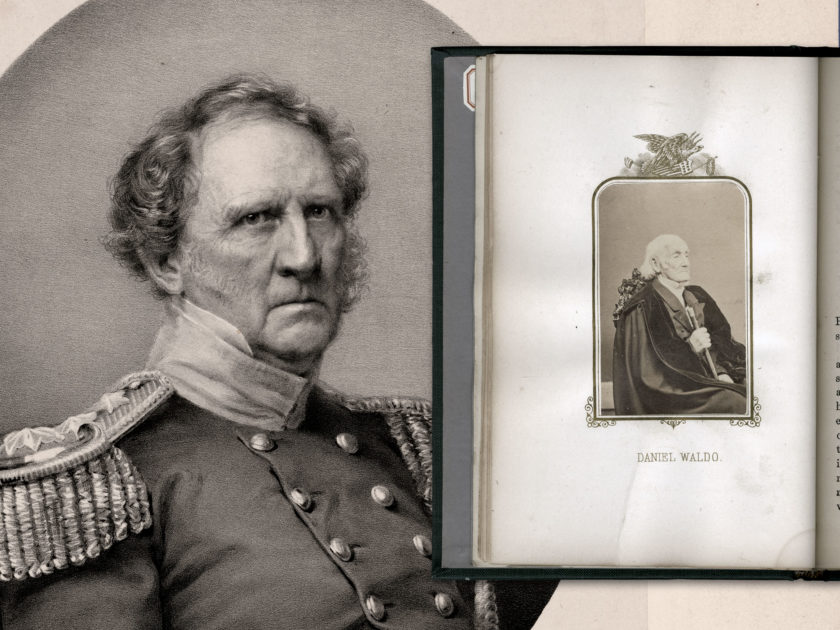
One book was a lavish production by the great showman-photographer Mathew Brady for the parlor or library, resplendent with lithographs based on daguerreotypes of young America’s movers and shakers.
The other edition, a modest affair by an unknown minister, Elias Brewster Hillard, was a small, thin volume of profiles of the last surviving soldiers of the struggle for independence from Great Britain, each illustrated with an original photograph of the grizzled centenarian.
Brady’s 1850 Gallery of Illustrious Americans and Hillard’s 1864 Last Men of the Revolution are examples of biographical books with a tradition that dates back to the 15th century. Steeped in unabashed exceptionalism, each was a product of its time. Both books resulted from the convergence of illustrated and photographically illustrated books— a distinction significant to photographic historians.
Photography Impacts a Nation Consumed with Portraiture
Prior to the advent of photography, American generals, politicians and other notable figures either appeared in public or through drawings or paintings. Once Frenchman Louis-Jacques-Mandé Daguerre invented the daguerreotype, a unique photographic image captured on a silver-clad copper plate, it became the preferred original from which portraits were reproduced as lithographs or engravings in publications.
In Mirror Image, a volume about the daguerreotype and its influence on American society, author Richard Rudisill explained that in the 19th century there was “a comprehensive effort to characterize the nation” through “national portraiture,” hence the interest in portraits of eminent citizens. Salons of portrait photographs, or portrait galleries, allowed the public to view original photographs of national leaders and celebrities in the form of daguerreotypes. The first establishment of this type in the United States was John Plumbe’s New York Gallery in 1847, followed shortly after by Brady’s Gallery.
The invention of the wet plate collodion negative and the albumen print photographic processes in 1850-51 gave the world a photographic negative-positive capability superior in quality to earlier similar processes. These developments marked the demise of the daguerreotype and the swift ascent of the carte de visite, a calling card-sized portrait more easily mass-produced and affordable.
Brady’s idea of publishing Gallery of Illustrious Americans drawn from his popular physical gallery of daguerreotypes in New York represented a move to capitalize on the public’s interest in celebrities and historical figures. The Gallery embodied the same principles that still permeate the contemporary media, such as the marketing of personality and image commodification. Unfortunately, the idea lacked the significant advantages that photographic prints and cartes de visite had only a few years later: easy reproducibility, portability and low cost.
Photographer André-Adolphe-Eugène Disdéri patented the carte de visite in France in 1854. But it did not become popular in his country until 1858. England followed suit in 1859-1860, and the format arrived in America late in the summer of 1860. Portraits of military officers, politicians, presidents, authors, artists and other prominent public figures became instant top sellers. According to Dan Younger in “Cartes de Visite: Precedents and Social Influences,” the carte de visite phenomena resulted in profound changes in the “format, style, availability and social exchange of photographic portraiture.” These photographic gems represented the living generation of that time, and, importantly for historians, the nation’s leaders and other public personalities.
The popularity of relatively tiny cartes de visite prints completely altered the size of biographical books, thus explaining the difference between Brady’s large format volume and the small 1864 Hillard book.
Biographical books
In her book on Disdéri, author Elizabeth Anne McCauley cites several early examples of biographical publications about artists and public figures from the 15th and 16th centuries. These precedents illustrate a tradition of books that served common readers as inspiration and motivation by portraying the subjects as heroes. But by the 19th century, this genre of book served less as a platform for hero worship, and more as a useful source of knowledge about people involved in contemporary affairs. Some of these publications were made up of more than one volume, listing people in alphabetical order, and featuring the words ‘dictionary’ or ‘encyclopaedia’ in their titles.
Brady’s idea of publishing Gallery of Illustrious Americans drawn from his popular physical gallery of daguerreotypes in New York represented a move to capitalize on the public’s interest in celebrities and historical figures.
After the introduction of the daguerreotype in 1839, reproductions in the form of lithographs, wood engravings and line drawings based on photographs made the subjects more lifelike, as with the case of Brady’s Gallery, as explained by its editor, Charles Edward Lester, in an article he wrote for the Photographic Art Journal in January 1851. “Before the Daguerrean art was discovered, it is all useless to say that it was within the power of any publisher in the world, or any artist in the world, to execute such faithful, life-like, and strikingly beautiful portraits of our public men.”
A mere decade later however, the much-improved wet plate collodion process allowed actual photographic prints to be used to illustrate publications that include Hillard’s Last Men.
The George Eastman Museum library in Rochester, N.Y., holds several interesting examples of photographically illustrated biographical publications. The Album Contemporain, published in Paris in 1866, contains more than 300 postage stamp size portraits of celebrities, accompanied by short biographical facts. Editor Justin Lallier capitalized on the portrait-collecting trend of the mid-19th century by incorporating portraits of European royalty, military men, artists and eminent public servants.
The addition of actual photographic prints into books remained the only method to include authentic portraits in printed publications until the 1870s. At this time, the halftone process revolutionized printing by reproducing continuous tone images as tiny dots.
The first printed photograph employing the halftone process was an image of Manhattan’s Steinway Hall published in the Dec. 2, 1873, issue of The Daily Graphic, a New York periodical. Perfected by the early 1890s, the process allowed photographs to be mechanically reproduced and incorporated alongside written text in illustrated publications.